NBA owners and general managers, get ready; it's decision time.
The class of 2011 is due for a raise.
October 31 marks the deadline to extend fourth-year players like Klay Thompson and Kawhi Leonard. Failing to reach a deal means restricted free agency is on the horizon next summer, which, as we know, can often be complicated and emotionally draining.
From a front office perspective, the first three years of a rookie contract are tough to beat. Organizations get 36 months to examine their draftees, hopefully gleaning insights about their futures while hopefully also getting low-cost on-court contributions.
In theory, three years is plenty of time to figure out whether a draftee is worth keeping around on another deal.
But the decision-making process can be complicated. In the cases of the following players, max- or near-max-level contracts might be necessary to prevent restricted free agency from being an option. Even if the salary cap is likely to increase significantly with the NBA's new television deal in 2016, doling out eight figures a year is a major commitment.
So, in advance of what should be a fascinating final chunk of the NBA offseason, we'll run down eight players who can either sign extensions before Halloween or head into restricted free agency next summer.
The pressure's on, and teams need to get these pay-or-pass decisions right.
Klay Thompson, Golden State Warriors
1 of 8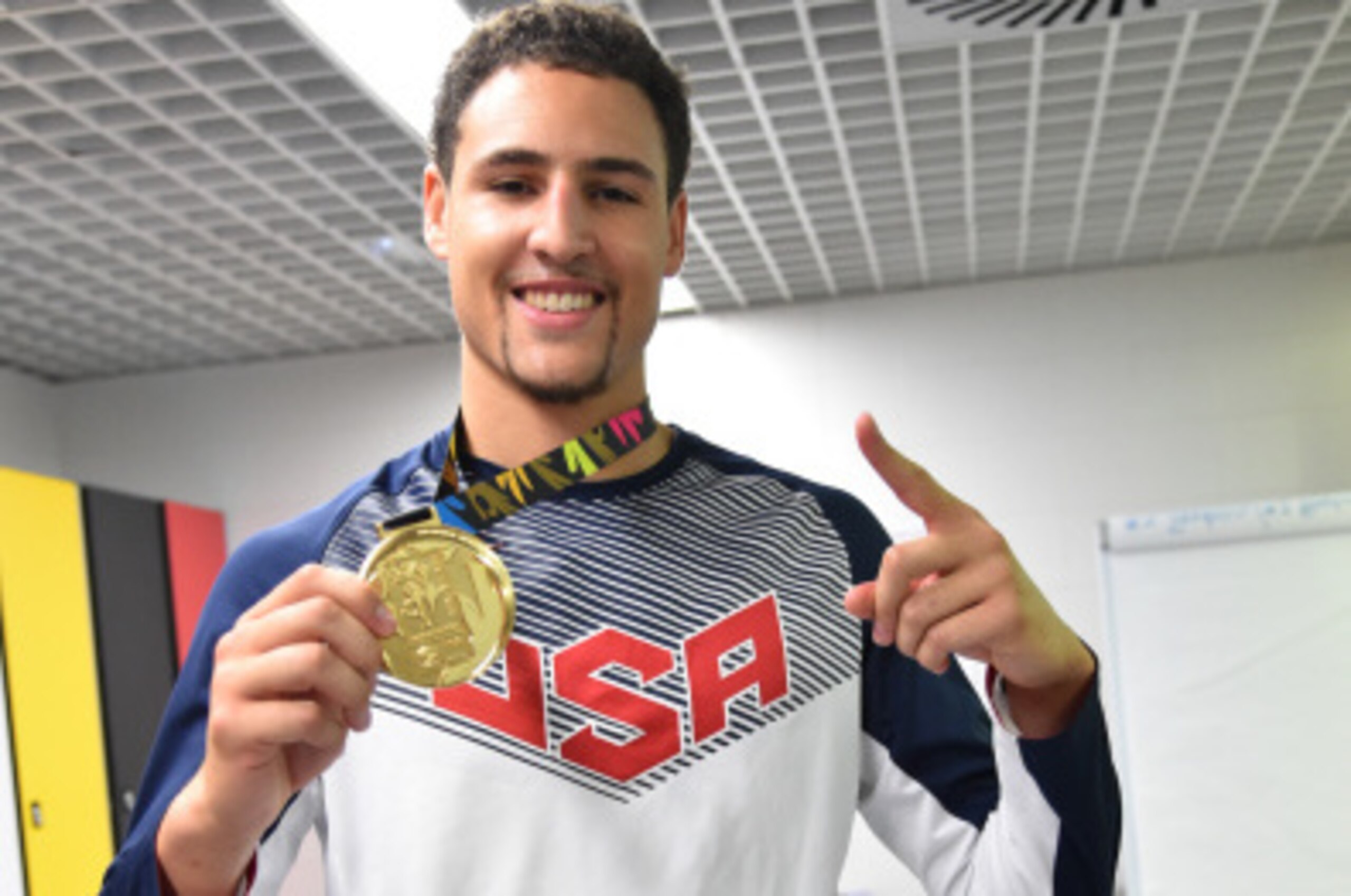
Verdict: Pay
New rule: If, as a franchise, you determine a player is too good to include in a trade that could bring back Kevin Love, you pay that player whatever it takes to keep him.
The Golden State Warriors are pot stuck on Thompson, fully committed to a shooting guard upon whom they obviously place a high price tag. Typically, teams don't have to broadcast that message during offseason trade negotiations, but there can't be any doubt now that the Dubs are going to extend Thompson early.
They have to—and not just because owner Joe Lacob said so in a radio interview on 95.7 The Game in April:"We are going to re-sign Klay Thompson. I will say that unequivocally."
That certainty is not a bad thing. Klay used his time with Team USA to show the world his unflappable confidence, deadly perimeter stroke and underrated defensive chops. His agent, Bill Duffy, opportunistically touted Thompson after the U.S. gold-medal run, telling Sam Amick of USA Today:
"I think Klay Thompson right now is the top two-way, two-guard in basketball. I think when you look at his body of work, when you look at what he accomplished guarding point guards on a regular basis (last season), I think it's pretty clear.
"
Clear or not, the Warriors need Thompson around so they can hide Stephen Curry from tough defensive assignments. The fact that he's also one of the game's best shooters doesn't hurt either.
Perhaps most importantly, a max deal that starts at $15.7 million per season won't look nearly so cumbersome to the Warriors when the cap rises in two years. In that sense, locking Thompson in now could be a bargain.
Golden State knows everything it needs to know about Thompson. It's time to pay Klay.
Ricky Rubio, Minnesota Timberwolves
2 of 8
Verdict: Pass
Ricky Rubio is likable, a brilliant passer, a rangy defender and young enough (he's only 23) to get better during his next contract.
But the Minnesota Timberwolves need to know more before they commit to extending him.
They need to know whether Rubio can improve his busted jumper enough to reverse a career track that Grantland's Zach Lowe noted puts the Spaniard "on pace to be the worst shooter in the modern history of the NBA."
Rubio is a career 36.8 percent shooter.
That's not good.
With Kevin Love now replaced by an inexperienced core, Rubio needs to prove he can be an offensive threat in ways that don't involve passing. Defenses already sag off him, clogging the lane. They already ignore him in their rotations, knowing any possession in which Rubio takes a jumper should be considered a defensive victory.
Rubio plays with a child-like joy that makes him easy to root for, but Minnesota needs to see him grow up before investing a significant chunk of its future in him. If Rubio matures this season, the Wolves can simply match whatever offer he receives in restricted free agency.
There's always a risk of alienating a player in situations like this (see: Bledsoe, Eric), but it's one the Timberwolves should take. They simply need to know more about Rubio before extending him.
Kawhi Leonard, San Antonio Spurs
3 of 8
Verdict: Pay
We can't pretend to know what Kawhi Leonard's career trajectory would have looked like if he hadn't had the good fortune of coming up in the San Antonio Spurs' unparalleled basketball development factory. All we know is that he's an NBA champ and Finals MVP at age 23.
Paying players for what you think they're going to do in the future is usually scary, but Leonard's steady improvement and air of stability make him a no-brainer extension lock.
Already, Leonard has shown the humility necessary to accept a limited role as well as the confidence required to take over on the big stage. That's not a common combination.
And while the Spurs could be justified in locking up Leonard on the strength of his makeup alone, his game isn't bad either.
A tireless worker, Leonard is already an elite wing defender. On the other end, he's reformed his offense to fit the ideal specifications of the modern NBA wing. Last year, Leonard finished 68.7 percent of his shots in the restricted area and also converted threes from the left and right corners at 37 and 38 percent respectively, per NBA.com.
He is a low-volume, high-efficiency scorer who defends at an elite level and doesn't shrink from the biggest moments.
Leonard deserves a max extension more than anybody else we'll see on this list.



Kenneth Faried, Denver Nuggets
4 of 8
Verdict: Pass
If you'll all please stop shouting about Kenneth Faried's breakout performance during the FIBA World Cup, I'll explain a few things that should inform the Denver Nuggets' decision on an early extension for the Manimal.
First of all, Faried doesn't do the things smart NBA teams want their big men to do. Is he a complete beast on the boards? Does he have a motor that never quits? Can he provide energy and interior scoring that inarguably help a team?
Yes, yes, yes and yes.
But Faried doesn't stretch the floor at all, and he can't defend the rim. In fact, he's pretty terrible at both of those things.
Perhaps more importantly, if the Nuggets were to extend Faried before October 31, they'd be doing so at the absolute worst time: when his value was at its peak. Does anybody really think he'll dominate for a full NBA season like he did in Spain this summer?
We have a very good idea of who Faried is as a player, and even if he showed improved post moves in the second half of last season, a guy with his skill set probably won't age all that well. Now, if Faried goes out and flashes three-point range or suddenly gets a clue about how to defend the paint in 2014-15, the Nuggets may have wished they'd signed him sooner.
But even if that happens, Faried's perceived value probably won't be any higher than it is now, and of course, the Nugs can just match any offer sheet he signs.
This isn't meant as a knock on Faried, who definitely brings a lot to the table. It's merely a statement on where he fits in an evolving league and the timing of his summer breakout.
The Nuggets can still buy Faried; they just shouldn't buy quite so high.
Jimmy Butler, Chicago Bulls
5 of 8
Verdict: Pay
Jimmy Butler is a complicated extension candidate because he's already shown the Chicago Bulls what they need to see. The problem is he did that two years ago.
Three-point accuracy is critical for a player like Butler, who excels as a premier on-ball defender but doesn't create much of his own offense. The Bulls shooting guard needs to be a reliable long-distance shooter in order to justify a big extension.
In 2012-13, Butler knocked down 38.1 percent of his threes. If the Bulls could have extended him after that season, they probably would have.
Last year, though, he connected on only 28.3 percent of his long-distance tries. No matter how stout a defender is, big extensions—especially max-level ones—don't tend to be awarded to guards who can't knock down spot-up shots.
So, which Butler is the real one?
According to Darryl Blackport of Nylon Calculus, it takes as many as 750 attempts before three-point shooting stabilizes. With Butler sitting at a career total of only 356 triple tries, we simply can't be sure which of his past two seasons was the outlier.
That's problematic for the Bulls because they might be able to sign Butler this offseason to a pricey but reasonable deal.
If they were confident he could hit 38 percent of his threes going forward, it would be easy to imagine Chicago offering a four-year deal worth at least $10 million per year. If Butler were to go out and drill triples at a 38 percent clip this season, you'd have to expect him to field bigger offers as a restricted free agent.
Chicago may have to gamble a bit in order to assure it isn't forced to match a bigger offer next year.
It's close, but the safe bet is probably paying Butler now.
At the very worst, the Bulls will still get a great team player who nullifies opposing scorers. There are worse things to overpay for.
Alec Burks, Utah Jazz
6 of 8
Verdict: Pass
Though Alec Burks' speed, creative finishes and upward-trending stats might tempt the Utah Jazz to offer a hefty extension this offseason, they'll be better off waiting until next summer.
That's because Burks' production has come in a losing environment, which makes it tough to tell if his skills will be as valuable if the Jazz ever get this thing turned around.
Utah stunk last year. It was the worst offensive team in the West and the worst defensive team in the entire league, according to NBA.com. In a situation like that, it's almost impossible to assign predictive value to individual statistics.
So while Burks' 15.8 player efficiency rating and 14 points per game look pretty good, they don't really mean much because they came in games where the opponent had typically accumulated a big lead and mentally checked out. Garbage time leads to garbage numbers, and few teams played more meaningless minutes than the Jazz last season.
What's more, bad as Utah was, Burks started just 12 of the 78 games in which he played. To be fair, his skills as a sparkplug scorer made him a natural off-the-bench weapon. But if a guy can't crack the starting lineup for a 25-win team, he probably shouldn't be an early-extension candidate.
Nikola Vucevic, Orlando Magic
7 of 8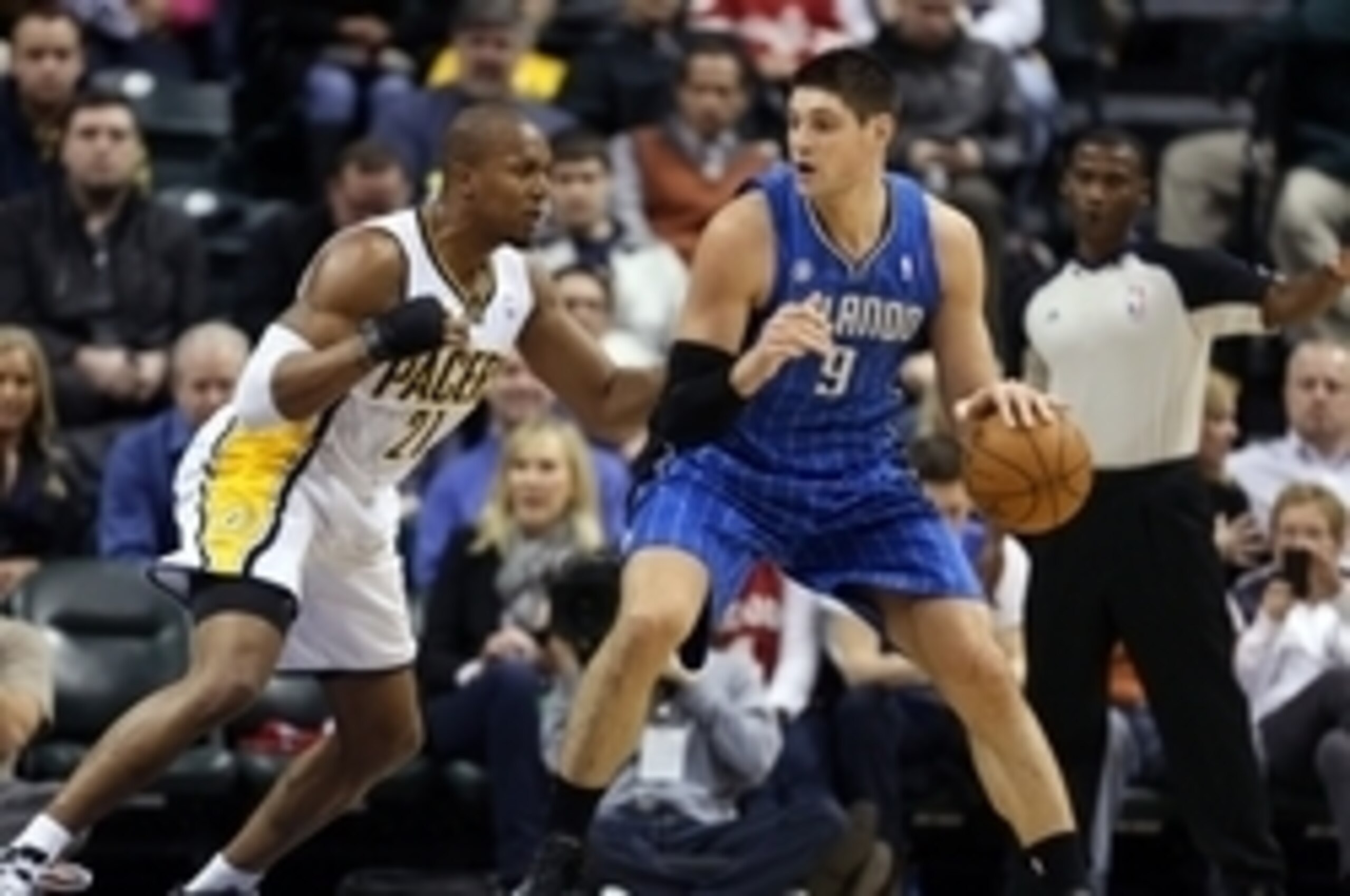
Verdict: Pay
After encouraging the Nuggets to pass on their non-shooting, minimally defending big man, it might seem inconsistent to suggest the Orlando Magic should work out a deal with Nikola Vucevic as soon as possible.
But there are some differences that justify the disparate treatment.
For starters, Vucevic is a legitimate center. And even if he's not an ideal interior defender because of his mechanical gait, he takes up tons of space and dominates on the boards—which is its own form of defense.
Vucevic can shoot a little too. He hit 50 percent of his shots from 10-16 feet last year, per Basketball-Reference. Three-point range is necessary from one of a team's two big men nowadays, but it's a lot easier to find that shooting in a power forward. So we won't dock Vucevic too severely for his lack of a long-distance shot.
With a power forward like Faried, who can't hit from outside the lane, offenses face a major spacing issue. As a center, Vucevic's space consumption isn't so problematic.
And to simplify things a bit more, Vucevic is just the kind of player other teams would likely overpay in restricted free agency. Only three other players from the 23-and-under crowd joined Vucevic in scoring at least 13 points and grabbing 10 rebounds last season, per Basketball-Reference: Anthony Davis, Andre Drummond and DeMarcus Cousins.
Those guys are all going to see max-level money when they're eligible, and Cousins has already signed his own huge deal.
If the Magic can do anything to lock up Vucevic now, they could save themselves a few million bucks in the long run.
Tristan Thompson, Cleveland Cavaliers
8 of 8
Verdict: Pass
Tristan Thompson might have a future with the Cleveland Cavaliers because he shares an agent with LeBron James, but paying him a significant chunk of money (now or at any point really) would be a huge mistake.
Maybe it's one the Cavs committed themselves to when they brought James back; it's not uncommon to see one of an agent's clients get overpaid after another signs a deal with a team.
Thompson, though, doesn't have a sensible role on the revamped Cavs.
He can't find the bucket unless he's right underneath it, having hit 34.9 percent of his shots from three-10 feet last season, per Basketball-Reference. And because he doesn't defend the rim, there's really no reason to ever play him over Kevin Love.
In addition, Thompson isn't big enough to play center, which means playing him alongside Love is also a nonstarter.
Look, Thompson has value as a backup big who can score a little bit down low and works hard on the boards. But he's eminently replaceable.
With the Cavaliers likely to have three high-dollar commitments when Love and James eventually sign longer deals, inking Thompson to an extension makes little sense. Especially at this early juncture.
James, who is apparently a fan of Thompson's, might get the final say here. But unless LBJ lobbies hard to keep his pal around on a new extension, the Cavaliers should wait to see what happens next summer.

.jpg?w=2560 "Raiders Could Start Mendoza")

.jpg?w=2560 "Rodgers Iced Out on Plane 💎")
.jpg?w=2560 "Packers Safety Slams Refs 🤬")
.jpg?w=2560 "🚨 Week 8 AP Top 25 Poll")