

How Much Blame Falls on Ryan Tannehill for Dolphins' Passing Woes?
Assigning blame over the happenings of a football game can be a slippery slope. Decisions are made in the blink of an eye by coaches trying to capitalize on weaknesses in an opposing team and by players trying to get in position to make plays. Sometimes, those decisions are correct; other times, they miss the mark. In either case, the only people privy to the "right answer" are the coaches making the calls and the players executing them.
There are times when it is clear who is at fault for a certain mistake—it is most certainly one player or another. There are other times where the truth is not one or the other, but somewhere in between.

.jpg?w=2560 "Rams Eagles Football")
In the case of Dolphins quarterback Ryan Tannehill, both of the above statements are true at different times. Just ask Dolphins head coach Joe Philbin and offensive coordinator Bill Lazor, who can't seem to agree on who should take the blame for the woes of the passing game (via Armando Salguero of The Miami Herald).
Here's Philbin on the matter:
"In the passing game, there are a lot of factors that go into a good passing game as you know. As we watched the film, the film says that we’re not detailed enough in any one area. In other words, there were pictures on the tape where the depth wasn’t quite the right depth. The angle at the top of the route coming out and separating at the top wasn't quite right. There were times where the location of the ball wasn't quite what it needs to be. There were times when the protection forced the quarterback off of some open receivers and into other options. So the answer is our passing game is not at the level it needs to be. Those are the facts, but it’s a unit issue.
"
And here's Lazor:
"There's no doubt that the blame rests 100 percent on me. It's my job when the unit fails in an area, whether it be completing enough passes, whatever the area is, and I felt like, when you look at us right now, if my stats are correct, unless someone has a really terrible game tonight, we'll probably be in the second-last in the league in yards-per-attempt, which I think is a pretty good indicator in the passing game of how you are doing offensively. That rests on the coordinator and just getting everybody to do it the right way and just getting everybody on the same page.
"
Philbin puts it all on the players. Lazor puts it all on himself. Never mind the mixed signals this sends to the team, but the two separate answers give you almost all the information you need: It's on everyone, not just one person, to fix this offense.
| New England Patriots | 33 | 360 | 5.1 | 25 | 5.1 | 5 |
| Buffalo Bills | 10 | 290 | 3.9 | 23 | 4 | 3.8 |
| Total | 43 (18) | 650 (21) | 4.5 (29) | 48 (6) | 4.4 (31) | 4.6 (13) |
Through two games, the Dolphins offense ranks 31st in net yards per passing play. Individually, Tannehill has the second-lowest passing yards per attempt in the NFL at 5.2.
There are a number of issues at hand. First is the introduction of Lazor as the offensive coordinator. His scheme is more quarterback friendly, but it is still unfamiliar for Tannehill, who has spent the past six years (four in college, two in the NFL) operating the offense of former coordinator Mike Sherman.
The other is that Tannehill has just been remarkably inconsistent. His accuracy—particularly on deep balls—has come into question. He missed another deep pass to wide receiver Mike Wallace, bringing the total up to four missed connections on the season, but it was a shorter misfired throw that caused more concern.
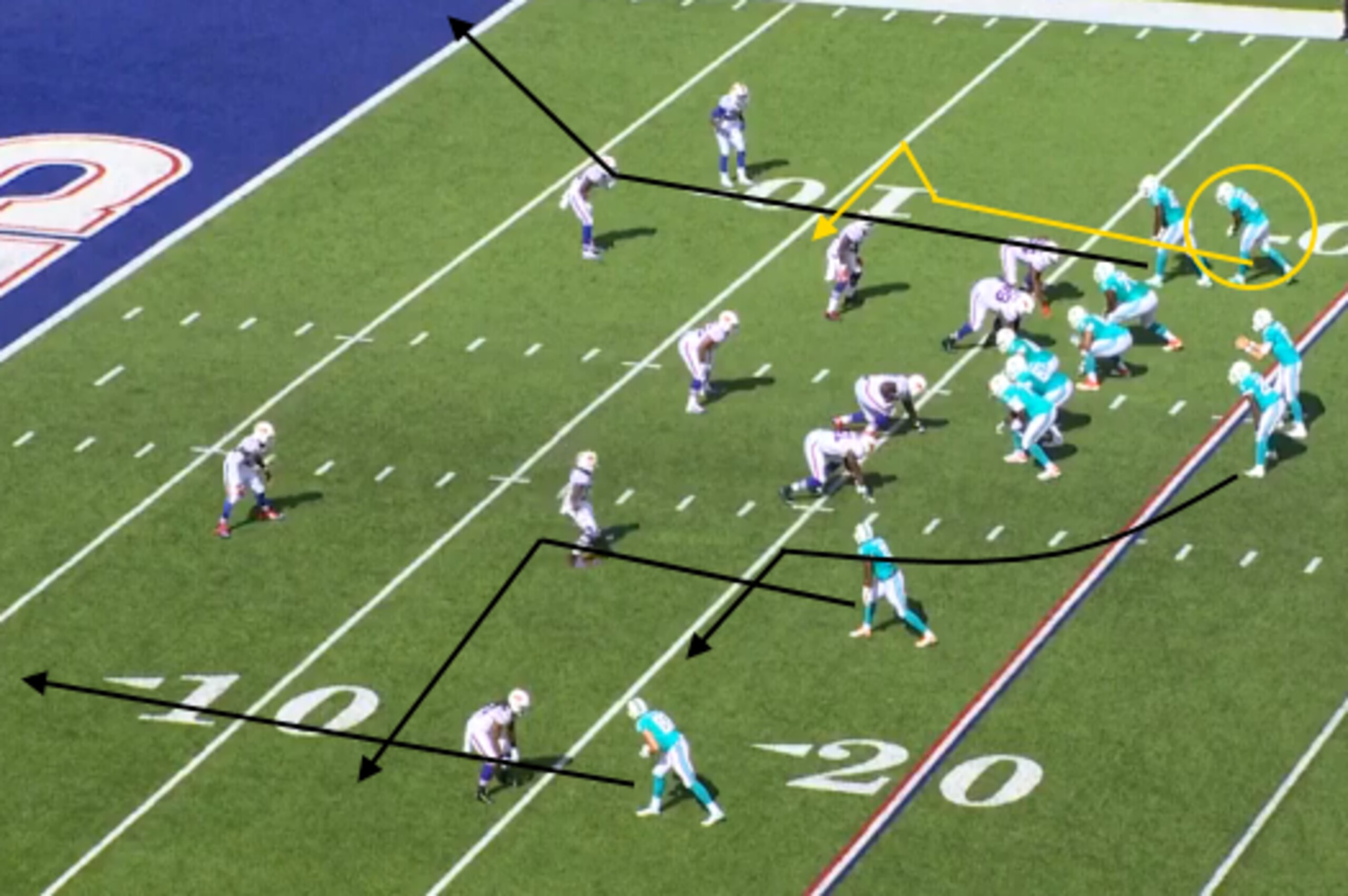
Brandon Gibson (circled in yellow) ran a pivot route on the right side of the field, with Mike Wallace running a corner route into the end zone. Tannehill never took his eyes off the right side of the field, and he saw Gibson running wide open to the inside.
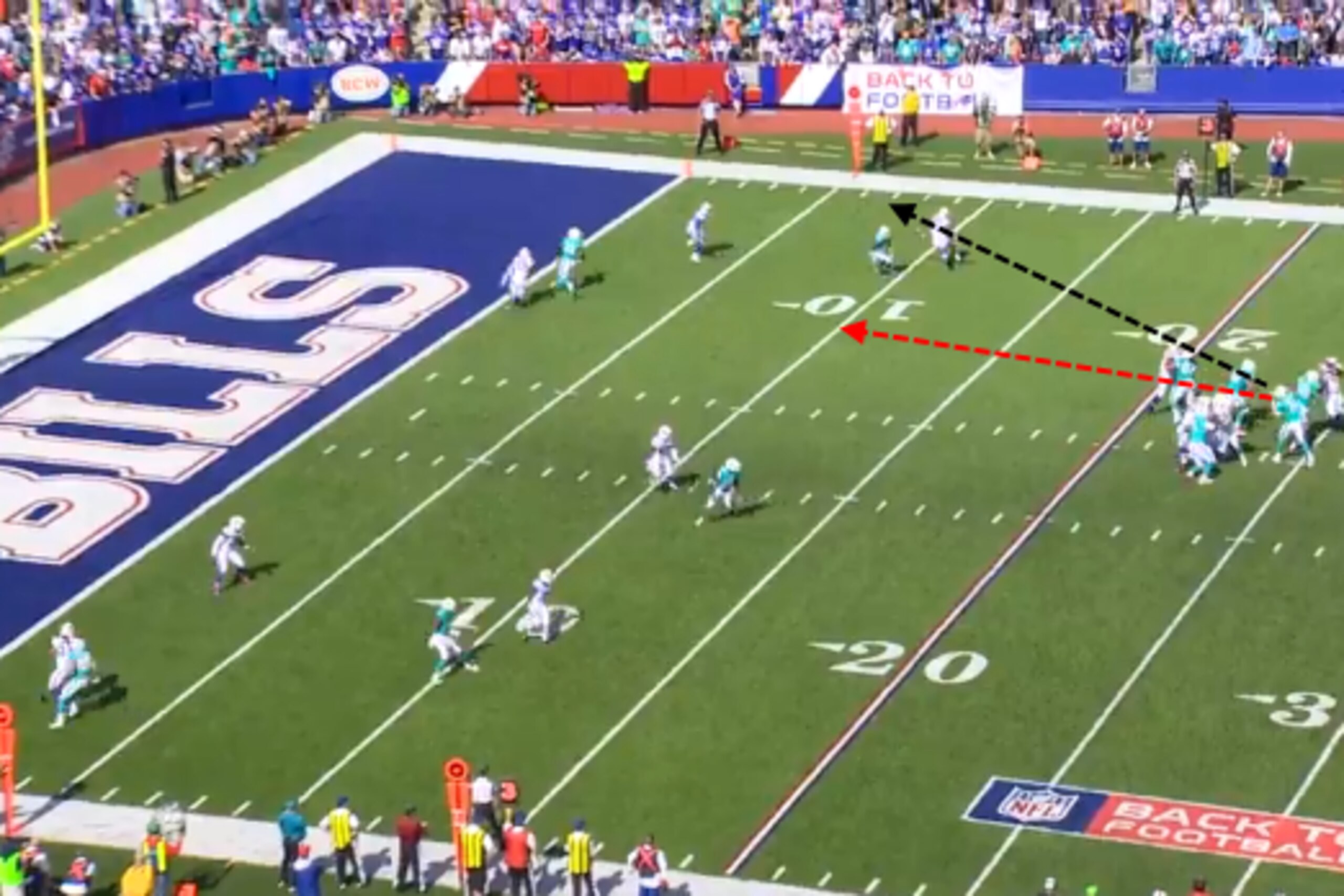
One problem: Tannehill threw the ball high and to the outside (black line), where he could have just thrown it anywhere inside (red line) to allow Gibson to run into the ball and make the catch in stride. A throw on the red line would have likely resulted in a touchdown, cutting the deficit to 9-7. Instead, the Dolphins settled for a field goal, and C.J. Spiller promptly returned the ensuing kickoff for a touchdown to make the score 16-3.
Why did Tannehill throw on the black line instead of the red line? Who knows? Maybe Gibson ran the wrong route—though the vast open space in front of him suggests he made the right choice. Perhaps Tannehill felt the incoming pressure and didn't step into his throw or deliver it quite the way he wanted. Or perhaps it was just the latest in a litany of inconsistent accuracy issues that have plagued Tannehill since he entered the league.
Those accuracy issues run deep—and on deep passes, as well.
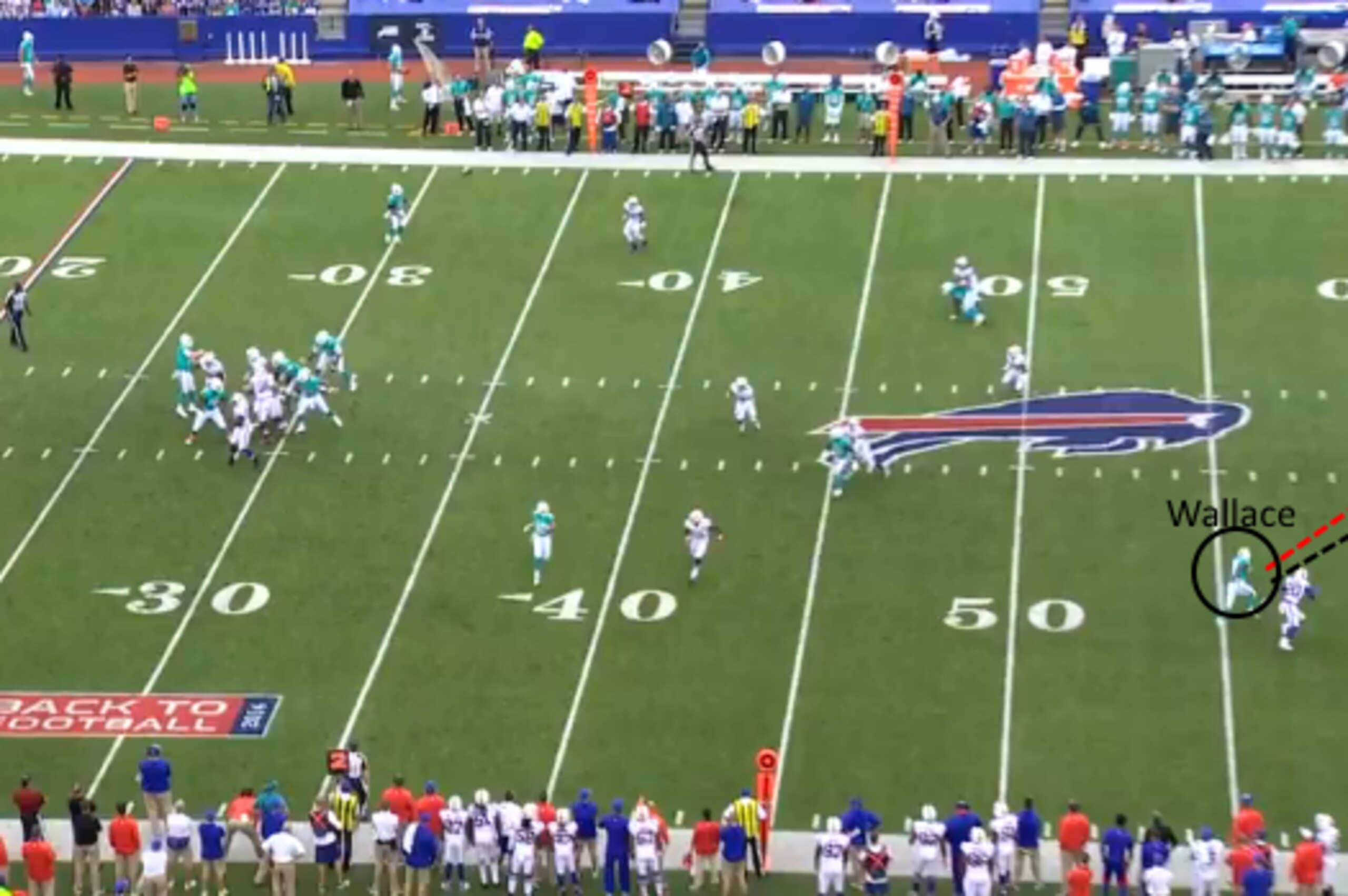
Tannehill had Wallace wide open deep down the middle of the field on 2nd-and-9 with 3:10 left in the first quarter. Wallace was running a deep post route, and had inside leverage on cornerback Corey Graham. When the receiver gets inside leverage, all the quarterback has to do is lead him inside and let him catch it in stride while continuing to break away from the defender.
The ideal throw would have had Wallace continue his pattern in a straight line (red line), but instead, Tannehill threw further upfield and did not lead Wallace inside, forcing the receiver to cut back into the defender (black line) and allowing Graham to break up the pass.
It's no wonder Wallace threw a small tantrum after the pass fell incomplete.
Make no mistake; The accuracy issues notwithstanding, part of the problem falls on the Dolphins receivers. Tannehill needs to be more accurate on a consistent basis, but his receivers have dropped seven passes, tied for second-most in the NFL through two games, according to Pro Football Focus (subscription required). Tannehill is surrounded by talent, and those pass-catchers must do a better job of, well, catching passes.
In his third year, Tannehill can no longer afford to be the same player he's been since he was drafted by the Dolphins with the eighth overall draft pick in 2012. That is especially true since the Dolphins must decide on whether to exercise the fifth-year option in his rookie contract before the deadline in May of 2015.
The Dolphins don't want to be an average team, they want to be great. If they get there, it won't be because of the offensive line, the defensive line or any other singular position on the roster. It will be because of the quarterback play. Or, it won't be because of the quarterback play.

.jpg?w=2560 "Grading WWE Raw 🔠")

.jpg?w=2560 "Injury-stricken Seahawks signing veteran RB")

