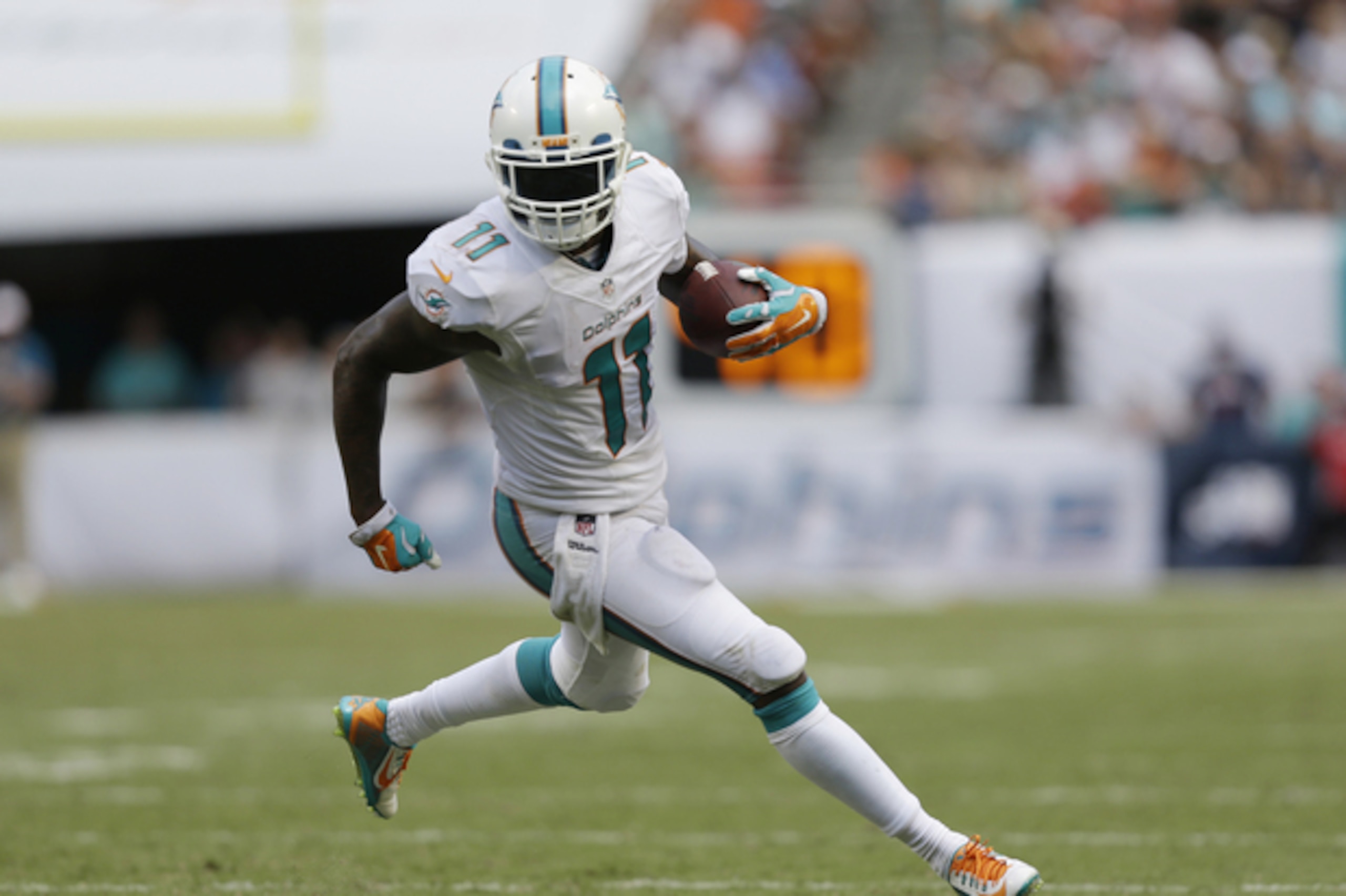

Where the Miami Dolphins' Offense Can Improve After Week 1
The Miami Dolphins’ impressive 33-20 victory over the New England Patriots is now in the rearview mirror, and it’s time to look at where the Dolphins offense can improve entering Week 2 against the Buffalo Bills.
There were a lot of positives for the Dolphins offense in Week 1, including the emergence of Knowshon Moreno, and the offensive line’s performance. The Dolphins offense only scored more than 33 once in 2013, so to come out and hang that many on the Patriots in the opening game was a statement to the rest of the NFL.
Although NFL players are often considered the best in the world in their profession, they’re still human, and mistakes will be made throughout the course of the game.

.jpg?w=2560 "Rams Eagles Football")
.jpg?w=2560 "Texans-Mixon Released Football")
So we’re going to take a look at three areas where the Dolphins offense needs to improve so it can be fully prepared to defeat another difficult division rival, the Buffalo Bills.
Limit Mistakes
The most human element of football is failing to execute even basic plays, such as maintaining possession of the ball after being hit, catching a ball that hits directly in the hands, and addressing wrap-up tackling.
Even the all-time great players were prone to having bad games, moments or even entire seasons, so it’s important to keep the human element in perspective, no matter how crushing the mistake.
That being said, the Dolphins’ skill players made a number of errors that cost the team the chance to score even more points.

On the Dolphins’ second drive, quarterback Ryan Tannehill delivered a pass to Mike Wallace on a crossing route. The placement of Tannehill’s pass was on the back shoulder, which is not ideal for a pass over the middle.
Wallace was able to adjust to the pass and establish control by taking three steps before getting hit. When Wallace was hit, however, he fumbled the football and allowed the Patriots to end the Dolphins’ drive prematurely.
Although Wallace was hit hard, he should’ve expected the hit. Crossing patterns often lead to linebackers and safeties delivering punishing blows, and Wallace wasn’t hit as he caught the ball, so the fumble was purely his own fault.
Midway through the second quarter, running back Lamar Miller exploded through a backside running lane for a 14-yard gain. As Miller was hit, his grip on the ball proved to be poor, and the ball popped out of his hands. This happened as the offense was progressing into field-goal range, so it was another costly turnover.

Quarterback Ryan Tannehill had one interception in Week 1, and it looked egregious on first view. Looking at the film, it’s easier to see why Tannehill misfired to Wallace deep. As the Patriots defender was nearing Tannehill, he didn’t have time to step into his throw, and his accuracy was off.
Instead of leading Wallace to the back of the end zone for a catch-in-stride, Tannehill threw it to where Wallace was currently located, and cornerback Alfonzo Dennard made the easy interception.
Tannehill must be smarter with the ball or get the pass out quicker when he feels the pressure.

Finally, the Dolphins had numerous dropped passes in Week 1. Mike Wallace had one bad drop in the third quarter on a pass that hit him square in the hands, as did rookie Jarvis Landry.
Wallace also had an opportunity to show up his nemesis, Darrelle Revis, but he couldn’t drag his second foot in the end zone.
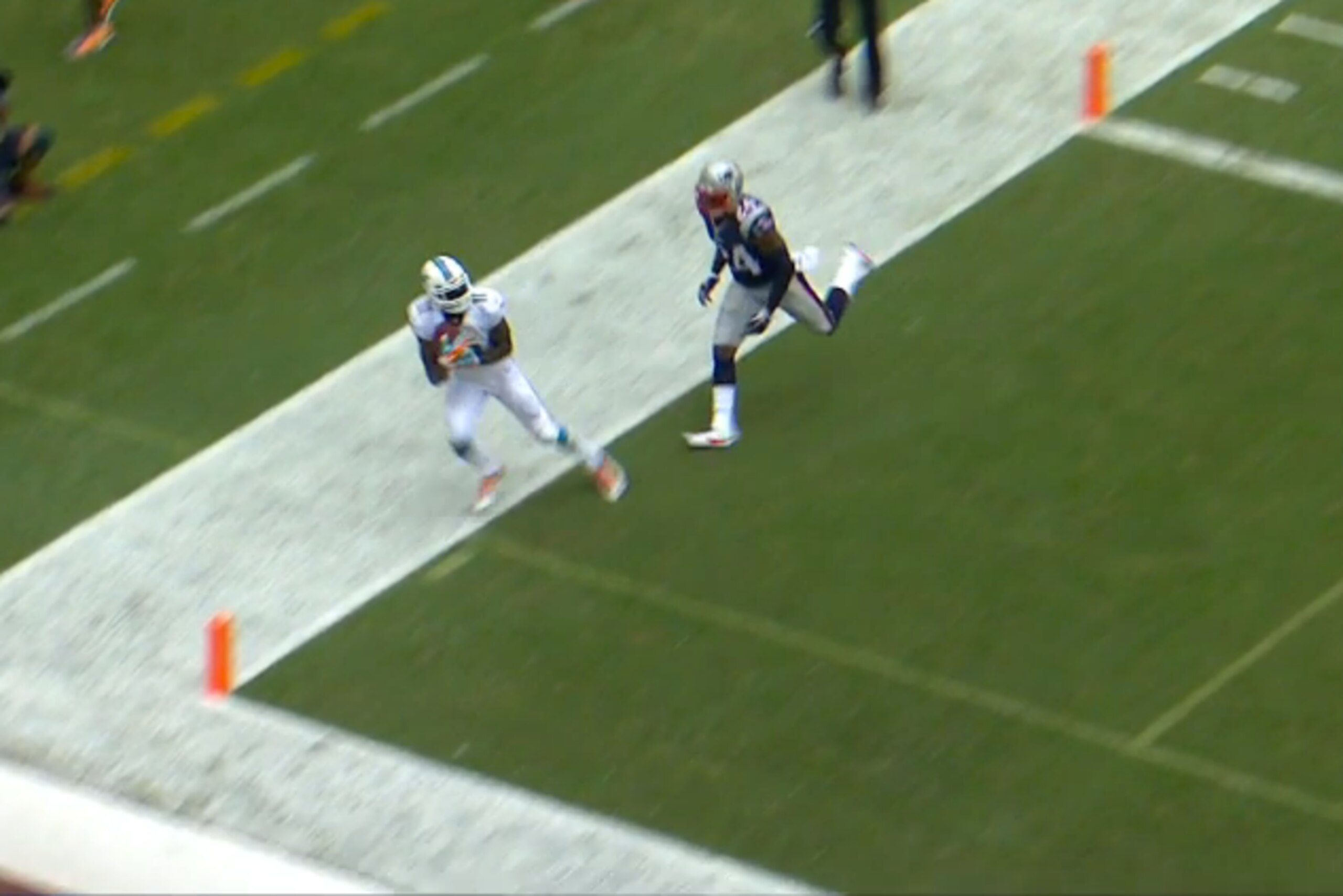
After burning Revis on a double move, Wallace streaked upfield to catch a perfect Tannehill throw. The stage was set for Wallace to finally catch a deep touchdown from Tannehill, but the receiver took a sideways step instead of dragging his toe, ruining a beautiful 50-yard pass on the move.
The NFL is a game of inches many times, and it requires some spectacular plays to come away the victor. For the Dolphins, they did enough to win this game, but they left as many as 20 points on the field due to very simple mistakes.
Interior Blocking
As well as the Dolphins line played, there were moments where Vince Wilfork was able to win at the line of scrimmage within a mere second of the snap. Even at 32 years old and coming off a devastating Achilles tear, Wilfork created pressure that folded three running plays and two passing plays before the Dolphins could really get started.

As you can see above, Tannehill is handing the ball off, and Wilfork has already gotten past left guard Daryn Colledge. With no cutback lane, Moreno can only get a minimal gain.
On Tannehill’s deep pass to Wallace, he was forced to make a rushed throw because Wilfork again blew past a Dolphins guard. This time, right guard Shelley Smith was his victim. Wilfork’s swim move instantly knocks Smith off balance, and Tannehill has to scramble until a receiver comes open.
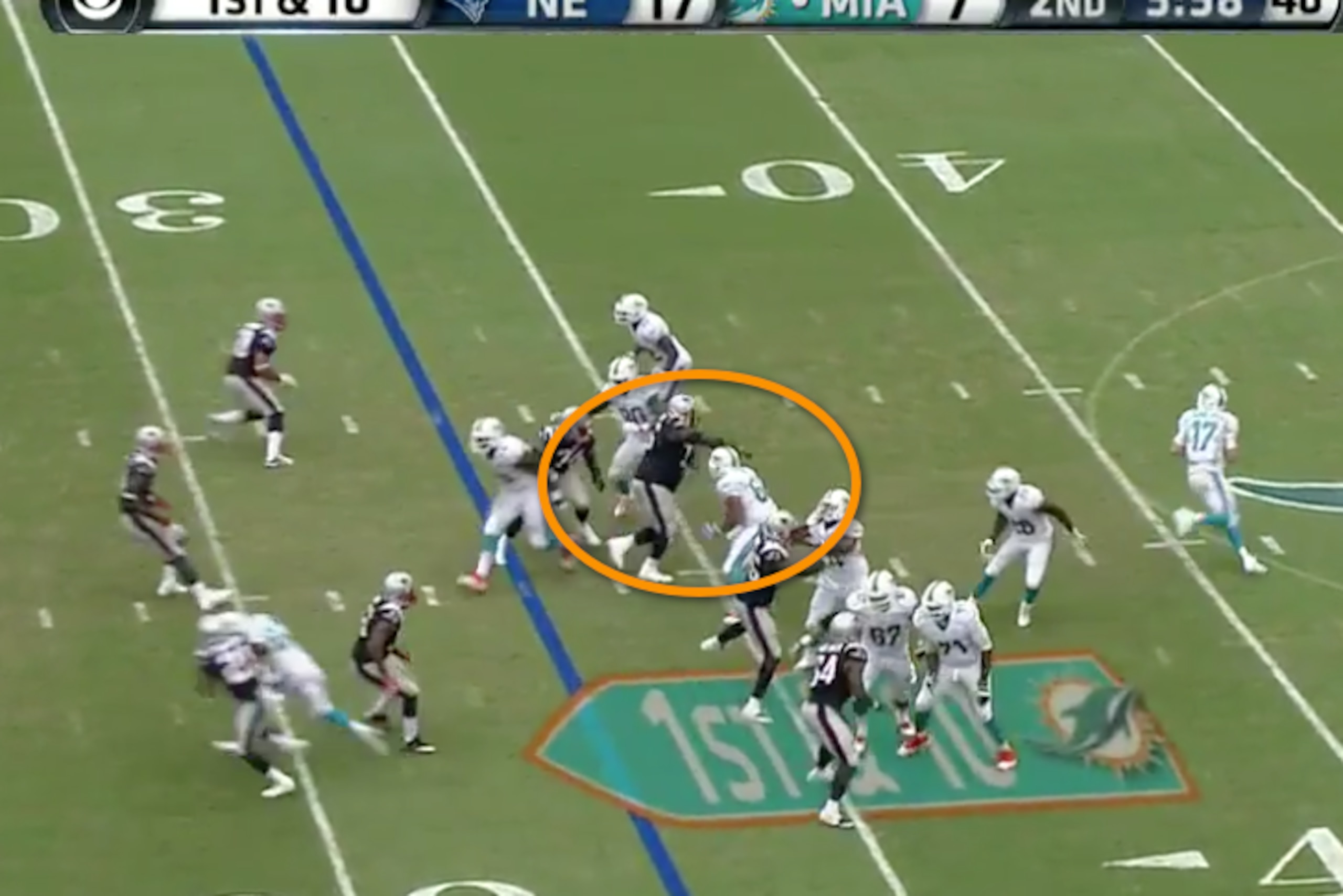
Center Samson Satele wasn’t left out from Wilfork’s fury, either. Take a look below and you’ll see Satele being pushed two yards back. Moreno has to bounce his run outside of the tackle prematurely, giving up the threat of a cutback into the heart of the defense.
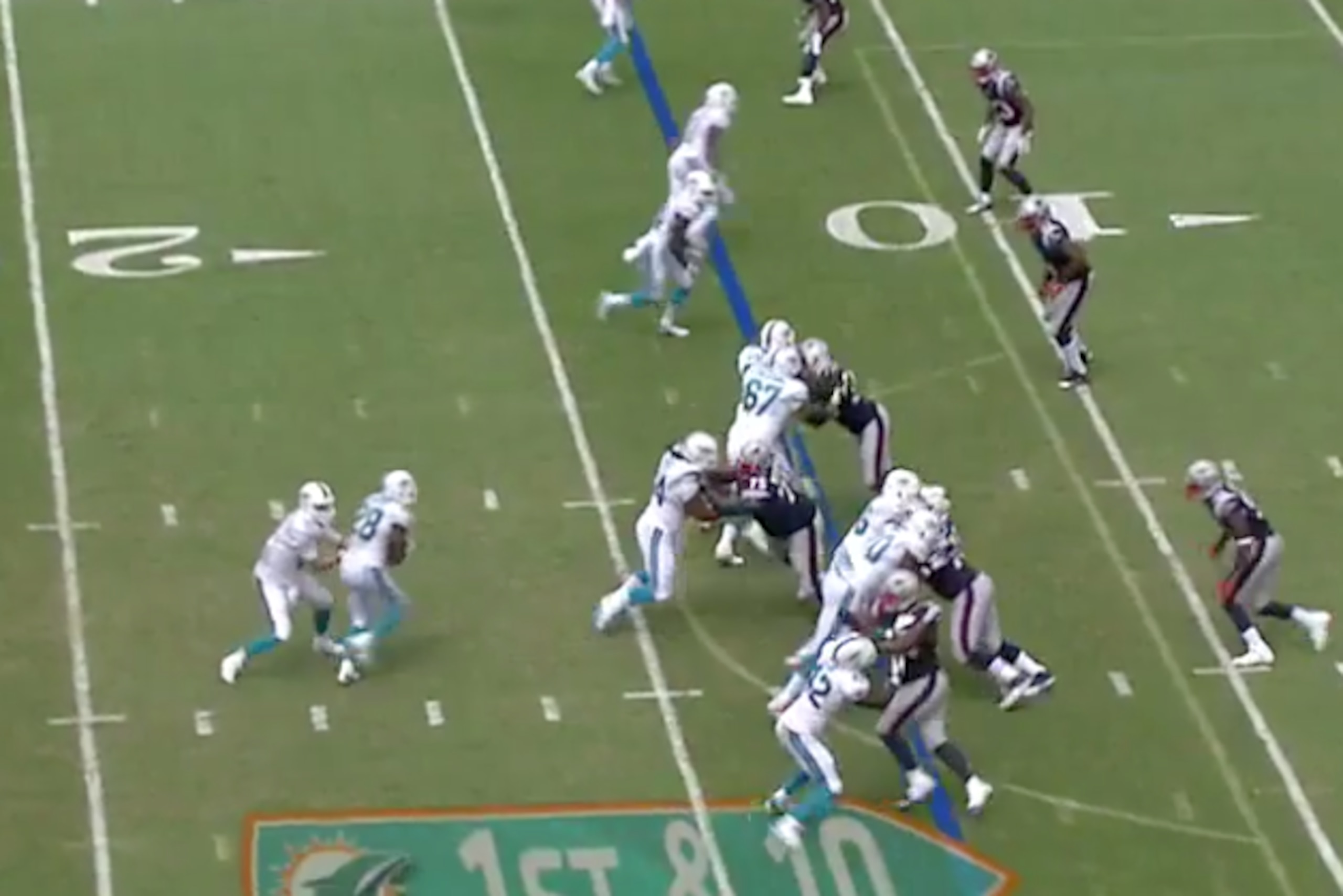
As the Dolphins prepare to play a very talented Bills defensive front, they will need to clean up some of the one-on-one opportunities on the interior line. The center needs to identify which guard needs help double-teaming and providing at least a chip to slow the defender down.
Consistent Rhythm
The Dolphins utilized a no-huddle offense for only one series in each half, totaling 10 plays. With the defense unable to substitute, the Dolphins were able to produce positive yards on eight plays, with the other two resulting in incompletions.
With the offense finding a rhythm, the defense is at a greater disadvantage. Tannehill has shown through his young career that when he finds his stride, he’s a much more accurate passer. Take a look at the passing chart for the first half below, which I tracked from Tannehill’s Week 1 passes. This is an accuracy chart, which accounts for passes that are catchable by receivers.
| 20+ yards | 1/2, INT | 0/0 | 1/1 |
| 11-19 yards | 1/1 | 0/1 | 0/0 |
| 0-10 yards | 5/5 | 1/1 | 3/4, TD |
| Side of Field | Left | Middle | Right |
The results were average, with Tannehill dominating the short passes but having few attempts downfield.
After the offense established the run and played faster in the second half, Tannehill was able to greatly improve his pass dispersion and accuracy.
| 20+ yards | 3/4, INT | 0/0 | 1/1 |
| 11-19 yards | 3/3 | 3/4, TD | 0/0 |
| 0-10 yards | 10/11 | 2/3 | 3/5, TD |
| Side of Field | Left | Middle | Right |
Offensive coordinator Bill Lazor heavily incorporated motion into his formations, totaling 24 plays with pre-snap movement in 76 offensive snaps. Stats show 31.5 percent of plays made the defense adjust to the offense, instead of letting the Patriots sit in their disguised defensive fronts.
The end result of the Dolphins’ offensive performance in Week 1 was promising that this team could make the playoffs this season. As we enter Week 2, the Dolphins will have to clean up their execution in the three areas above to keep their opponents one step behind.
To keep winning, constant improvement is needed. Look for that improvement this Sunday in Buffalo.
All stats used are from Pro Football Focus' Premium Stats (subscription required) or Sports-Reference.com. All contract information is courtesy of Spotrac.
Ian Wharton is a Miami Dolphins Featured Columnist for Bleacher Report, contributor for Optimum Scouting, and analyst for FinDepth. You can follow and interact with Ian Wharton on Twitter @NFLFilmStudy.
.jpg?w=2560 "Commanders Eagles Football")



.jpg?w=2560 "Mahomes' Wife Trolls Kubiak 💀")

.jpg?w=2560 "Grading WWE Raw 🔠")