What David Krejci's New Contract Could Mean for Other Boston Bruins Players
A Thursday press release on the team’s website confirms that the Boston Bruins aim to keep David Krejci through at least 2021. Per CapGeek, the new contract will take effect in 12 months, elevating Krejci’s cap hit from $5.25 million to $7.25 million.
With that, the first-line center will soon be the highest-grossing member of the team. He will pole-vault fellow core players Milan Lucic, Patrice Bergeron, Zdeno Chara and Tuukka Rask for that distinction.
Starting in 2015-16, this will mean carrying five cap hits of at least $6 million. Two of those five will go to Boston’s top two pivots and two will be in the $7 million range.
As their projected payroll stood this weekend, those are half of the 10 healthy Bruins currently under contract for next season.
With the long-injured Marc Savard in the equation, this leaves $14,756,190 to dole out to another half of the roster. Assuming the long-term injured reserve exception continues to help, the free space will be $18,783,303.
NHL or non-roster payroll, here are some key pending free agents who may be seeking a share of that space: Gregory Campbell, Daniel Paille, Carl Soderberg, Reilly Smith, Johnny Boychuk, Dougie Hamilton, Torey Krug, Niklas Svedberg, Ryan Spooner, Matt Fraser.
Other current Bruins set to become unrestricted free agents or restricted free agents next July: Jordan Caron, Justin Florek, Adam McQuaid and Matt Bartkowski. While those ought to be less prized than the other group, their export is no guarantee until (and unless) it happens.
Krejci’s contract does not animate the reality as much as it lends it additional decibels. Whether it is through a trade or a lack of a re-up, Boston is bound to part with a few household names no later than next summer.
General manager Peter Chiarelli acknowledged the inescapable constriction, telling Caryn Switaj of the team’s website in a Friday write-up, “unfortunately when you’re in the position of success that we’ve had and players are at an age that they’re commanding, based on their years of service, certain salaries, you have to make tough decisions.”
The financial factor holds the most readily apparent and widely applicable influence on that front. It explains why a defenseman such as Boychuk, he of a $3,366,667 cap hit, has been subject to trade rumors, according to Joe Haggerty of CSNNE.com
Even if the Bruins keep him for the balance of his current pact, a more lucrative deal thereafter is virtually out of the question. After all, Hamilton’s entry-level deal is set to expire and Boston will need to start setting aside seven figures for Chara’s heir apparent.
But there are also on-ice, depth chart-based implications. With Krejci and Bergeron, who is under contract through 2022, Boston is expressing no immediate plans to replace its top two centers.
Soderberg could wind up being the fundamental face of both factors. The late-blooming Swede will cost $1,008,333 to keep patrolling the third-line pivot for one more year.
In an Aug. 24 notes column, Boston Globe scribe Fluto Shinzawa all but foretold Krejci’s contract renewal. He went on to pen a prediction that “Boychuk will price himself out of Boston’s budget. Soderberg could do so too.”
Now that we know the exact figures in the wake of Krejci’s new deal, the Soderberg aspect warrants a more prominent position in the discussion.
Beyond that, though, he may seek more than just elevated compensation. Soderberg could strive to convince potential free-agency suitors that he is capable of assuming a top-six position.
Based on their long-term promise, the same notion may someday apply to prospects Alexander Khokhlachev and Spooner.
Because they have yet to play a full NHL season, Khokhlachev and Spooner have more time to take shape as centers at the highest level. At least one, if not both, will fill a wing for 2014-15, and they should fit in as depth strikers for multiple years.
But by the time Krejci is up for another renewal, Spooner will be 29 and Khokhlachev will be 27 going on 28. If they develop according to plan, odds are they will warrant top-six consideration up the middle between now and then.
Naturally, that also buys the Bruins ample time to foster other prospects whose names have yet to grace scouting leaderboards. For the individuals in question, though, thicker long-term ice could surface in another organization.
Simply put, the only way each party sustains mutual interest into the next decade is if Khokhlachev and Spooner emerge as third-line-caliber players or permanently transition to the wing. Bergeron and Krejci are going to block their natural, coveted slots for too long.
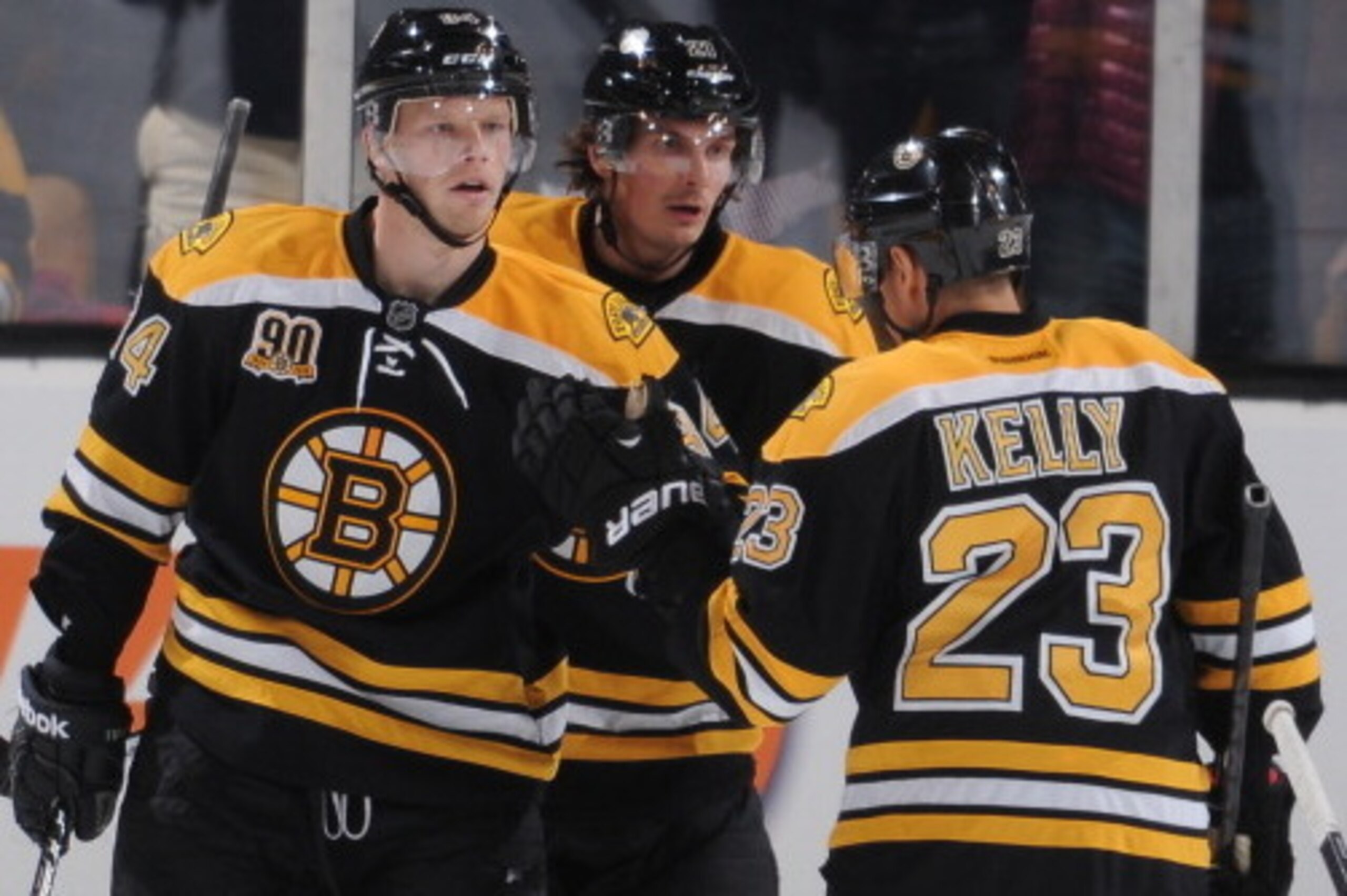
For the less distant future, though, it is reasonable to envision Spooner as the third-line pivot. He has already taken some authentic tests on that front when Chris Kelly was out last December and January.
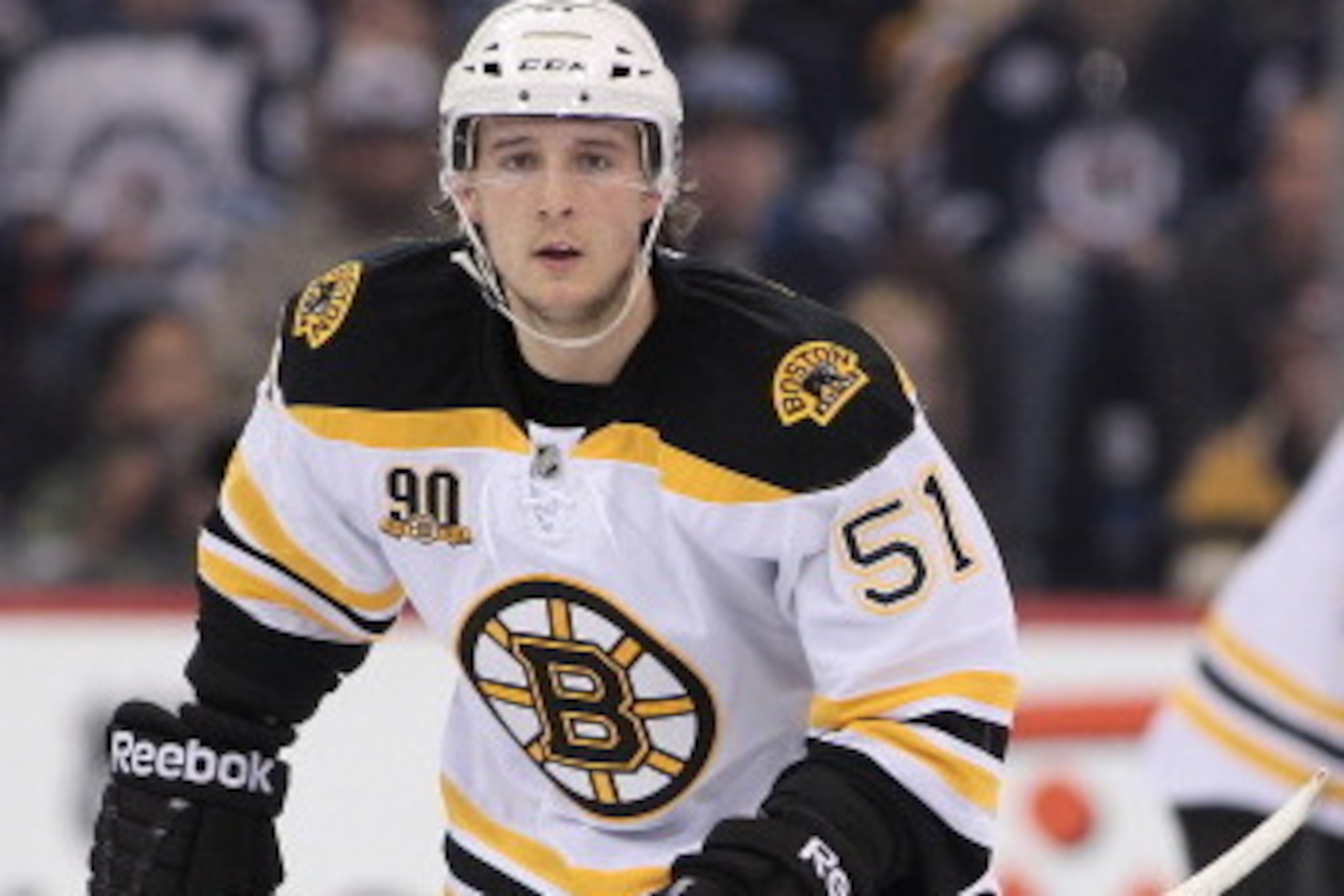
Add the fact that he will almost certainly command a less swollen raise when he and Soderberg both hit free agency in 2015. If the aforementioned Shinzawa’s prophecy unfolds, Spooner ought to have a smooth path to succession.
In that event, the veteran Kelly could crave an opportunity to don a new crest. The 33-year-old once rigidly occupied Boston’s third-line center slot until his bout with the injury bug.
By arriving at the earliest possible date for informal skates two weeks ahead of training camp, Kelly shows hope to return to 100 percent status. But with his current employer’s circumstances and his contract running through 2015-16 with a $3 million cap hit, his best bet may be to take his replenished form elsewhere.
Unless new issues flare up, it would not be a stretch to envision an in-season trade this fall or winter. Of those who currently project to consume some of Boston’s cap space in 2015-16, Kelly makes the most sense to remove.
Chiarelli, whose history with Kelly dates back to Ottawa, will need to shake off any sentimental reluctance at this point. Giving Krejci a raise amidst an already snug salary situation means he will need an above-and-beyond savings plan to ensure the rest of his roster.
Remember: Krug and Smith still do not have contracts for the approaching campaign, let alone next season. Paille and Campbell can still lend useful seasoning to the third and/or fourth line.
Could other multiyear contracts, such as those of wingers Loui Eriksson ($4,250,000) and Brad Marchand ($4,500,000), make decent trade bait? Theoretically, they could, but that would only be worthwhile if they fetch a proven return piece for a lighter cap hit.
In contrast to its overstock of capable centers, Boston should be diligent about ruffling its wings. On defense, Hamilton and Krug are untouchable for their respective potentials as an all-around elite and a prolific puck-moving specialist.
This means prioritizing the players of those positions as the crowd outgrows the surface of the cap cliff. Those who are making the center position the greatest cause of numerical and financial overflow are the logical choice as the inevitable sacrifice.
If the opportunity arises, trading Kelly would serve everyone’s interest ahead of next summer’s free-agent tempest. At best, it could embolden Boston’s fighting chance to retain the likes of Boychuk or Soderberg.
At worst, the loss of those three would yield a silver lining in more space for a fresher, younger contingent to complement what remains of the proven, veteran leadership core.
At the very least, that core has more of a future with Krejci's renewal. How the Bruins continue to build around the nucleus and who gets to take part for how long will be the ongoing question.

.jpg?w=2560 "Rodgers Iced Out on Plane 💎")
.jpg?w=2560 "Mahomes Told Teammate to Leave Meeting")
.jpg?w=2560 "🚨 Week 8 AP Top 25 Poll")


.jpg?w=2560 "Raiders Could Start Mendoza")
.jpg?w=2560 "Lamar Being Out Shocked Ravens")