Is Melvin Gordon the Best Running Back Eligible for the 2015 NFL Draft?
Over the past decade or so, the NFL has seen a shift. Gone are the days of running backs routinely being selected in the top 10 of the NFL's annual draft. In 2005, three of the top five picks in the draft were running backs—Ronnie Brown, Cedric Benson and Carnell "Cadillac" Williams. In 2008, the NFL saw five running backs drafted within the first 24 picks.
Fast-forward to 2014, where the highest-drafted RB in the 2014 NFL draft was Bishop Sankey out of Washington, a late second-round pick (54th overall) of the Tennessee Titans. In 2013, Giovani Bernard was the top-drafted RB as an early second-round pick (37th overall) for the Cincinnati Bengals.
TOP NEWS
.jpg?w=2560 "NFL Paris Football")
NFL House in Paris Closes for Protests
.jpg?w=2560 "Seahawks Chiefs Football")
Trevon Diggs Cut by Seahawks
.jpg?w=2560)
B/R's Expert Week 7 NFL Picks 🔮
Perhaps it was the disappointment of Trent Richardson in 2012 (third overall) or the success of later-round picks and undrafted free agents such as Alfred Morris and Arian Foster. But the NFL has seemingly devalued the running back position on draft day in recent years.
In an interview with Chris Low at ESPN The Magazine, Melvin Gordon said, "You hear a lot of things about running backs not being as important anymore. Some people in the NFL may think they don't need backs early in the draft. I want to change that."
And that should change in 2015 if running backs Gordon (Wisconsin) and Todd Gurley (Georgia) decide to forgo their remaining eligibility and enter the 2015 NFL draft.
The debate over Gordon and Gurley has been going on all season. Some pundits prefer Gordon's flash, while others prefer Gurley's more powerful, well-rounded game.
| 20+ | 15 |
| 30+ | 11 |
| 40+ | 8 |
| 50+ | 5 |
Truth be told, both players are terrific overall talents. It reminds me of the A.J. Green vs. Julio Jones debates that raged on before the 2011 NFL draft. Both Gurley and Gordon should become Pro Bowl-caliber talents in the NFL. It really comes down to a matter of preference and team fit on draft day.
This is not a slight on Gurley, who is fantastic in his own right, but it's my opinion that Gordon is the best draft-eligible running back prospect in the country right now and the best overall running back prospect the NFL has seen since Trent Richardson in 2012.
| 400 | 3276 | 8.2 | 28 |
What makes Gordon so special? It's not the statistics, which are mind-blowing when you consider sample size and level of competition. It's the traits. The rare set of qualities that Gordon has sets him apart from any other runner in recent years.
Acceleration
Peter Bukowski of Sports Illustrated described Gordon as "explosive," as he defined key components of his skill set:
Perhaps Gordon's best trait is his acceleration. He has an ability to go from 0-60 in the blink of an eye. The image below really is the turbo-button exemplified in real life and all you need to be able to see his rare acceleration.

Power
Lost in all of the Jamaal Charles comparisons for Gordon is that he is quite powerful. His frame is a little bit bigger than Charles', and he runs much more violently than Charles does. Take a look at the following videos.


As you can see, Gordon does a great job of keeping his legs moving through the pile and getting an extra 4-5 yards after contact in each instance. A big part of the reason Gordon averaged nearly eight yards per carry over the past two years is his ability to get the extra 1-2 yards after contact on each carry.
Vision and Quick Feet at Line of Scrimmage
A huge part of playing the running back position is having the ability to make a man miss behind the line of scrimmage and get up field. This is one of the main reasons you'll see many running backs who dominated college fail at the NFL level.
Players who are used to having wide-open running lanes in college, suddenly get to the NFL and now have a 300-pound defensive tackle in their face a split second after they receive the handoff. Can he make the defender miss? Or is he going to run right into him and get swallowed at the line?

This is something Gordon has definitely shown the ability to do at the collegiate level. Many will assume that because Gordon plays at Wisconsin, he's constantly running through wide-open alleys. But that's simply not the case. There have been a multitude of plays where things get blown up at the line.
Let's take a look at two plays specifically here.
In this first example, the play is contained at the line of scrimmage. See the image below.

There's nowhere to go in the above image; it looks like the play is dead. But watch Gordon's nifty moves at the line of scrimmage to open a running lane and explode up field.

The above play turned into a 35-yard gain after looking like there was nothing there at the line of scrimmage.
Here's a second example:
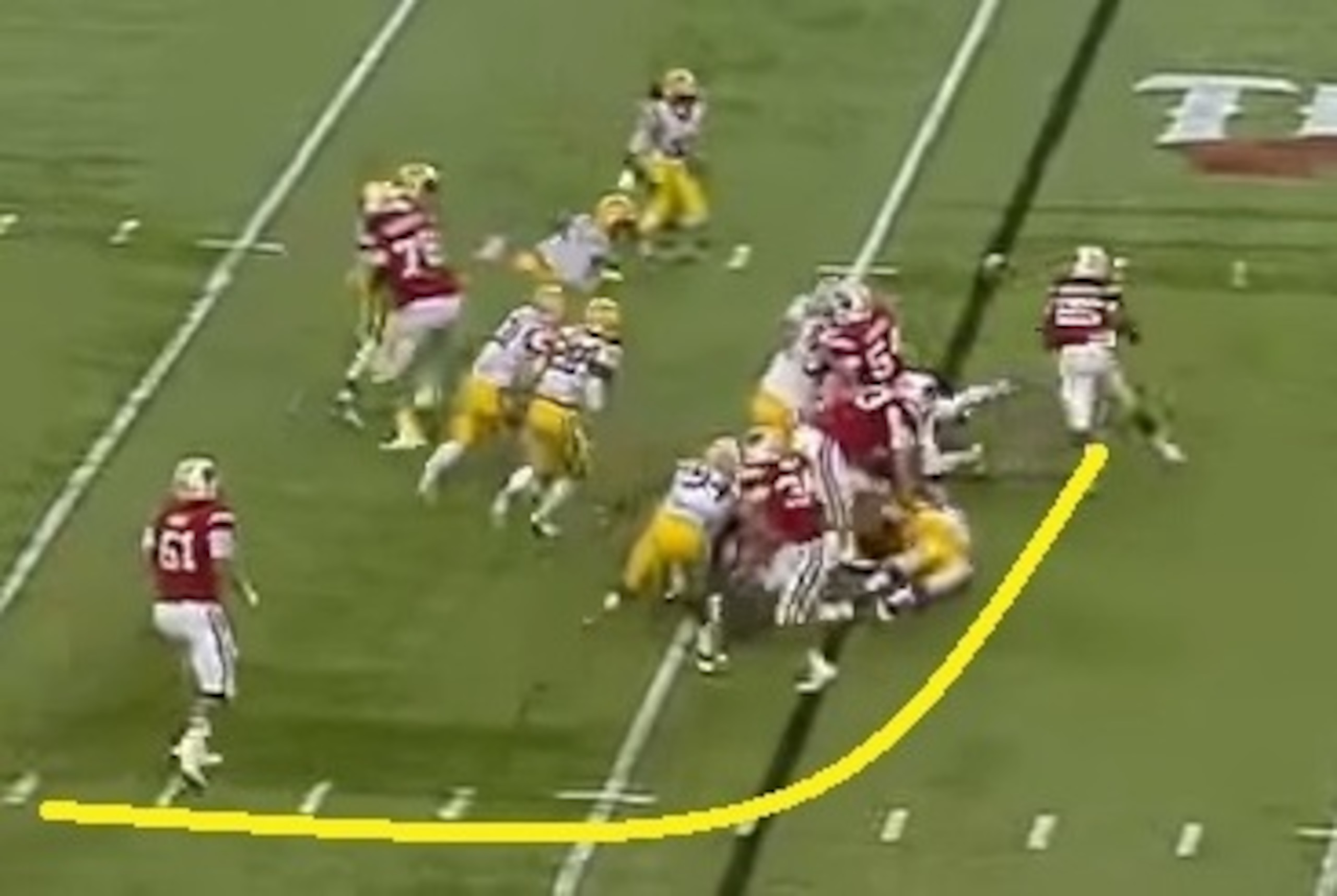
The above play looks totally contained at the line of scrimage. Gordon has nowhere to go with LSU defenders in front of him. But he has the vision and quick feet to reverse field and turn this into a solid gain.

Balance
One of Gordon's more impressive traits is his ability to maintain his balance while brushing off defenders, allowing him to focus on making the next man miss. Check out the video below:

In this play, Gordon breaks two tackles, maintains his balance and is able to sidestep a defender while spinning out of a tackle. That's extremely impressive balance for a runner who isn't often punishing defenders with his size.
Open-Field Creativity
Many will assume that because Gordon is a long strider, he doesn't have the ability to make a man miss in the open field. Most long striders will struggle to change direction at full speed but not Gordon. He has a plethora of open-field moves that have proven deadly at the collegiate level and translate to the NFL.
Gordon owns a very Arian Foster-esque sidestep hesitation move as seen below.


He also is much quicker than defenders think and has some shake-and-bake to his game.

In the above video, check out how No. 88 on Bowling Green is running at Gordon and still can't catch up to him, despite Gordon's shake-and-bake move. Gordon is able to pull that move off while running at full speed.
Work Ethic
All of the on-field traits exemplified above are great, but what sets apart great prospects from NFL stars is the ability to work hard off the field and have the desire to be the greatest.
As Chris Low notes in his ESPN The Magazine piece, Gordon came into Wisconsin at 195 pounds, but "he bulked up to 216 pounds...he's squatted 510 pounds five times this summer; last year the most he could do was 465 pounds."
Gordon had the ability to enter the 2014 NFL draft after a breakout redshirt sophomore season, but the Wisconsin product opted to return for his junior season. Why? Because Gordon wants to be remembered as one of the best to ever play Wisconsin.
Gordon told Jeff Potrykus of the Milwaukee Journal Sentinel after making his decision, "It is one thing to just come and go," Gordon said. "But you want to leave a legacy. ... To be remembered, that is big for me."
And for NFL evaluators, the drive to want to be remembered will be big for them.
But Can He Play in the Passing Game?
This is by far the biggest criticism Gordon faces as he transitions into the NFL. Gordon has nine receptions in his entire career at Wisconsin and was often subbed out as a sophomore for James White who was more adept in pass protection.
However, I am going to tell you not to worry about Gordon's raw statistics as a college receiver. I am not concerned about his ability to transition to a pass-first NFL style of play in the slightest.
Through six games, Gordon has more touches on offense this season than Wisconsin has total pass attempts. The passing game isn't his best trait, so it's a great time for Wisconsin to get him some rest. Wisconsin had one of the best third-down backs in the country in 2013 in James White, so it would make sense that Gary Andersen would sit his bell-cow back in those situations.
This season, Gordon is tied for third on Wisconsin's roster in receptions with six. You read that right; there are only two players on Wisconsin's entire roster who have more than six receptions. The Wisconsin offense is predicated on running the football and taking deep shots to WR Alex Erickson or tight end Sam Arneson.
To compare, in Montee Ball's final season at Wisconsin, he caught three passes in his final 12 games for the Badgers. Yet, Ball has been a fine receiver out of the backfield for Peyton Manning in Denver with 26 receptions in his past 11 regular-season games.
When Gordon has been thrown to, he's shown a fine ability to catch the ball out of the backfield. Is he Darren Sproles? Absolutely not. But he's shown more than enough skills in the receptions he has made to show that he can contribute on passing downs. It's a problem of usage, not a problem of skill.
Gordon has struggled in pass protection in years past. However, he has shown much more willingness to help out in the pass protection in 2014.

In the play above, Gordon does a good job of taking out the LSU defender before he can get to Wisconsin QB Tanner McEvoy who wildly throws the ball away.
Gordon is not the best receiver out of the backfield, and he's not great in pass protection, but he's not terrible at either. He has shown enough that teams should be able to utilize him on all three downs.
Why Gordon over Gurley?
Again, the matter of Gordon vs. Gurley comes down to a matter of preference. Both players are top-20 NFL talents. Both players should be Pro Bowl-caliber players. But why Gordon? Because the NFL is becoming a sideline-to-sideline game, and that's more suited for him.
The NFL has become so much about getting playmakers the ball in space rather than pounding the ball up the gut that I think Gordon becomes the bigger commodity for NFL teams. Gurley would have been the pick back in 1999, but in 2014, give me the faster, more elusive Gordon.
Overall Draft Projection
Despite my opinion that Gordon is the top back in the draft, expect Gordon to be the second running back drafted if both he and Gurley declare. Gordon would be a fantastic value pick at the end of the first round for a team such as the Indianapolis Colts or Carolina Panthers if the Panthers decide to part with their DeAngelo Williams-Jonathan Stewart pairing.
.jpg?w=2560 "Titans Colts Football")