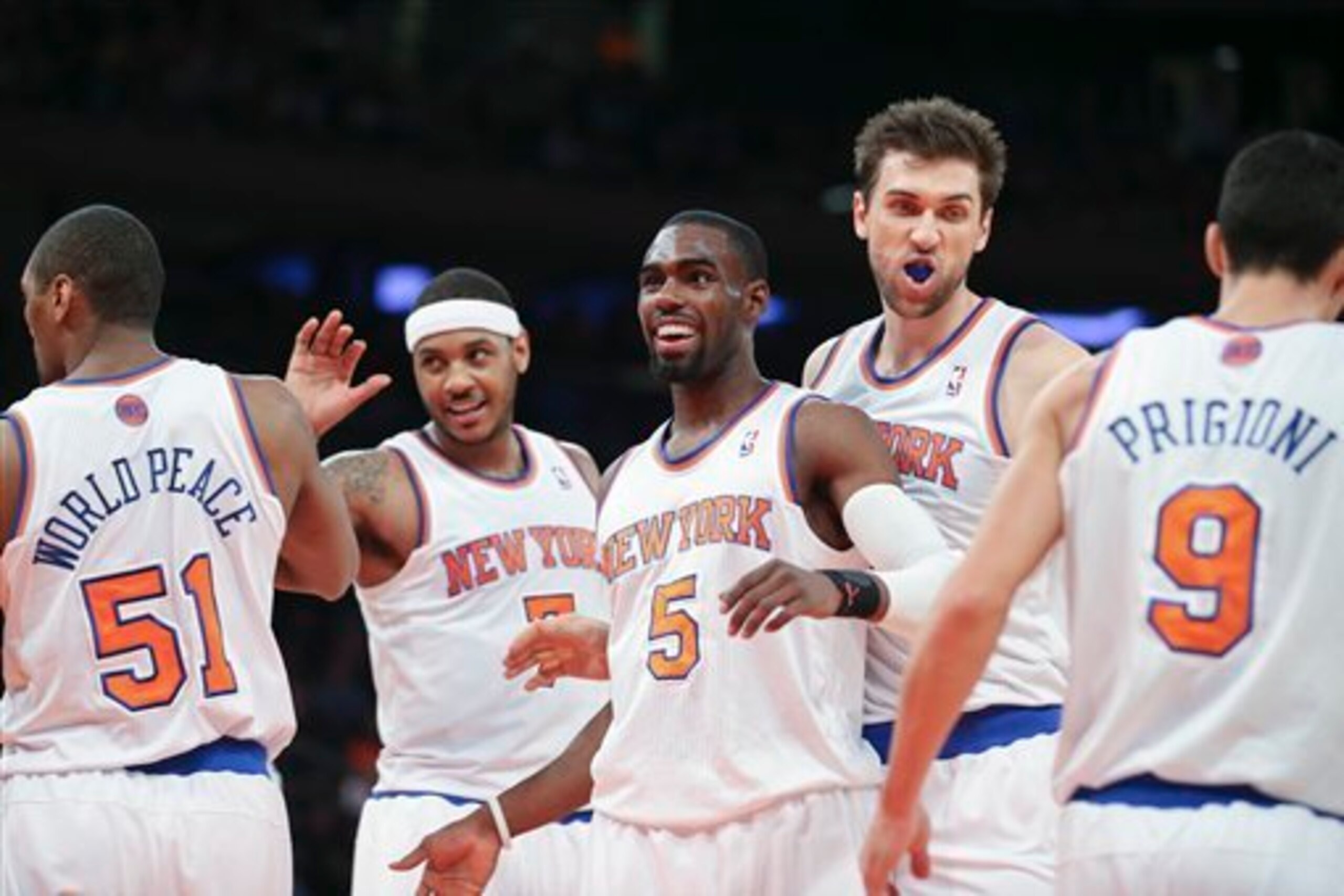

Predicting the NY Knicks' Opening Night Starting Lineup
It’s easy to view the recent re-signing of Carmelo Anthony as the most crucial move for the future of the New York Knicks.
And it most certainly is that. Really, though, retaining Anthony was merely the first step in what president Phil Jackson sees as a multi-year process intended to do what no Knicks team has done in more than 40 years: bring a championship banner to Madison Square Garden (from ESPN New York's Ian Begley).
Jackson doubtless has plenty more moves up his sleeves. In the meantime, Knicks coach Derek Fisher is doubtless concerning himself with a more immediately pressing reality:
What, exactly, will be the team’s opening night starting lineup?
We know Anthony will be there. The other four positions, on the other hand, remain largely up in the air. Even if New York’s starting five changes over the subsequent weeks and months, how they begin the season is sure to offer an interesting window in to Jackson and Fisher’s rotational philosophy.
Let’s get to the guesswork.
Point Guard: Jose Calderon
1 of 6
After suffering through the worst year of what was already a pretty average career from Raymond Felton, Knicks fans could’ve been forgiven for thinking an 85-year-old Bob Cousy would be an upgrade.
Jackson did them a little better than that.
On June 25, Jackson spearheaded the first major move of his administration, dealing Felton and Tyson Chandler to the Dallas Mavericks in exchange for Samuel Dalembert, Wayne Ellington, Shane Larkin, a pair of draft picks and—most crucial of all—veteran floor general Jose Calderon.
Few doubt Calderon’s basketball superiority, even in a contextual vacuum. But it’s how well the 32-year-old Spaniard fits the triangle system—patient, smart, deadly from deep—that stands to be the trade’s biggest windfall.
Here's Bleacher Report's Dylan Murphy on Calderon prospective triangle fit:
"The triangle offense is said to neutralize the impact of point guards by using a two-guard front—the two lead guards, typically the point guard and shooting guard. The two mirror each other by standing elevated above the three-point line and aligned with the paint, then cut to the corners, which will actually be to Calderon's benefit.
In the simplest sense, this will maximize Calderon's corner three-point shooting. Though he's certainly a capable passer and more than qualified to run an offense, his single most dominant trait is his shooting. Especially if Anthony returns to the Knicks, Calderon won't have the ball in his hands as much to impact the game from a ball-handling perspective.
"
Even if he’s not a viable long-term solution, Calderon’s poise and savvy will undoubtedly accelerate New York’s crash course in the triangle arts.
Carmelo Anthony has been searching his whole career for a point guard who fits his unique playing style. In Calderon—willing to shoot but just as happy setting the table—he may have finally found him.
Shooting Guard: Iman Shumpert
2 of 6
One of the biggest near-future challenges Jackson faces lies in figuring out how to untangle New York’s backcourt logjam, why with Iman Shumpert, J.R. Smith, Tim Hardaway Jr. and Ellington all vying for valuable minutes.
After winning the league’s Sixth Man of the Year award in 2013, J.R. Smith was rewarded by head coach Mike Woodson—some might say hastily—with an opening night starting spot the following season.
How did Smith respond? By registering arguably the worst statistical campaign since his second year in the league, naturally.
Injuries, off-court distractions—blame what you will. Fact is, Smith seems destined to return to his role as a top-tier bench scorer.
This, coupled with a report by the New York Post’s Marc Berman suggesting an affinity by Jackson for the younger, more upside-laden Shumpert, means the writing is, for now, all but on the wall.
Shumpert has a ways to go before becoming the two-way force Knicks fans think he can be. But if the early returns are to be believed, then he’ll have every opportunity to do just that under the new regime.
Small Forward: Metta World Peace
3 of 6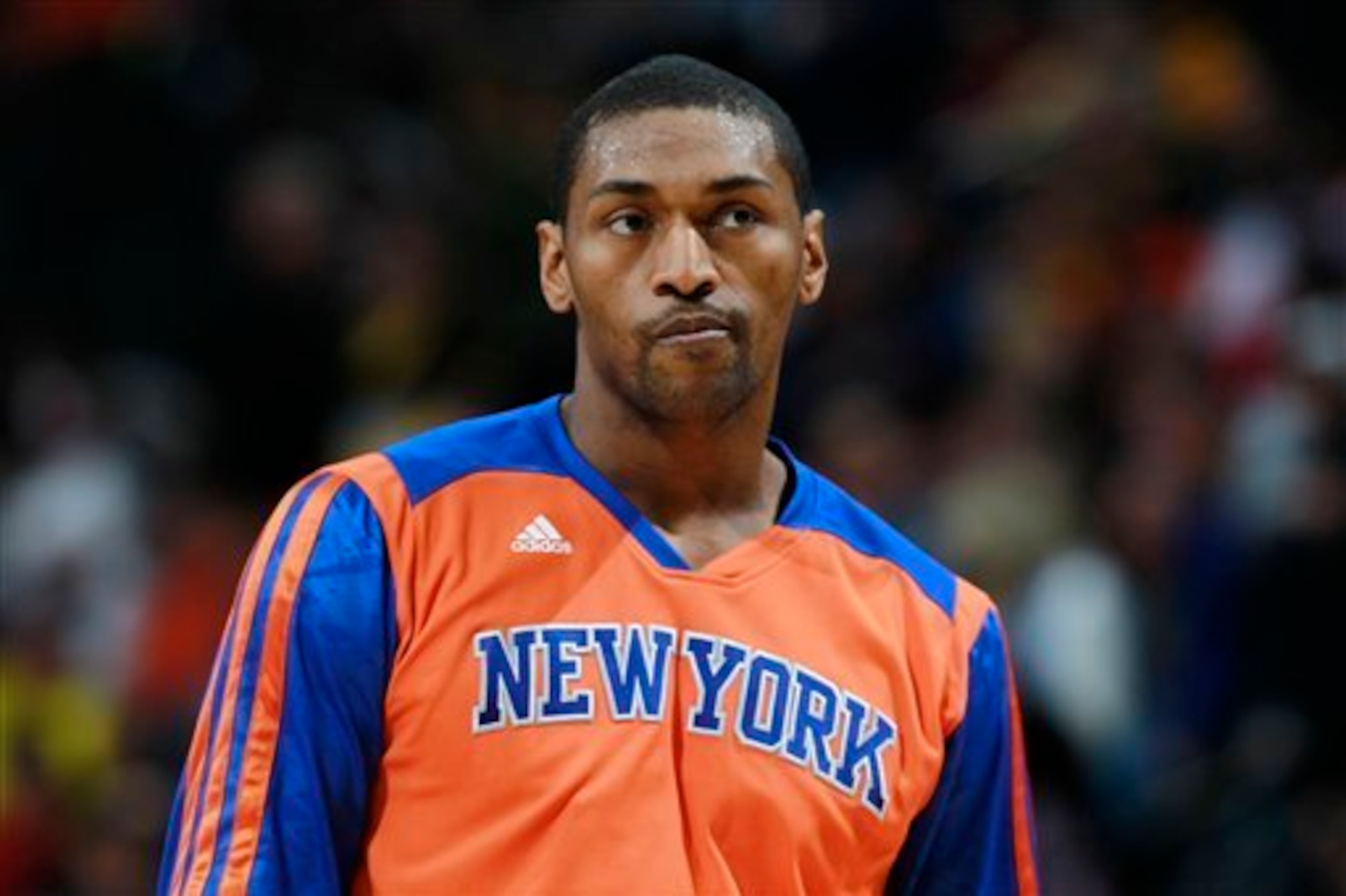
Do not adjust your computer screens—I just typed that.
According to Berman, the Knicks have already had internal discussions about whether not to bring Metta World Peace—who was waived this past February—back into the Knicks fold.
As Berman points out, the move makes sense on more than a few levels. First, World Peace is a tried and true triangle denizen, having been a key cog in Jackson’s last title-winning team, the 2010 Los Angeles Lakers.
Second, New York currently has something of a dearth at the small forward slot, with Anthony and rookie Cleanthony Early being the team’s only true 3s.
At 34 years old, World Peace isn’t out of NBA gas just yet. How durable he can be while logging heavy minutes in New York’s frontcourt, however, is an altogether different concern.
Still, to the extent that the upcoming season is being seen as a bridge between now and next summer’s free-agent bonanza, starting World Peace will—at the very least—help accelerate the team’s triangle learning curve.

Power Forward: Carmelo Anthony
4 of 6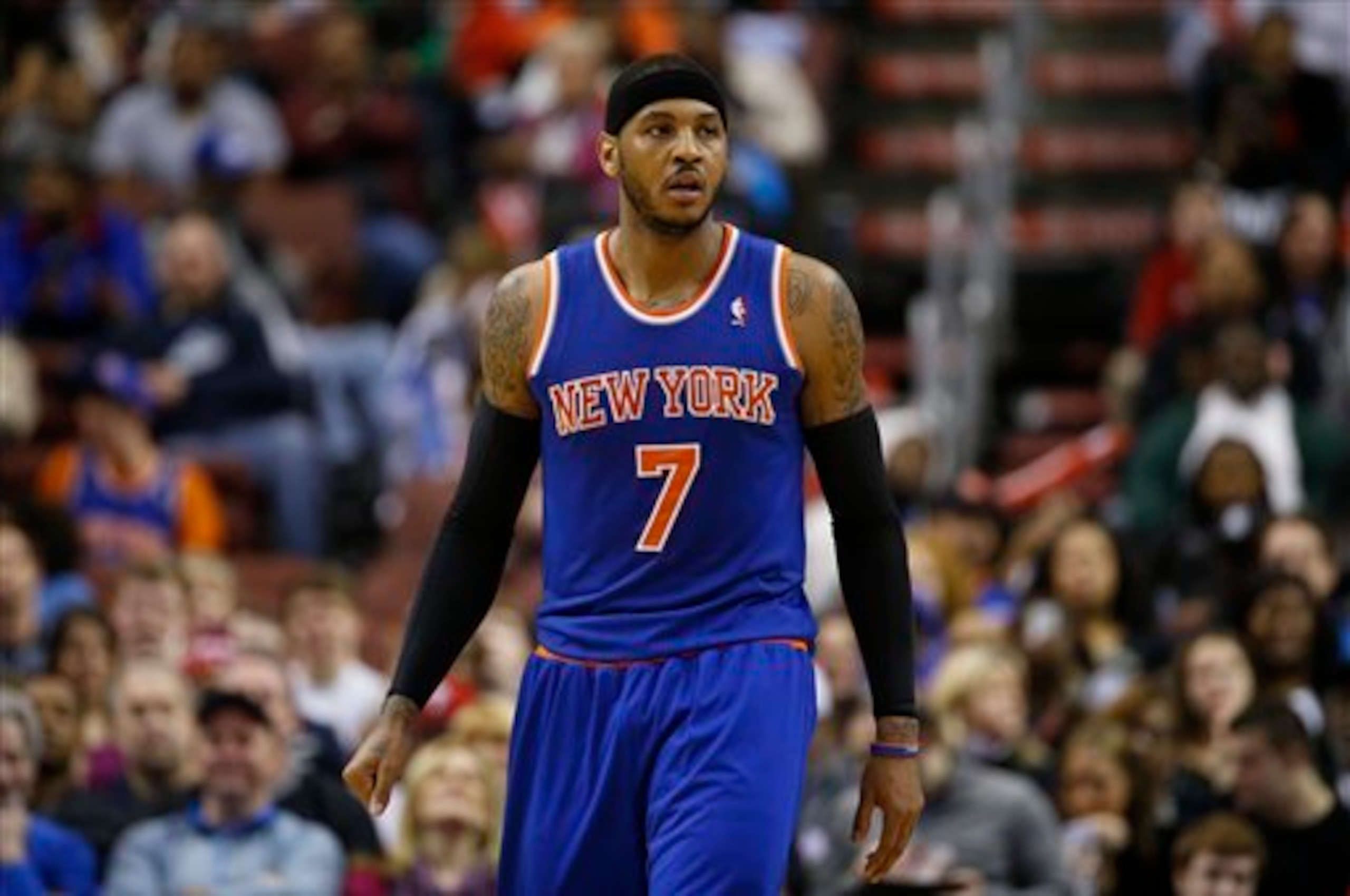
You’d be hard-pressed to find an Ivy School library with fewer pages than those dedicated to Carmelo Anthony’s superior effectiveness at power forward.
Jackson and Fisher know this, of course. And while they’re certainly not willing to simply shoehorn Anthony at the 4 and hope for the best, nabbing a little more frontcourt help—starting, perhaps, with World Peace—should give them the depth necessary to make it a strategic staple.
As this handy video breaks down, playing Anthony at the 4 also makes the most sense from a triangle perspective, positioning Anthony more in his sweet spots at or around the pinch posts and giving him more fluid surrounding movement with which to work.
Much has been made of Anthony’s decision not to leave more money on the table. However, such criticism ignores the importance of essentially sacrificing this season for the sake of the future.
Anthony is likely to remain the Knicks' main draw for years to come—not to mention their best and most important player. Whether he can sustain his recent success at the 4 could be key to whether that importance translates to genuine playoff contention.
Center: Andrea Bargnani
5 of 6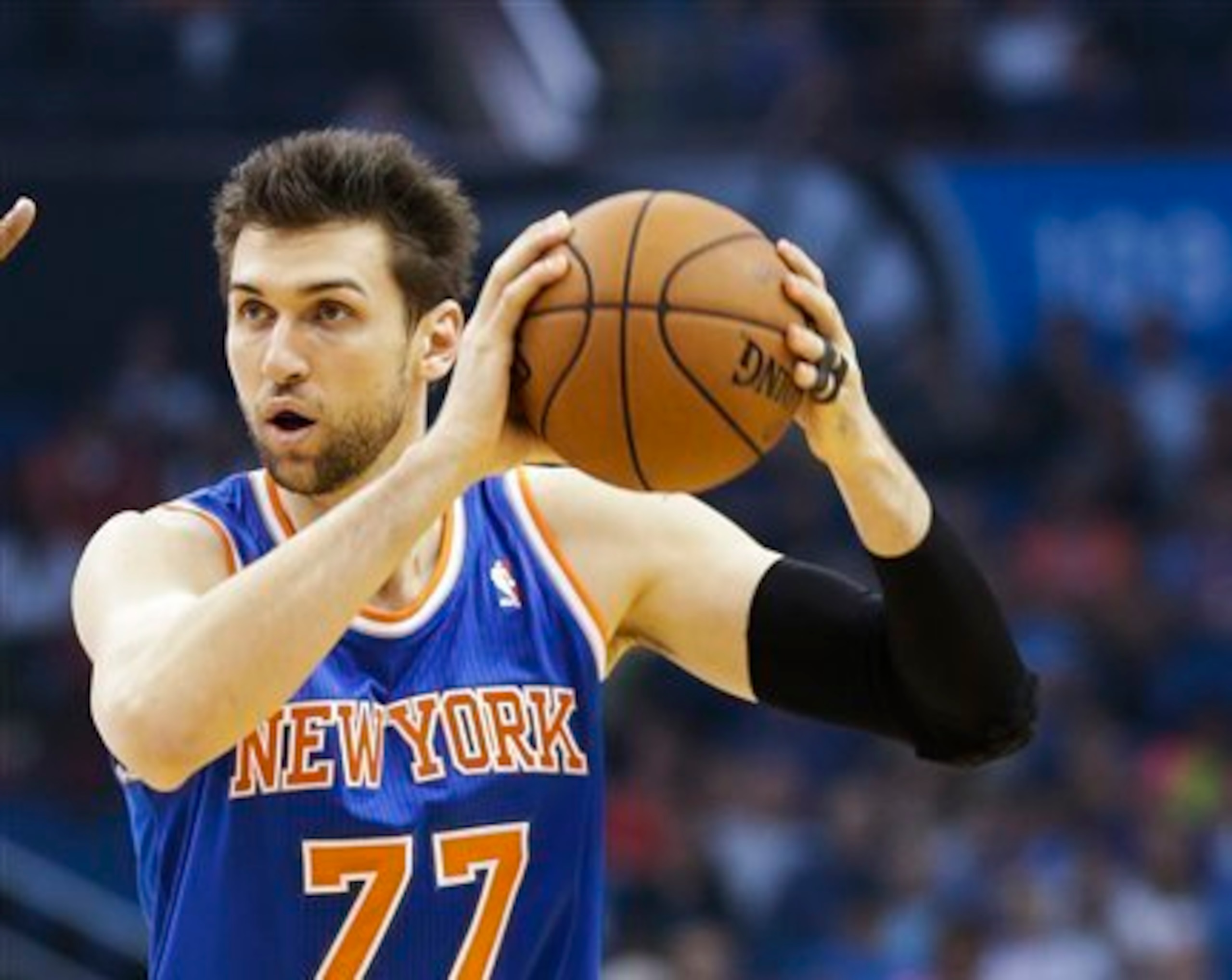
We might as well save our most controversial slide for last, right?
There are few NBA players more polarizing than Andrea Bargnani, the 7-foot center whom the Knicks acquired in a costly trade one year ago. The early returns were, to put it mildly, not encouraging.
However, in a recent interview with the New York Daily News’ Peter Botte, Jackson was optimistic in his assessment of how Bargnani might fit in a new, more dynamic offensive system:
"He's overlooked. We think he's going to really do well in the system we have. We have a couple of guards he likes to play with, Jose (Calderon) and Pablo (Prigioni), and I think he's going to be a surprise and a pleasant one for our fans.
"
Bargnani has earned a reputation as something of a sieve on defense. But, as stats from 82games.com highlight, the Italian national hasn’t been near the liability at center as he is at power forward.
Bargnani’s propensity for lurking along the perimeter is bound to drive both Fisher and Knicks fans batty—at least on occasion. But if there’s ever been a coach-general manager tandem capable of putting him in the proper position to succeed, then it’s New York’s two-headed triangle monster.
The Bench
6 of 6
Pablo Prigioni: Played solidly as New York’s primary backup point guard the past two seasons. How good was Prigioni? He finished sixth in the league—and first among point guards—in true-shooting percentage. Now if only the Knicks can actually get him to, you know, shoot.
J.R. Smith: Figures to get heavy minutes spelling both Shumpert and World Peace. So long as he can keep his focus, that is. It will definitely be fascinating to see how the triangle accentuates Smith’s best and worst tendencies.
Amar’e Stoudemire: Finished last season on something of a statistical tear. This after numerous setbacks and sanctioned stretches of rest for Stoudemire’s oft-repaired knees. He could see plenty of minutes at the 5, which could prove a boon to New York’s offense. Its defense? Not so much.
Tim Hardaway Jr.: Last year’s All-Rookie First Team selection had himself a dandy of a Las Vegas Summer League. Now to see whether the second-year sharpshooter can reign in the trigger finger to fit Fisher’s pass-happy offense.
Cleanthony Early: New York’s first pick of this year's draft (acquired in the Felton-Chandler trade), Early gives the Knicks some much-needed frontcourt depth. At 23, his experience and maturity should pay immediate dividends—both in terms of playing time as well as his overall triangle acumen.
Jason Smith: Smith, whom the Knicks recently signed to a one-year, $3.3 million deal (per USA Today’s Sam Amick), gives the Knicks even more frontcourt scoring. A capable mid-range shooter, Smith could prove a potent triangle fit.
Cole Aldrich: Aldrich isn’t the most versatile center in the world, but his rebounding and ability to protect the rim will be welcome strengths indeed.
Samuel Dalembert: Dalembert never fully realized the potential he once displayed with the Philadelphia 76ers. But as a bench-center option, you'd be hard-pressed to do worse than this reasonably versatile big.
Shane Larkin: Getting Larkin in the Felton-Chandler trade was one of Jackson’s sneaky-clever coups. After missing nearly all of his rookie season with a foot injury, Larkin is determined to prove his lottery status wasn’t a fluke.
Wayne Ellington: Played in the triangle under Kurt Rambis—now a Knicks assistant—while with the Minnesota Timberwolves. Experience could help him crack the rotation.
.jpg?w=2560 "Commanders OL HEATED After Tie ▶️")
.jpg?w=2560 "49ers LB Suspended for Headbutt")
.jpg?w=2560 "DAL Hiring New Defensive Coach")