
Re-Grading Philadelphia Eagles' Past 5 Drafts
You can usually tell an awful lot about a team simply by examining how well they’ve drafted over time. Sure enough, the highs and lows of the Philadelphia Eagles’ past five seasons on the field tend to correspond with how successful the team has been in the selection process.
It’s also a fact in the NFL that the grades we award teams on draft day often look very different one, two and especially five years down the road. Only after a certain amount of time has gone by, once players have reached their promise or faded into oblivion, is the true success or failure of a class revealed.
With the 2014 draft little more than two weeks away, we’re reflecting on recent Eagles drafts. Based on the timeline, it’s not difficult to see why Andy Reid lost his job as head coach. And if current trends hold up under Chip Kelly, it wouldn’t be unwise to predict bigger things are still to come for the Birds.
2009
1 of 5
| Round | Pick | Position | Player | School |
| 1 | 19 | WR | Jeremy Maclin | Missouri |
| 2 | 53 | RB | LeSean McCoy | Pittsburgh |
| 5 | 153 | TE | Cornelius Ingram | Florida |
| 5 | 157 | DB | Macho Harris | Virginia Tech |
| 5 | 159 | OL | Fenuki Tupou | Oregon |
| 6 | 194 | WR | Brandon Gibson | Washington St. |
| 7 | 213 | OG | Paul Fanaika | Arizona St. |
| 7 | 230 | LB | Moise Fokou | Maryland |
The tale of Jeremy Maclin’s draft-day slide might prove relevant in 2014. Widely considered a top-10 talent, the two-time consensus All-American wound up in a free fall after the Oakland Raiders chose Darrius Heyward-Bey instead at No. 7 overall. The Eagles tossed the Cleveland Browns a sixth-round pick to move up two spots from No. 21 and steal Maclin.
This year, the Eagles are scheduled to pick 22nd, and while they don’t have their sixth-rounder, a similarly subtle upward move could be in the cards should a big name drop.
As for Maclin, he likely would’ve become the top receiver on roughly half the teams in the league by now. In Philadelphia, he’ll finally get a chance to step out of DeSean Jackson’s shadow and assume that role in ’14. As long as Maclin has recovered from a torn ACL, he could live up to the hype yet.
Conversely, Round 2 was the epitome of the old saying, “Good things happen to those who wait.” The Eagles missed out on three first-round running backs, only to have LeSean McCoy fall in their laps at No. 53. Perhaps the most complete back in the NFL today, Shady is well on his way to breaking the franchise record for rushing yards—likely this season, at the ripe age of 26, provided he stays healthy.
2009 was an extremely weak draft outside the first couple rounds. Thus, the Eagles were content to trade down often or unload selections altogether.
Philadelphia traded out of Round 3 in a series of moves. Given the fact that just three Pro Bowlers came after the No. 86 pick—one defense, two special teams—no apparent harm done there, a little tidbit that will affect the final grade.
The Birds’ fourth-round pick was already committed to the Buffalo Bills from the previous offseason’s trade for All-Pro left tackle Jason Peters.
The Eagles sent two fifth-round picks acquired through all their maneuvering to the New England Patriots in exchange for veteran cornerback Ellis Hobbs. Hobbs wound up starting seven games the next season before suffering a career-ending injury.
Of the collection of spare parts from Rounds 5-7, three are still hovering around the NFL. Moise Fokou started 22 games in midnight green. Traded to the St. Louis Rams as a rookie, Brandon Gibson has never posted fewer than 30 receptions in a season. Paul Fanaika came out of nowhere to start all 16 games for the Arizona Cardinals in ’13. The scouts did a good job of identifying talent, even if it didn’t pan out in Philly.
This was a two-player draft. Given it was two very good players though (one elite) in a class that quite honestly stank, not to mention the front office accomplished some things with all the moving around, it was a quality two-player draft.
Grade: A-
2010
2 of 5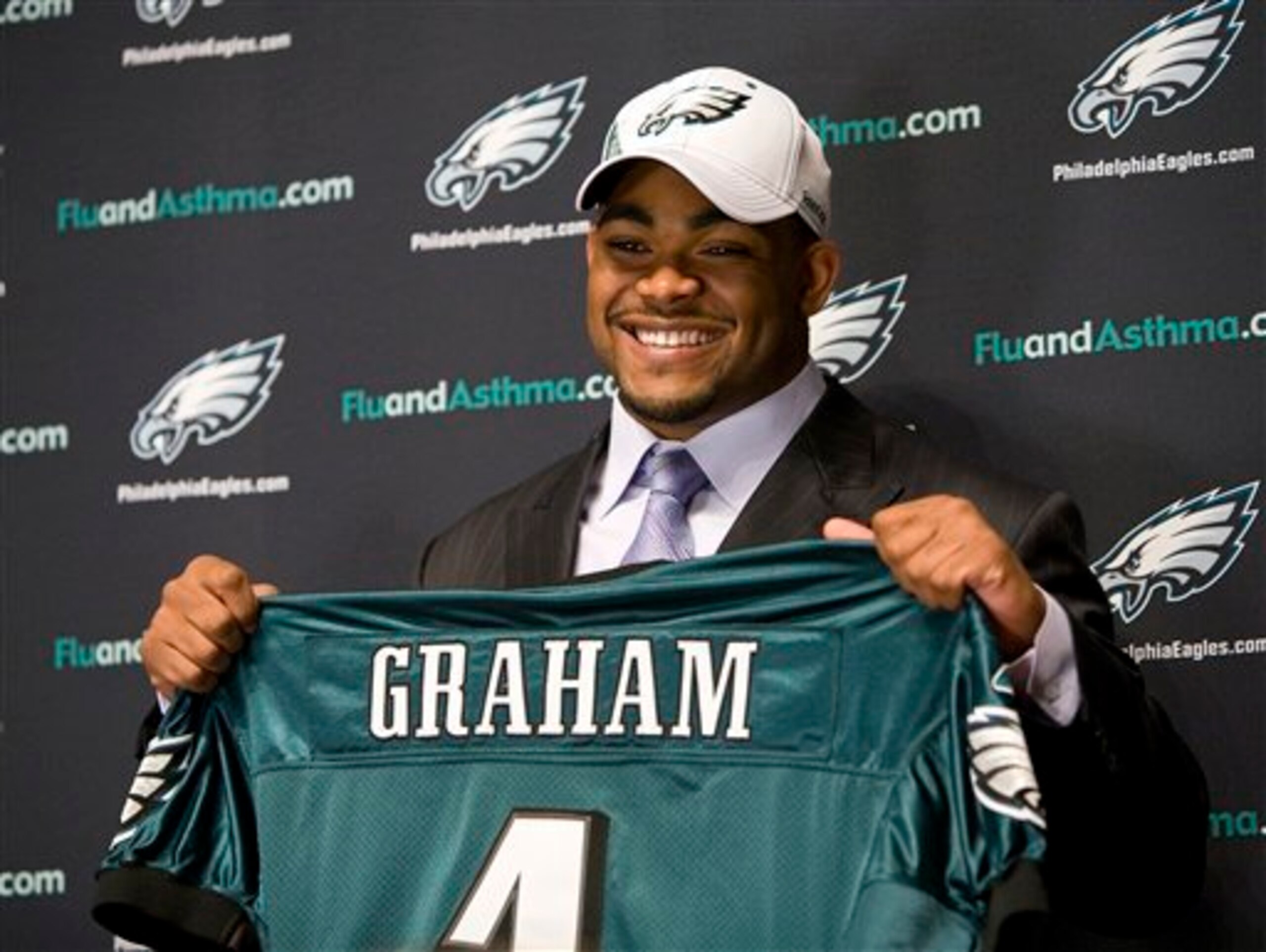
| Round | Pick | Position | Player | School |
| 1 | 13 | DE/OLB | Brandon Graham | Michigan |
| 2 | 37 | S | Nate Allen | South Florida |
| 3 | 86 | DE | Daniel Te'o-Nesheim | Washington |
| 4 | 105 | CB | Trevard Lindley | Kentucky |
| 4 | 121 | LB | Keenan Clayton | Oklahoma |
| 4 | 122 | QB | Mike Kafka | Northwestern |
| 4 | 125 | TE | Clay Harbor | SW Missouri St. |
| 5 | 134 | DE | Ricky Sapp | Clemson |
| 5 | 159 | WR | Riley Cooper | Florida |
| Round | Pick | Position | Player | School |
| 6 | 200 | RB | Charles Scott | LSU |
| 7 | 220 | LB | Jamar Chaney | Mississippi St. |
| 7 | 243 | DT | Jeff Owens | Georgia |
| 7 | 244 | S | Kurt Coleman | Ohio St. |
In terms of the draft, this is where things really started to go wrong for the Andy Reid-era Eagles. They hadn’t unearthed a deep, productive class in years, and despite acquiring and spending a whopping 13 picks here, 2010 provided far too little help.
Some of that was bad luck to an extent. Brandon Graham and Nate Allen enjoyed promising rookie seasons, but the injury bug bit both hard in December.
Graham’s torn ACL required a more serious microfracture surgery than what might be considered standard, then a much longer road to recovery as well. Graham wasn’t healthy until 2012 and has since found himself continuously blocked on the depth chart despite charting well in Pro Football Focus’ metrics for pass-rush productivity (subscription required).
The Eagles threw in two third-round picks to move up from No. 24 to 13 to select Graham.
Selected with the second-round pick that was the crown jewel of the Donovan McNabb trade to Washington, Allen sustained a ruptured patellar tendon. Whether it was the injury or the Wide-9 defensive front that put undue strain on the back end of the secondary, he never looked “right” until this past season, which was competent yet nothing special.
Graham and Allen are still on the team, of course (for now at least), but neither is expected to live up to his potential at this stage of their respective careers.
Luck aside, the fact that none of Daniel Te’o-Nesheim, Trevard Lindley, Keenan Clayton, Mike Kafka, Ricky Sapp or Charles Scott ever contributed much of anything, anywhere is damning. That’s half the draft class right there.
It’s telling that Jamar Chaney and Kurt Coleman were among the biggest contributors in Philadelphia. The pair of seventh-round picks started a combined 52 games in midnight green.
Riley Cooper’s sudden development last season helps drag the class of ‘10’s grade out of the dumps, even though the possibility remains he’s a one-hit wonder. Graham and Allen are solid players that simply haven’t lived up to their draft status, so it’s not as if this was a total lost cause.
Now there’s a ringing endorsement.
Grade: C-
2011
3 of 5
| Round | Pick | Position | Player | School |
| 1 | 23 | OG | Danny Watkins | Baylor |
| 2 | 54 | S | Jaiquawn Jarrett | Temple |
| 3 | 90 | CB | Curtis Marsh | Utah State |
| 4 | 116 | LB | Casey Matthews | Oregon |
| 4 | 120 | K | Alex Henery | Nebraska |
| 5 | 149 | RB | Dion Lewis | Pittsburgh |
| 5 | 161 | OL | Julian Vandervelde | Iowa |
| 6 | 191 | C | Jason Kelce | Cincinnati |
| 6 | 193 | LB | Brian Rolle | Ohio St. |
| Round | Pick | Position | Player | School |
| 7 | 237 | LB | Greg Lloyd | Connecticut |
| 7 | 240 | FB | Stanley Havili | USC |
It’s generally considered a failure when any of a franchise’s Round 1-3 draft picks isn’t even on the 53-man roster two short years later. The Eagles somehow managed to have that happen to all three of theirs.
A 27-year-old first-round pick—better known as a Canadian firefighter now—Danny Watkins never adjusted to professional football. He just didn’t have the mindset, the pedigree, whatever. He was benched midway into his second season, cut out of training camp the ensuing summer. Even the Miami Dolphins didn’t see fit to try Watkins in more than one game last year.
Jaiquawn Jarrett has become the poster boy for draft-day “reaches” in Philadelphia. General manager Howie Roseman never passes up an opportunity to use this selection as an example of what happens when a team picks based on need. Jarrett, a Temple product, was released one week into his second NFL season.
Curtis Marsh has never even so much as started an NFL game, for the Eagles or otherwise. It’s probably safe to say he’ll be out of the league soon.
Talk about a class that could set a franchise back for years to come. Even the guys that are still hanging around the NovaCare Complex are on their last legs. Casey Matthews, Alex Henery and Julian Vandervelde’s roster spots will all be up for grabs this summer.
The only, and I mean only, saving grace from this class is Jason Kelce, who in just a few short seasons is already earning recognition as one of the best linemen in the league. Analytics web site Pro Football Focus (subscription required) gave him the top cumulative score among all centers. The Eagles awarded Kelce a six-year contract extension this offseason.
Otherwise, the results of this draft were what caused Reid’s influence in the organization to wane. Roseman assumed the controls the following year, and shortly thereafter, the head coach of 14 seasons was fired for a 4-12 record.
Grade: F
.jpg?w=2560 "Packers 49ers Football")
.jpg?w=2560 "Lions Cardinals Football")
2012
4 of 5
| Round | Pick | Position | Player | School |
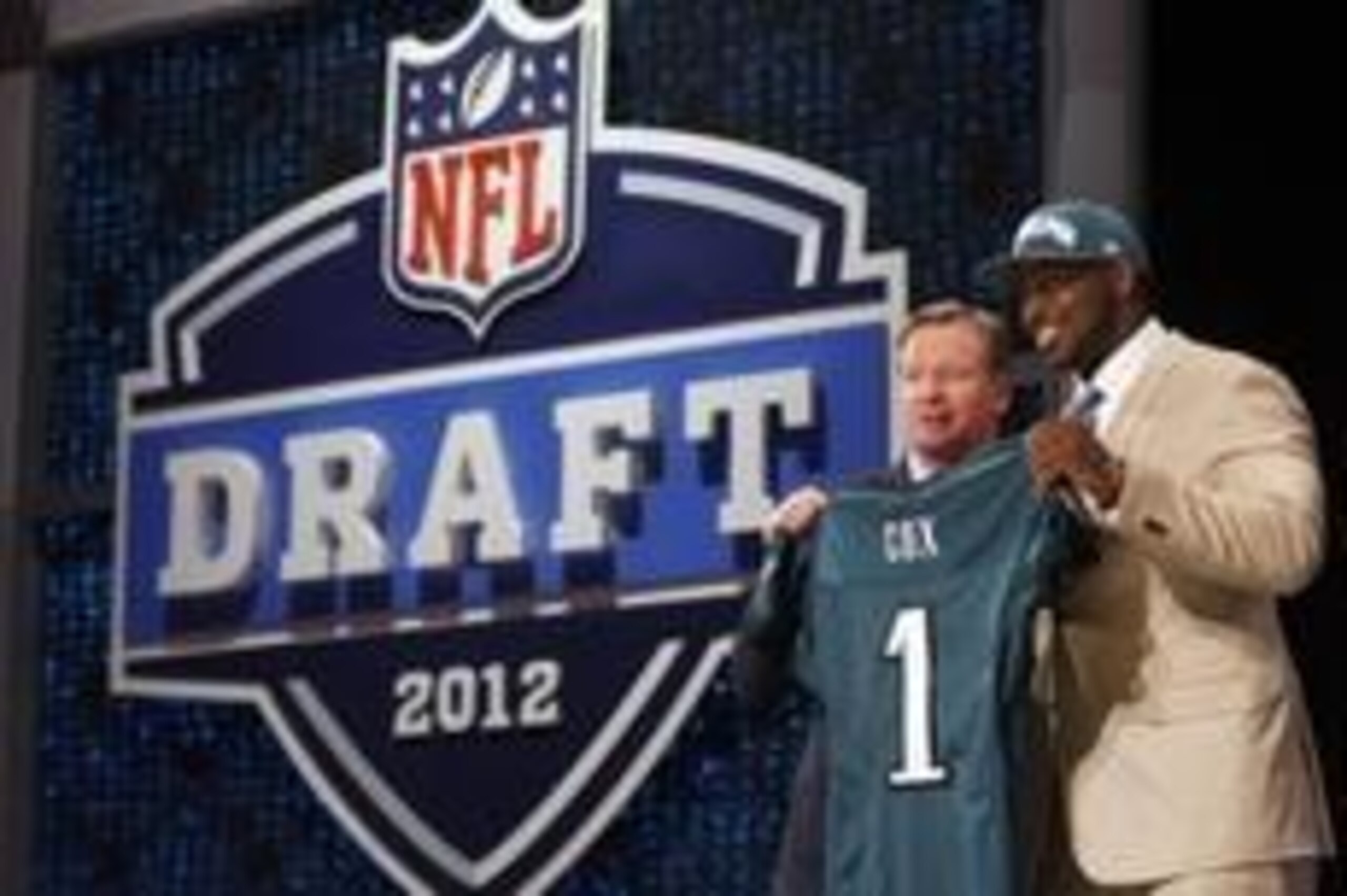
| 1 | 12 | DE | Fletcher Cox | Mississippi St. |
| 2 | 46 | LB | Mychal Kendricks | California |
| 2 | 59 | DE | Vinny Curry | Marshall |
| 3 | 88 | QB | Nick Foles | Arizona |
| 4 | 123 | CB | Brandon Boykin | Georgia |
| 5 | 153 | OL | Dennis Kelly | Purdue |
| 6 | 194 | WR | Marvin McNutt | Iowa |
| 6 | 200 | OG | Brandon Washington | Miami |
| 7 | 229 | RB | Bryce Brown | Kansas St. |
Typically, it takes several years until one can satisfactorily evaluate the success or failure of a draft. In the case of the Eagles’ class of 2012, it appears to have already produced at least five, maybe six serviceable NFL players already.
That’s putting it mildly. Of course, nobody could have imagined at the time that Nick Foles was going to set an NFL record with a 27-2 touchdown-to-interception ratio or lead the league in passer rating at the time. But now that he’s accomplished those feats, likely entrenching himself as Philadelphia’s quarterback of the future in the process, Foles seems to be an okay pick for Round 3.
The second-best selection of the bunch could very well be fourth-rounder Brandon Boykin, who has quickly become one of the best slot specialists in the game. Boykin finished tied for second with six interceptions in ’13, which is impressive in itself. The fact that he only played roughly 50 percent of the Eagles’ defensive snaps makes it downright incredible.
If Fletcher Cox didn’t seem as dominant in year two, blame the scheme change. He was still very good—worth the fourth- and sixth-round picks it cost to move up three spots to grab him at No. 12—and could anchor the Birds’ defensive line for years to come.
Mychal Kendricks has his moments, good and bad. He’s a capable playmaker, albeit with some physical restrictions due to his short stature. Maybe he’ll never be great, but Kendricks would crack almost any club’s starting lineup.
There are a few parts that haven’t quite meshed with the new regime. Vinny Curry seems better suited to play end in a 4-3, but he’s been an effective pass-rusher in very limited playing time. Bryce Brown tried to bounce far too many runs to the outside, but he did produce back-to-back 150-yard games as a rookie. Dennis Kelly may have some value as a reserve lineman.
The best part about this draft is there appears to have been very few wasted selections. Give Roseman credit, as owner Jeffrey Lurie has since Reid’s firing. Apparently, this strong class was largely the general manager’s doing.
Grade: A
2013
5 of 5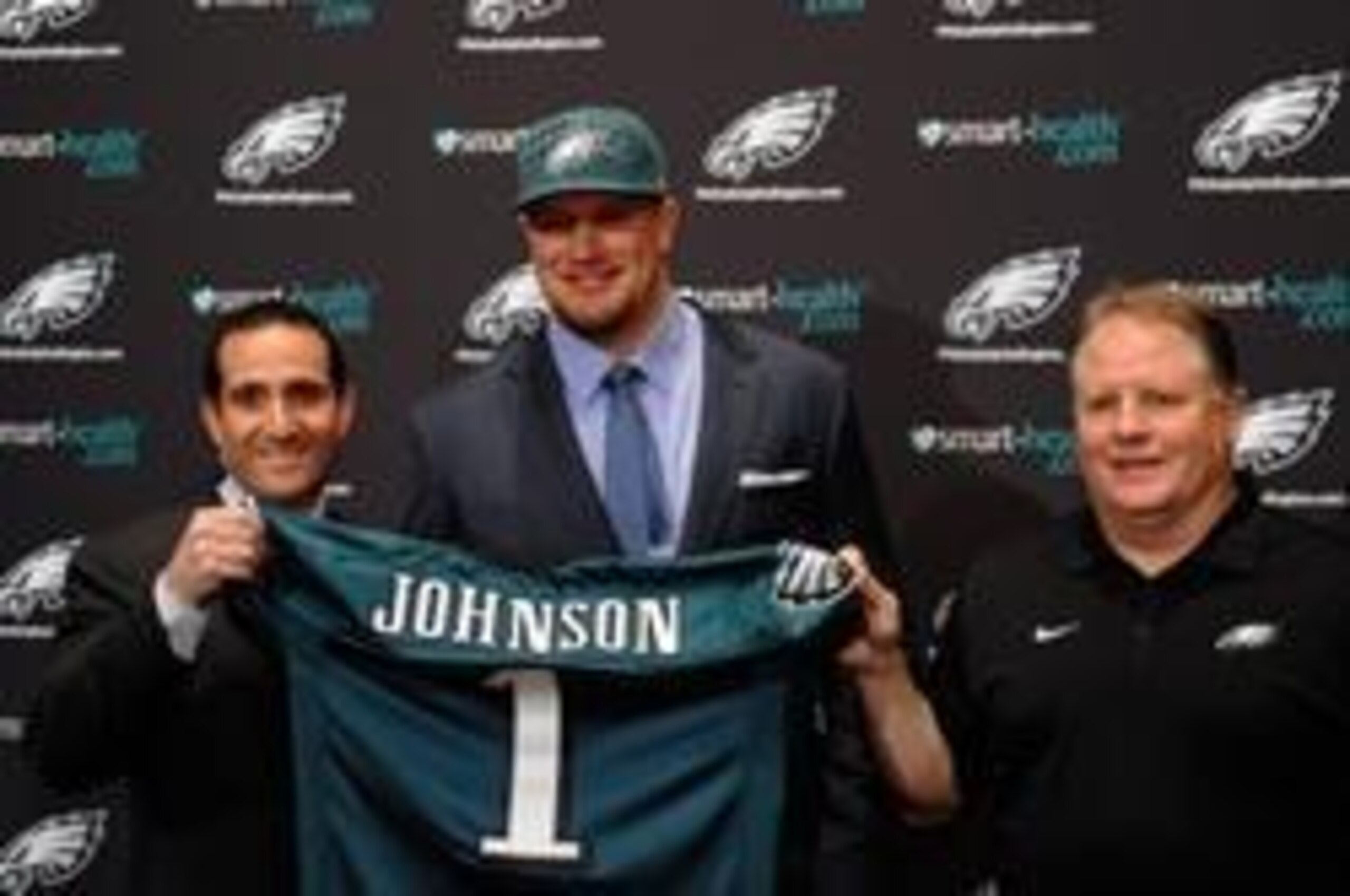
| Round | Pick | Position | Player | School |
| 1 | 4 | OT | Lane Johnson | Oklahoma |
| 2 | 35 | TE | Zach Ertz | Stanford |
| 3 | 67 | NT | Bennie Logan | LSU |
| 4 | 98 | QB | Matt Barkley | USC |
| 5 | 136 | S | Earl Wolff | North Carolina St. |
| 7 | 212 | DE | Joe Kruger | Utah |
| 7 | 218 | CB | Jordan Poyer | Oregon St. |
| 7 | 239 | DL | David King | Oklahoma |
Here’s one way this class was a welcome change: In Philadelphia’s first run with Chip Kelly as head coach, the front office didn’t get cute for a change. But for one trade, the team stayed put and made actual picks when it was on the clock.
You almost needed a compass and a map to follow an Eagles draft during the Reid days.
Of course, the Birds also had more favorable position than they’ve been accustomed to coming off their first losing season since…well, since before this study. Which is just another way of saying it’s a lot harder to mess up with the fourth overall pick.
Lane Johnson experienced his share of “welcome to the NFL moments” the first bunch of weeks of the season. By the end of the season though, it was easy to forget the Eagles had a rookie starting at right tackle.
Zach Ertz’s line of 36 receptions, 469 yards and four touchdowns might seem ordinary to the casual observer. Under closer inspection, those are better numbers than Pro Bowl and Hall of Fame types such as Antonio Gates, Jimmy Graham, Jason Witten and Vernon Davis in their rookie seasons.
The Eagles felt so good about Bennie Logan’s development, they shipped out starting nose tackle Isaac Sopoaga midseason prior to the trade deadline. Word is the organization really likes the LSU product as the keystone of its 3-4 defense.
Earl Wolff is expected to compete with Nate Allen and perhaps a ’14 draft pick for a starting safety job this summer.
While it’s far too early to say for sure where any of these players will be in their development a few years from now, so far, so good. The Eagles found three, possibly four starting-caliber players in last year’s draft, a potential backup quarterback in Matt Barkley and Joe Kruger could compete for a roster spot as well. Very little to complain about here…for the time being.
Grade: B+
.jpg?w=2560 "Steelers Browns Football")
.jpg?w=2560 "Texans Titans Football")
.jpg?w=2560 "Buzz: MHJ Hired Agents for Trade")
.jpg?w=2560 "Chargers Fall to 0-5 🤢")