In Search of the Hardest Thing to Do in Baseball
Allow me to open with a moderately amusing anecdote.
Last month, I was sitting in a room with Oakland A's pitchers Jim Johnson and Sonny Gray and maybe a dozen baseball bloggers. At one point, there was an awkward silence and Gray turned to Johnson and asked him what he thought about the question that had just been asked.
"I don't know," he mumbled with a sheepish sort of grin. "I've never been asked this question before."
TOP NEWS

MLB Proposes Fewer Games
.jpg?w=2560)
Jazz Chisholm Landing Spots📍
.jpg?w=2560)
Best Fits for Michael King and Casey Mize ⚾
That question, in a nutshell: What's the hardest thing to do in baseball?
Gray remained stumped. Johnson, however, was eventually able to conjure an answer. So did the other players I spoke to. Some of them thought of several. Along the way, I learned a thing or two.
Including this: What they say about hitting is true. Maybe even truer than you might realize.
When I asked Hall of Fame shortstop Ozzie Smith where he stands on the difficulty of hitting, he did a fine job of outlining the general premise.
"Simply because you’re hitting a round object that’s traveling at 95 to 100 miles per hour and you’re trying to hit it on the square part of a round bat,” he said. “It takes great hand-eye coordination. And the guys who do it and leave this game with an over .300 batting average, I look at those guys as being super, super players."
Smith, of course, hit just .262 in 19 seasons. So maybe you're thinking: Of course he would side with the conventional wisdom about hitting.
But if part of what Smith said sounded familiar, that might be because something very similar was once said by a .344 career hitter.
As the great Ted Williams told The New York Times in 1982:
"I've always said that hitting a baseball is the hardest thing to do in sports. The hardest thing - a round ball, round bat, curves, sliders, knuckleballs, upside down and a ball coming in at 90 miles to 100 miles an hour, it's a pretty lethal thing.
"
Indeed, and there's more to be said about the specifics of the difficulty of hitting, starting with one of the common themes we have so far: velocity.
Reaction time is vital with all pitches. But the higher a pitch's velocity, the more critical reaction time becomes. Logic says so, and science concurs.
Because some sort of Internet black magic has blocked me from embedding it, I implore you go to check out a segment that ESPN's "Sport Science" did on velocity and reaction time. Either that, or you can dig the short version:
- A 90 mph fastball goes from release to across the plate in less than 0.44 seconds.
- The ball travels 12 feet before the hitter is even able to pick it up.
- The ball travels another 10 feet before the hitter calculates speed, spin and trajectory.
- For the last 10 feet of its journey toward the catcher's mitt, the ball is effectively invisible.
Basically, blink and you're out. And as Boston Red Sox outfielder Jonny Gomes pointed out, major league hitters have to deal with 90 mph heaters all...the...time.
"That’s something we have to do daily, and do it at a .300 average clip," said Gomes of hitting 90 mph heat. "It’s pretty easy to run, it’s pretty easy to throw, pretty easy to run and catch and run and throw. But tell you what, at the end of the day, we kinda take it for granted that hitting a fastball is pretty difficult.”
It's not getting any easier. According to FanGraphs, the average fastball in 2002 was 89.9 miles per hour. In 2013, it was 91.7. Today's pitchers have more hitting kryptonite than ever before.
But there's more to it than velocity. Whereas the pitcher and catcher both know what's coming from pitch to pitch, it really does make it that much tougher for hitters because they have to react on the fly.
Said Pittsburgh Pirates catcher Chris Stewart: “We have to adjust to the ball coming in at a certain velocity and with certain spin. It’s going to break one way or another. It’s going to move one way or another."
Don't underestimate that last part. Timing velocity is tough, but one player told me that calculating movement is harder.
"Most of all, the hardest thing to do is gauge movement—it’s almost impossible to do it," he said. "People who watch the game can’t really see what a ball looks like coming into a hitter. They expect their best hitter on the team to get a hit every time, or at least hit the ball hard. But some [pitchers] just have some of the craziest movement you’ve ever seen."
Lest it cross your mind that this sounds like a complaint, it's more like sympathy. This came from the mouth of a pitcher: Minnesota Twins prospect Trevor May.
And he's right about some guys having crazy movement. May picked a fine example in Chicago White Sox southpaw Chris Sale. Even the straightest of his pitches isn't very straight.
“He throws hard, too—he throws in the mid-90s—but even when he throws 91, it’s moving half a foot away from a right-handed hitter,” said May of Sale's fastball.
Half a foot is actually conservative. Per Brooks Baseball data (by way of Baseball Prospectus), an average Sale four-seam fastball has 10.12 inches of horizontal movement. Of all the heaters that have been thrown at least 500 times since 2007, that's the most.
The idea that hitting is the hardest thing to do in baseball is an old one. Maybe it will go away someday. Since we're in an age when strikeouts are at an all-time high and the league batting average just dipped to its lowest mark in over 40 years, though, that day probably isn't coming any time soon.
But what about pitchers? Curious me couldn't help but wonder: Surely there's something they do that's harder than people realize!
Well, back in 2005, the Chicago Tribune picked up on a common idea.
"I'd have to say throwing the ball where you want to throw it," said then-Milwaukee Brewers lefty Doug Davis.
"I'd say throwing a ball where you want it. That's pretty dang hard, too," said then-White Sox lefty Neal Cotts.
Here we are looking at another idea that's not exactly new. This one's been around for a while. But once again, the extent of just how true this is might be lost on some fans.
If it is, that's probably because fans form their baseball opinions on what happens in the majors. As May pointed out, the command major league pitchers have is hardly typical of the bulk of the pitching population. They're not quite as good at throwing the ball where they want in the minors.
And that's true even at the rung just below the majors. The BB/9 at Triple-A in 2013 was 3.53, half a tick higher than the 3.02 BB/9 posted by major league pitchers.
The ability to throw the ball where you want it time after time, May says, is above all a matter of focus.
"It’s a relatively simple task that you’re doing. You’re trying to throw a ball into a glove," he said. "But there are so many other things going on in your head...I think it always comes down to focusing on what you’re doing on every single pitch of every game...Sometimes there’s other stuff going on around you, and just staying on what you’re doing, for me in the past, has been the hardest thing.”
As a catcher, Stewart sympathizes with how difficult it is for pitchers to stay focused pitch after pitch, inning after inning. He's more impressed, however, with the mechanical spectacle that is pitchers repeating their mechanics pitch after pitch and inning after inning.
"I think them being physically able to consistently hone their mechanics, consistently hone their arm slot to make those consistent pitches on a nightly routine is something that amazes me. Those guys go out there with pinpoint accuracy, and it’s like they can throw the ball wherever they want, however they want," said Stewart.
He added: "It’s that consistent approach where guys know their body well enough, they practice well enough, and they go through their routines to where they feel comfortable enough to do whatever they need to do in order to make each pitch to every single hitter."
Stewart pointed to former teammate Hiroki Kuroda as an example. Since entering the league in 2008, Kuroda's established himself as one of baseball's top strike-throwers. To that, much is owed to his ability to transform into a machine when on the mound.
By game score, the best Kuroda performance that Stewart caught in 2013 was when he threw eight shutout innings against the Los Angeles Angels on August 12. As TexasLeaguers.com can show, "inconsistent" doesn't work so well to describe Kuroda's arm slot in that game:
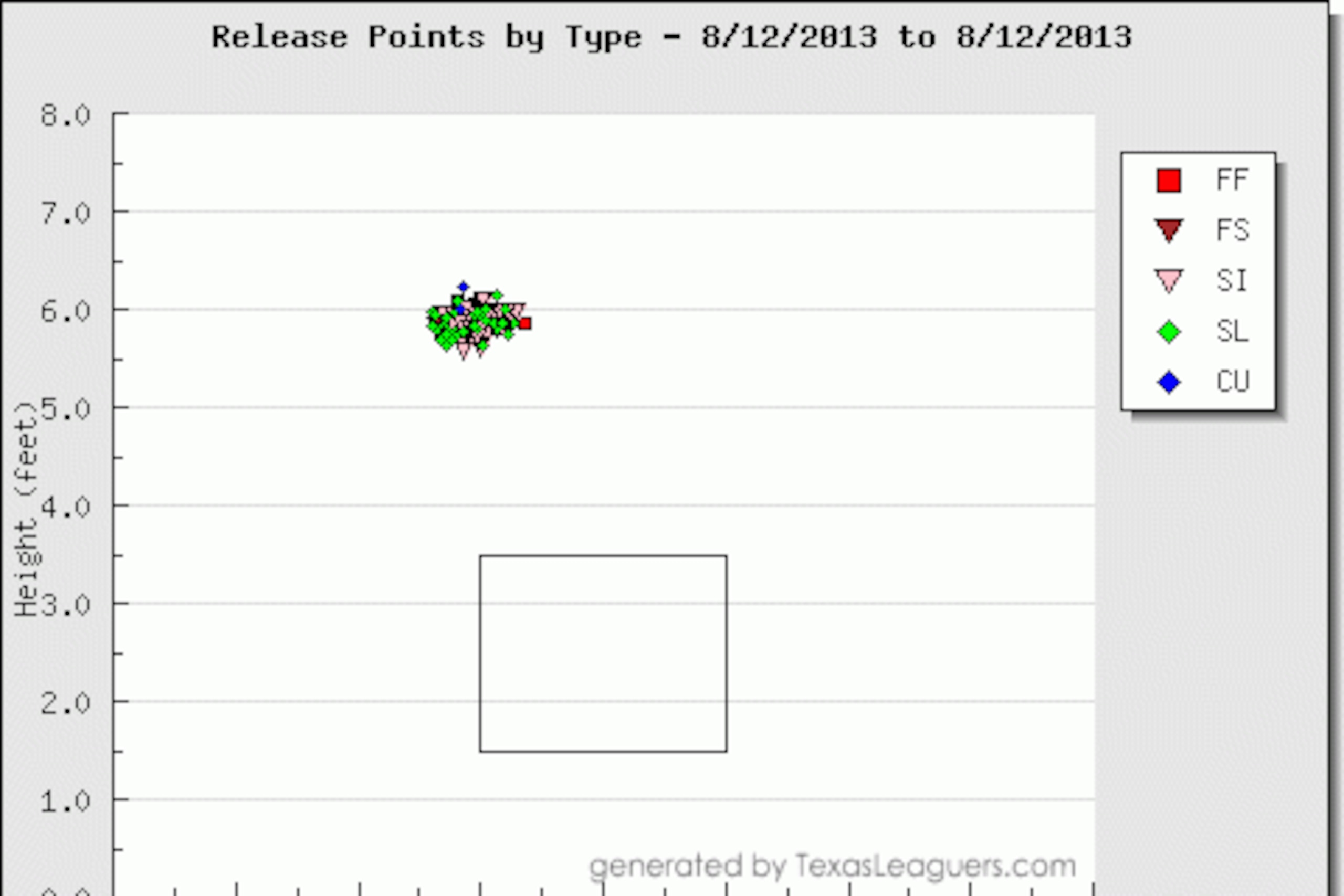
So as far as things that happen within games, well, there you go. The age-old wisdom that hitting is the hardest thing to do in baseball is as true now as it's ever been. The notion that pitchers throwing the ball where they want is awfully hard holds plenty of water in its own right.
But we're not done yet. There's one other thing to be said on the topic of difficulty and baseball: When it comes to simply playing the game, the two terms go hand in hand.
Baseball's season is 162 games played in about 180 days. That's a lot of action without many lulls, and what lulls exist are often used for traveling all over the union. It goes without saying that it takes its toll physically, but the mental toll may be the harder part.
In fact, Stewart said that's the hardest part about playing baseball.
"I think it’s just the mental side of preparing yourself to play 162 games throughout the season when you’re getting one day off every couple weeks and you’re traveling from city to city," Stewart said. "You’re away from your family a lot. And during the game too, [you're a good hitter] if you fail seven out of ten times."
To boot, Stewart is a catcher. He admits to being a "nerd" for the extra mental preparation that comes with the job, but he's well aware that he and his fellow catchers do face "a lot more responsibility." Surely, the grind is a lot harder for them than it is for, say, relief pitchers.
Actually, maybe not.
Which brings us, finally, to what Johnson came up with on that day in Oakland.
"There are some days where you might not feel your best, but you know you have to be able to make pitches and you just have to find a way. Learning to pitch like that, a little banged up, but to be able to get the job done every single day and come to the ballpark every single day ready to go and bring it."
The All-Star closer added: "You have to commit to it. There’s no half-a--ing it. I think that’s the one separator at this level."
It's a hard game, baseball. There are things within the game that are extraordinarily difficult to do, and making it all the way through a 162-game season requires just as much mental toughness as physical toughness.
And yet The Show goes on. If you take Stewart's word for it, it's all worth it.
"We’re playing a game that we played growing up as kids, dreaming of being in the big leagues playing in front of 40,000 people in major league stadiums," he said. "So you take the good with the bad and just try to stay as positive as you can throughout the season. And before you know it, you’re in the World Series playing for a world championship. You can’t ask for anything better than that."
Note: Stats courtesy of Baseball-Reference.com unless otherwise noted/linked. Quotes obtained firsthand unless otherwise noted.
If you want to talk baseball, hit me up on Twitter.








.jpg?w=2560 "Lions DC Defends Play Calls 🫥")