


There's no sporting event in the world quite like the World Cup.
Millions upon millions watch as 32 countries do battle to decide which nation gets to lay claim to being the world's best. National pride is at stake, the game's top players are pitted in head-to-head battles and, for one month in the summer every four years, there doesn't seem to be anything more important than the action on the pitch.
While we still have several months to wait for the action in Brazil to commence, we now know which countries have qualified and in what groups they have been placed. In other words, we have plenty of time to analyze every little detail of the tournament.
If you were looking for a primer to the entire event, you've come to the right place. From a full schedule and television information to the U.S. team's chances to which countries ended up in the dreaded "Group of Death," you'll find everything you need to know about the 2014 World Cup right here.
Groups and Schedule
1 of 9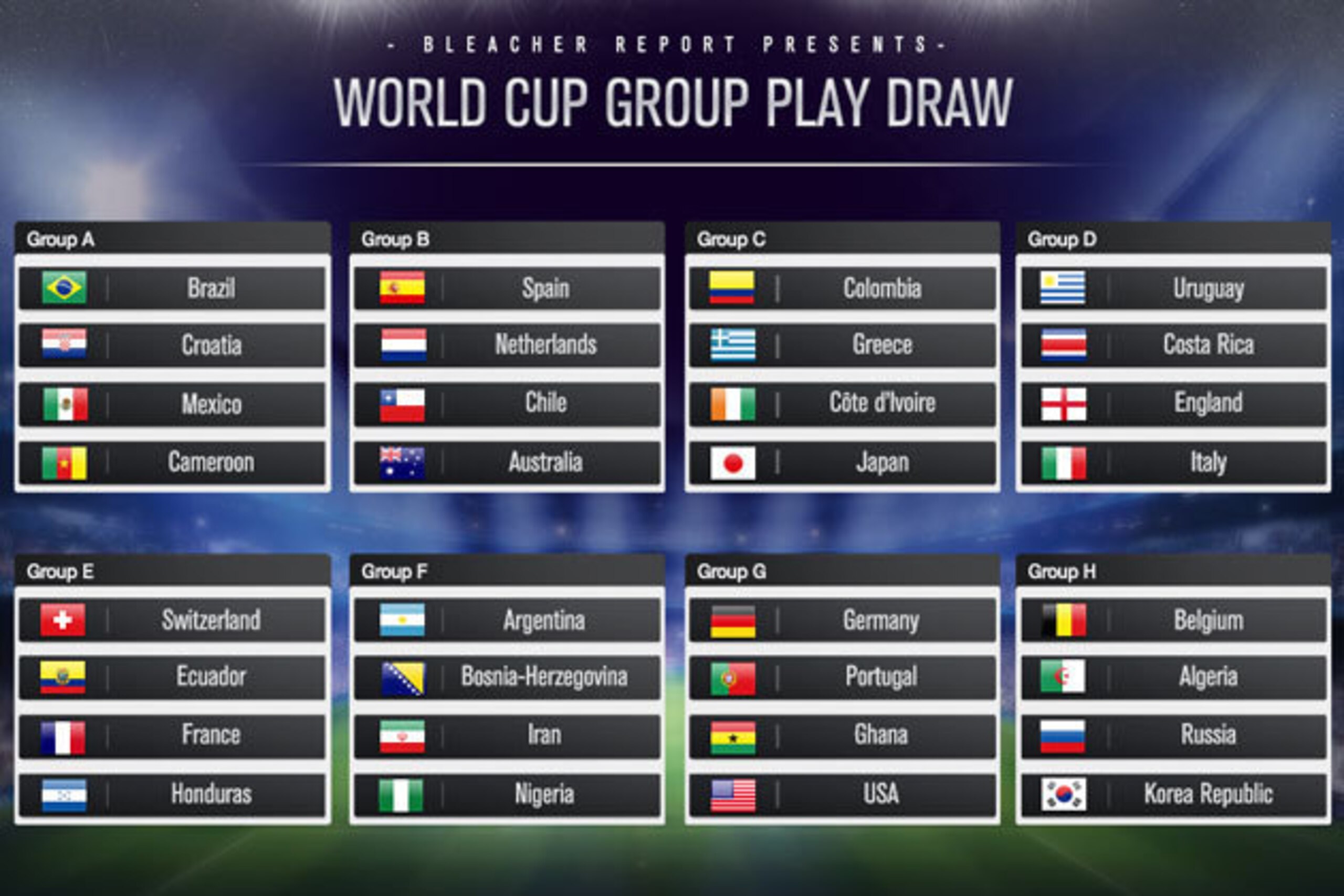
| 1 | June 12 at 4 p.m. | Sao Paulo | Brazil vs. Croatia |
| 2 | June 13 at noon | Natal | Mexico vs. Cameroon |
| 17 | June 17 at 3 p.m. | Fortaleza | Brazil vs. Mexico |
| 18 | June 18 at 3 p.m. | Manaus | Cameroon vs. Croatia |
| 33 | June 23 at 4 p.m. | Brasilia | Cameroon vs. Brazil |
| 34 | June 23 at 4 p.m. | Recife | Croatia vs. Mexico |
| 3 | June 13 at 3 p.m. | Salvador | Spain vs. Netherlands |
| 4 | June 13 at 6 p.m. | Cuiaba | Chile vs. Australia |
| 19 | June 18 at 6 p.m. | Rio de Janeiro | Spain vs. Chile |
| 20 | June 18 at noon | Porto Alegre | Australia vs. Netherlands |
| 35 | June 23 at noon | Curitiba | Australia vs. Spain |
| 36 | June 23 at noon | Sao Paulo | Netherlands vs. Chile |
| 5 | June 14 at noon | Belo Horizonte | Colombia vs. Greece |
| 6 | June 14 at 6 p.m. | Recife | Ivory Coast vs. Japan |
| 21 | June 19 at noon | Brasilia | Colombia vs. Ivory Coast |
| 22 | June 19 at 6 p.m. | Natal | Japan vs. Greece |
| 37 | June 24 at 4 p.m. | Cuiaba | Japan vs. Colombia |
| 38 | June 24 at 4 p.m. | Fortaleza | Greece vs. Ivory Coast |
| 7 | June 14 at 3 p.m. | Fortaleza | Uruguay vs. Costa Rica |
| 8 | June 14 at 6 p.m. | Manaus | England vs. Italy |
| 23 | June 19 at 3 p.m. | Sao Paulo | Uruguay vs. England |
| 24 | June 20 at noon | Recife | Costa Rica vs. Italy |
| 39 | June 24 at noon | Natal | Italy vs. Uruguay |
| 40 | June 24 at noon | Belo Horizonte | Costa Rica vs. England |
| 9 | June 15 at noon | Brasilia | Switzerland vs. Ecuador |
| 10 | June 15 at 3 p.m. | Porto Alegre | France vs. Honduras |
| 25 | June 20 at 3 p.m. | Salvador | Switzerland vs. France |
| 26 | June 20 at 6 p.m. | Curitiba | Honduras vs. Ecuador |
| 41 | June 25 at 4 p.m. | Manaus | Honduras vs. Switzerland |
| 42 | June 25 at 4 p.m. | Rio de Janeiro | Ecuador vs. France |
| 11 | June 15 at 6 p.m. | Rio de Janeiro | Argentina vs. Bosnia-Herzegovina |
| 12 | June 16 at 3 p.m. | Curitiba | Iran vs. Nigeria |
| 27 | June 21 at noon | Belo Horizonte | Argentina vs. Iran |
| 28 | June 21 at 6 p.m. | Cuiaba | Nigeria vs. Bosnia-Herzegovina |
| 43 | June 25 at noon | Porto Alegre | Nigeria vs. Argentina |
| 44 | June 25 at noon | Salvador | Bosnia-Herzegovina vs. Iran |
| 13 | June 16 at noon | Salvador | Germany vs. Portugal |
| 14 | June 16 at 6 p.m. | Natal | Ghana vs. United States |
| 29 | June 21 at 3 p.m. | Fortaleza | Germany vs. Ghana |
| 30 | June 22 at 3 p.m. | Manaus | United States vs. Portugal |
| 45 | June 26 at noon | Recife | United States vs. Germany |
| 46 | June 26 at noon | Brasilia | Portugal vs. Ghana |
| 15 | June 17 at noon | Belo Horizonte | Belgium vs. Algeria |
| 16 | June 17 at 6 p.m. | Cuiaba | Russia vs. Korea Republic |
| 31 | June 22 at 6 p.m. | Rio de Janeiro | Belgium vs. Russia |
| 32 | June 22 at noon | Porto Alegre | Korea Republic vs. Algeria |
| 47 | June 26 at 4 p.m. | Sao Paulo | Korea Republic vs. Belgium |
| 48 | June 26 at 4 p.m. | Curitiba | Algeria vs. Russia |
| 49 | June 28 at noon | Belo Horizonte | 1A vs. 2B |
| 50 | June 28 at 4 p.m. | Rio de Janeiro | 1C vs. 2D |
| 51 | June 29 at noon | Fortaleza | 1B vs. 2A |
| 52 | June 29 at 4 p.m. | Recife | 1D vs. 2C |
| 53 | June 30 at noon | Brasilia | 1E vs. 2F |
| 54 | June 30 at 4 p.m. | Porto Alegre | 1G vs. 2H |
| 55 | July 1 at noon | Sao Paulo | 1F vs. 2E |
| 56 | July 1 at 4 p.m. | Salvador | 1H vs. 2G |
| 57 | July 4 at 4 p.m. | Fortaleza | W49 vs. W50 |
| 58 | July 4 at noon | Rio de Janeiro | W53 vs. W54 |
| 59 | July 5 at 4 p.m. | Salvador | W51 vs. W52 |
| 60 | July 5 at noon | Brasilia | W55 vs. W56 |
| 61 | July 8 at 4 p.m. | Belo Horizonte | W57 vs. W58 |
| 62 | July 9 at 4 p.m. | Sao Paulo | W59 vs. W60 |
| 64 | July 13 at 3 p.m. | Rio de Janeiro | W61 vs. W62 |
Schedule details courtesy of FIFA.com.
Television Listings
2 of 9
In the United States, every match will be broadcast by ABC and the ESPN network of channels in English, while Univision will handle the Spanish broadcasts.
Here are ESPN's full plans for its coverage:
"The 2014 FIFA World Cup will be ESPN’s eighth World Cup and most comprehensive presentation to date. ESPN, ESPN2 and ABC will combine to air all 64 matches live and in high definition (June 12 – July 13, 2014), and WatchESPN will show all ESPN and ESPN2 games. ESPN3, ESPN’s live multi-screen sports network available in more than 85 million homes, will present matches live in multiple languages (other than English and Spanish).
Additionally, all ESPN studio programming—World Cup Tonight, ESPN FC World Cup Encore, ESPN FC, editions of SportsCenter, as well as the pre-game, halftime and post-game shows—and ESPN Deportes’ game-around-the-game programs will originate from the company’s production headquarters throughout the month at Clube dos Marimbás on the southern tip of the famed Copacabana Beach in Rio de Janeiro.
"
While the announcing teams are not yet known, ESPN has already stated that Michael Ballack, Alexi Lalas, Santiago Solari, Steve McManaman and Taylor Twellman will be brought on as analysts. The first three will serve as halftime, pre- and post-match analysts, while Twellman will be a color commentator, and McManaman is expected to fill both roles.
Bob Ley will once again be the halftime, pre- and post-match host, a role he has filled superbly for the network.
Breaking Down the United States
3 of 9
The United States will come into the 2014 World Cup with arguably their strongest team ever. They absolutely dominated the hexagonal portion of CONCACAF's World Cup qualifying, they are deeper than they've been in years past and they've really bought into manager Jurgen Klinsmann's tactics.
The key for the United States is the production of four players: Michael Bradley, Landon Donovan, Clint Dempsey and Jozy Altidore.
Bradley is the engine in the midfield and the deep-lying playmaker for the United States that pushes the attack forward. He's a poor man's Andrea Pirlo (Italy's midfield quarterback) for the USMNT, and they are a much less effective team when he's not on the pitch.
Donovan remains the team's best overall player, equally capable of taking on defenders and creating his own shot or facilitating for his teammates. He's the most experienced and decorated player in USMNT history, and he has enough magic left in his system to lead the United States on a nice run.
Dempsey and Altidore are the scorers. Dempsey is a poacher at his best playing behind a central forward, and his clever runs and creative ways of creating space before shooting on goal make him a constant threat. Altidore has struggled to find his way at Sunderland, but he has been excellent for the national team, giving the United States the true No. 9 they've lacked in years past.
Ultimately, the Americans' defense will keep them from advancing deep into this tournament. The back four simply can't compete with the top attacks in the world, even if keeper Tim Howard is excellent between the pipes.
The United States are tough to predict. They could easily come out flat and fail to advance past the group stage, but they've also been so good in the past year it isn't inconceivable that they could ride that momentum to a spot in the quarterfinals.
Manager Jurgen Klinsmann talked about the team's chances in its group, according to the Associated Press (via ESPN.com):
"Obviously it's one of the most difficult groups in the whole draw, having Portugal with Cristiano Ronaldo and then Ghana, who has a history with the United States. It couldn't get any more difficult or any bigger. It's a real challenge. And we'll take it. We'll take it on, and hopefully we're going to surprise some people there.
"
Prediction
In a group comprised of Germany, Portugal and Ghana, it's incredibly difficult to see the United States advancing past the group stage. The Germans are one of the deepest teams in the world, Cristiano Ronaldo awaits for Portugal and Ghana always gives the USMNT trouble.
This is a nightmare draw for the United States. They'll finish third in Group G but won't advance past the group stage.


The Favorites
4 of 9
Spain
The defending World Cup champions are the most technically gifted team in the world, controlling possession and frustrating opponents with their tiki-taka style of play. Led by Iniesta, Xavi, Sergio Busquets, Sergio Ramos, Gerard Pique and Cesc Fabregas, among others, the Spaniards are deep, experienced and supremely talented.
They don't come without their share of questions: Who will earn the gig at forward? Are they too old? Are they physical enough to fend off the top contenders?
The Spanish also face a really difficult group, with the Netherlands, Chile and Australia. The contest against the Netherlands will be a rematch of the 2010 World Cup final and could decide which country wins this group, though Chile is definitely a team that shouldn't be taken lightly.
Spain will have a major say over the proceedings in Brazil. But their group draw, without question, didn't do them any favors.
Brazil
The hosts are young, athletic, incredibly creative and sure to put on a show in front of their home supporters. Led by the electrifying Neymar, the aptly nicknamed Hulk and midfield dynamo Paulinho, the Brazilians are capable of dominating possession or sinking back and crushing teams with one of the world's most dangerous counterattacks.
Even the defense is deadly, with Dani Alves and Marcelo capable of making darting runs off the pitch. Meanwhile, Thiago Silva is one of the sturdiest central defenders in the world, and David Luiz is versatile enough to play in the midfield but imposing enough to patrol as a center-back.
Group A doesn't prevent many pitfalls either. Traditionally Mexico might have been the biggest challenger, but they barely qualified for the tournament in the first place, while Croatia has some talented players (Luka Modric and Mario Mandzukic, among others) but aren't on the level of Brazil.
After embarrassing Spain in the finals of the Confederation Cup, Brazil made it clear that they would be a top contender for the 2014 World Cup title. They will be extremely difficult to beat in their home country.
Germany
There might not be a deeper side in the world or one with fewer weaknesses than Germany.
Looking for creative playmakers or scorers? Look no further than Ozil, Thomas Mueller, Mario Goetze, Marco Reus, Mario Gomez and Toni Kroos. Want a player that bosses the midfield? That's Bastian Schweinsteiger in a nutshell. Want truly elite defenders or a world-class keeper? Say hello to Philipp Lahm, Mats Hummels and Manuel Neuer.
Germany are disciplined, direct and balanced. They will not give up an easy goal, and they will ruthlessly pounce on opponents if they leave themselves exposed in defense. Expectations are extremely high.
But their group is pretty brutal, with Portugal, the United States and Ghana awaiting them. Cristiano Ronaldo is capable of winning a game by himself, so the Portuguese will offer a tough test, while neither the United States or Ghana is a gimme.
Still, this is a group that the Germans should top. After all, anything less than a title will be a disappointment in Germany.
Argentina
Argentina are famous for having Lionel Messi lead the line, but the overall talent of the team is immense. Few teams boast the attacking talent of Argentina, with elite forwards like Gonzalo Higuain and Sergio Aguero available. They can also call on attackers like Angel di Maria, Rodrigo Palacio, Ezequiel Lavezzi, Erik Lamela and Javier Pastore.
This team is so stacked up top that it can afford to leave Carlos Tevez off the team sheet entirely, something manager Alejandro Sabella has done of late.
Add in a physical midfield and a solid defense, and this team has the makings of a World Cup contender. And with a really favorable group—they face Bosnia-Herzegovina, Iran and Nigeria—it's hard to imagine the Argentines being tested in the group phase. Led by Edin Dzeko, Bosnia-Herzegovina is no joke, but they aren't going to top Group F unless Argentina stumble.
For Argentina, everything ultimately boils down to the impact of Messi, as the Barcelona star is one of the rare players who can lift his team to the title. Anything less than a trip to the semifinals would be surprising.
Sleeper: France
France is such a fickle team, it's surprising that the French would be considered a sleeper considering their successful history and overall talent, but it's also surprising that this inconsistent squad might be capable of making a dent in the tournament.
But look at the draw. France have a group of Switzerland, Ecuador and Honduras. If they win that group—which they absolutely should—they'll face either Bosnia-Herzegovina, Iran and Nigeria, assuming Argentina wins Group F.
Essentially, if the French come close to playing to their potential, they should find themselves in the quarterfinals. And if players like Franck Ribery, Karim Benzema, Olivier Giroud and Samir Nasri, among others, get on a roll and really start clicking, the French have the talent to beat absolutely any team they face.
The French couldn't have asked for a better draw. Now, they have to prove that they have the mentality to match the raw talent they possess and easy schedule they were gifted.
Top Players to Watch
5 of 9
Lionel Messi, Argentina
Widely considered the best player in the world, Messi is a forward who also plays for Barcelona and has won numerous titles and personal achievements on the club level. However, many people are waiting to see him have international success with Argentina before dubbing him one of the greatest players in history.
Though diminutive in stature, Messi is lightning-quick, an incredibly precise shooter, a consistent finisher and truly a marvel to watch given his impeccable touch and control on the ball. This allows him to create opportunities in even the tightest of spaces on the pitch.
Watching him play the game is akin to listening to one of Beethoven's symphonies—technically beautiful, always memorable and powerful at precisely the right moment.
Cristiano Ronaldo, Portugal
If there is a player other than Messi worthy of being named the world's best, it is Ronaldo, who plays for Barcelona rival Real Madrid at the club level. Like Messi, he has achieved a laundry list of personal and club achievements but has yet to win a major tournament with Portugal.
Whereas Messi plays centrally and is lauded for his technical brilliance, Ronaldo mostly plays out wide as a winger and is arguably the most impressive athlete in all of world football. He is blazing fast, an excellent leaper in the box, has one of the most powerful and accurate shots from distance and possesses absolutely amazing footwork.
From an athletic standpoint, he's the LeBron James of this World Cup. Portugal isn't nearly as talented as Argentina, so for Portugal to win the World Cup, Ronaldo has to have a truly epic tournament, whereas Messi has more support in his pursuit for a title.
Given how special Ronaldo is, however, it's not beyond the realm of possibility.
Franck Ribery, France
While Ribery will never score nearly the number of goals that Messi or Ronaldo are capable of accumulating, few players can dominate a game like this Bayern Munich and French winger.
Ribery combines excellent pace with a dogged determination on the ball, making it very difficult to force him off the ball from his position on the flank. He can certainly rip a shot on goal, but he is at his best running toward the goal line and looking to create a scoring chance for one of his teammates. From the opening whistle to the close of a match, Ribery will continue to press forward and attack.
France are a temperamental, inconsistent bunch with a penchant for underachieving, but in Ribery they have one of the finest playmakers in the world and a player that could lift them to great heights.
Neymar, Brazil
Messi's teammate at Barcelona, Neymar is the great hope for the host country at this year's World Cup. A dazzling combination of athleticism, technical ability and creativity, Neymar is just as likely to score a goal as he is to take your breath away with a bit of clever play or a moment of unbelievable footwork.
He absolutely dominated this year's Confederations Cup, scoring four goals, littering the tournament with brilliant plays and leading Brazil past Spain in dominating fashion, winning 3-0. He is often criticized for a nasty habit of simulating fouls and diving to the ground, but few players offer the flair, excitement or overall talent of Neymar.
Radamel Falcao, Colombia
If you are looking to build the ideal striker, you could pretty much just make Falcao.
One of the truly clinical goalscorers in this year's World Cup, the AS Monaco striker can score in any manner. Need a player to dominate in the air? Falcao can score with his head. Need a player that can take a shot from distance? He has you covered there too.
Colombia come into this tournament as a popular pick to surprise people and win the whole thing, in no small part to the world-class striker they have leading the line.
Andres Iniesta, Spain
On a Spanish roster brimming with technically brilliant players, Iniesta stands out. The Barcelona midfielder rarely makes the wrong decision, and his poise on the ball is second to none. He also has the ability to make passes that most players wouldn't even imagine or slip out of tight spaces with amazing touch and dexterity.
If you're the type of person who enjoys watching the small nuances of, say, Peyton Manning playing quarterback, you'll enjoy the heady experience of appreciating Iniesta do all of the small things with true class. He's a huge reason why Spain are the defending World Cup and two-time European champions.
Wayne Rooney, England
Let's not mince words—Rooney is, and has been for some time, England's great hope. A well-rounded performer who is just as capable of scoring goals as he is setting them up for his teammates, Rooney is a rare mix of engine, creativity and scoring prowess.
If England score a goal, there's a good chance Rooney was either the one to do it or was in the middle of the build-up play. He's currently playing excellent football for Manchester United, and he could bring some of his finest form in years to Brazil.
Luis Suarez, Uruguay
Suarez has become as famous for his unbelievable talent as he has for several questionable transgressions on the pitch, including racial abuse and biting other players. Yes, biting. But boy oh boy, can he play.
A top-notch goalscorer both for Uruguay and his club Liverpool, Suarez is known for his darting runs behind defenders, accurate free kicks and ability to score from pretty much any angle, however difficult. He's an incredibly fun player to watch and is one of the most dangerous performers in the world, and a strong performance at the World Cup would go a long way toward healing a damaged reputation.
Mesut Ozil, Germany
Imagine Steve Nash in his prime, and you'll get a pretty good idea of the impact Ozil is capable of having for Germany.
Simply put, the Arsenal midfielder is one of the finest playmakers in world football today, combining incisive passing, intelligent movement and sound decision-making. He never seems rushed on the ball or indecisive, and he has the ability to break down a defense with a singe, thoughtful pass.
Germany are absolutely loaded with talent and will be a favorite to win this tournament, but the point guard of the team is unquestionably Ozil.
Robin van Persie, Netherlands
One of the most clinical finishers in the world, Manchester United's Robin van Persie leads the line for a very talented Netherlands squad. With a booming left foot, he can score in a number of ways and is especially proficient at volleying the ball out of the air and into the net no matter how difficult the attempt.
After the Dutch failed to advance out of the group stage at the 2012 Euros, all of the pressure turned to the upcoming World Cup. If van Persie is on his game, the Netherlands will be a very, very difficult team to beat.
Top Storylines and Controversies
6 of 9
Will Mario Balotelli be More Super or Stupor?
Few players can amaze and dismay—often in the same match—like Mario Balotelli, and the electrifying striker will be the key for an experienced and disciplined Italian side that doesn't have a ton of firepower if Balotelli doesn't produce.
When he is at his best, he is an absolute beast on the ball that is a truly complete forward and one of the most athletically gifted players in the sport. When he loses his cool or composure, however, he is a red card waiting to happen.
Thus, all eyes will be on Balotelli in Brazil. If he is on form, Italy are among a handful of teams capable of winning the tournament. If we see the worst parts of Balotelli, though, the Italians will go home disappointed indeed.
Stadium Issues in Brazil
Will the stadiums be done in time?
This is one of the main concerns surrounding this year's World Cup, and it was only compounded in late November after a crane collapsed into Sao Paulo's Itaquerao Stadium, killing two workers and causing damage to the stadium (albeit not much, as the stadium is nearly complete).
According to BBC Sport, three stadiums will not be completed by the end of December, the deadline set by FIFA for Brazil. While the stadiums are expected to be finished in time for the event, Brazil's inability to deliver all of them by deadline has made everyone a bit nervous with the event approaching.
Protests
There will be protests. There were protests in last summer's Confederations Cup, and as Owen Gibson and Jonathan Watts of The Guardian report, protests are expected at the World Cup as well.
Brazilians are not pleased that so much of the country's money and resources are being poured into one event. It's long been a dirty little secret of the World Cup and Olympics that they aren't actually viable economic stimulants for nations that don't already have stadiums and large venues in place, instead costing far more than the investment eventually pays off.
In particular, two stadiums in Brazil are being built in Manaus and Cuiaba, where there isn't a prevalent football culture in the first place. The fear is that these stadiums will become obsolete in future years, thus rendering their construction a poor long-term investment.
A Sixth Title for the Hosts?
The Brazilians have long been thought to provide the soul of football with the joy and creativity they incorporate in their style of play. Of course, it doesn't hurt that they are one of the world's traditional powers in the sport as well, with five World Cup titles, the most in the event's history.
In fact, Brazil are one of just eight nations to ever win the title, along with Italy (four), Germany (three), Argentina (two), Uruguay (two), England (one), France (one) and Spain (one).
With a young star in Neymar and the home faithful behind them, Brazil will be extremely difficult to beat in this year's event. Of course, top squads like Spain, Germany and Argentina, among others, will have something to say about that.
Top Players Chase International Glory
Lionel Messi and Cristiano Ronaldo are not only the finest players of this generation, but two of the best players the game has ever seen. However, neither has earned much in the way of international glory, and many fans will reserve deeming either the best to ever play—among the likes of Pele and Diego Maradona—until one of them can take home a World Cup title for their country.
Messi has the better supporting cast, with players like Sergio Aguero, Gonzalo Higuain and Angel di Maria, to name a few, forming one of the deadliest attacks in the world. Ronaldo will have to be a bit more of a one-man show to lead Portugal to a title, but anyone who watched him skewer Sweden in the UEFA play-in round knows he's capable of doing just that.
Key Injuries to Monitor
7 of 9
While it's a bit early to determine whether smaller injuries will compound into knocks that will cost key players a trip to Brazil, there are a few players either likely to be out already or who have caused concerns with injury issues this year.
Sami Khedira, Germany
Khedira is a long shot for this year's World Cup after tearing his medial and anterior cruciate ligament in November.
Lionel Messi, Argentina
While Messi isn't currently carrying any knocks that are expected to affect him into the World Cup, he's been banged and bruised enough in the past year—and has missed a solid chunk of time in the past two seasons—to raise doubts about whether he has become injury prone.
He would have to be unable to walk to miss this tournament, but his suddenly constant ailments are worth monitoring.
Marco van Ginkel, Netherlands
Another victim of an ACL tear, van Ginkel could also be lost for the tournament after sustaining the injury in late September. Van Ginkel is just 21 years of age, so there will be World Cups in his future even if he misses this one.
Robin van Persie, Netherlands
While the current groin issue that has kept him out of recent matches shouldn't be an issue come the World Cup, van Persie has always been a bit of an injury concern. As he gets older, the possibility of him missing time increases. He's worth monitoring on this front.
How Does the Group Stage Work?
8 of 9
The World Cup is divided into eight groups composed of four teams each. In every group, each team will play every other team once. A win is worth three points, a draw is worth one point and a loss isn't worth any points.
After every team has played one another, the two teams with the most points from those games will advance to the Round of 16. Things get a bit trickier, however, if two or more teams are tied in points.
Here are the tiebreaker procedures, according to FIFA:
- Goal differential from group games
- Most goals scored during group games
If two or more teams still remain tied after the above, the following criteria will be applied:
- Greatest number of points obtained in the group matches between the teams concerned
- Goal differential in the group matches between the teams concerned
- Most goals scored during group matches between the teams concerned
- Drawing of lots by the FIFA committee
It should be noted that the final two games of every group will be played simultaneously.
Also, after the group stage there are no ties. Rather, the teams will play two 15-minute overtime periods. If the game remains even after that, the contest will be decided by a penalty shootout.
Glossary of Essential World Cup Terms
9 of 9
Goal Differential: This is the difference between the number of goals scored and the number of goals allowed. For instance, if a team has scored five goals and allowed three, its goal differential is two. If it has scored one goal and allowed four, its goal differential is minus-three.
Penalty Shootout: A team is allowed to select five players to take a shot from the penalty spot against the opposing goalkeeper. Whichever team leads in goals after five penalty takers (or establishes an unbeatable advantage) wins the match. If there is no advantage after five takers, the shootout will continue until an advantage is established.
Pitch: The playing field.
Cross: A pass into the box intended to be either headed or deflected into the net by a teammate running toward the opponent's goal.
Free Kick (or Spot Kick): After a foul is called, play is stopped and the team is allowed to place the ball at the spot of the foul and advance play as it sees fit. If a player is fouled in his opponent's box, a penalty kick will be awarded.
Playing Advantage: After a foul is called, the referee can allow the team that was fouled to continue playing rather than stop play for a free kick. This is often done when a team is on the attack and stopping play would prevent the team from potentially having a scoring opportunity.
Yellow Card: A player is given a yellow card after a particularly harsh foul that the referee determined was unsportsmanlike, overly aggressive or wasn't within the bounds of fair play. If a player is given two yellow cards in a match, he is removed from that match and is not eligible for the team's next match. Handballs deemed to be intentional also warrant a yellow card.
Red Card: A player is given a red card after a foul so egregious the referee decides to remove him from the game. A player given a red card also is not eligible for the team's next game. Fouling a player who has a clear path to the goal and has run past the defense (a breakaway) also warrants a red card.
Offside: A player is called offside after he moves behind the opposing team's last defender and receives a pass. In essence, a player must either be level with the opponent's last player (keepers not included) or have a player between him and a goal before a pass is played in his direction. Otherwise, play is stopped and the other team is given a free kick at the spot of the transgression. This prevents teams from employing a "cherry-picking" style of play.
Tiki-Taka: A style of play predicated on short, quick passes utilized to control possession. This is a style of play popularized in recent times by the Spanish national team.
.jpg?w=2560 "Chiefs Giants Football")
.jpg?w=2560 "🚨 Week 8 AP Top 25 Poll")


.jpg?w=2560 "Baker Gets Glove From Rays 🧤")

.jpg?w=2560 "Updates from EVERY NFL Game 🏈")
