
Is Kobe or LeBron the MVP on Numbers?
NBA fans endlessly wrangle about who should be the most valuable player in a given season but it’s a question that’s quite resolvable by statistical analysis. Of course fans might prefer to continue wrangling because they enjoy it, and that’s fine, but for those who’d prefer a way out, I’ve got a pretty simple solution.
The old principle that the MVP should be the best player on the best team is too simple, but it at least moves in the right direction because it links individual performance to team success. The MVP is not simply the best player. If that player’s team is at the bottom of its division he cannot be the league's most valuable.
TOP NEWS

J-Dub Suffers Gruesome Injury
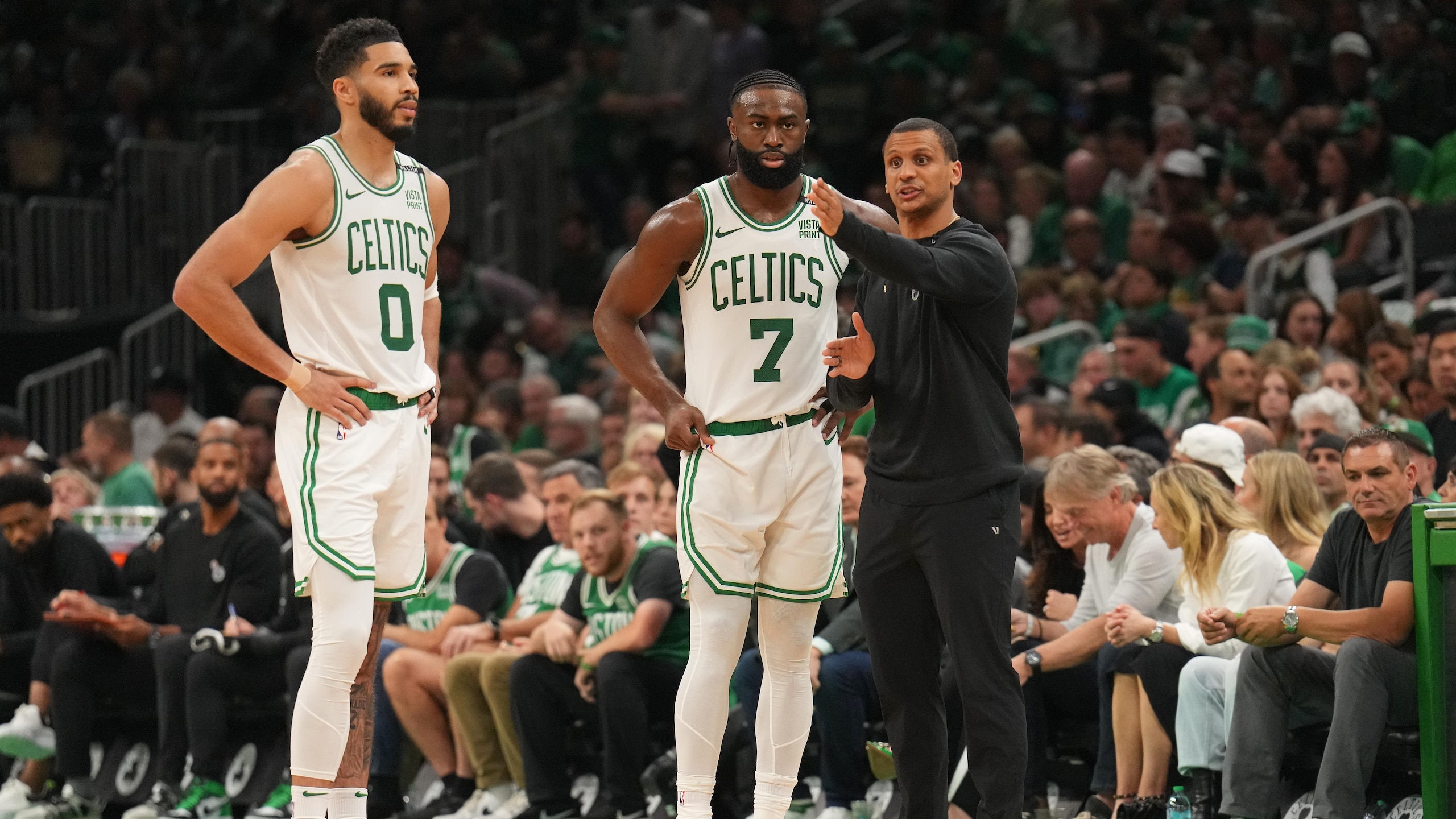
Mazzulla Weighs In on Brown-Tatum Drama

Blockbuster Trade Idea To Shake Up the East
The MVP does not operate in a vacuum. To be the MVP he must be a great player who translates his individual efforts into team results. But “best player on the best team” is too simple because it doesn’t allow for gradations: what if the best (winningest) team, having balanced production between three or four players, has one more win than the second best team, overwhelmingly led by a single great player who does everything for his team and carries them on his back?
We can refine the “best player on the best team” credo then by stating that the MVP is the player who does the most to generate wins for his team—and that, my friends is for the most part quantifiable.
We know how many wins a team has—that’s an objective fact. So then it’s a matter of divvying up the “pie” of the team’s wins (with some pies being bigger than others) according to the contributions of its players. The guy in the league with the biggest slice of pie is the MVP.
On that principle, Cleveland’s and Los Angeles' pies this year are going to end up much bigger than Miami’s, so even if Dwyane Wade’s portion of Miami’s pie is equal to, or bigger than LeBron James' or Kobe Bryant's portions of their teams’ pies, it seems unlikely that his slice will be as big as theirs, but we’ll see.
To determine the portion of the pie that goes to one player, we need a single measure of overall statistical production (OSP). With that the rest is simple: take the player’s OSP and divide it by the team’s OSP to come up with a percentage (top players in the league typically account from 20 to almost 30 percent of their teams’ OSP). Then multiply that percentage by the team’s wins, and you’ve got the player’s piece of the pie. A player whose OSP is 20 percent of his team’s OSP, and whose team wins 60 games, will have an MVP “pie slice” of 12 win shares.
So who's more deserving—will a 30 percent player on a 40-win team, or a 24 percent player on a 50-win team get the honors? By this measure, all three hypothetical players would be tied for MVP, but if any of them could increase his percentage of OSP without losing more games, or win more games while maintaining his percentage of OSP, he would move ahead of the other two.
So we need a method of taking all of a player’s statistics and combining them into a single figure for OSP. That may be easier said than done, and people will argue over the details, but at least we know what the stats are (points, rebounds, assists, steals, blocks, shooting percentages, and turnovers). It’s simply a question of the relative weights these statistics are given in the formula for combining them.
Cards on the table time: I’ll describe my own formula, which I have settled on after using spreadsheets to experiment with a variety of systems.
I’ve tried to keep my formula for OSP as simple as possible. Players get one credit every time they make a positive play, whether scoring a basket (or its equivalent: a field goal equals half a basket, a three-point field goal equals 1.5 baskets), pulling down a rebound, dishing out an assist, blocking a shot, or stealing the ball).
To these metrics I add two efficiency measures, one for shooting and one for ball-handling. A player increases his OSP, or decreases it for every point he scores above or below the league rate given the number of his scoring attempts.
(The league rate after last night’s games was 1.087857 points per scoring attempt, where scoring attempts = field goal attempts plus .44 times free throw attempts. Statisticians determined that .44 was a more accurate measure than .5, given and-one plays, technical fouls, and the occasional three free throws for a fouled three-point shooter.) This efficiency measure typically ranges from -2, up to +3 or rarely +4.
For ball handling I use the number that the statistician John Hollinger calls the pure point guard rating. The formula is 2/3 times assists, minus turnovers, and the results, again, range from about -2 to +4. In effect this allows for an acceptable number of turnovers if a player is handling the ball and distributing it, but it also assesses a penalty for turnovers beyond that acceptable number and adds a bonus for greater ball handling efficiency.
So there’s my OSP formula. Other people might want to tinker with it, but I doubt the MVP results will change much once you multiply the players’ percentage of OSP times the teams’ wins. Below in the table are my results for the top 30 MVP candidates, statistically speaking. The number of wins and win shares given are projected over 82 games.
I know by experience on this website that there are people who will look at the table and declare it stupid and insane that, for instance, Rajon Rondo could be listed ahead of all the other Celtics. My response is that the Celtics’ “big three” must be stupid and insane, since they’ve all testified that Rondo has been the Celtics’ most valuable player this year. I stress that the table does not show who is the BEST player, just the one who gets the most credit for the most wins (i.e. the biggest slice of pie).
And remember, the pie is bigger for the Cavs, Lakers, and Celts. If you run this system for the whole league and total the win shares for all the individual players on a given team, it will exactly equal the number of wins the team projects to given its current winning percentage. For the rest, I let the numbers talk, and invite others who know how to use spreadsheets to download the data from basketball-reference.com and run their own formulas.
The last thing I’ll add is that if LeBron does indeed finish the season at 18.71 win shares as he projects to as of now, it will be the fifth greatest NBA MVP season in history, with only Chamberlain (twice), Mikan, and Abdul-Jabbar ever totalling more win shares (Mikan doing it in 1950, when teams played just 68 regular season games). And yes, I’ve crunched the numbers for every NBA season.
I do happen to be a Cavs fan, but I don’t necessarily think that LeBron is the best player in the NBA today—he has weaknesses, some of which show up particularly in big games. Still, what he’s doing this year in terms of leading the Cavs' to wins is remarkable. Here are your results for 2008-09 so far:
| OSPRk | MVP | Player | TM | G | PjWSh | OSP/G | %OSP | ProjWins | ||||||
| 2 | 1 | LeBron James | CLE | 70 | 18.71 | 36.1 | 28.0 | 66.8 | ||||||
| 1 | 2 | Chris Paul | NOH | 65 | 14.90 | 36.8 | 28.5 | 52.3 | ||||||
| 4 | 3 | Dwight Howard | ORL | 67 | 13.44 | 29.6 | 22.2 | 60.6 | ||||||
| 5 | 4 | Kobe Bryant | LAL | 69 | 12.71 | 27.5 | 19.4 | 65.4 | ||||||
| 6 | 5 | Pau Gasol | LAL | 68 | 12.20 | 26.7 | 18.7 | 65.4 | ||||||
| 3 | 6 | Dwyane Wade | MIA | 68 | 12.13 | 34.5 | 27.6 | 44.0 | ||||||
| 16 | 7 | Rajon Rondo | BOS | 69 | 11.11 | 24.9 | 18.2 | 61.2 | ||||||
| 7 | 8 | Tim Duncan | SAS | 64 | 10.67 | 26.7 | 19.9 | 53.5 | ||||||
| 32 | 9 | Paul Pierce | BOS | 71 | 10.02 | 21.8 | 16.4 | 61.2 | ||||||
| 11 | 10 | Brandon Roy | POR | 66 | 9.95 | 25.5 | 19.3 | 51.5 | ||||||
| 56 | 11 | Mo Williams | CLE | 70 | 9.91 | 19.1 | 14.8 | 66.8 | ||||||
| 19 | 12 | Yao Ming | HOU | 68 | 9.77 | 24.0 | 18.2 | 53.5 | ||||||
| 13 | 13 | Jason Kidd | DAL | 70 | 9.61 | 25.3 | 19.5 | 49.2 | ||||||
| 12 | 14 | Dirk Nowitzki | DAL | 69 | 9.48 | 25.3 | 19.3 | 49.2 | ||||||
| 46 | 15 | Rashard Lewis | ORL | 69 | 9.30 | 19.9 | 15.3 | 60.6 | ||||||
| 44 | 16 | Hedo Turkoglu | ORL | 66 | 9.04 | 20.2 | 14.9 | 60.6 | ||||||
| 20 | 17 | Joe Johnson | ATL | 68 | 8.87 | 23.5 | 18.5 | 48.0 | ||||||
| 55 | 18 | Ray Allen | BOS | 70 | 8.67 | 19.1 | 14.2 | 61.2 | ||||||
| 23 | 19 | Chauncey Billups | DEN | 65 | 8.59 | 23.2 | 16.3 | 52.7 | ||||||
| 8 | 20 | Deron Williams | UTA | 55 | 8.56 | 28.4 | 16.7 | 51.1 | ||||||
| 26 | 21 | Tony Parker | SAS | 59 | 8.53 | 23.2 | 16.0 | 53.5 | ||||||
| 35 | 22 | David West | NOH | 63 | 8.35 | 21.3 | 16.0 | 52.3 | ||||||
| 21 | 23 | Andre Iguodala | PHI | 68 | 8.15 | 23.5 | 19.3 | 42.2 | ||||||
| 25 | 24 | Andre Miller | PHI | 68 | 7.97 | 23.0 | 18.9 | 42.2 | ||||||
| 59 | 25 | Lamar Odom | LAL | 65 | 7.92 | 18.2 | 12.1 | 65.4 | ||||||
| 41 | 26 | Kevin Garnett | BOS | 55 | 7.89 | 22.1 | 12.9 | 61.2 | ||||||
| 40 | 27 | Nene Hilario | DEN | 67 | 7.83 | 20.5 | 14.8 | 52.7 | ||||||
| 57 | 28 | LaMarcus Aldridge | POR | 69 | 7.74 | 19.0 | 15.0 | 51.5 | ||||||
| 68 | 29 | Luis Scola | HOU | 72 | 7.54 | 17.5 | 14.1 | 53.5 | ||||||
| 10 | 30 | Steve Nash | PHO | 61 | 7.45 | 25.8 | 16.5 | 45.2 |




.jpg?w=2560 "Latest Peyton-Colts Rumors")

.jpg?w=2560 "Landing Spots for Trade Candidates 📍")
.jpg?w=2560 "Ugly Jets Scoring Stat 😳")