
Why the Mid-Range Jumper Is Key to Winning an NBA Title
With the rise of advanced stats, the mid-range jumper has come under fire. The argument is that the mid-range shot is the most inefficient one in the game and therefore should be avoided. Because of that the mid-range shot has become the black sheep of the NBA-shot family and as such, is becoming a lost art.
In sports there's winning and there's winning. You can win games in the regular season with gimmicks in any sport, but if you don't know how to grind them out in out in the postseason you can't win titles. To do that every sport has it's thing that no one likes to watch or do, but you have to have it.
TOP NEWS
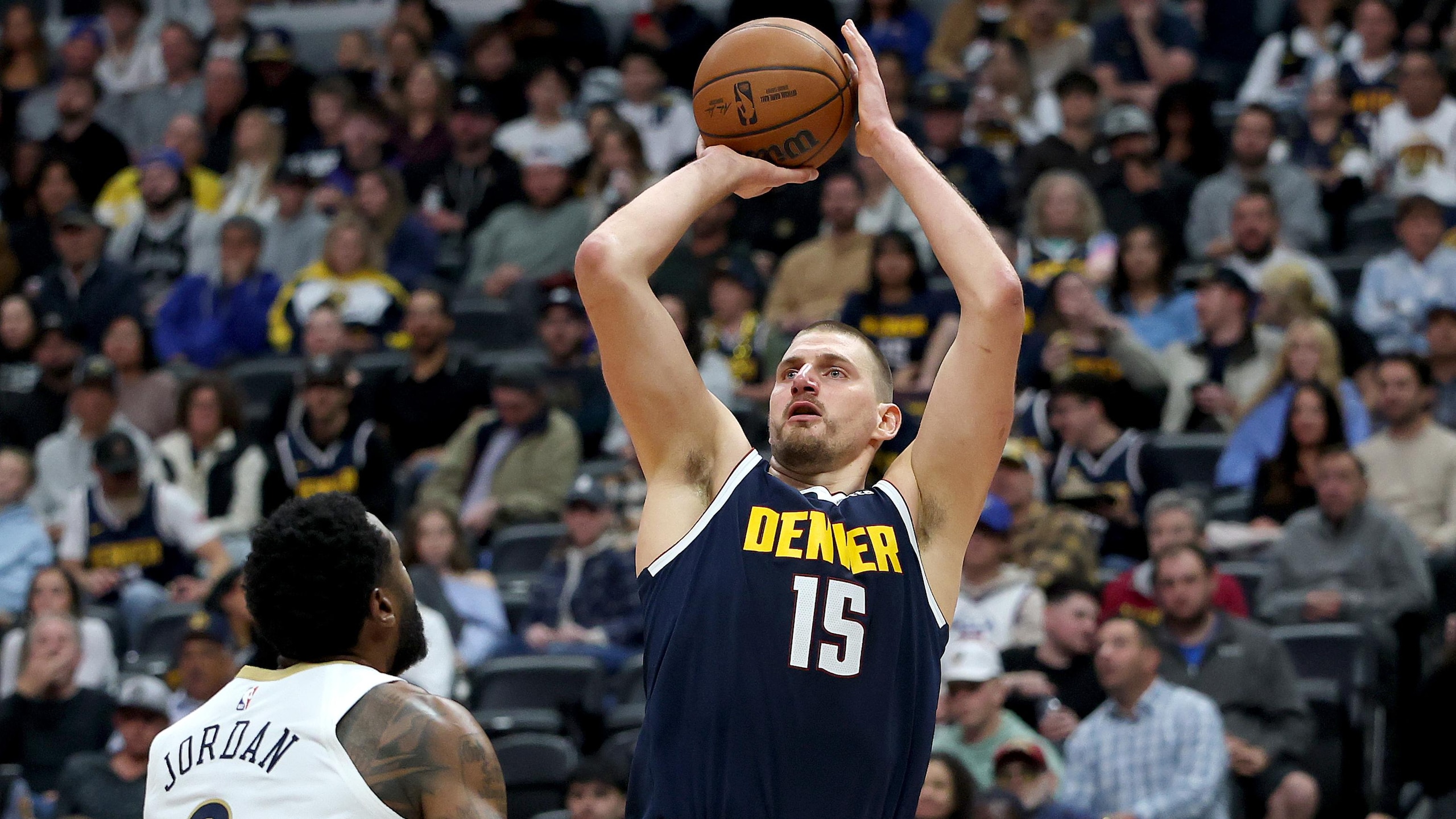
Jokic says booing fans not welcome in Denver

Brown with an all-time summary of relationship with Tatum
Worst NBA Predictions 🫣
In football, you need that ability to grind out a three- or four-yard rush up the middle. It's not glamorous but it wins games. It's why backs like Emmitt Smith, John Riggins and Jerome Bettis have rings while guys like Barry Sanders don't.
In baseball you need that ability to manufacture runs. It's why Tony LaRussa has rings.
I saw an interview once where Tiger Woods said that the secret in golf was knowing the value of a par, a lesson he'd learned from Jack Nicklaus.
In basketball, it's the mid-range jumper. Just like all those other things, you aren't guaranteed to win with it, but you can sure lose without it.
Sooner or later the lane is going to get shut down and the shots aren't going to be falling from deep. And if you don't have the mid-range shot when that happens, you're going to start losing games.
Shooting the mid-range jumper forces opponents to defend the entire court. It can draw opponents into contact, putting them closer to the penalty or into the penalty. It's taking what the defense gives you, and if you can't take it when the defense gives you it, you won't win titles.
Obviously, it's not advisable to make the mid-range shot the staple of your offense, but if you don't have the ability to go to it when you need to, you won't win a title.
Of course, just saying that is one thing, but proving it is another. So I looked at past NBA champions to see how they did with their mid-range shots. I checked for two things. First, did they have the one guy they could lean on when they needed him? Second, did they score as a team from the mid-range efficiently.
For the purpose of the research, I defined a mid-range jumper as anywhere between the restricted area and the three-point line. Shots went in at roughly the same rate from three to nine feet (37.6 percent), 10 to 15 feet (38.3 percent), and 16 to 22 feet (38.1 percent) last year.
The data for individual shots was compiled by using the Play Index+ Shot Finder at Basketball-Reference.com. Links to the individual years can be seen by clicking on the player name. Results were obtained for as far back as they were available.
For the team data it was based upon data compiled at HoopData.com. Once again, the table shows the data for as far back as it goes. They keep the data in three separate ranges, but they were summed together in the table below. You can see the data for each year by clicking the team name.
| Season | Team | Player | FG | Rank | Team FG% | Tm Rank |
| 2012 | Miami Heat | LeBron James | 238 | 8th | 39.73% | 6th |
| 2011 | Dallas Mavericks | Dirk Nowitzki | 420 | 1st | 43.24% | 1st |
| 2010 | Los Angeles Lakers | Kobe Bryant | 366 | 3rd | 42.29% | 6th |
| 2009 | Los Angeles Lakers | Kobe Bryant | 423 | 2nd | 42.64% | 3rd |
| 2008 | Boston Celtics | Kevin Garnett | 331 | 6th | 43.12% | 3rd |
| 2007 | San Antonio Spurs | Tony Parker | 249 | 16th | 41.83% | 5th |
| 2006 | Miami Heat | Dwyane Wade | 305 | 9th | ||
| 2005 | San Antonio Spurs | Tim Duncan | 242 | 23rd | ||
| 2004 | Detroit Pistons | Richard Hamilton | 308 | 8th | ||
| 2003 | San Antonio Spurs | Tim Duncan | 316 | 18th | ||
| 2002 | Los Angeles Lakers | Kobe Bryant | 428 | 3rd | ||
| 2001 | Los Angeles Lakers | Kobe Bryant | 268 | 22nd |
In the last 11 years, four times the NBA champion boasted one of the top three mid-range shooters in the game in terms of field goals made. Only four times, in three cases with the Spurs, did they not boast a top-10 mid-range shooter.
There are a few mitigating factors with the Spurs. First, they distribute the their mid-range shots between Tim Duncan, Tony Parker and Manu Ginobili. Second, Tim Duncan missed 16 games in 2005. Finally, the totals don't reveal the hook shots Duncan has made. If you count overall shots. Duncan would be 11th in the 2003 and 12th in 2007.
With the 2001 Lakers, while Kobe Bryant was only 22nd, he was let loose in the postseason, making his mid-range shots at a rate of more than six per game in the playoffs.
As to the teams, the last six champions have all been in the top 20 percent of the NBA in terms of being able to be efficient form mid-range.
In both cases it's confirmed that teams that win the title have the ability to score from mid-range consistently and the ability as a team to score from there efficiently.
While being good from mid-range hardly promises winning a title, it's a sure bet that you won't if you can't.
Sadly, though, fewer and fewer players are mastering the art.

.jpg?w=2560 "Mahomes Told Teammate to Leave Meeting")
.jpg?w=2560 "5 Teams Eyeing Jonathan Taylor")
.jpg?w=2560 "Jonathan Taylor Landing Spots 📍")
.jpg?w=2560 "Baker Gets Glove From Rays 🧤")
.jpg?w=2560 "NFL investigating Eagles")
