
Ranking the Best Student Sections in College Basketball
Which schools boast the best student sections in college basketball? It’s a question that is absolutely impossible to answer with anything resembling neutrality or tangible evidence—until now.
The first part of creating this list was identifying what makes one student section better than the other. For the basis of this article…
A good student section is one that leads the entire stadium in creating an atmosphere, by any means necessary, and that gives their school opportunities to win that they do not receive on the road.
I have not been to every basketball stadium in the country so taking “usual” methods of formulating this list would be nothing more than hearsay.
Say no to hearsay! Say yes to math!
It is with great pride, pleasure and fatigue (I’ve been at this for hours) that I introduce the ASS (Advantage from the Student Section).
There were three variables used to calculate ASS. Click on to see them before getting to the final values.
Power Rating Difference (PRD)
1 of 23TeamRankings.com has a statistic known as “Power Rating” for both home and away performance. Power Rating is largely based on win percentage but also takes into account strength of schedule.
I examined Power Ratings for each of the last four seasons (almost all the students from five years ago are no longer part of the section) by taking the Top 50 schools in each year for both home and away. Any team that failed to appear in multiple years was removed.
Power Rating, as it pertains to ASS, is a scaled variable and each school’s final score was a scaled one.
Say what?
Perhaps an example would work best. Let’s take a look how West Virginia’s Power Rating score was calculated:
Home PR scores for each year: 108.6, 116.4, 116.6, 114.8
Home PR average: 114.1
The home PR score was then weighed against the mean of all eligible teams, which was 110.7. That means that West Virginia’s Home PR score is 3.4 (114.1 minus 110.7).
Recall from the intro that ASS puts a premium on schools performing better at home than they do on the road. So, Road PR scores were subtracted from Home PR scores to determine the difference of the home court.
Here is some more WVU:
Away PR average score: 113.3
Mean of all eligible teams: 113.0
WVU’s weighed away PR sore: 113.3-113.0 = 0.3
Final PR differential: 3.4 – (0.75 * 0.35) = 3.1
Note: I subtracted only 75 percent of the away score for each team to avoid excessively strong penalties
Double Note: All of these intricacies were made before the final calculations.
Party School Rankings (PS)
2 of 23Pre-gaming is not reserved for the actual players.
It takes alcohol in one’s system to have the confidence to pull some of the stunts we see every week in college basketball. The more boisterous the fans, the louder (and more creative) the cheers.
If you found the previous, arithmetic-heavy slide to be challenging, perhaps this one will come easier. Every time a school appeared in the Top-20 “(in)famous” ranking, it received 0.75 points to their PR score.
West Virginia: 3.1 + (4 * 0.75) = 6.1
Volume Bonus (VB)
3 of 23For the final variable, I dug up this older article from ESPN by Ian Gordon, which sought out to examine the loudest arenas in college basketball.
They employed their own detailed process to formulate their answers, but suffice to say that science and math were very much at a premium.
As it pertains to my rankings, note that Gordon reiterates the importance that court proximity plays in stadium volume. The student sections are typically close to the court and largely responsible for creating the noise.
One more time, the “best” student sections do more than just get loud. They have to improve their schools’ chances of winning. However, a deafening cheer and constant “oh-oh-oh-oh”s are effective in achieving this.
A mention in the ESPN article resulted in an increase of 1.25.
West Virginia: 6.1 + (no mention in ESPN article) = 6.1
We are officially set to begin. Enjoy and feel free to offer more subjective ways of deciding this.
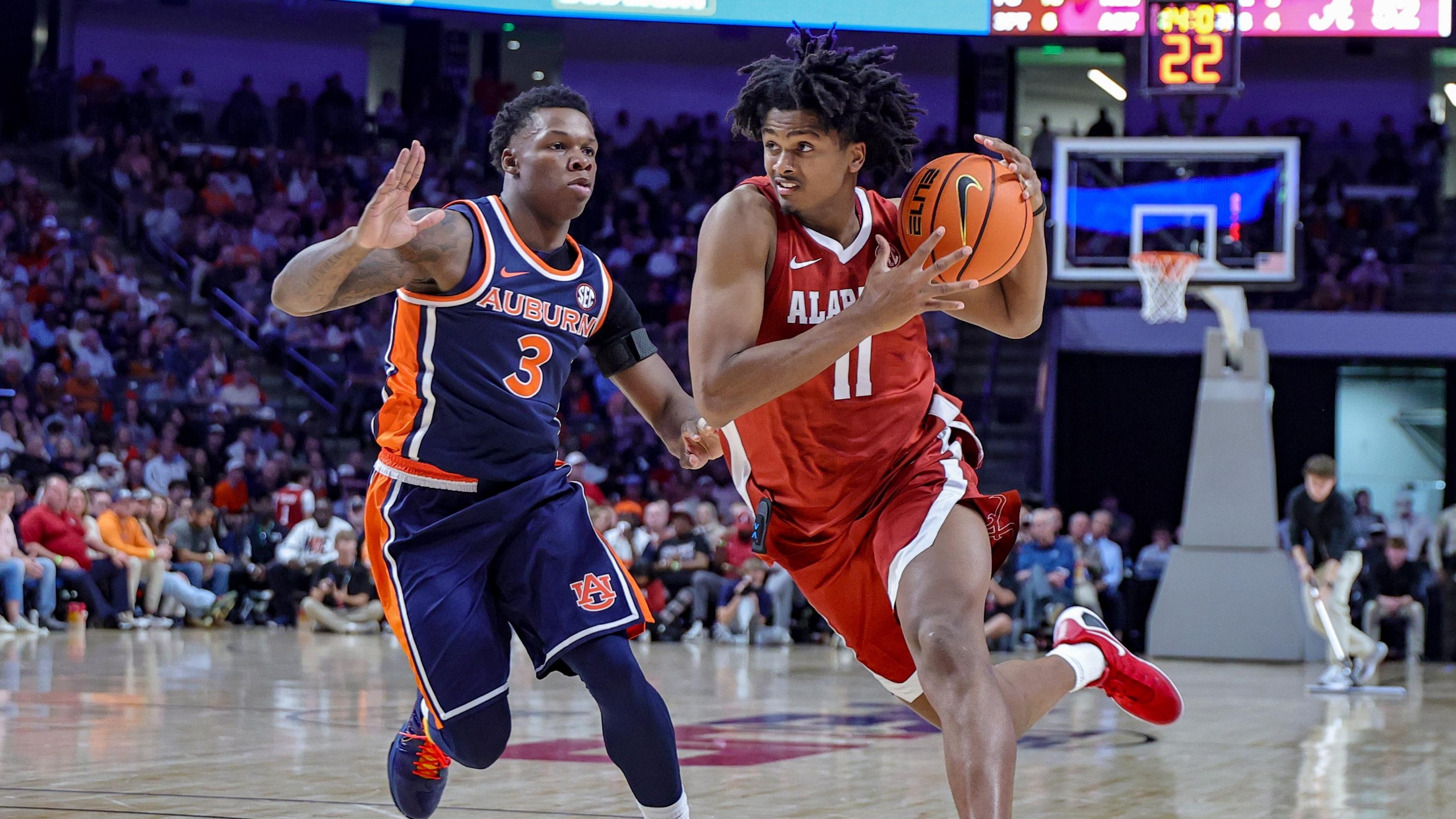


20. Utah State
4 of 23ASS Score:
4.04 (PRD) + 0 (PS) + 0 (VB) = 4.04
19. Texas A&M
5 of 23ASS Score:
4.31 (PRD) + 0 (PS) + 0 (VB) = 4.31
18. Florida State
6 of 23ASS Score:
1.42 (PRD) + 3 (PS) + 0 (VB) = 4.42
17. Siena
7 of 23ASS Score:
4.41 (PRD) + 0 (PS) + 0 (VB) = 4.41
16. Indiana
8 of 23ASS Score:
2.27 (PRD) + 2.25 (PS) + 0 (VB) = 4.52
15. Ohio State
9 of 23ASS Score:
4.54 (PRD) + 0 (PS) + 0 (VB) = 4.54
14. Tennessee
10 of 23ASS Score:
2.39 (PRD) + 2.25 (PS) + 0 (VB) = 4.64
13. Illinois
11 of 23ASS Score:
1.72 (PRD) + 2.25 (PS) + 1.25 (VB) = 5.22
12. Florida
12 of 23ASS Score:
1.17 (PRD) + 3 (PS) + 1.25 (VB) = 5.42
11. Oklahoma State
13 of 23ASS Score:
4.64 (PRD) + 0 (PS) + 1.25 (VB) = 5.89
10. Notre Dame
14 of 23ASS Score:
5.94 (PRD) + 0 (PS) + 0 (VB) = 5.94
9. West Virginia
15 of 23ASS Score:
3.10 (PRD) + 3 (PS) + 0 (VB) = 6.1
8. Wake Forest
16 of 23ASS Score:
6.17 (PRD) + 0 (PS) + 0 (VB) = 6.17
7. Kansas
17 of 23ASS Score:
5.03 (PRD) + 0 (PS) + 1.25 (VB) = 6.28
6. Kentucky
18 of 23ASS Score:
5.04 (PRD) + 0 (PS) + 1.25 (VB) = 6.29
5. Texas
19 of 23ASS Score:
4.37 (PRD) + 3 (PS) + 0 (VB) = 7.37
4. Missouri
20 of 23ASS Score:
7.67 (PRD) + 0 (PS) + 0 (VB) = 7.67
3. Wisconsin
21 of 23ASS Score:
5.52 (PRD) + 2.25 (PS) + 0 (VB) = 7.77
2. Pittsburgh
22 of 23ASS Score:
6.82 (PRD) + 0 (PS) + 1.25 (VB) = 8.07
1. Duke
23 of 23ASS Score:
7.14 (PRD) + 0 (PS) + 1.25 (VB) = 8.39


.jpg?w=2560 "Jonathan Taylor Landing Spots 📍")

.jpg?w=2560 "Why Josh Simmons Was Told to Leave Meeting by Mahomes, Reid Revealed in New Chiefs Rumors")


