Ryan Giggs: A Living Legend
Like many of my generation, I was brought into football fanhood on the coat tails of the launch of the Premier League. Through a selection process that I struggle to recall with great clarity, I was a Tottenham Hotspur fan. [i]
It is was a sign of things to come that one of my earliest memories as a fan was seeing the league table for the first time, with Spurs languishing in the bottom three after a wobbly start to that inaugural season.
A happier memory from that time was the discovery of Match of the Day. Slave though I was to my parents remembering to press the record button, it quickly became a highlight of the week and none more so than on that last Saturday of each month when the goal of the month competition was aired.
TOP NEWS

Soccer Stock Check 📈📉
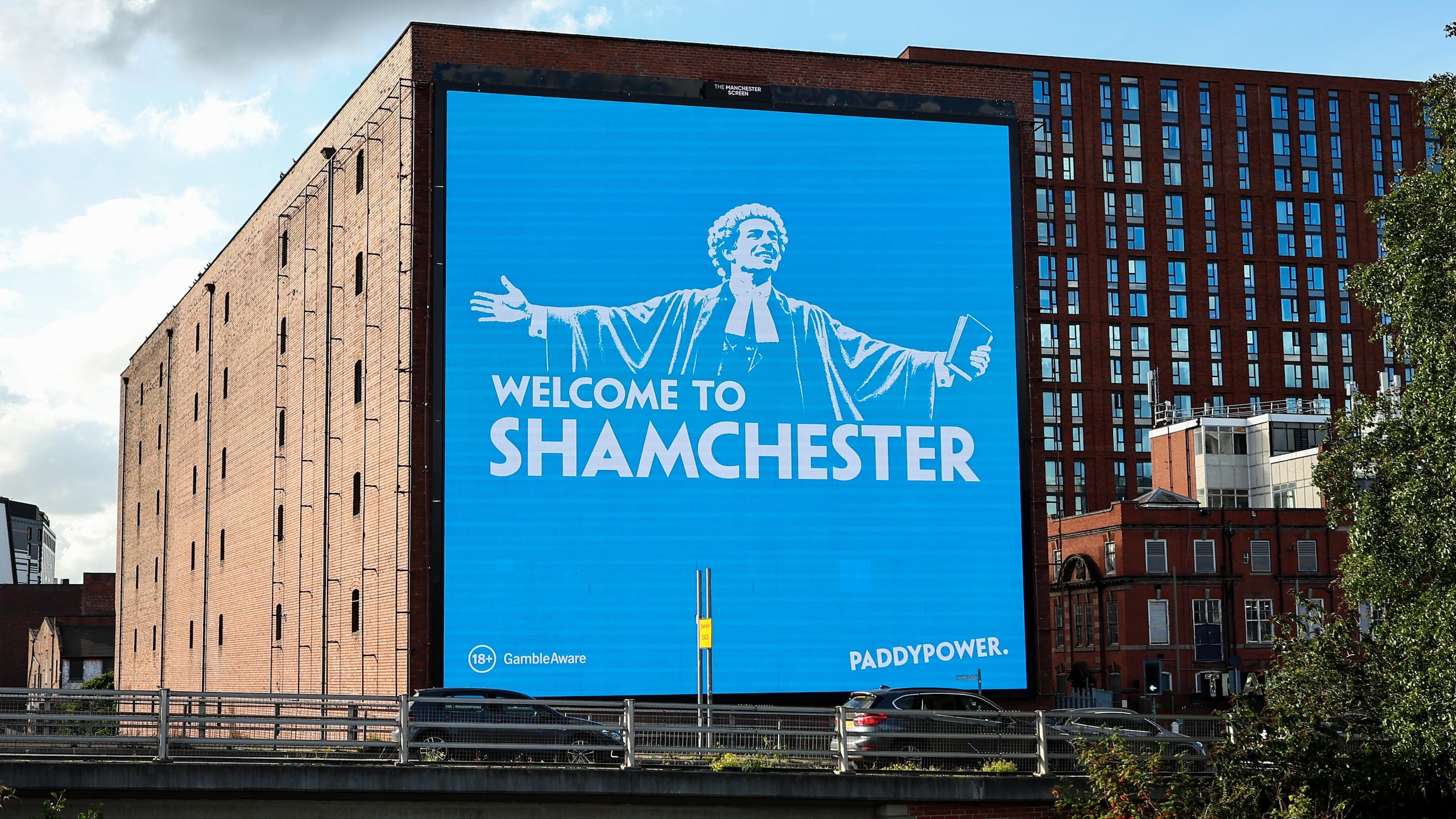
Billboard Trolls Man City 👀

New NFL contenders starting to emerge after Week 4
A highlight to be savoured and reenacted the following week, I still recall the Lightning Seeds theme tune. Any football aficionado old enough to recall the year will surely recall a particular gem from those embryonic Premier League days …
Winning the ball halfway in the opposition’s half, accelerating from the midfield with ease, playing possibly the most audacious nutmeg I have ever seen, rounding the keeper and finally slotting home from an angle that would have been the undoing of many, Ryan Giggs’ sublime strike on Sept. 19, 1992, was a profound marker laid by an incredible talent.[ii]
Giggs had, by this time, already established himself in Manchester United’s starting eleven. A prominent member of the side that finished second to Leeds the previous season, the teenage Welshman had been named PFA Young Player of the year.
Yet it was the thrilling nature of this goal, as the new season gathered pace, that hinted at the unique career Giggs would go on to enjoy.
And what a career it has been. Last weekend, Ryan Giggs scored his first league goal of the current season, making him the only player to have scored in each and every Premier League season to date.
Giggs also scored in both the 1990/91 (once, in just two appearances) and the aforementioned 1991/92 campaigns. As a result, should he manage to find the net in the league next year, he will hold the likely unassailable record of having scored in 20 consecutive top flight campaigns.
A distinct possibility, after his match winning contribution against West Ham was swiftly followed by the awarding of a further one year extension to his contract, a deal that will now expire just a few months shy of the player’s 37th birthday.
In some respects, Giggs’ fabulous career is not unprecedented. He is still 23 league games shy of surpassing Gary Speed’s record of 535 Premier League performances by an outfield player.
He is also not alone in having featured in all 17 Premier League seasons, joined in this regard by David James, Sol Campbell, and former team-mate Nicky Butt. Where Giggs comes into his own is in his loyalty and his medal cabinet.
The two are, of course, linked. Giggs was at the heart of the Manchester United team that stormed to that opening Premier League title, the club’s first championship in 26 years. Neither club nor player looked back.
Although Arsenal and Chelsea have both posed credible threats to United’s hegemony in recent years, both have been shrugged off and Giggs and co. look set to record the club's second series of three straight titles in a decade.
Giggs, as much a part of the club as he was 17 years ago, stands to collect his 11th winner’s medal.
That is on top of four FA Cup and two Champions League wins. As if to underline Giggs’ individual contribution to these successes, he has been named in the PFA team of the year on seven occasions, including a recent entry in 2007.
There is, I think, a tangible link between loyalty and success. I racked my brain (briefly) to come up with a list of players who, while not necessarily as senior in years as Giggs, could be considered unusual in their loyalty to one club.
Focusing on the top flight, the names I came up with were as follows: John Terry, Paul Scholes, Ledley King, Gary Neville, Steven Gerrard and Jamie Carragher. This is, I am positive, not an exhaustive list (please do point to others I have missed, even if they do undermine my point!) but, I believe, an indicative one.
With the exception of Ledley King (in my eyes, a living legend also), each of these players has achieved considerable success. Not quite of the order of Giggs’ own, but up there with the very best of their generation, nonetheless.
King, the black sheep of the group, may well have been lured away from White Hart Lane had injuries not overcome his career of late.
Loyalty and success it would seem, mix well. That Giggs has been able to combine the two for quite so long, needs further consideration.
A key reason behind Giggs’ continued success has been his ability to recreate himself. No longer quite as fleet of foot and able to leave terrorised full backs for dead, Giggs has ceased to be a winger in the traditional sense.
Instead, he has become a versatile midfielder able to perform a number of roles. Manchester United’s recent dismantling of Chelsea is an excellent example.
His performance, lauded in many quarters, won him the man of the match award and triggered this short piece:
A gift that keeps giving. Indeed. Bagchi suggests that Giggs might have struck a peripheral figure of late but the fact that he has played a part in 17 of United’s 24 league games, as well as 4 of 6 Champions League fixtures, suggests otherwise.
Indeed, just the very act of giving Giggs such a key (not to mention unfamiliar) role in the Chelsea game, one of the key games of the season, demonstrates Ferguson’s unyielding faith in the player. Only the sheer fact of his age has likely precluded an even greater level of involvement.
Nor does this season represent an Indian summer for Giggs; he featured in 41 games across all competitions last season, including a record 759th appearance in a United shirt (albeit from the bench) in the Champion’s League Final, converting the penultimate spot kick as Anelka went on to miss.
The one black mark against Ryan Giggs’ illustrious career is his international record. Although he won a highly respectable 64 caps, scoring 12 goals along the way and captaining the side from 2004, Giggs never made an appearance in a top tier international competition, arguably the greatest player of the modern game to have never done so.
It was probably with mixed feelings then, that Giggs called it a day in 2007, perhaps frustrated that he had been unable to transport a measure of his club success to his national side.
Though Wales’ inability to qualify for major tournaments certainly contributed to this decision, it was likely reinforced by Giggs’ desire to prolong his career at Old Trafford.
Giggs, like any outfield player entering his mid-30s, is no longer able to play two games a week. Not only this, but in recent years his contribution is undoubtedly less tangible than it once was.
To be clear, I am not suggesting that is contribution is necessarily less than it was, though some will doubtless take this view, but that it is merely less visible.
For example, it is no coincidence that the majority of his finer goals, often combining pace, dazzling footwork, and a sumptuous left (and on occasion right) foot, came in the first phase of United’s domestic dominance.
In this way, his unforgettable goal against Arsenal in 1999 can be said, with the benefit of hindsight, to mark a turning point in the Welshman’s career. It perhaps brought to a close, symbolically at least, the eye catching part of his career.
In reality of course, the shift was not so black and white. But as Bagchi states, a series of injuries combined with perhaps an autumnal but mild malaise in form did signal a new chapter in Giggs’ career.
Increasingly, he took a more back seat role and let the likes of Rooney, Ronaldo, et al sweep the headlines as United briefly lost and then spectacularly regained the initiative over Chelsea.
But today, Giggs looks as far away as ever from becoming a peripheral squad player, as the recent Chelsea game demonstrated. If he does retire at the end of new deal, next summer, then he will do so from the very top.
Bagchi suggests that Giggs’ character, as much as his physical attributes, has contributed to his enduring success and he may be right.
More than anything, however, Giggs’ attitude...to the game, to his teammates, to his conduct off the pitch...should be held aloft as a shining beacon in murky waters. That Giggs has maintained this attitude in the face of such dizzying success, just adds to the legend.
As a final thought, I draw your attention to the link below to YouTube and a collection of Giggs’ best goals. The ease with which Giggs would leave a player trailing in his wake makes for mesmerising viewing; I defy you not to get goosebumps.
And his goal last weekend shows that, whilst he may no longer possess breathtaking speed and acceleration, he is still a wonderful talent befitting of a place in a title winning side.
[i] I believe it was a combination of the 1991 FA Cup final. Lineker and Gasgoigne had both departed prior to the big kick off but up to that point were household names to latch upon, and a fellow 9-year-old who (incidentally, was always ahead of the curve in the fashion department) very kindly donated be a pair of ‘Spurs’ wristbands once he had moved on to pastures new (Manchester United...not without irony given where I am heading). Sweets may have changed hands.
[ii] This goal was scored at White Hart Lane, of all places, perhaps explaining why it is so etched in my memory. I am happy to report that Spurs came back to draw 1-1, as our season began to steadily improve after a slow start.
.jpg?w=2560 "Cardinals Giants Football")

.jpg?w=2560 "Report: Chiefs Contact Hill's Agent")
.jpg?w=2560 "OBJ Calls Out Giants 😳")
.jpg?w=2560 "Tyreek makes another cryptic post amid Chiefs rumors")