Kobe Schmobe: Why LeBron James Is the Real NBA MVP
Basketball is about assimilation. Integration. I’m not talking about racial integration, although the game has obviously been well-served by that as well. I’m talking integration in the sense of the American Heritage definition of the word: “The state of combination, or the process of combining into completeness and harmony.”
Yes, harmony.
That’s what I’m talking about. Five players moving in perfect rhythm, whether on offense or defense, such that the movements and actions of one player ripple down through the movements and actions of the other four. When it’s done right, when it’s really good, it is—to use a time-worn metaphor—not unlike sex.
TOP NEWS
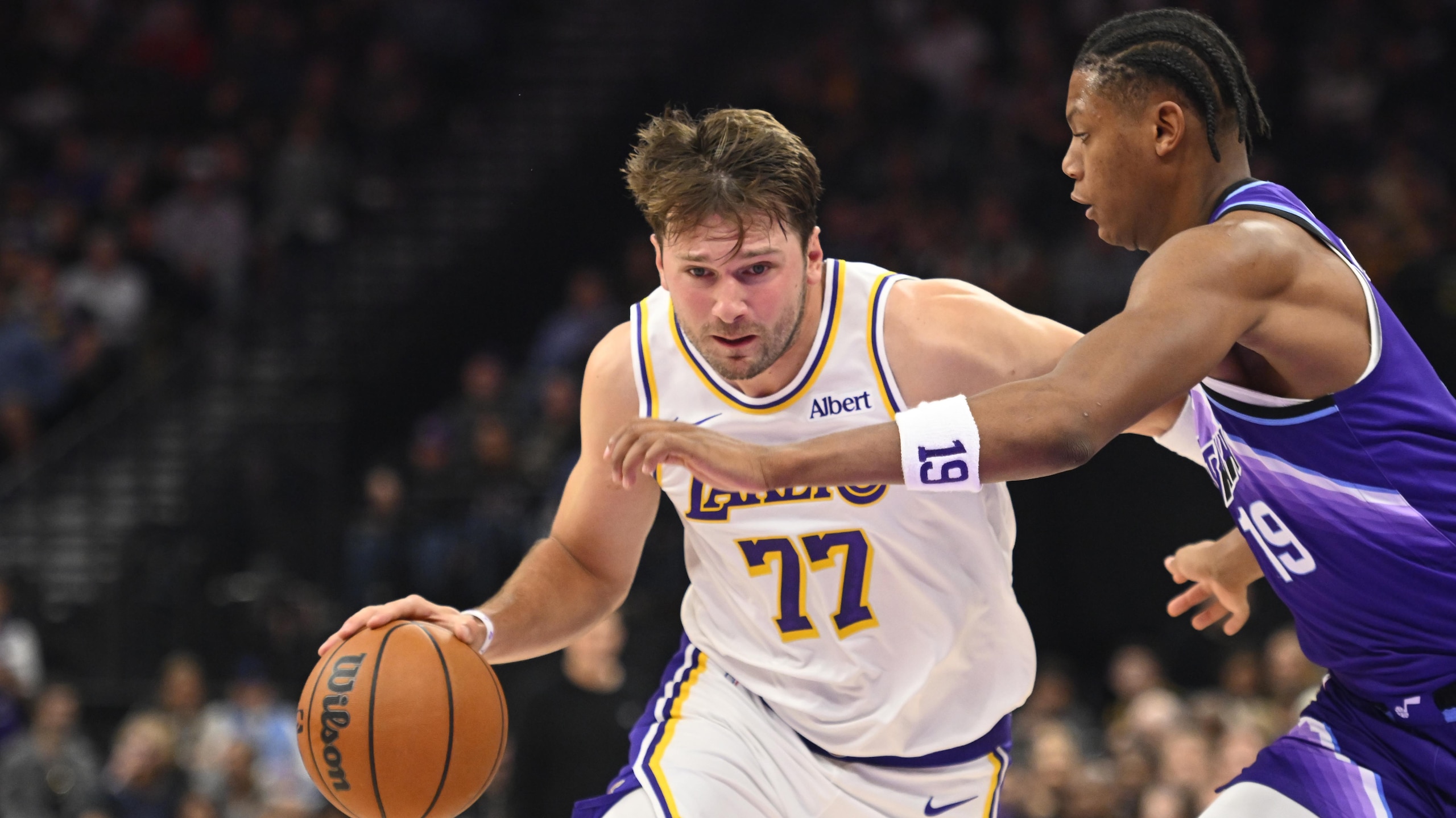
Luka 50 Piece in Win 🔥

Power Ranking Every NBA Team's Starting Lineup 🔢

Embiid Out vs. Pistons
If great team basketball is like sex, then Kobe Bryant’s game is like, well, um, let's just say that it sometimes looks like he’s trying to do it all by himself out there.
This is not to say that his game is not spectacular. Kobe Bryant is a talented and elegant athlete. He is an excellent offensive player and scorer, although not always the most efficient one.
His athleticism is apparent on defense as well, making him tantalizingly close to being an all-around great player. What he lacks however, particularly on offense, is integration.
What Kobe does on the court is often great and always fun to watch. However, it is generally not well-synchronized with the playing style of his teammates. When compared to the greats of recent vintage, players like Bird, Magic, and Jordan, the gaping hole in Kobe’s game is painfully clear.
He does not make his teammates better. He does not lift his team up aside from what he accomplishes on his own. His teammates, in the end, often just stand around and watch.
Is Kobe selfish? I believe that he is. My gut tells me that his statements about the importance of team and the ultimate priority of winning are phony.
Logic confirms my hunch. If winning was the ultimate priority, why did Kobe not accommodate Shaquille O’Neal when the team was winning championships? What possible reason could Kobe have had for being unhappy in such circumstances? Winning means everything, right?
In reality, of course, winning wasn’t the most important thing for Kobe Bryant. The important thing was that it was “his” team. The important thing was that the spotlight shined on him.
I am convinced that, if in a dark and private moment, an angel came down from basketball heaven and offered Kobe Bryant his choice of an NBA Championship or an MVP award, he would choose the latter.
Look at Kobe’s actions, not his words, if you want to see his true character. Or just look at his game.
Even if we suppose, for the sake of argument, that Kobe truly is an unselfish team player, it is apparent that he doesn’t understand how to gel with four other players. His basketball I.Q., which is considerable, lacks this particular kind of intelligence necessary for any player to achieve greatness.
Kobe’s idea of being a team player is to not shoot the ball for a given period of time, let his teammates try to score, and then, if the team falls behind or the game is on the line, take things into his own hands once again. This is not integration. This is selective self-assertion.
Integration, as it turns out, is also the fundamental difference between Kobe and LeBron James.
James can take over a game offensively as quickly and spectacularly as Kobe can, however, the difference is that he makes his teammates better in the process. This is the deadly combination that makes a player truly valuable.
It is this type of player alone that is capable of elevating a group of mid-range players to the NBA Finals. Kobe has never been able to do this. He wants to win, but the only thing he knows how to do is to put a team on his back and carry them. LeBron can do this when the situation calls for it. What he can also do, and what Kobe can’t, is empower his teammates.
For those stat-geeks out there, the numbers offer strong support for my assertion that LeBron is the better and more valuable player.
In order to comprehend the differences between LeBron’s game and Kobe’s, it’s useful to compare them both to the stratospheric Jordan standard. It’s rather surprising how many modern fans and even media commentators, who should know better, are quick to imply that Kobe has reached Jordan’s level as an offensive player.
This must be based on the fact that, night-in, night-out, Kobe makes plays that show up on ESPN that look as spectacular as anything Jordan ever did.
Problem is, ESPN never seems to show all those bad shots that Kobe took.
All the times that he drove into the teeth of three converging defenders and threw up a log while his teammates stood flat-footed around him. All the times that he dribbled around the perimeter and tossed up an off-balance floater as the shot clock went off. In moments like these, Kobe is sometimes a little too easy to defend. Because he’s not integrated.
Here’s a hint: If you really want to understand what an astounding offensive player Jordan was, look at his field goal percentages. Jordan shot .497 from the floor for his career. He shot over .500 six times and was over .480 another four times. Think about that. He was a guard and he played on the perimeter, yet he still hit more than half of his shots.
In the 1988-89 season, Jordan was No. 10 overall in the NBA with a mind-blowing .538 percentage. The nine players ahead of him were Rodman, Barkley, Parish, Ewing, Worthy, McHale, Otis Thorpe, Benoit Benjamin, and Larry Nance. All big men. All guys who took the vast majority of their shots in the paint.
And yet Jordan was in the same category in terms of offensive efficiency. This indicates that even though he was not necessarily an outstanding passer, he was in-sync with his teammates. He knew when to take his shot. He knew the difference between a good shot and a bad shot.
And, yes, he could create shots better than Kobe as well.
Bryant, by comparison, has never shot higher than .469 from the field in any given season.
Think about this the next time you’re inclined to think that Kobe is in Jordan’s league as an offensive player. Think about this as well: Jordan averaged 5.3 assists per game in his career with an individual season high of 8.0 per game in 1988-89.
Bryant, on the other hand, averages 4.6 for his career with an individual season high of 6.0. Not only was Jordan a more efficient scorer, but he created more scoring opportunities for his teammates.
In LeBron’s case, the stats tell an equally compelling story. What they tell us is that he, not Kobe, is the real heir to Jordan. Whereas Kobe has never topped .469 from the field, LeBron, over the last four seasons, has shot percentages of .472, .480, .476, and .482. While he’s not quite on Jordan’s level just yet, he’s within range. As this indicates, his shot selection and offensive efficiency are far superior to Kobe’s.
In fact, he’s statistically superior to Kobe in virtually every aspect of the game. Those who argue Kobe over LeBron for MVP should take a look at the numbers.
When comparing Kobe and James's season averages, LeBron has more points per game (30.2/28.5),) more rebounds (7.9/6.3,) more assists (7.3/5.4), and a higher FG percentage (.482/.460.)
Defensively they are tied in steals (1.8 each) and LeBron is more likely to block a shot (1.1/0.5.) If your appreciation and knowledge of the game was not sufficient enough to allow your naked eye to see the superiority of LeBron over Kobe beforehand, how, after seeing these numbers, can anyone possibly claim that Kobe is the better player?
Perhaps, if he’s lucky, Kobe Bryant will have a career comparable to Clyde Drexler’s. To date, Kobe’s rebounds per game, assists per game, and FG percentage are below Clyde the Glide’s career numbers, but there’s nothing wrong with that.
Kobe is one of the best players of his time and a future Hall-of-Famer. However, he is not the second coming of Michael Jordan. He is not the best player of his time. That honor will go to LeBron James.
He is the best player. He is the MVP. He is not only better than Kobe Bryant, he is far superior.
For me, the one thing that really sums up Kobe Bryant’s game, and maybe even who he is as a person, is his now infamous comment that, when he was in high school, he would sometimes let other teams back into the game towards the end just so he could take a potential game-winning shot at the buzzer.
For anyone who has ever played team basketball, this is a rather alarming notion.
What about the other players on Kobe’s high school team? Did they factor into his decision at all? They were working and playing to win the game, not to serve one man’s narcissistic daydream.
And what about the guys on the bench, the ones who showed up for practice but didn’t always get into the game? Did it ever occur to Kobe that it might be nice to blow the other team out so that some of his teammates might get a chance to play too?
Apparently it did not. Apparently he was not well-integrated with the eleven other boys on his high school team. It’s a tough problem for a basketball player to have, and a bit of an Achilles heel that haunts him to this day.
Some have argued that Kobe's heroics against Spain in the 2008 Olympics offer some kind of absolute proof that he is the best player in the world. With so many great players to choose from, including LeBron, the argument is that the team went to Kobe for the big shot.
However, just because Kobe took those shots and hit them does not mean that LeBron, or for that matter Dwyane Wade or Chris Paul could not have taken those shots and hit them as well.
In fact, it is the very willingness of LeBron to defer to Kobe in that way that makes him the best basketball player in the world. LeBron understands that basketball is a team game, not an athletic beauty contest. As the younger guy, LeBron showed an ability to defer to Kobe in much the opposite way that Kobe refused to defer to Shaq.
LeBron's game is summed up not only by his willingness to defer for the good of the team in Beijing, but his willingness to do the same with his teammates on the Cavaliers. I am reminded of one game in particular in April 2008.
The Cavs, down by 14 midway through the third quarter, came back to win as LeBron scored 33 points on 11-21 shooting, along with seven boards, and eight assists. The highlights on ESPN were full of shots of LeBron slashing to the basket and sticking jumpers from downtown.
But it was one play in particular, an assist, which stood out to me. LeBron dribbled the ball on the perimeter. Cavs center Zydrunas Ilgauskas lumbered out and seemed to be setting up for the pick-and-roll.
But LeBron moved away from the pick, luring not only his own defender but Ilgauskas’ as well. As both defenders locked in on LeBron, frozen for a split second, Ilgauskas released, and cut back towards the basket, and LeBron whipped him a perfect pass for a layup and a three-point play.
As a big man, Ilgauskas is not the second coming of Bill Russell. He is more like Bill Cartwright. But that’s okay because he plays with LeBron, and because the Cavs are in-sync with one another.
Integrated.
It was a pass that made you stand up and cheer.
When, I ask you, when was the last time Kobe Bryant made a pass that made you stand up and cheer?
Still thinking? Yeah, me too.

.jpg?w=2560 "Rodgers Iced Out on Plane 💎")
.jpg?w=2560 "Mahomes Told Teammate to Leave Meeting")
.jpg?w=2560 "🚨 Week 8 AP Top 25 Poll")
.jpg?w=2560 "Raiders Could Start Mendoza")


.jpg?w=2560 "Lamar Being Out Shocked Ravens")