Roger Federer Defeats Rafael Nadal: Making the Best of Less
They have played a mind-boggling 28 times, but only four of those meetings have come on an outdoor hard court.
Rafael Nadal claimed two of them, but the last time his longtime rival Roger Federer won one was way back in 2005, when it was just a rivalry in the cot. That was a five-set epic, and he was lucky to scrape through it.
It came as something of a surprise, then, that Federer finally won his second such match yesterday, defeating Nadal 6-3, 6-4. Long touted as an 18-10 head-to-head heavily lopsided by Nadal’s victories on clay, Federer has long needed to claim some turf of his own on the hard courts.
TOP NEWS
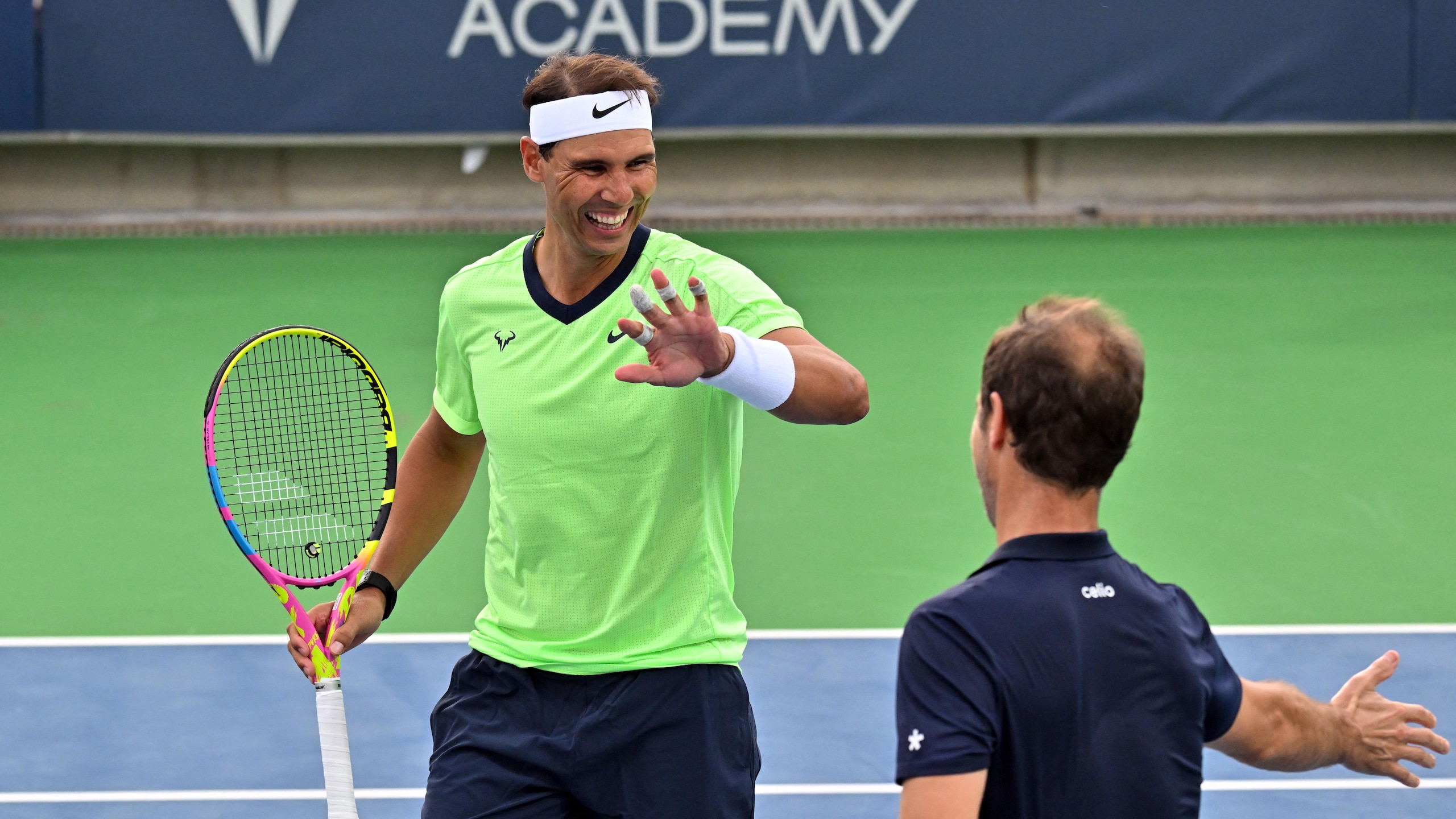
Rafa Playing Exhibition 🎾
J-Dub, Wallace May Miss Entire Season
.jpg?w=2560 "Seahawks Chiefs Football")
Chiefs, Steelers Eye WR Trades
Meetings at the US Open, some speculated, would have evened things up, with slick, swift cement playing advantageously into the Swiss master’s hands.
Yet discounting the fact that they have now played 11 times on hard courts (Federer leading 6-5), four of those Federer victories came indoors—Nadal in fact leads 5-2 outdoors. Well, he led 5-1, but yesterday’s result patched that up slightly.
The outdoors serve the Spaniard well in numerous ways, with his high-bouncing topspin against Federer’s well-oiled, high-risk style of play having proven a steady formula for success. Indoors, Federer doesn’t have to worry as much about this, because closed conditions prevent external climatic disturbances to play, as well as allow him to hit as cleanly as he can.
Aggression is served best indoors—outdoors, it becomes a few shots harder to hit that winner.
Indeed, Federer is a woeful 6-18 against Nadal outdoors. That, perhaps more than any surface statistics—with hard courts playing more like clay at times these days and grass slowing—has become the defining difference between these two in the last two years.
Were we to remove the Wimbledon matches and fast clay matches at Madrid and Hamburg, Federer stands only at 2-13. That would have been 1-13 before yesterday. Considering the manifest suitability of a slower outdoor court for a defensive power player like Nadal, the tennis geometry between a heavily top-spinning lefty and a classical, flat hitting right-hander has produced a compelling dynamic in the Federer-Nadal rivalry.
For some time, it also seemed like one invariably attended by a foregone conclusion: The reality being that no matter how swift out of the blocks Federer came, no matter how cleanly he would strike the ball, no matter how perfect his initial game plan might seem, Nadal would somehow crawl—quite literally—his way back into his rival’s head.
Admittedly, the difference between indoor and outdoor tennis shouldn’t be over-exaggerated. Tactics that work on one are likely to succeed on the other. But it is crucial to remember that almost anytime these two stepped on a court without shelter, Nadal had come to be favourite over the last four years.
It is worrying to note that 1-13, before yesterday, was sounding a bit like another lopsided "rivalry" that Federer once gladly entertained—his storied tennis courtship with Andy Roddick in earlier years led to an ungainly 21-2 in Federer’s favour. Federer’s record against Nadal isn’t as bad, but it does go to show something about bad matchups.
It is certainly impossible to compare any of Federer’s battles with Roddick to the titanic struggles he has endured against Nadal.
Federer just read Roddick so well, and one feels, if the American could have done the same more often, a few matches might have gone his way. But few could doubt that a more dynamic and famous contrast existed in men’s tennis in the Federer-Nadal rivalry, with the one the inferior and underdog not on account of any mental failing—we are talking about the 16-time grand slam champ—but very largely of a tactical matchup which he has struggled to consistently solve. A tactical matchup exacerbated when brought outdoors.
Still, Federer managed to earn his second victory over Nadal in such conditions.
A watershed moment, one might ask? Likely not—Federer is 30, and the court had been rained on for two hours before. There were unpleasant gusts, too, that Federer tore through with his bullet hitting.
But it was a memorable and big win, no doubt. One suspects that this complex tennis geometry between Nadal and Federer has evolved into something wilder and more colourful. In recent performances, Nadal has had to exploit Federer’s movement to the right as much as his traditional matchup against his backhand to retain a winning pattern.
Federer has become more creative on the return and relentless against Nadal’s own backhand. The backhand was a liability for when Federer last won in 2005, and it had strengthened by bounds in both camps.
Nonetheless, the essential geometry remained, and remains. But Federer managed to turn it around in remarkable fashion, playing as he recently did (not in Melbourne, but in London) when he dealt Nadal one of his worst defeats.
He was translating some of his indoor lore outdoors. More than that, his high-risk aggressive tactics, which brought him so tantalisingly close to victory so often in the past, finally paid dividends. Sweet dividends they were, because he solved, for one day, a seemingly insoluble tennis problem.
This was a victory that finally said something about Federer, when all along we had only had things to say of Nadal.
.jpg?w=2560)


.jpg?w=2560 "Multiple NFL Trades Predicted")
.jpg?w=2560 "🚨Jay-Z Headlining Super Bowl")