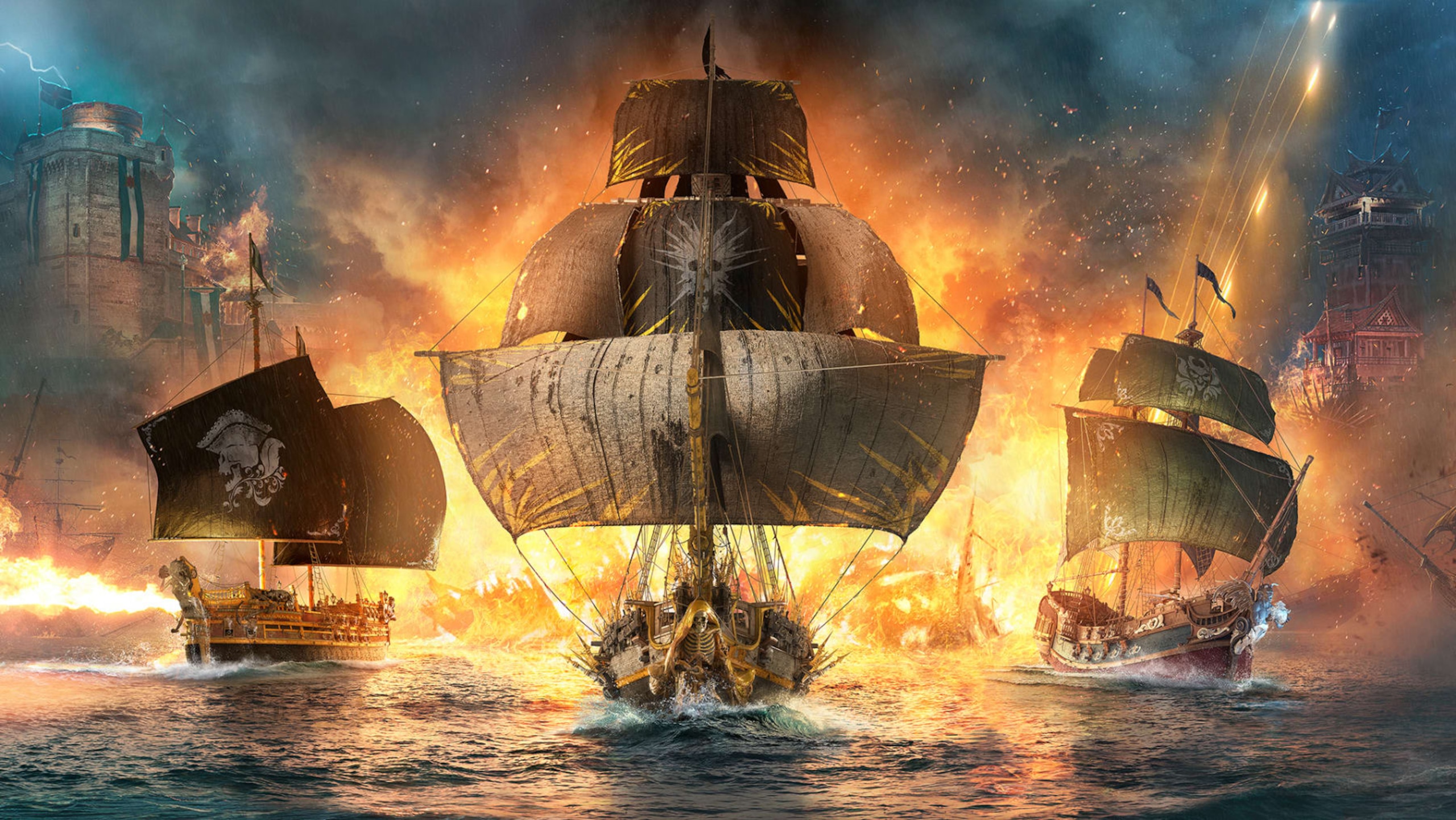


The story of Skull and Bones set sail a long time ago.
Developed by Ubisoft Singapore, work on the game started in 2013 and was billed as an expansion to Assassin's Creed IV: Black Flag.
It sounded like one of the easiest no-brainers in modern gaming history—the pirate-infused ship combat of the first game captivated players and deserved expanded upon. But the title suffered several major reworks, from an MMO to live-service components and many outright delays.
TOP NEWS
.jpg?w=2560 "Chiefs Giants Football")
Mahomes Told Teammate to Leave Meeting

Geno Explains Wilson Exchange

McCarthy Wins 1st Giants Start
Now, Skull and Bones arrives as an open-world RPG and some rather large expectations anyway because frankly, Black Flag has held a soft spot in the hearts of many and itself is still worth revisiting.
After a tumultuous journey, Skull and Bones impressively still has a chance to capture the magic that inspired it.
Graphics and Gameplay
One thing's apparent from the first romp into the Indian Ocean with up to two friends—it's a looker.
If Skull and Bones put super effort into one thing, it was the visual presentation and ambiance. That's an important thing to get right with this particular game more than most, too, considering the Black Flag inspiration.
There was just something downright special (and still is, really) about exiting the usual Assasin's Creed formula and hitting the ocean, singing sea shanties with the crew. One could taste the salt water. It had no business being as good at the pirate thing as it was.
And to its credit, Skull and Bones manages to grasp those heights, presentation-wise. The game's visuals are a treat most others can't match, a colorful, tropical display of what current hardware can do in the best way. Even by boat, traveling to each of the big regions feels distinct.
There's clearly been special attention paid to the stunning explosions of naval warfare as chunks of wood fly into the air and come back down, as fire besieges a deck of crewmen and smoke billows. The physics are impressive, highlighted by just how good foamy waves and things that drive upon them look—never mind how their momentum impacts vessels.
There are moments that will stick with gamers for a long time, like one stunning setpiece that features a lightning storm at night. The shanties are there, the sound design and ambiance of the wildlife is good and it's an overall presentation package most gamers owe it to themselves to check out.
Unfortunately, as hinted, the visuals and vibe represent Skull and Bones' peak.
In a way, it might be better to think about the whole experience as similar to a car game like the Forza series. Players never—not in a way pirate-game way one might expect, at least—leave their ships, merely traversing the world by boat at all times.
The only time a player isn't on a boat is during brief trips to what serves as the game's social hub. But that's forgettable in of itself—they don't feel all that necessary.
Ship combat is fun and scales in engrossing ways. Players will find it necessary to kit out their ships with upgrades to stand a chance at all as they encounter tougher and tougher enemies. And there's some light build crafting that can help when playing with friends, as certain combinations can create something akin to "tank" and "DPS" roles. Base armor ratings, stacking resistances and different types of weapons, be it fire, piercing, flooding or others, define a familiar-feeling experience compared to other games with loadouts, and not in a bad way.
Builds are important, but so is proper communication and aim.
Meaning, properly positioning a boat to get the right set of weapons targeted on an enemy at a time that aligns with the cooldowns of those abilities. Managing a boat's turning radius, the waves, wind and the enemy's positioning many seconds in advance is no easy task, especially at later stages of the game.
For some players, though, how light each ship feels on the water might feel a little too slanted toward the arcade feel than they would prefer. But hey, there are also equippable cannons that can heal ally ships, so suspension of disbelief is already pretty stretched.
Unfortunately, the problem is Skull and Bones will never escape those comparisons to Black Flag. Even if it hadn't technically been a planned expansion to that very game at one point, all those pirate-themed maritime offerings that follow, do so in its gigantic shadow.
So for Skull and Bones to spend this long in the oven, only to omit the experience of actually getting out of one's ship and engaging in on-foot combat while boarding an enemy vessel, is pretty inexcusable. Boarding another ship, instead, is reserved to a blip of a cinematic before players go sailing away again. Likewise, the spirit of exploration of the gorgeous setting gets gutted because players simply cannot pull up to an island, hop out and explore.
Again, it's a little different than say, bemoaning that a racing game won't allow players to pull over and explore the nearest building in a city. The Black Flag shadow is far too large. Even gathering resources from islands across the world, such as gathering up lumber, is reserved for an almost lockpicking-styled minigame from aboard the ship.
It doesn't help that the live-service wrapping creates a grind. Little time-wasting tidbits of missions and ranks to grind in order to unlock small upgrades can feel like busywork. It's especially problematic when there isn't much of a PVE endgame (more on PVP in a bit). The experience can be fun, but actually "finishing" or "winning" Skull and Bones is a matter of time investment and one's patience for checklists.
Story and More
Skull and Bones takes place in the late 17th century, also known as the golden age for the beloved staple modern audiences known as pirates.
But readers might notice that the above is just table-setting background stuff, not actually story. That's because there isn't much doing here. Players meet two notable NPCs at the start, handle a small questline for each that functions more like a tutorial and are then whisked away into the open waters, story-less.
In the same way the gameplay won't be able to escape the shadow of Black Flag, nor will the story escape past pirate offerings across all genres of entertainment. There aren't any anti-hero moments, great suspense, friction amongst a crew, upsetting of world governments or supernatural treasures. Heck, there's hardly a narrative thread between NPCs encountered, as most just feel like fronts for typical looter-game vendors.
One of the unexpected places Skull and Bones really shines is through what is essentially an economy simulator. It seems the size of a minigame and nothing more until really digging into it. But before long, players can manipulate the globe's market by transporting goods (or smuggling them), buying low and selling high and even converting areas into passive-income bases that feed the bank accounts.
This loops in some genuinely fun PVP and PvPvE. Hostile Takeover is a competition to see which player can take down the most ships. Legendary Heists ask players to attack convoys, then each other, with a last man standing sort of feel that's a thrill.
One notable open-world event lets players opt-in to PVP (similar to being marked in Diablo games, etc.) in order to double their yield from a base—but other players on the server get alerted and can attempt to steal them by sinking the player.
The backbone of multiplayer in Skull and Bones is very limited, but also very fun. But it will run into similar problems facing live-service games like Destiny—how many players will want to put up with it at all? At launch, it feels like those who had the most time to play wind up winning, so like the PVE, it's going to need help over the long run.
As a live-service hopeful, there's also the conversation of cash. Microtransactions include being able to use real money to purchase in-game silver—the currency that, among other things, fuels fast travel.
At launch, the game is messy in the area of performance. Erraant notifications pop up sometimes, crashes occur infrequently and little things like texture pop-in clearly need to be ironed out. Sound glitches happen too, including waves losing all sound.
Conclusion
Skull and Bones feels like it's earned a "walk the plank" cliche here.
Mostly, because it suffers from the same issues other live-service games do. Had the game launched as a full-blown experience, then tacked on live-service elements at a later date, it's fair to imagine it would be a much better experience. It's more apparent here than perhaps ever before because it, after all, guts mechanics from a beloved entry in a series from a decade ago.
Even so, if one can look past the eye-roll-worthy live-service systems and lack of a story, there's a chance Skull and Bones can find some serious longevity if supported well with savvy updates and expansions. But with so many similar grind-fests in gaming right now, there are only so many players and so much time.
Skull and Bones can be very, very fun in bursts and thanks to the economy simulation of the late-game, there's more meat on the well, bones, than most live-service offerings. But in a sea of them, it might have to settle for simply being a niche game when a player gets the itch to be a pirate.
.jpg?w=2560 "AP Poll Top Five Week 9")


.jpg?w=2560 "Updates from EVERY NFL Game 🏈")