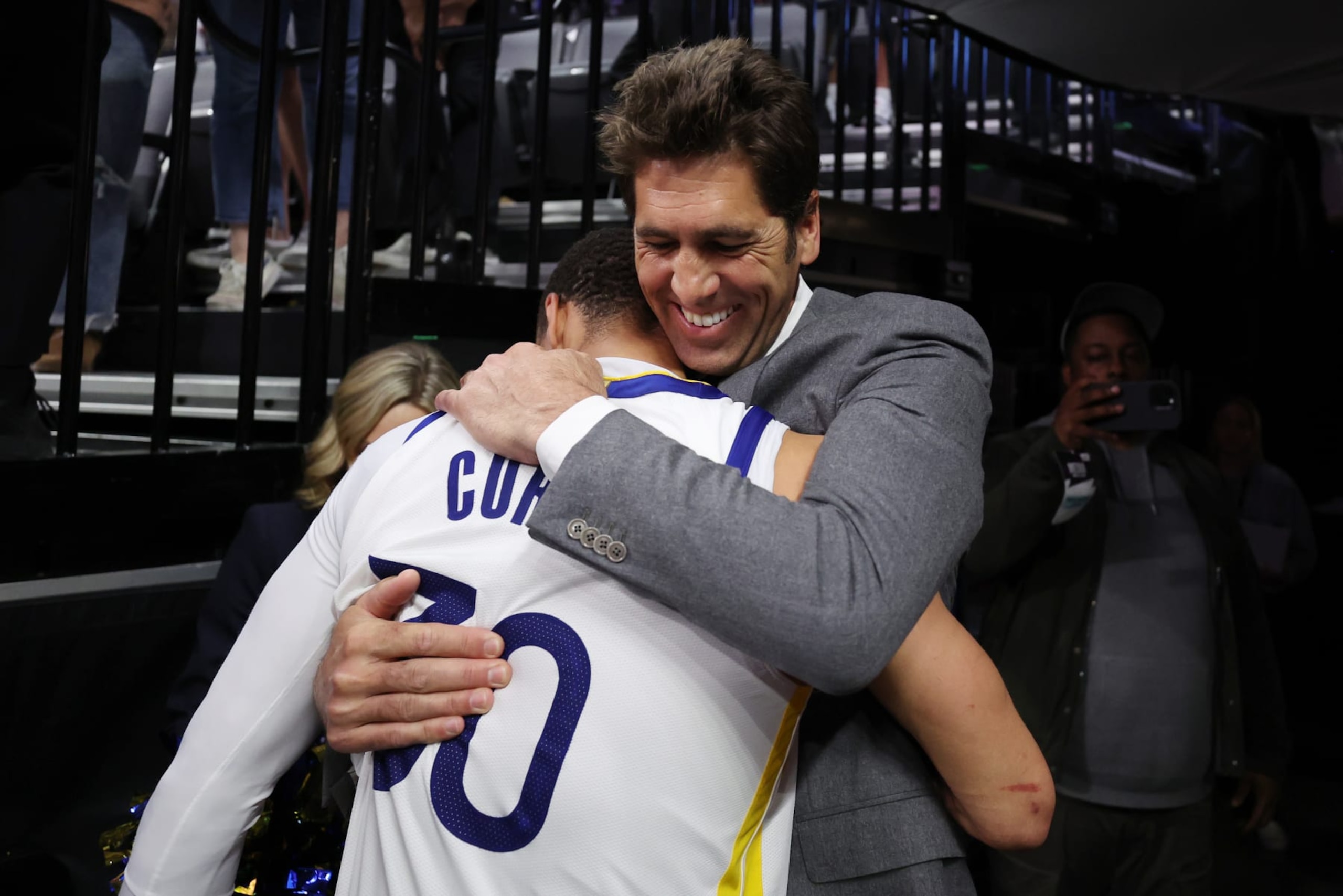

How Myers' Exit Impacts Draymond Green, Klay Thompson Contracts and Warriors Dynasty
The architect of the Golden State Warriors' dynasty is gone.
President of basketball operations Bob Myers announced his intention to leave the Warriors on Tuesday in an interview with ESPN's Adrian Wojnarowski.
"It's just time," Myers said.
TOP NEWS

Buzz: Bron Chopper Part of Deal 🚁

Buzz: Knicks' KAT Offer Revealed

MJ Makes Record-Setting Donation 🙌
Myers' contract is set to expire at the end of June, and he turned down multiple offers that would have "paid him among the league's top-earning executives."
It's unclear whether Myers plans to pursue an opportunity with another team—he'll have no shortage of offers—or pursue another career path. He joined the Warriors organization in 2011 after already putting together a successful career as a player agent by his mid-30s.
What is clear is that the Warriors organization is facing its greatest period of uncertainty since Kevin Durant left in 2019—and perhaps its greatest in nearly a decade. It was Myers who orchestrated the core of Klay Thompson and Draymond Green around Stephen Curry, who helped convince Durant to sign with Golden State in 2016, and who reconfigured the roster after Durant's departure and built another championship core.
The most obvious—and likeliest—way for the Warriors to continue foraging forward without Myers is to rely on the foundation he built.
Mike Dunleavy Jr. is the favorite to take over for Myers, having been groomed for the job since becoming his right-hand man in 2019. He has basketball bonafides, having played 15 seasons in the NBA, and he recently represented the Warriors at the NBA general manager meetings.
Kirk Lacob, the son of governor Joe Lacob, may also have a more "prominent" role in basketball operations moving forward, according to Wojnarowski. Kirk Lacob has been with the franchise behind the scenes for more than a decade, but there would be undoubtedly concerns of nepotism if he's given the top job over Dunleavy.
Regardless, whoever inherits this roster does not have a straightforward path to title contention.
This is a Warriors team that fractured under the weight of championship expectations before the season even began, with Draymond Green's fist hitting Jordan Poole's jaw and shattering team chemistry in the process. Coach Steve Kerr admitted the Warriors, who went 44-38 and looked discombobulated on the road all season, never had trust in one another after the incident.
"Anytime some trust is lost, then it makes the process much more difficult, and there was some trust lost," Kerr told reporters after the Warriors' second-round playoff exit. "That's as blunt as I can be. We have to get back to what has made us really successful, which is a really trusting environment and a group that relies on one another and makes each other better."
Green has a player option for next season and is likely to decline that deal in search of a long-term contract. The Warriors may have to decide between keeping Green or Poole—not only due to potential chemistry issues but also financial constraints.
Perhaps the biggest change in the NBA's new collective bargaining agreement is a new set of financial rules aimed directly at the league's richest teams. Franchises $17.5 million above the tax apron are set to face the following consequences once the new rules are fully implemented in 2024-25:
- The inability to use any cap exceptions to sign a player (e.g. taxpayer mid-level, biannual exception)
- The inability to sign players on the buyout market
- The inability to include cash in trades or take on more salary than is outgoing in a deal
- The inability to trade a draft pick seven years into the future
If that's not prohibitive enough, teams that go over the second tax apron twice in the span of four years will have their draft pick seven years in the future kicked to the end of the first round. The second apron is as close to a hard cap as we're ever likely to see in the NBA. Teams will occasionally go over it in chase of a championship, but the days of the Lacobs and Steve Ballmers just throwing money at role players is over.
The Warriors will not be able to retain their current roster without blowing the second tax figure out of the water. Poole's four-year, $128 million extension kicks in next season, giving Golden State $210.7 million in taxable salaries. (That figure includes Green's player option, but the number works as a functional hold because it's unlikely he'd return for anything less than $25 million per season.)
The Warriors could kick the can down the road for one more year and wait until the new financial rules fully form, but there's no light at the end of this tunnel. If the Warriors decide to retain Green and Poole, the odd man out becomes Thompson, who reportedly will be seeking a maximum contract extension this offseason.
There is no scenario in the new NBA world in which Green, Poole and Thompson are all in the Warriors' long-term plans. One of them has to go. Logic would dictate it would be Green or Poole given the tension between the two clearly never subsided, but Thompson is 33 years old with two catastrophic leg injuries in his not-too-distant past. If Green and Poole could patch things up, there's some logic in running things back for a year and allowing Thompson to leave in free agency.
Poole is a flawed decision-maker and inconsistent defender, but he's a full decade younger than Thompson and a better playmaker. There's something to be said for giving him increased playmaking responsibilities to lessen the load on Curry and Green as they age. Thompson has never been a great playmaker, and his defense has understandably been his biggest regression point since coming back from injury.
If Myers had returned, smart money would have been on the Warriors riding out the trio of Curry-Thompson-Green until the wheels fall off. There's a significant bond Myers formed with the three stars over more than a decade, and the players have been open about wanting to play together for as long as possible.
In a sense, Myers stepping down could be a final act of servitude to the organization, allowing a new voice to come in and make difficult decisions he couldn't.
Or maybe he saw more than $230 million guaranteed to Poole and Andrew Wiggins and decided to get out while the getting's good. Either way, Myers' exit is the first domino falling in what could be the collapse of the Warriors dynasty.




.jpg?w=2560 "Love's Body Already 'Tired'")
.jpg?w=2560 "Mahomes' Wife Trolls Kubiak 💀")

.jpg?w=2560 "2 NFL Officials Suspended")