

Trade Packages to Jump 5 Teams into the 2023 NBA Draft Lottery
To whomever ordered the fresh batch of trade proposals featuring 2023 NBA lottery picks: It's ready.
But be careful, it's still hot.
And maybe a little spicy.
This latest trade-idea dump will seek to place teams into lottery selections without giving up a top-14 pick of their own. This means we're in the market for squads that could reasonably try to enter the draft lottery or that have the equity to acquire a second pick in the top 14.
Assume that all of these deals will be completed during the new league year. Some proposals require the lottery picks to be used as actual salary within the package. Others will need them to be moved before they count against calculations. Rest assured, though, all of these ideas fit within the NBA's trade rules.
The only question left to ask: Who says no?!
Brooklyn Hits the Reset Button
1 of 5
Brooklyn Nets Receive: Nassir Little, Shadeon Sharpe, No. 3 pick, No. 23 pick
Portland Trail Blazers Receive: Mikal Bridges, Nicolas Claxton
The Houston Rockets control the Nets' next four first-rounders after this year, with outright ownership in 2024 and 2026, and then unprotected swap rights in 2025 and 2027. That gives Brooklyn plenty of incentive to avoid hitting reset.
This jibes with recent reporting. The Nets aren't looking to move Bridges, and the combination of No. 3 and Shaedon Sharpe won't change their mind according to The Athletic's Alex Schiffer.
This feels extreme. The third overall pick gets the Nets Scoot Henderson or Brandon Miller. Sharpe was drafted seventh overall last year and doesn't turn 20 until May 30. Getting both for Bridges is worth consideration. He may be a rising star on one of the league's best contracts (three years, $69.9 million), but he'll celebrate his 27th birthday in August. Graduating into top-20-player territory would be one of the all-time developmental anomalies.
If Brooklyn is really turning down a pair of top-seven prospects for Bridges, it better plan to acquire a marquee name of its own. Slow-building around him, without many of your own firsts, is a ticket to the middle.
Portland's end of the table is less complicated. It likely argues that Sharpe and No. 3 are an overpay for someone yet to make an All-Star team. Lopping off Nurkić's deal and adding Claxton's defense evens out the perspective. Brooklyn probably flinches at including the latter. He's still only 24. But he'll be up for a raise after next season, and the Nets are getting yet another first (No. 23) on top of everything.
Atlanta's Inevitable Bookkeeping Begins
2 of 5
Atlanta Hawks Receive: Lindy Waters III, No. 12, 2024 first-round pick (less favorable from Oklahoma City and L.A. Clippers; lottery protection; turns into two second-rounders if not conveyed)
Oklahoma City Thunder Receive: Clint Capela, No. 15
Team governor Tony Ressler has yet to pay the tax since taking control of the Hawks. On a somewhat related note: Atlanta is scheduled to be more than $10 million into the tax next season.
That won't hold. Ressler has only ever given lukewarm indications he'd cannonball into the tax. And the caveat is always the same: The Hawks must be good enough.
This roster, as currently constructed, isn't good enough. That's left many scrambling to find John Collins trades. And that practice will endure. But Capela himself could become collateral damage. His contract is shorter (two years, $42.9 million), and the Hawks have a(n undersized) replacement behind him in Onyeka Okongwu.
Flipping Capela for a cheap motion shooter (Waters), a three-spot jump in this year's draft and a lottery-protected pick isn't sexy. Maybe Atlanta can get more. But for all his value on the glass and around the basket, Capela is past his athletic prime and limited on the offensive end.
Shaving almost $20 million off next year's books is part of the value here, too. The Thunder are looking at $30-plus million in cap space they're unlikely to actually spend. They'd probably prefer to burn flexibility on a combo forward, but they also need to get bigger up front, period. Capela accomplishes that while coming off the books before their core gets expensive, and a healthy Chet Holmgren has the spacing and ball skills to play alongside him.
Utah "Splurges" on Second Lottery Pick
3 of 5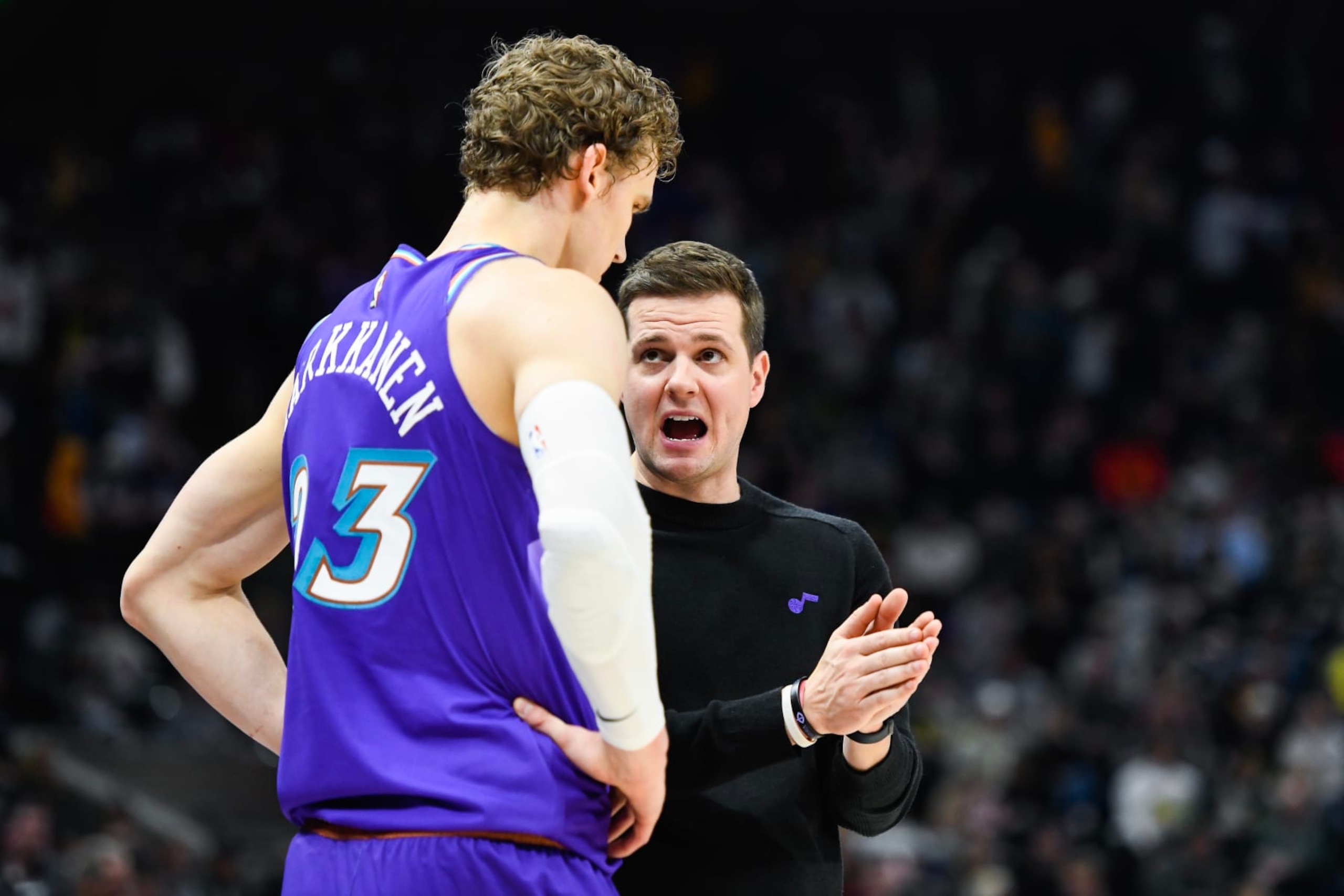
Utah Jazz Receive: No. 13 pick
Toronto Raptors Receive: No. 16 picks, No. 28 pick
Armed with three firsts in this year's draft (Nos. 9, 16 and 28), the Jazz are prime trade-up/deal-for-a-second-lottery-pick candidates.
Granted, Utah needs to have someone it really likes at No. 13 to punt on No. 28. That's eminently possible. The back end of the lottery through the rest of the first round is a minefield of scenarios.
Perhaps the Jazz want to ensure they can bag one, if not both, of Anthony Black and Gradey Dick. This deal makes that happen. If there's someone they're smitten with at No. 28, they can try buying a pick near the start of the second round.
The Raptors may not bite if they don't see an infusion of shot-making and/or creation available at No. 16. This might be a no-go should Cason Wallace tumble to No. 13. But if he's already off the board, drafting at No. 16 leaves them in play for Jordan Hawkins, Nick Smith Jr., Kobe Bufkin, Brice Sensabaugh, et al.
Snaring a late first-rounder is also shrewd for a Toronto franchise potentially on the verge of funneling massive amounts of money into its core. Jakob Poeltl, Gary Trent Jr. (player option) and Fred VanVleet (player option) are all free agents this summer. OG Anunoby (player option) and Pascal Siakam follow suit in 2024. This trade gives the Raptors a chance to scoop up a cost-controlled contributor.
Phoenix Moves on from Deandre Ayton
4 of 5
Phoenix Suns Receive: Davis Bertans, Tim Hardaway Jr., No. 10 pick
Dallas Mavericks Receive: Deandre Ayton
Sources told ESPN's Tim MacMahon that Ayton would welcome a fresh start elsewhere. The Suns probably feel the same way after watching him in the playoffs (and, frankly, the regular season).
Moving on from head coach Monty Williams may increase the likelihood that Phoenix sticks with Ayton. Still, his salary remains prohibitive. Paying over $30 million per year to a center who provides neither a consistent defensive nor offensive punch is difficult when you have almost $84 million allocated to Kevin Durant and Devin Booker and another expensive season left on Chris Paul's deal.
Turning Ayton into Bertans (two years, $33 million), Hardaway (two years, $34 million) and the 10th overall pick isn't blockbuster stuff. The two inbound contracts aren't great, and a lottery prospect likely won't have have an immediate impact.
Breaking up Ayton's deal into a pair of smaller ones is nevertheless valuable. They should be easier to move in subsequent trades, and the No. 10 pick is another asset Phoenix can dangle. Worst-case scenario, the Suns end up with a top-10 prospect to groom and a whole bunch of extra shooting and then look to fill the center void on the cheap.
Dallas' side is more straightforward. It desperately needs a defensive backbone. Ayton was up to the task less than two years ago. There's risk involved. And the Mavs will need Ayton to be comfortable continuing his third-wheel status alongside Luka Dončić and Kyrie Irving. But getting off two less-than-awesome contracts mitigates some of the downside.
Indiana Scoops Up a Second Top-10 Pick
5 of 5
Indiana Pacers Receive: Maxi Kleber, JaVale McGee, No. 10 pick
Dallas Mavericks Receive: Myles Turner
Shipping out Myles Turner for another lottery pick doesn't necessarily align with the Pacers' window. They have spent, roughly, the past two seasons rebuilding harder than they normally do. With a tantalizing nucleus in place and oodle of cap space, they may have designs on taking a galactic leap next year.
Moving Turner runs counter to that aim. But entering 2023-24 with two top-10 prospects alongside Tyrese Haliburton and Bennedict Mathurin is endlessly intriguing. The Pacers could also look to repackage No. 10 with No. 7 in an attempt to climb further up the lottery ladder.
Oh, and who's to say Indy devolves into deliberate disaster anyway? This trade keeps the Pacers' $25-plus million worth of cap space intact, and they're getting a rock-solid big man who can sponge up reps at the 4 or 5 in Kleber. McGee's deal is a net negative, but it's cheap and short enough (two years, $11.7 million) to be little more than a footnote.
The Mavs might cower at the thought of losing Kleber. But Turner is the rare big who capably stretches the floor and protects the rim. His offense outside of spot-up sniping also improved this past year, and the smarts with which he defends near and away from the hoop are just what a team that plans to build around Luka Dončić and Kyrie Irving needs.
Unless otherwise noted, stats courtesy of NBA.com, Basketball Reference, Stathead or Cleaning the Glass. Salary information via Spotrac.
Dan Favale covers the NBA for Bleacher Report. Follow him on Twitter (@danfavale), and subscribe to the Hardwood Knocks podcast, co-hosted by Bleacher Report's Grant Hughes.
.jpg?w=2560 "Lions DC Defends Play Calls 🫥")
.jpg?w=2560 "Jazz Chisholm Landing Spots📍")