Where The Bloodline Rank Among Greatest Factions in History Before WWE WrestleMania
Factions are a staple of the pro wrestling industry, groups of competitors coming together in an attempt to dominate the scene while providing backup and support for each other.
They are typically heel groups, with the leader being a main event-level star who surrounds himself with friends and/or family in an attempt to preserve his spot at the top.
Over the years, some of the hottest stories have been attributed to the involvement of factions. The current era of WWE programming is no different, thanks to the presence of The Bloodline, a family-based group that has dominated in the name of keeping Roman Reigns' spot as The Head of the Table.
But where do they rank among the greatest of all time as they prepare for the culmination of two years of exploits at WrestleMania 39 on April 1-2?
Let's journey through wrestling history to decide their place.
8. The Hart Foundation
1 of 8Members: Bret Hart, Owen Hart, Davey Boy Smith, Jim Neidhart, Brian Pillman
Formed in 1997 in correlation with Bret Hart's heel turn, The Hart Foundation quickly became a centerpiece of WWE booking.
The anti-American faction were beloved everywhere but the United States, where fans greeted them with deafening boos as they opposed the popular "Stone Cold" Steve Austin, The Undertaker, Shawn Michaels, Ken Shamrock and Goldust, among others.
The Hitman, his brother Owen Hart, brothers-in-law Davey Boy Smith and Jim Neidhart, and family friend Brian Pillman have been underrated in the story of WWE's come-from-behind win in the Monday Night Wars, with many forgetting they helped shift the tone of the company's programming.
Whether the top heels in America or beloved heroes north of the border in their native Canada, the Hart Foundation ruled over WWE for one unforgettable summer.
It is their lack of longevity that hurts their spot in these rankings, even if they are still revered some 25 years later.
7. Bullet Club
2 of 8Members: Ace Austin, Bad Luck Fale, Chase Owens, Chris Bey, Dick Togo, Doc Gallows, El Phantasmo, Evil, Gedo, Juice Robinson, Karl Anderson, Kenta, Sho, Taiji Ishimori, Yujiro Takahashi, Adam Cole, Adam Page, AJ Styles, Bone Soldier, Cody Rhodes, Cody Hall, El Terrible, Frankie Kazarian, Gino Gambino, Hikuleo, Jado, Jay White, Kenny Omega, La Comandante, Marty Scurll, Matt Jackson, Nick Jackson, Prince Devitt, Robbie Eagles, Tama Tonga, Tonga Loa
There are few modern factions more influential on the landscape of professional wrestling than Bullet Club.
The brainchild of Prince Devitt (Finn Bálor) in the mid-2010s, the New Japan Pro-Wrestling group would go on to become a headline act around which top storylines would revolve.
Over the years, they have been forced to change leaders as greater opportunities presented themselves, but the men who have filled that role are a Who's Who of pro wrestling: AJ Styles, Devitt, Kenny Omega and Jay White.
Cody Rhodes, Adam Cole and The Young Bucks are just some of the men who filtered in and out of the group while making it one that transcended the sport.
Bullet Club shirts, hats, backpacks and more became prominent in pop culture, while the stable's popularity sparked renewed interest in the Japanese wrestling scene.
Unfortunately, the group struggled to maintain the momentum when Omega, the Bucks, Page and Rhodes left to create All Elite Wrestling. And despite a wealth of talent, it hasn't been able to reach the heights it did prior to 2019.
Still, the popularity of Bullet Club and its sub-factions, such as The Elite, allowed their most prominent members to realize the desire of wrestling fans for a true alternative, indirectly leading to the formation of AEW.
6. D-Generation X
3 of 8Members: Triple H, Shawn Michaels, Rick Rude, Chyna, X-Pac, Road Dogg and Billy Gunn
D-Generation X have been a persistent presence in WWE over the years.
The faction began as an anti-authority, rebellious one that spat in the face of tradition and followed it up with an irreverent crotch chop. It raised hell, mocking the likes of Bret Hart and The Undertaker before Michaels' loss to Steve Austin at WrestleMania XIV threatened its existence.
However, Triple H picked up the ball dropped by his teammate and ran with it, recruiting X-Pac and the New Age Outlaws to fill out the group alongside him and Chyna. What resulted was one of the most popular factions of all time and a staple of Attitude Era television.
The reboot in 2006 was a watered-down mess that relied on Dad jokes as Triple H and Michaels attempted to relive the past while making life a nightmare for Vince McMahon. But the fans bought it and the merchandise, so it was a success. Ditto the return in 2009.
Over the years, the faction pops up on legends nights and reunion shows and is generally met with positive reactions every time.
In 2019, D-X were inducted into the WWE Hall of Fame, forever solidifying their place in wrestling history.
If there was a flaw, it was in how far removed from their original ideals the group became over the years. The edginess wore off, the controversy was extinguished and what remained was a caricature of the old group rather than a return to form.
For that reason, they falter a bit in these rankings, even though they remained a main event attraction throughout their existence.
.jpg?w=2560)
.jpg?w=2560)
5. The Shield
4 of 8Members: Roman Reigns, Seth Rollins, Dean Ambrose
Technically, The Shield are a trio, but there are few groups of the last 20 years that have made the impact and continue to have a presence like they have.
Roman Reigns, Seth Rollins and Dean Ambrose exploded onto the scene in 2012 and immediately provided WWE television with a much-needed injection of youth and energy.
Intent on proving themselves as the future of the industry, they wasted no time showing up and showing out while sharing the ring with major names such as John Cena, Big Show, Randy Orton, Sheamus, Ryback and more.
They proved their worth in banger match after banger match while also leaving fans buzzing after every appearance.
Their year-and-a-half inaugural run was among the best any faction has ever enjoyed, with Reigns and Rollins striking gold in the tag team division while Ambrose went on a historic run with the United States Championship.
They were so over that, by the spring of 2014, there was no choice but to turn them babyface and program them opposite Triple H, Randy Orton and Batista in a feud with Evolution; a feud they won with consecutive pay-per-view victories.
A premature breakup after that program saw each man embark on singles runs, to varying degrees of success. Eventually, though, all three were established stars who captured a world title, making their 2018 reunion that much more special.
Rarely does a faction change the landscape, develop three stars who become world champions, then reunite successfully as The Shield did. What could have been a waste of three talented individuals instead became one of the greatest success stories in WWE.
Today, Rollins and Reigns rule the roost in WWE while Ambrose has found success as Jon Moxley in AEW, where he is the only three-time world champion in the promotion's history.
4. Evolution
5 of 8Members: Triple H, Ric Flair, Randy Orton, Batista
From the foundation built by The Four Horsemen (more on them shortly) came Evolution, which was an attempt by Triple H to recreate something he loved about 1980s Jim Crockett Promotions placed in a modern setting in 2003.
The result was a faction that highlighted both him and Ric Flair while helping to develop two stars of the future in Randy Orton and Batista.
It was a rough start, to say the least, thanks in large part to untimely injuries to The Legend Killer and The Animal, but they eventually got on track; and when they did, they dominated.
The heel quartet battled every top star on Raw while ensuring they remained the focal point of the creative efforts. Triple H carried the world title for a long period, Orton won the Intercontinental Championship, and Batista and Flair enjoyed a run as tag team champs.
When Orton captured the same World Heavyweight Championship Triple H coveted, though, the faction saw its first fracture. The third-generation star was booted and in the wake of that betrayal, Batista began to notice that all was not as it seemed within the group as Triple H made moves that directly benefited himself instead of anyone else.
Eventually, The Animal won the Royal Rumble and decided to challenge his mentor for the top prize in the industry, defeating him at WrestleMania 21 and splitting the group up for good. Or at least until 2014, when they reunited to feud with The Shield in a losing effort.
Like The Hart Foundation, Evolution's dominance was fleeting. It was short-lived but what it accomplished is undeniable. Like The Shield, it helped establish two main event, world champions whose contributions to the future of the industry were enormous.
Orton remains an active competitor and always a threat to win a world title, while Batista is primed to join Triple H and Flair in the WWE Hall of Fame sooner rather than later.
Evolution accomplished what they set out to and left the WWE product in better shape than they found it. As a result, they earn their place among the elite factions of all time.
3. New World Order
6 of 8Members: Scott Hall, Kevin Nash, Hollywood Hogan, Ted DiBiase, The Giant, Fake Sting, Vincent, Syxx, Miss Elizabeth, Nick Patrick, Eric Bischoff, Buff Bagwell, VK Wallstreet, Big Bubba Rogers, Scott Norton, Randy Savage, Dennis Rodman, Konan, Curt Hennig, Rick Rude, Louie Spicolli, Dusty Rhodes, Brian Adams, Scott Steiner, The Disciple, Lex Luger, Sting, Stevie Ray, Horace Hogan, Disco Inferno, David Flair, Torrie Wilson, Bret Hart, Jeff Jarrett, Midajah, Ron Harris, Don Harris, Booker T, Shawn Michaels
New World Order were a game-changing faction.
Led by "Hollywood" Hulk Hogan, Kevin Nash and Scott Hall, they shook up an industry when it was badly needed and brought new life to professional wrestling. They were edgy and cool and had a sense of realism in WCW that directly opposed the more over-the-top, cartoony nature of Vince McMahon's WWE.
The introduction of the NWO brought a drastic shift in television viewership, fueling WCW to an unpredictable 83-week smackdown in the battle for ratings supremacy while breathing new life into its leaders' careers.
It also proved effective in making pro wrestling must-see television. The rise of the NWO and the ripple effect it caused in the industry made fans flock back in droves, resulting in a boom period that remains one of the most successful in the long and prosperous history of sports entertainment.
The faction went through several incarnations in both WCW and in McMahon's promotion once he purchased his competitor, wreaking havoc and threatening the stability and future of both companies along the way.
To this day, though, it is not uncommon to see fans rocking the familiar NWO letters on T-shirts and hats. Had management, including group member Eric Bischoff, resisted the urge to overexpose it and water it down with too many members, the faction could have landed the top spot in these rankings.
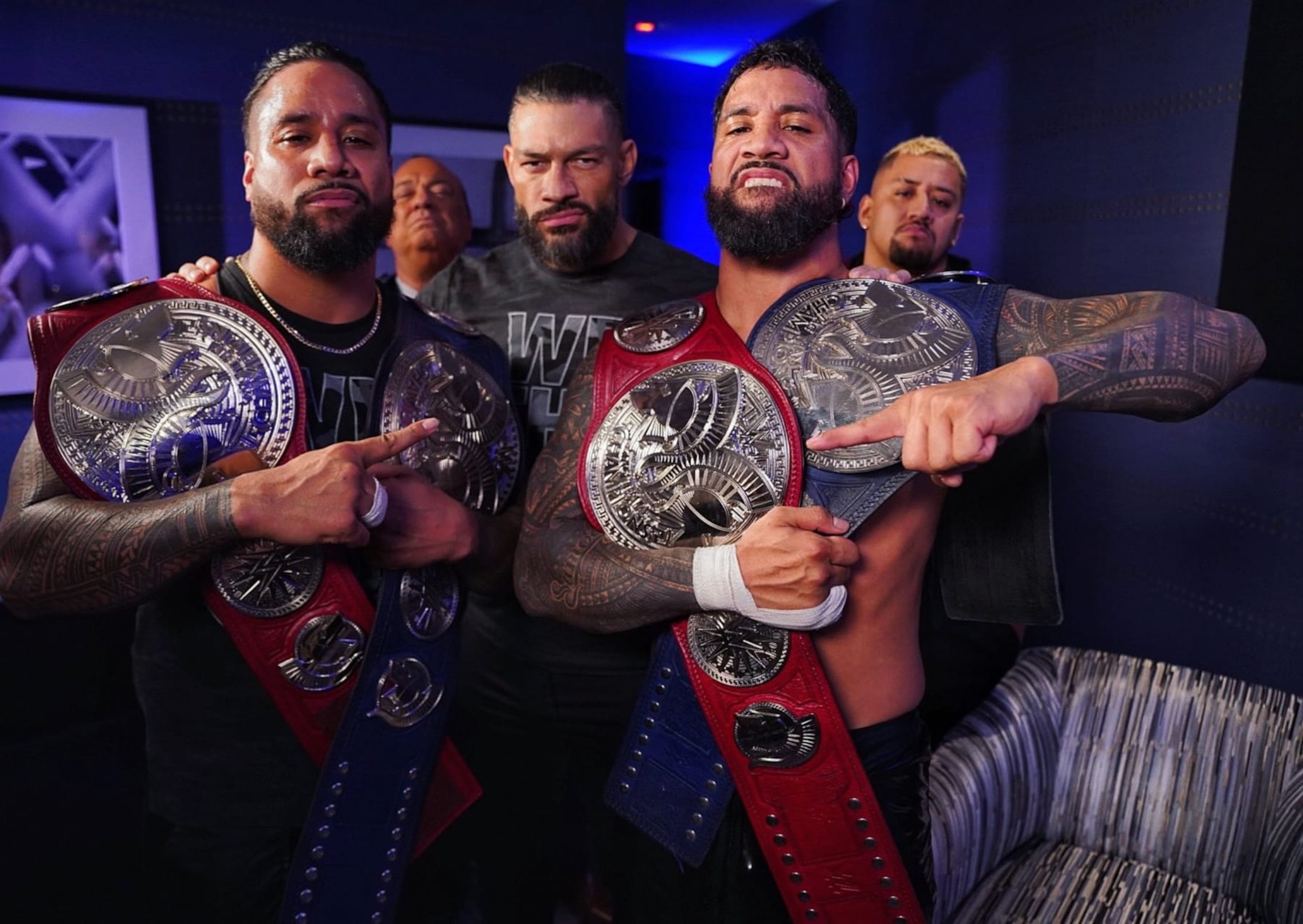
2. The Bloodline
7 of 8Members: Roman Reigns, Jimmy Uso, Jey Uso, Solo Sikoa, Paul Heyman
Recentness is a very real thing, with the emotion and excitement over something new and shiny sometimes swaying judgment. That is undeniable.
What is not is that the creative surrounding The Bloodline and its production has created some of the best television WWE fans have seen in decades, earning the faction the No. 2 spot on this countdown.
Reigns realized his fullest potential as the egotistical star heel of the company, accepting the advice of "Wise Man" Paul Heyman and proceeding to insulate himself within his family.
First, he shattered Jey Uso's independence by defeating him in two consecutive pay-per-view matches, then won over Jimmy. When the tag team champions were not enough to secure his continued dominance, he turned to Solo Sikoa.
Still not content that he was properly protected from defeat, he allowed Sami Zayn into the group.
They are still evolving as a faction, with plenty of stories still to tell. What has made the group so successful are its many layers and threads. Reigns is a manipulator, something Zayn figured out before betraying him. It is something he is trying to convey to The Usos, but their loyalty to their cousin is strong.
Well, maybe, because Jey is starting to rediscover independence and exactly how self-centered his cousin is, teasing a schism within the family.
Add the in-ring dominance in both the singles and tag team divisions, and you have a faction that has captivated a generation of fans and controlled the overarching narrative on WWE television for two years.
Best yet, their story has rarely felt stale. That is a testament to those involved, the storytellers at work and the performances of the stars.
1. Four Horsemen
8 of 8Members: Ric Flair, Ole Anderson, Arn Anderson, Tully Blanchard, Lex Luger, Barry Windham, Sting, Sid Vicious, Paul Roma, Brian Pillman, Chris Benoit, Steve McMichael, Curt Hennig, Dean Malenko, Jeff Jarrett, JJ Dillon
The Four Horsemen may not have been the first wrestling faction, but they are the inspiration for all that have come after them.
The result of a one-off line by Arn Anderson in a promo, during which he referred to himself, Ole, Blanchard and Flair as "The Four Horsemen of the Apocalypse," the group grew into a dominant entity at the top of Jim Crockett Promotions.
They were the heel foil to popular babyfaces such as Dusty Rhodes, Ricky Steamboat, Nikita Koloff, The Road Warriors, Barry Windham and Sting.
Flair's bravado, Blanchard's arrogance and the Andersons' gleeful ability to beat people up helped establish the group as one of the most over in wrestling history.
Over the years, stars would be cycled in and out as need demanded, with the aforementioned Windham being a great addition, but the core of Flair and Arn remained constant.
The 1990s brought tumultuous times for the Horsemen as creative failures doomed them to mediocrity, but there was no denying that during the height of their run through the National Wrestling Alliance, they were an unstoppable force that won over the fans (by angering them) and set up unforgettable rivalries that will live on well beyond the men involved.
The influence of the Horsemen can be seen in every major faction that has followed, including several on this list. There is a main eventer at the head of the group, a dominant tag team and an enforcer-type or midcard champion to go along with them.
The Bloodline, D-Generation X, Evolution and even the core of NWO are evidence of the group's influence on the immediate and long-term future of the industry.
That they are still cited as the preeminent faction in wrestling nearly 40 years after first forming is a testament to what Flair and Co. created by accident while selling a few multi-wrestler tag matches during the territory days.

.jpg?w=2560 "Reported Details of Seahawks-K9 Split")