
From MVP to Liability: The Dodgers Have a Massive Cody Bellinger Problem

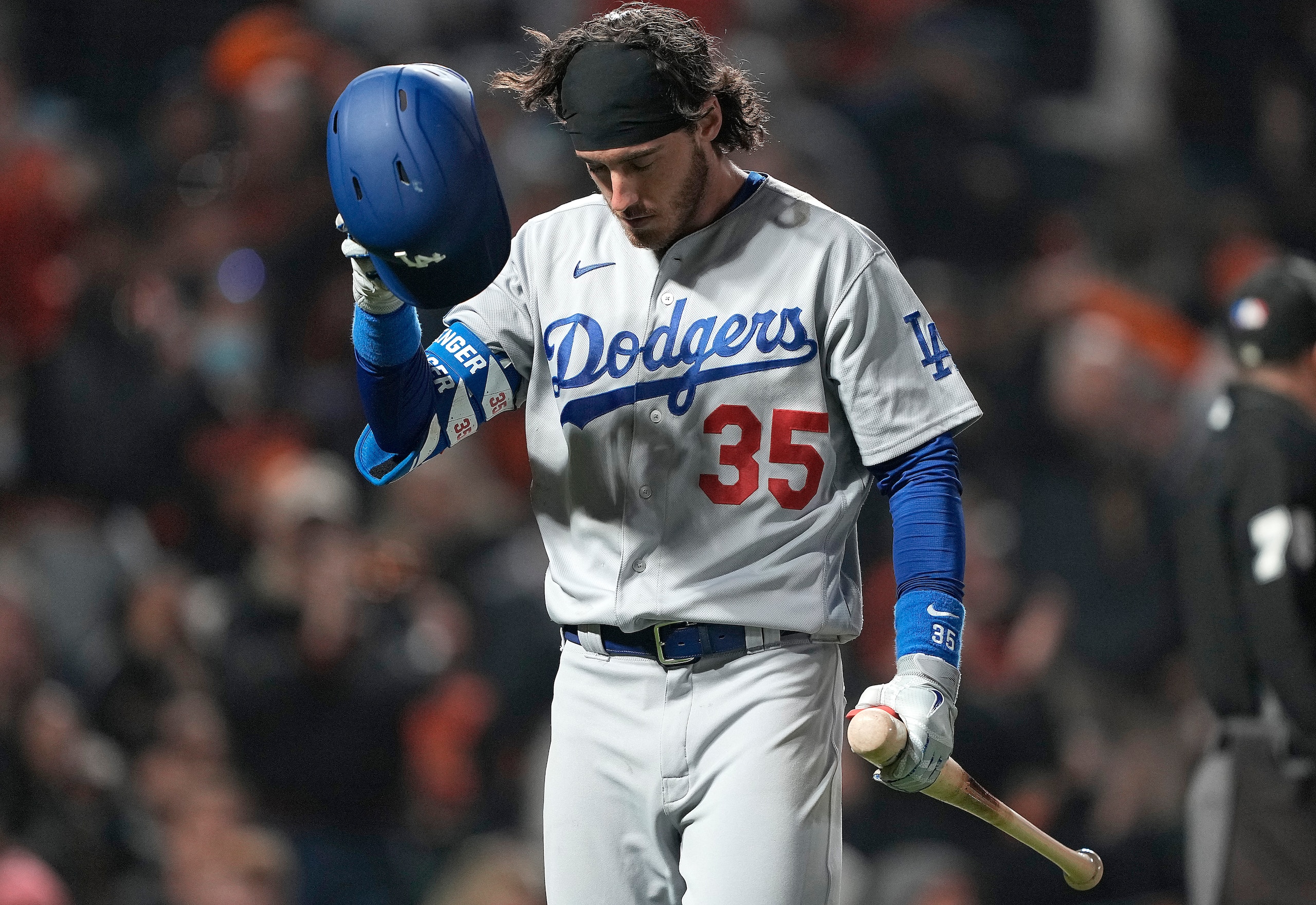
The Los Angeles Dodgers aren't where they want to be as the end of the 2021 season draws near, yet it is commendable that the reigning World Series champions are 35 games over .500 even though one of their four MVPs has become one of the worst players in baseball.
Sorry, Cody Bellinger. But there's no other way to put it.
It was only two years ago that the 26-year-old outfielder/first baseman was arguably the best player in Major League Baseball, much less the National League. His 2019 season saw him rack up a .305/.406/.629 batting line with 47 home runs and an NL-best 8.6 rWAR, all of which made him the easy choice for the NL MVP award.
TOP NEWS
World Series Game 2 Highlights 🎬
Miz Trades Cards With Kid 🥹

MLB Commissioner Defends Salary Cap
His swing, which was already plenty sweet in his first two seasons with the Dodgers in 2017 and 2018, was never sweeter than in 2019:
In 2021, though, Bellinger isn't that guy anymore.
His minus-1.7 rWAR is third-worst among position players who've taken at least 300 plate appearances. On offense, specifically, he has only nine home runs and a .158/.232/.292 batting line that translates to a 42 OPS+. That's 66 points below league average and second-worst among that same field of players.
In spite of all this, Bellinger has started in 73 of the 82 games he's played this season. That partially speaks to the injury issues that the Dodgers have had in their outfield, but it also speaks to their fundamental dilemma with Bellinger.
Basically, just how impatient should they be with a guy who was one of baseball's brightest superstars so recently?
Is Bellinger Damaged Goods?
There's at least one extent to which Bellinger's struggles are understandable, in that he's almost certainly not 100 percent healthy.
Bellinger has had to go on the injured list twice this season, first with a broken leg in April and again with hamstring tightness in June. And this is after the left-handed swinger initially came into the season off surgery to repair a right shoulder that he dislocated more than once, including during the Dodgers' triumphant World Series run in 2020.
In contextualizing just how difficult it is for a hitter to fully recover from surgery to his lead shoulder, Dodgers manager Dave Roberts pointed to the experiences of two notable former Dodgers when speaking to reporters (via Matt Borelli of DodgerBlue.com):
"He’s grinding. He’s been grinding. It’s been a difficult time for him trying to perform at this level and still trying to get that front shoulder strength when you’re recovering from a surgery. "
"Dodger fans know, whether it’s Adrian Gonzalez having to go through that, Matt Kemp going through that same type of thing, that first year out is tough. Cody’s going through it."
If Bellinger's right shoulder is indeed not yet at full strength, that would explain why he hasn't been hitting the ball as hard. Though his average exit velocity of 89.4 mph doesn't mark a career low, the same isn't true of his 33.8 hard-hit percentage.
More specifically, his hard-hit rates have dropped off on his pull side and to the opposite field while more or less remaining steady up the middle:
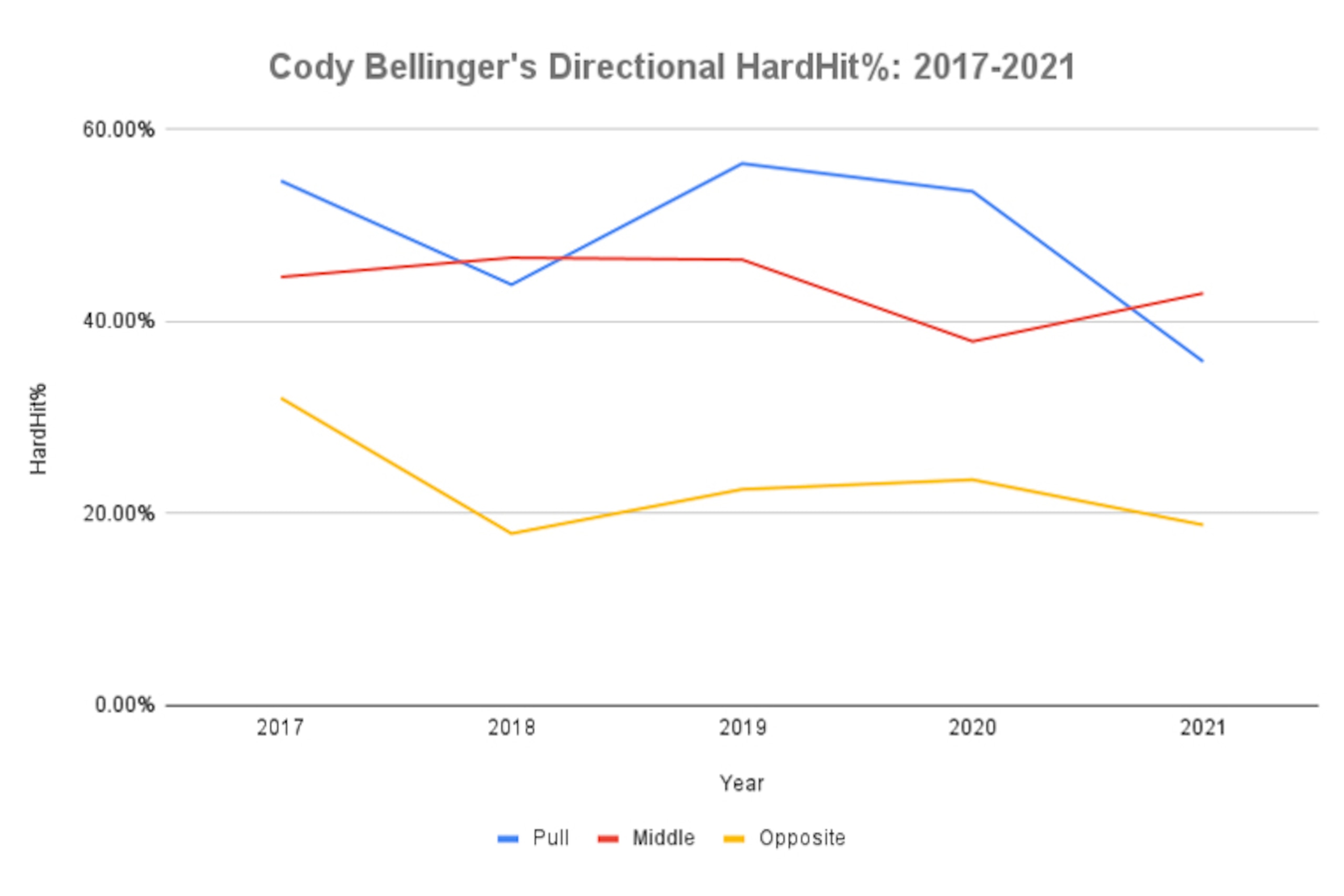
This means Bellinger's power has effectively been cut off from the two sides of the field where the outfield fences are closest. His loss of power to right field is especially painful, as that's the area that accounts for 86 of his 132 career home runs.
The Dodgers might have anticipated Bellinger's surgically repaired shoulder being a problem early in the season after he was limited to 28 at-bats during spring training. But whereas they might have hoped that time would literally heal this particular wound, by now they ought to be past the point of having second thoughts.
This Is an Ongoing Decline
Bellinger's time with the Dodgers is already a tale of two careers, and the demarcation line between the good and the bad isn't where you probably think.
The good began with a 2017 season in which he won the NL Rookie of the Year on the strength of what was then a National League rookie record 39 home runs. He took a step back in 2018 but was still mostly good, as he hit .260/.343/.470 with 25 long balls. He then had an otherworldly first half in 2019, hitting .336/.432/.692 with 30 homers.
In the second half of '19, however, pitchers limited Bellinger to a good-not-great .263/.371/.546 slash line and 17 homers. A key approach involved throwing fastballs higher, going from an average height of 2.55 feet to 2.78 feet. Accordingly, his slugging percentage (see here and here) against fastballs fell by over 100 points.
The experience threw Bellinger for a loop, as Roberts told reporters in July 2020 that it was precisely because of the slugger's difficult second half that he went into the following season with a more compact swing.
Suffice it to say the changes didn't work. Though he had some moments in the playoffs—including a series-clinching home run in Game 7 of the National League Championship Series—Bellinger otherwise hit a modest .239/.333/.455 in the regular season.
So, he changed his swing mechanics again ahead of the 2021 season. This time, he was familiarly upright in the box but with more of an open stance:
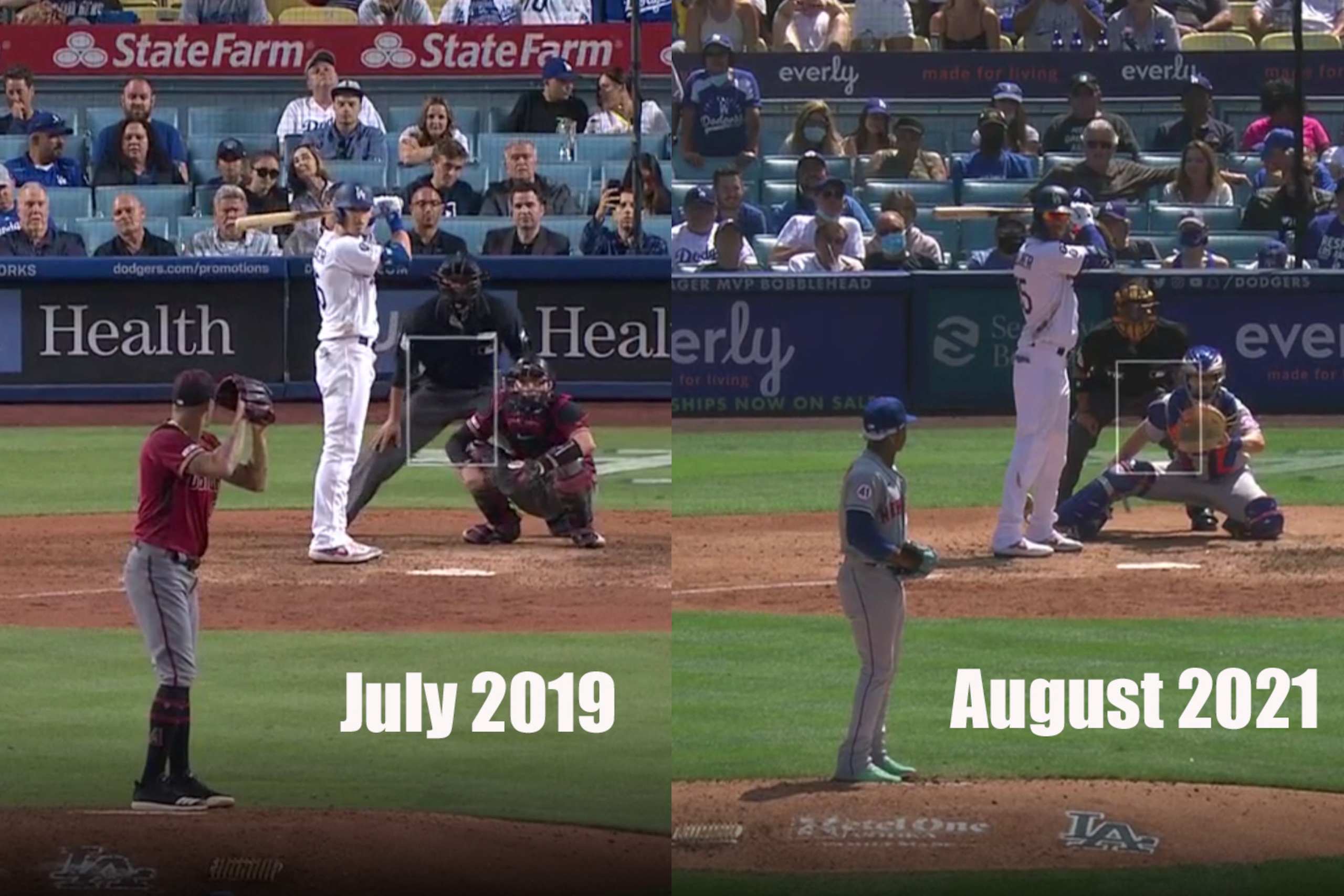
Yet this change, too, is failing him. Bellinger is still seeing fastballs up in the zone, and his overall slugging percentage against the hard stuff has gone from an ugly .358 in 2020 to an even uglier .298 in 2021.
When said heat is over 95 mph, Bellinger's problems are that much worse:
As much as anything, this problem stems from how Bellinger is having a hard time making contact against fastballs. His whiff rate against heaters has risen from 19.0 to 27.3 percent since 2019, mirroring the overall rise in his strikeout rate from 16.4 to 27.3 percent.
This makes it all too easy to wonder if Bellinger's compromised shoulder is only half the problem. The other half sure seems to be his swing. No matter the stance he uses, perhaps his next project should be cutting down on all his moving parts before he swings, and then shortening his swing itself. Right now, it's too long and therefore a poor match for fastballs.
So, What Are the Dodgers to Do with Bellinger?
L.A. doesn't have much choice but to keep running him out there as its starting center fielder. He's effectively the next man up until AJ Pollock recovers from a hamstring injury, which may not be until the end of the month.
Assuming Pollock does make it back by then, the best spot for Bellinger will be on the bench.
That might sound hot take-y, but this version of Bellinger has no place starting over Pollock or Chris Taylor, and certainly not Mookie Betts. The first two are having fine seasons, while the latter is playing more like his MVP-caliber self of 2018 and 2020 than he's gotten credit for.
If there's a bright side to benching Bellinger, it's that he could still be useful to the Dodgers as a pinch hitter and defensive replacement.
Of his nine home runs, eight have come against right-handed pitchers. He also hasn't needed a healthy right shoulder on defense, where he can still run down fly balls and unleash strong throws. To wit, his work in center field alone has been worth two outs above average in 2021.
Come the offseason, the Dodgers might feel an ever so slight temptation to non-tender Bellinger rather than go through arbitration and pay him a raise on the $16.1 million he's making this year.
However, the odds of that happening are probably less than 1 percent. Ultimately, cooler heads should prevail as president of baseball operations Andrew Friedman and the rest of the front office reason that, should Bellinger show up to 2022 fully healthy and with a properly revamped swing, he may well be an MVP again.
In the meantime, they'll just have to live with his lost season.
Stats courtesy of Baseball Reference, FanGraphs and Baseball Savant.




.png?w=2560 "Week 8 Winners & Losers 📊")



.jpg?w=2560 "Jonathan Taylor Landing Spots")