Eric Staal's Miserable Showing with Rangers Has Torpedoed His Free-Agency Value
It is often claimed that a strong performance from a player in a contract year should be mistrusted, that the incentive of a pricey new deal can drive players to levels of performance that are not sustainable over any kind of longer term. What such arguments ignore are those players who stumble and fall in contract years, players such as New York Rangers centre Eric Staal.
Staal followed a mediocre performance with the Carolina Hurricanes prior to the trade deadline with a disastrous regular-season run with New York. Just when it looked like things couldn't get any worse, Staal went pointless and posted a minus-seven rating in the Rangers' five-game first-round defeat at the hands of the Pittsburgh Penguins.
TOP NEWS
.jpg?w=2560 "NHL Trade Block Big Board")
B/R NHL Trade Block Big Board for October 2026
-(2).jpg?w=2560 "Bleacher Report")
Opening Week Power Rankings 📊

Ranking Every Team's Road Jersey 🧵
It is the kind of season that will give general managers who might have been interested in signing Staal second thoughts—the kind of season that might end up costing Staal dearly in terms of both dollars and years when he goes to negotiate a new deal in free agency.

In fairness to Staal, that minus-seven rating in the playoffs is an unfair way to judge him. With the exception of a Bryan Rust goal in Game 5, it's hard to spot many instances where Staal made glaring errors on those goals against.
Mostly, that ugly minus rating was a result of a) defensive collapses by other players, b) a modestly sub-average performance in terms of puck possession and c) the lack of any kind of offence to mitigate the goals against.
It would be wrong to describe Staal as a total defensive train wreck in the playoffs. It would, however, be accurate to describe him as a thoroughly mediocre puck-possession player and a non-entity offensively.
It's a description that partially fits his entire Rangers tenure. Over his 20 regular-season games in New York, Staal put up just six points. His line did outperform the rest of the team by shot metrics, even though it came in with and a sub-50 percent Fenwick rating.
There isn't a general manager in the league who will be able to enter July 1 convinced that Staal can help his team offensively.
Staal's offensive game hit new lows this year, and while there were some unique circumstances—joining a team at midseason can be hard and clearly did him no favours—it's worth noting that this is a continuation of a long-term trend.
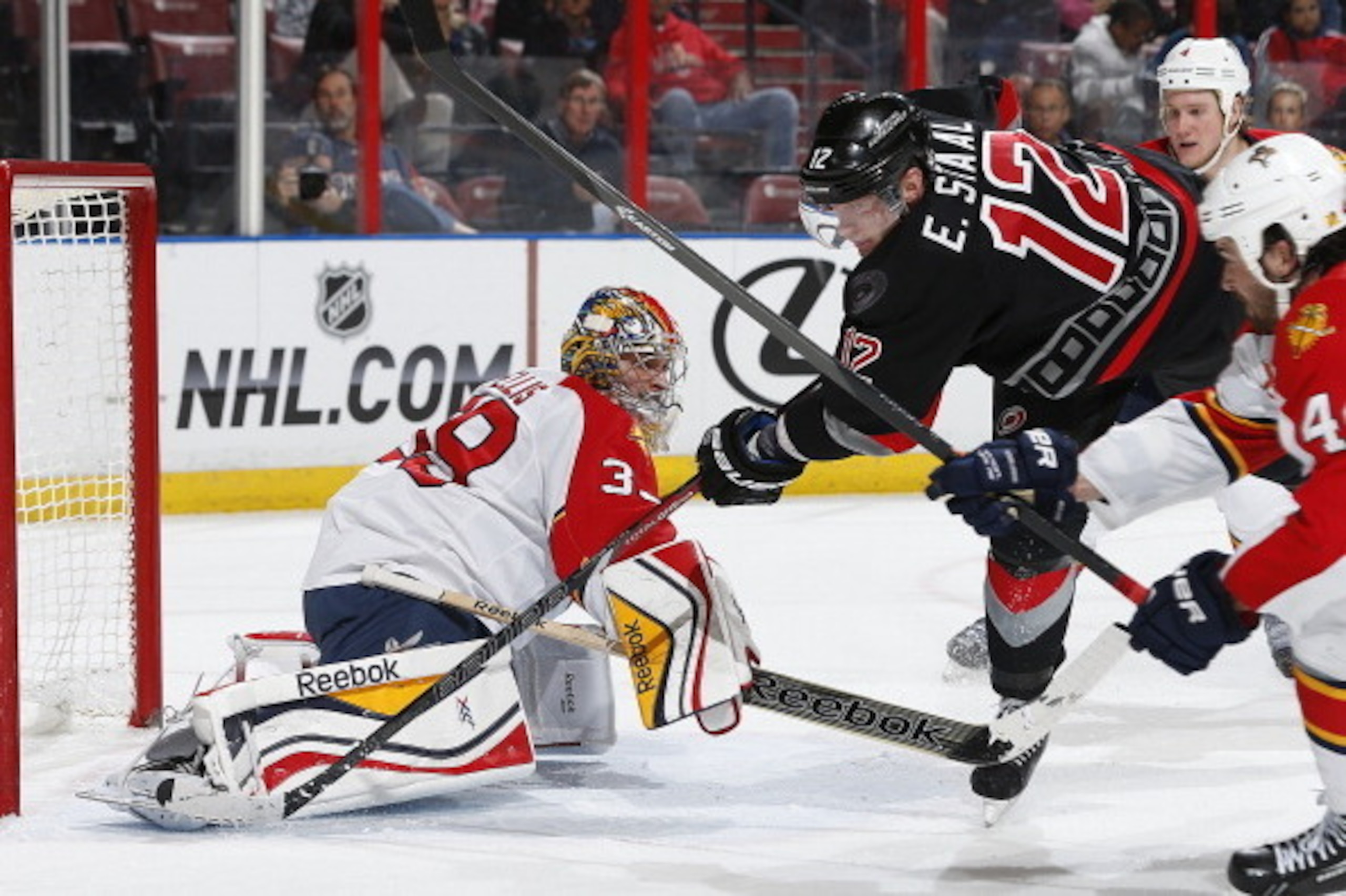
Staal's shooting percentage has fallen off dramatically. Between 2005-11, he scored on 10 percent or more of his shots every single year, with a high coming in 2005-06 when he shot at a 16.1 percent clip. Since 2011, he's scored on fewer than 10 percent of his shots in four of five seasons. The lone exception was the lockout-shortened 2012-13 campaign.
The one caveat here is that the decline in shooting percentage has gone hand in glove with a decline in power-play goals. After years of dominance on the power play, Staal's performance faltered in 2011-12 when Kirk Muller replaced Paul Maurice as head coach. He has never recovered.
Not only is Staal scoring on fewer of his shots, but he's taking fewer shots overall. In 2008-09, he hit a peak of 4.5 shots per game. In the five seasons that followed, that number declined every year, finally falling below 3.0 shots per game in 2013-14.
Staal bounced back slightly in 2014-15 but collapsed this season. He was firing just 2.5 shots per game (his lowest total since his rookie year) before being dealt to New York and dropped to a career-low 2.0 shots per game after the trade.
Staal's one point of refuge is improved shot metrics, but there's a problem there, too. Since 2012-13, he has been increasingly used as an offensive specialist, far more likely to start his shifts in the offensive than defensive zone. He still matches up against good opponents, but with that kind of deployment, he absolutely should be posting better shot metrics.
Put everything together, and there is a lot here that should be concerning to a general manager. Staal is a player who no longer looks capable of driving offensive results at even strength. He hasn't been a major factor on the power play in half a decade. His superficially impressive shot metrics are heavily driven by usage. He's 31 years old and in the back nine of his playing career.
Most importantly, the last team that paid a heavy price to land him ended up thoroughly disappointed by what it received.
It might be in everyone's interest for Staal to sign a short-term deal this summer. For the player, it would represent a chance to show he still has gas left in the tank, to put a miserable campaign behind him and try again to land a big deal in a year or two. For the signing team, such a deal carries far less risk than a long-term pact with someone whose game may be in significant decline.
Statistics courtesy of Hockey Reference.com and Natural Stat Trick.
Jonathan Willis covers the NHL for Bleacher Report. Follow him on Twitter for more of his work.