

NHL Playoffs Roundup: Blues Still Face Tough Road Ahead vs. Blackhawks After Win
On Sunday afternoon, the St. Louis Blues did something remarkable. In a single period, they put an end to Chicago’s long run of dominance when leading after two frames, scoring twice and eking out a 3-2 victory over their first-round rival. More importantly, the Blues re-established their series lead, taking a 2-1 edge.
Now, the challenge will be to parlay that lead into a series win, and it is truly a challenge. Recent NHL history is littered with teams that found the Blackhawks surprisingly tough to eliminate, and the Blues themselves have an unpleasant track record of blowing this kind of advantage against strong opponents.

For a while, it looked like Game 3 was going to be another missed opportunity for St. Louis.

The Blues started the game strongly, putting the Blackhawks on their heels and both generating a number of high-probability scoring chances and dominating territorially five-on-five. However, undisciplined penalties from veteran Blues players allowed Chicago to push back. First, it was Kyle Brodziak in the box, and then Jay Bouwmeester took consecutive penalties, with the second in the sequence the result of a boneheaded decision to play the puck before leaving the penalty box.
St. Louis managed to hold a potent ‘Hawks power play to a single marker, thanks in large part to Brian Elliott's solid work. When it got a power play of its own in the back half of the first, it took Colton Parayko all of seven seconds to tie the game at 1-1, thereby letting the Blues off the hook for some sloppy play.
Chicago coach Joel Quenneville regretted Chicago’s inability to score a second power-play marker, but he told NBC’s Pierre McGuire—in a between-the-benches interview—he expected a close contest:
"[Corey Crawford] made three or four big stops before we scored on the PP. We had two good looks after on the power play, it would have been nice to go up by two, and they cashed in right away. It’s going to be tight. Expect this kind of game going forward and this kind of series as well.
"
Despite Quenneville’s prediction, Chicago ran away with the second period. The Blackhawks lit up St. Louis for 24 shots in the middle frame and took a one-goal lead when 170-pound winger Artemi Panarin simply outworked the 6’6”, 226-pound Parayko in the Blues’ zone:
At this point, Quenneville had to like his chances. As Charlie Roumeliotis of Comcast SportsNet Chicago noted, the Blackhawks were 70-0-4 when leading after two periods over the previous two seasons. All they had to do was hold on for one period to stretch the run to 75 games without a regulation loss.
It didn’t happen.
Early in the third period, a long Patrik Berglund shot took a funny hop high in the zone and found its way past Crawford. Then, Blackhawks star Patrick Kane took a double-minor for high-sticking, sending St. Louis to its second power play of the game.
St. Louis needed more than 10 seconds to score, but when Jaden Schwartz found the back of the net with less than seven minutes to go in the third, it gave the Blues a lead they would hold for the win.
With two wins, the Blues now have an edge in series play, but the team’s recent history suggests getting the last two victories necessary to advance may prove more difficult. Consider the last three first-round exits by this team:
- 2014-15: Lost to Minnesota in six games. The series was tied, 2-2, and St. Louis had home-ice advantage on its side but lost the final two contests by a combined score of 8-2 to allow Minnesota an upset win.
- 2013-14: Lost to Chicago in six games. The Blues held a 2-0 edge on the Blackhawks but then lost four straight—a run that included a 5-1 defeat in the decisive Game 6.
- 2012-13: Lost to Los Angeles in six games. Again, St. Louis held a 2-0 series lead but then lost four straight games.
Sunday was a good step, and taking the series lead was certainly a feather in the Blues’ cap. All St. Louis needs to do now is show the kind of killer instinct it hasn’t had in previous campaigns.
Petr Mrazek's Shutout Leads Detroit's Much-Needed Awakening
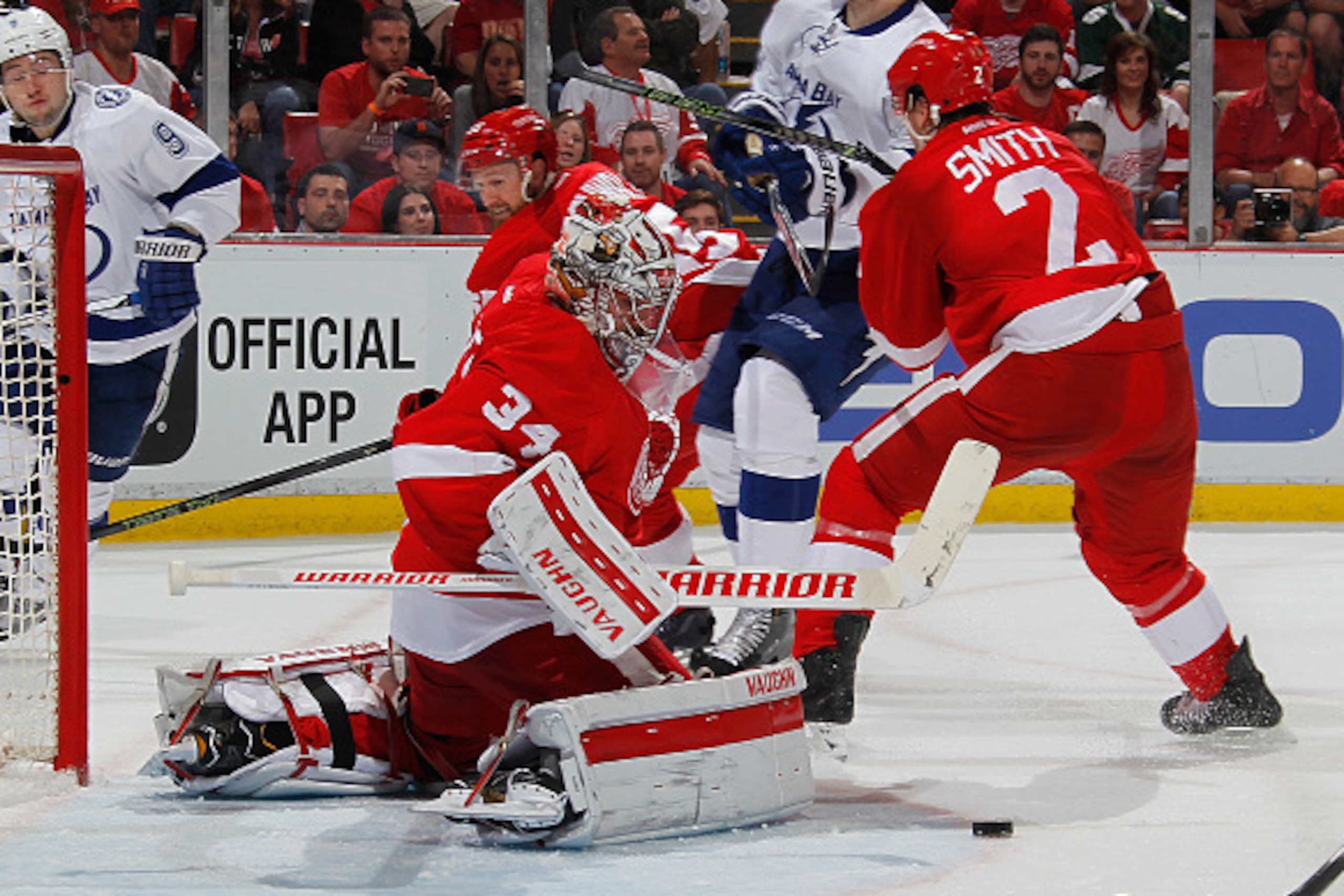
After a 5-2 loss in Game 2, it seemed inevitable the Detroit Red Wings would make some changes. That’s exactly what they did, hoping to reshape the story in a series where the Tampa Bay Lightning were close to establishing a stranglehold.
The decision paid off, and Detroit came away with a 2-0 victory, winning its first game against the Lightning.
Goaltender Petr Mrazek, who recorded two shutouts and a .925 save percentage in a seven-game series loss to Tampa Bay last year, stepped in for Jimmy Howard and was perfect, turning aside all 16 shots he faced. Defenceman Brendan Smith played his first game of the series, too, skating nearly 17 minutes and recording three hits.
A bigger improvement was arguably the decision to separate Pavel Datsyuk and Henrik Zetterberg. Datsyuk had a mostly quiet evening, but Zetterberg looked fantastic, getting six shots through to Lightning goaltender Ben Bishop and having five other attempts either miss or get blocked. He also scored the insurance-marker for the Red Wings:
Tampa Bay, meanwhile, had what was easily its weakest game of the playoffs. After narrowly losing the possession battle in Game 1 and narrowly winning it in Game 2—and given the Lightning played most of Game 2 with the lead, that was to be expected—the Bolts got blown out in Game 3. Detroit had a 30-16 edge on the shot clock and a 64-36 Corsi advantage, per Natural Stat Trick. Essentially, it fired two shots for every one Tampa Bay managed.
The Lightning still have the series lead, but they can’t afford to play like this again. Mrazek gave them a very difficult time a year ago, and if they can’t at least saw-off on the shot clock (turning it into a goalie duel between Mrazek and Bishop), that lead isn’t going to hold.
Panthers Blown Lead Very Costly in Neck-and-Neck Series with Islanders
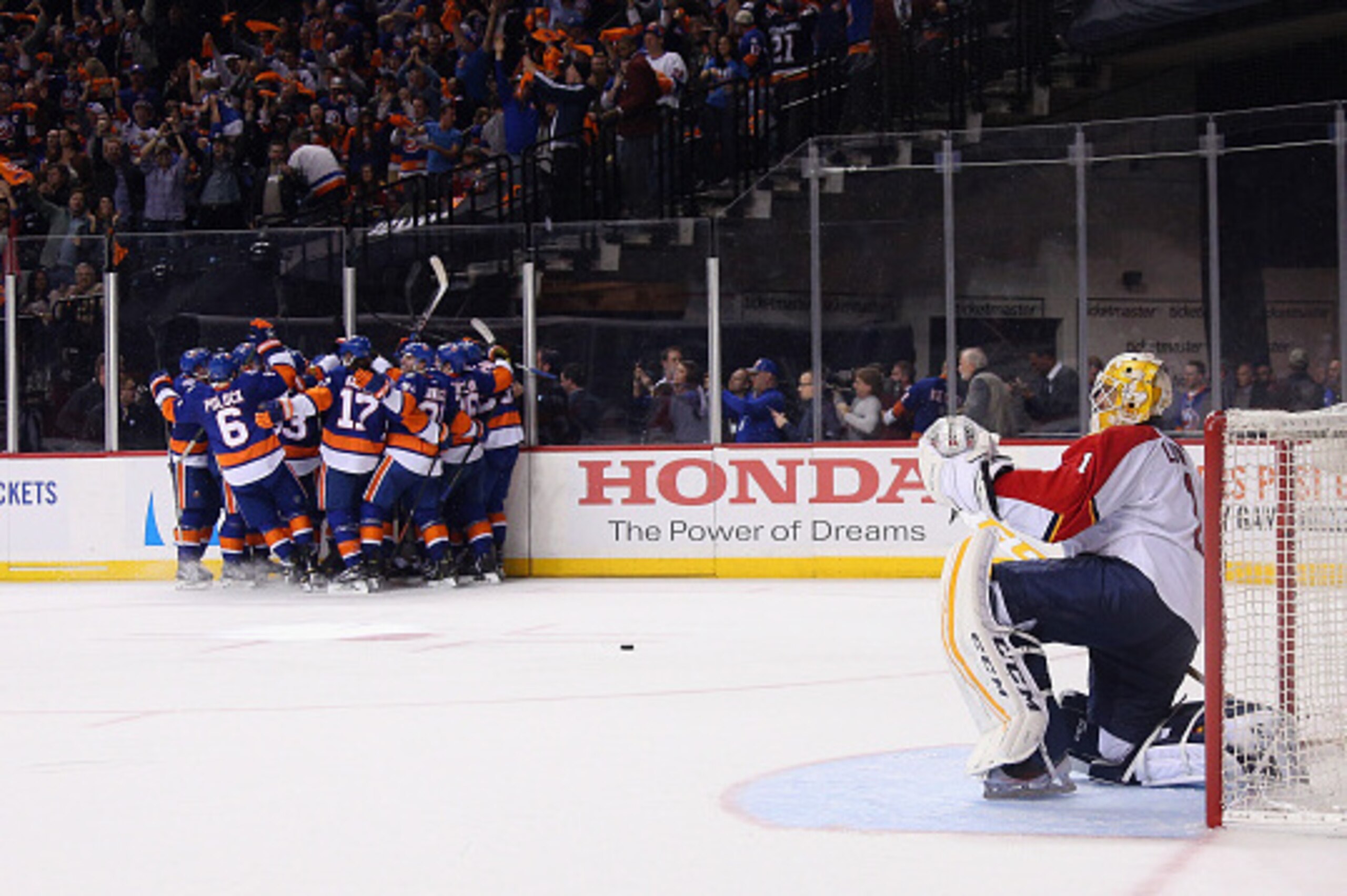
Thomas Hickey’s first career playoff goal was a big one, giving the New York Islanders a 4-3 overtime victory over the Florida Panthers and with it a 2-1 lead in the best-of-seven series between the two teams.
From the Panthers’ perspective, the goal should never have happened, because the game should never have gone into overtime. Florida established 2-0 and 3-1 leads in the second period, but it blew that advantage in the back half of that very frame as Shane Prince and Frans Nielsen scored for the Isles. In a series that looked close on paper and has been very tight through three games, that inability to bar the door could well prove fatal to Florida.
It’s been a problem for the team all year. The Panthers’ record when leading after two periods is 33-4-5, which looks really good until one compares it to the rest of the NHL. Florida’s winning percentage of .786 in those situations ranked 26th overall in the league; among playoff teams, only the Red Wings were less impressive.

The Panthers would also benefit from some secondary scoring. The red-hot trio of Jussi Jokinen, Nick Bjugstad and Reilly Smith scored two of Florida’s three goals on the night and has tallied seven of the Panthers’ 10 markers over the course of the series. That line has been great, but it can’t carry the offence alone.
As for the Islanders, John Tavares continued what so far has been a stunning postseason performance. He earned the primary assist on Nielsen’s tying goal and picked up another helper on the Isles’ first goal of the game. He didn’t score a goal himself but did lead the club with five shots. So far in the series, he has six points and 16 shots through just three games.
Balanced Attack Propels Nashville to Commanding Lead over Ducks
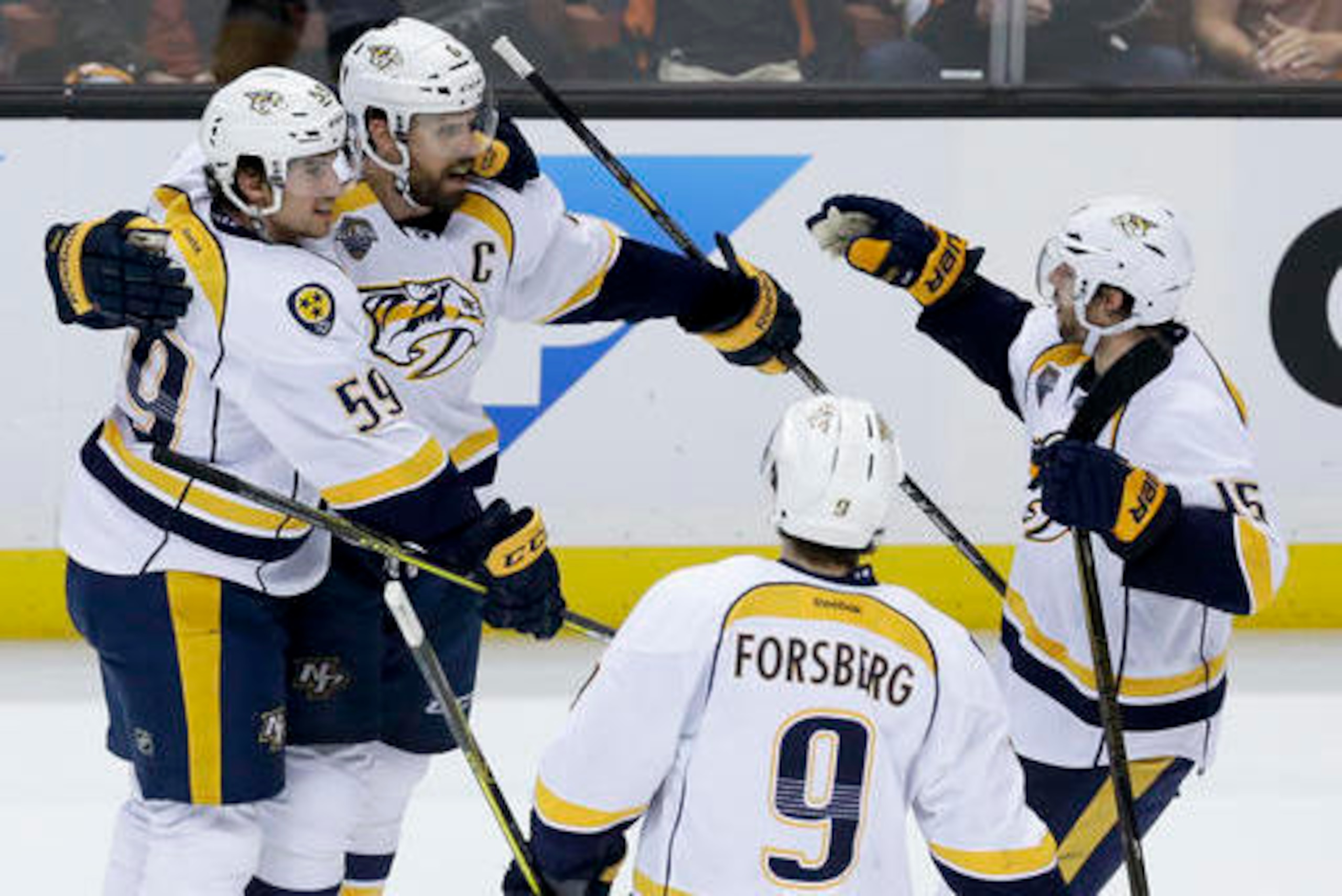
The Nashville Predators took a commanding 2-0 lead in their best-of-seven series against the Anaheim Ducks on Sunday with a 3-2 victory over their Western Conference foes. As they had in Game 1, the Preds leaned on three different scorers, bringing the total number of scorers over the last two games to six.
Shea Weber hammered the kind of power-play blast he’s so well-known for to give Nashville three goals on the night; at that point, the score was 3-1, but ultimately Weber’s goal stood up as the winner. However, from the Ducks’ perspective, it was the Predators’ other two goals that were the greatest cause for concern. Both defenceman Mattias Ekholm and forward Craig Smith penetrated the slot and scored their markers at close range:
Nate Thompson pulled Anaheim within one when he banked a fortunate shot off Roman Josi’s skate, but that would be as close as the Ducks got.
The series now shifts back to Nashville, where the next two games and three of the next five (if the series runs that long) will be played. The Predators started out as underdogs, crossing over from the Central Division as a wild card, but with the series where it’s at, they now must be favoured to move on to the next round.
Anaheim isn’t scoring a lot, but the bigger concern is defensive play and in net. John Gibson is now at a .900 save percentage for the series, and three goals against per game is a lot higher than the Ducks' regular-season average. Over 82 games, the Ducks led the league in goals against, allowing just 2.29 per contest.
Statistics courtesy of NHL.com and NaturalStatTrick.com.
Jonathan Willis covers the NHL for Bleacher Report. Follow him on Twitter for more of his work.

.jpg?w=2560)


.jpg?w=2560 "Puka Dealing with Calf Injury")