

NHL Playoffs Roundup: Has Evgeni Malkin's Return Disrupted Penguins' Chemistry?
The Pittsburgh Penguins are unquestionably a more talented team with Evgeni Malkin in the lineup. The big Russian center is one of the game's most skilled players, a two-time Art Ross Trophy winner with a Hart Trophy and Stanley Cup also on his resume.
So why, especially this season, did Pittsburgh do so much better without Malkin in the lineup? This is a question some around the Penguins might be thinking more about, especially after their 4-2 loss to the New York Rangers in Game 2 of their Eastern Conference quarterfinal series Saturday afternoon at Consol Energy Center.
The series is now tied at a game apiece, with the setting for the next two games moving to Madison Square Garden starting Tuesday night.
TOP NEWS
3-Way Hellebuyck Trade Ideas 💡

Every Team's Odds to Win the Cup 🏆

Ovechkin's Greatest Moments 🎱
Things were going fine for the Penguins to the mid-point of the game, when some defensive miscues did them in. Eric Fehr was caught watching the puck too much on the other side, allowing Keith Yandle to sneak down the weak side and one-time J.T. Miller's crossing pass past Jeff Zatkoff. Defenseman Olli Maatta let Derick Brassard slip behind him in the neutral zone for the Rangers' second goal, and Trevor Daley and Carl Hagelin were caught floating too far in the middle, allowing Mats Zuccarello to one-time a terrific Miller pass into the net 16 minutes, 52 seconds into the second period.
Those three goals would be enough for Henrik Lundqvist, who returned to the lineup after missing the final two periods of Game 1 with an injury to his right eye. Lundqvist now gets to play at home, where he went 22-6-3 in the regular season.
In Malkin's first game since March 11, the Penguins reverted to the sloppy moments that had characterized their season too much when he was healthy. After he was lost to an upper-body injury in a March 11 game against Columbus, the Penguins with 13-2-0 in the 15 full regular-season games they played without him, outscoring opponents 62-33. Then came Game 1 against the Rangers Wednesday night, a 5-2 Pittsburgh win in which Malkin sat out.
After the Penguins' 3-2 victory over Columbus March 11, their goal differential to that point was 183-170. In the 16 games without him following the injury, the record was 14-2-0, the differential 67-35.
Does Malkin's presence just disrupt the overall chemistry somehow? Do Pittsburgh's other players think things will naturally come easier with Malkin in the lineup and stop trying to overachieve?
It may seem like a dumb premise, but the numbers are the numbers. If the answer is yes, it's up to Penguins coach Mike Sullivan to figure out how to correct it. Sullivan centered Malkin between Bryan Rust and Conor Sheary, but the line didn't do a whole lot. Malkin did record an assist, but it came on a power-play goal by Phil Kessel. Otherwise, Malkin did not get a shot on goal. Rust and Sheary had one each.
Sullivan might be tempted to put Malkin on a line with Sidney Crosby, something the Penguins have often done in times of crisis.
This loss can't be pinned on just Malkin. He handled the puck well and helped give Pittsburgh some good looks on the power play with his puck patience. But why were the numbers so much better without him? Chemistry is a very difficult thing to define, but like former Supreme Court Justice Potter Stewart's old definition of pornography, you know it when you see it.
Or, when you don't see it. For whatever reason so far this season, the Penguins seemed to have better chemistry without Malkin. They may have as few as three games left, before it ends, to find a better mix.
Mason's Muff Dooms Flyers in Game 2 Loss
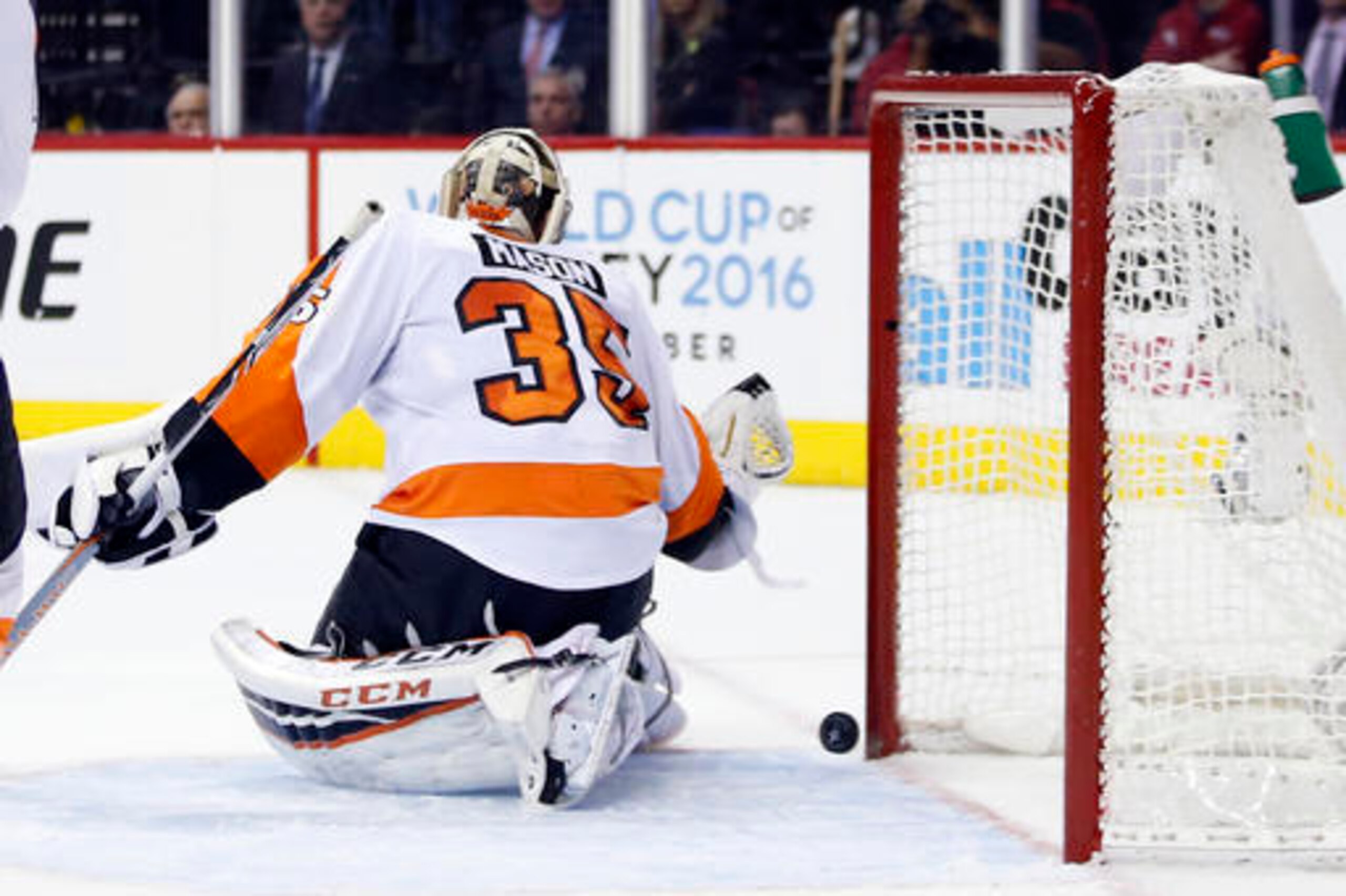
NBC's Mike Milbury called it the “worst goal” in Stanley Cup playoff history. Mad Mike is prone to exaggeration, but he probably got this one right.
Right after making a highlight-reel save to keep it a one-goal game, Steve Mason made the blooper reel. And it was the killer moment of the night for the Philadelphia Flyers in their 4-1 loss to the Washington Capitals in Game 2 of their Eastern quarterfinal. Washington takes a 2-0 lead into Game 3 on Monday night in Philadelphia.
The Caps had a 1-0 lead early in the second period when forward Jason Chimera redirected a Karl Alzner pass a few feet below the red line. Chimera was simply trying to get the puck deep for a line change. All Mason had to do was paddle the non-bouncing puck off to the side for his defense to bring it back out.
Except, Mason somehow, 1) failed to do what every goalie on a long shot like that is taught to do, which is squeeze the pads together to eliminate any chance of it squirting through and, 2) failed to get the paddle of his stick down perpendicular on the ice.
The puck, against all odds, found a way under Mason’s stick and between his pads. While he and the Flyers battled on, there simply was no recovering from this muff, which quickly went viral on the Internet.
Let’s not blame Mason for everything, though. Arguably, the Flyers’ power-play unit lost the game in the first period, when it failed to score with a lengthy five-on-three advantage. Braden Holtby, who faced only 19 shots in all of Game 1, stopped 19 in the first period alone. Several came on the five-on-three, and Philly seemed to sag severely after that. Holtby, the likely Vezina Trophy winner, has allowed only one goal in the series.
Everything we thought about this series has come true so far. The Flyers don’t have enough secondary scoring, and if they aren’t getting anything from Claude Giroux and Wayne Simmonds, there is no chance.
The chances of victory go down even more when the goalie can’t stop a skimming puck from 110 feet.
Disputed Goal Helps Stars Overcome Wild in Game 2

The Dallas Stars got what arguably was an undeserved goal in Game 2 of their Western Conference quarterfinal series with Minnesota. And, while the goal was a turning point in the game, the Stars nonetheless deserved what turned out to be a 2-1 victory at American Airlines Arena.
The top-seeded Stars take a 2-0 series lead into Game 3 on Monday night at Xcel Energy Center in St. Paul.
Antoine Roussel was credited with a goal at the 3:54 mark of the second period to break a scoreless tie. Roussel stuck his skate out toward an oncoming puck behind the Wild net, then watched it pop up into the air and deflect into the net off goalie Devan Dubnyk’s back while he dislodged the net off its moorings.
Referees initially ruled no goal, but after a video review, it was ruled a good goal. Here is the explanation from the NHL’s Situation Room as to why the refs were overruled (via NHL.com):
"According to Rule 78.4, The goal frame shall be considered in its proper position when at least a portion of the flexible peg(s) are still inside both the goal post and the hole in the ice."
If that had turned out to be the game-winning goal, we’d have a lot more controversy going forward. But Stars captain Jamie Benn scored on a breakaway in the third period for a 2-0 lead, and Dallas held off a late Wild rally.
Minnesota, playing without top forwards Zach Parise and Thomas Vanek because of injuries, has one goal through the first two games. The Wild lost their final five regular-season games and haven't looked any better in the postseason.
Road-Loving Sharks Grab 2-0 Lead on Kings
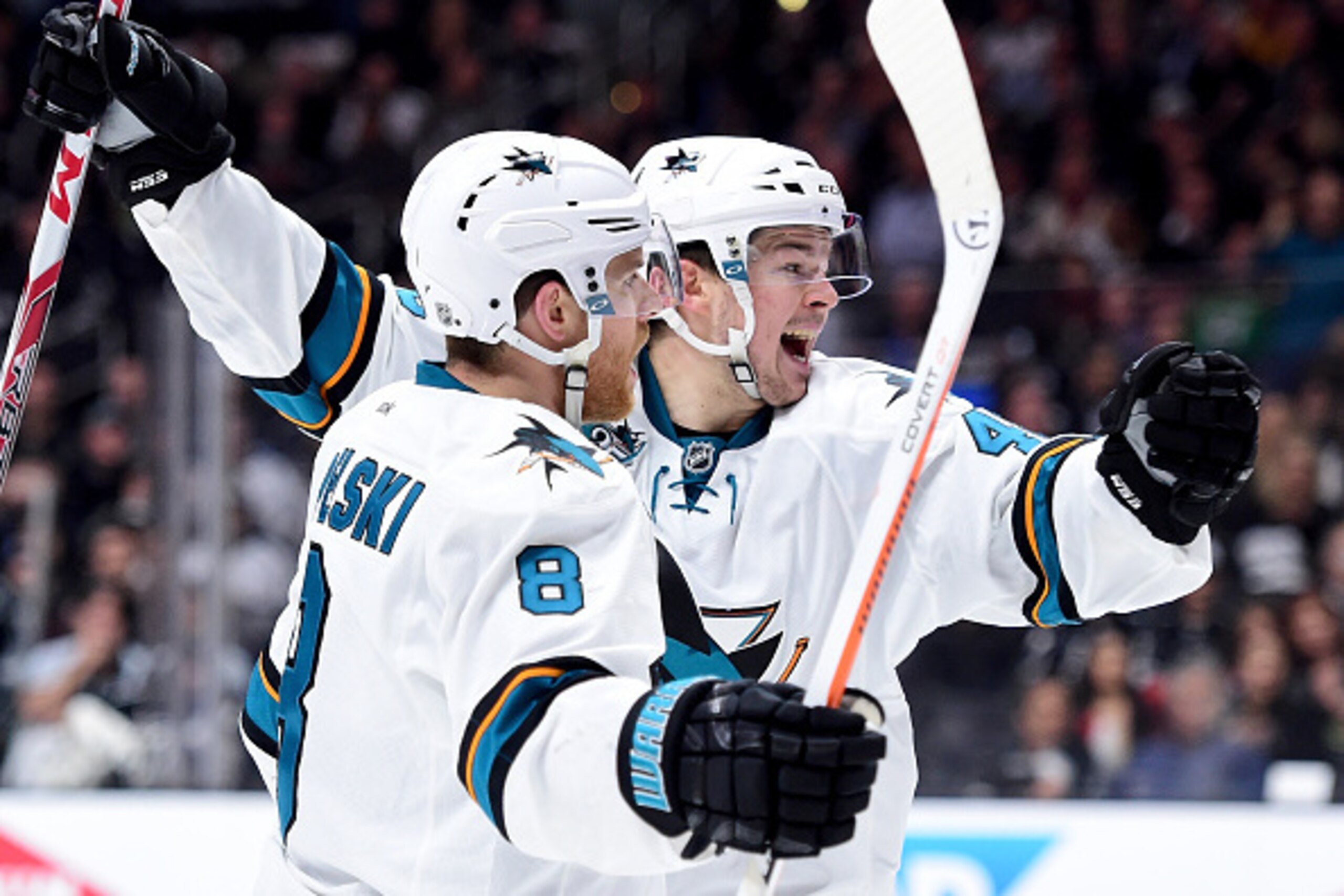
Bad news for the San Jose Sharks: They have to go play on home ice now.
The Western Conference’s best road team in the regular season (28-10-3) grabbed a two-games-to-none series lead on the Los Angeles Kings with a 2-1 victory Saturday night at Staples Center.
Martin Jones, a former backup goalie with the Kings, bested veteran Jonathan Quick, while Joe Pavelski scored his third goal of the series to put San Jose in commanding position heading back home.
But as anyone with even a casual knowledge of Sharks playoff history knows, there is no reason to get overconfident yet. That’s especially true for a team that was just 18-20-3 at the SAP Center in the regular season.
The Sharks blew a 3-0 first-round series lead two years ago to these same Kings, a team with two Stanley Cups in the last four years. Los Angeles had better get more out of its top offensive players if it wants another comeback story, especially top center Anze Kopitar.
Kopitar has been limited to just one assist so far, while Jeff Carter, Milan Lucic, Drew Doughty and Tyler Toffoli have also been kept in check.
This game really turned for the worse for the Kings at 8:14 of the second period, when Lucic (charging) and Toffoli (roughing) were called for penalties, giving the Sharks a five-on-three for two minutes.
Quick made a sliding save of a Pavelski one-timer in close, but the goalie was out of position for Logan Couture’s tap-in at 8:44 that made it 2-0. Jones, along with a physical Sharks’ pressuring defense, took it from there.
Vincent Lecavalier made it interesting late, scoring his 26th career playoff goal with 5:01 left. But the Sharks from there did a good job of getting the puck out of their own end, and in getting it past the red line for non-icing dump-ins.
The series might seem over, but that ignores the Kings'—and Sharks'—recent histories.
Adrian Dater covers the NHL for Bleacher Report.

.jpg?w=2560 "Grading WWE Raw 🔠")


.jpg?w=2560 "2 NFL Officials Suspended")


.jpg?w=2560 "Viral Rams Coach Vid 🖕")