
Horizon Forbidden West Review: Gameplay Impressions, Videos, Speedrunning Tips
Horizon Forbidden West is a rare chance for a relatively new series to become a juggernaut in the video game space.
A sequel to 2017's Horizon Zero Dawn, developer Guerrilla Games has gone all-in on expanding the game in every sensible direction.
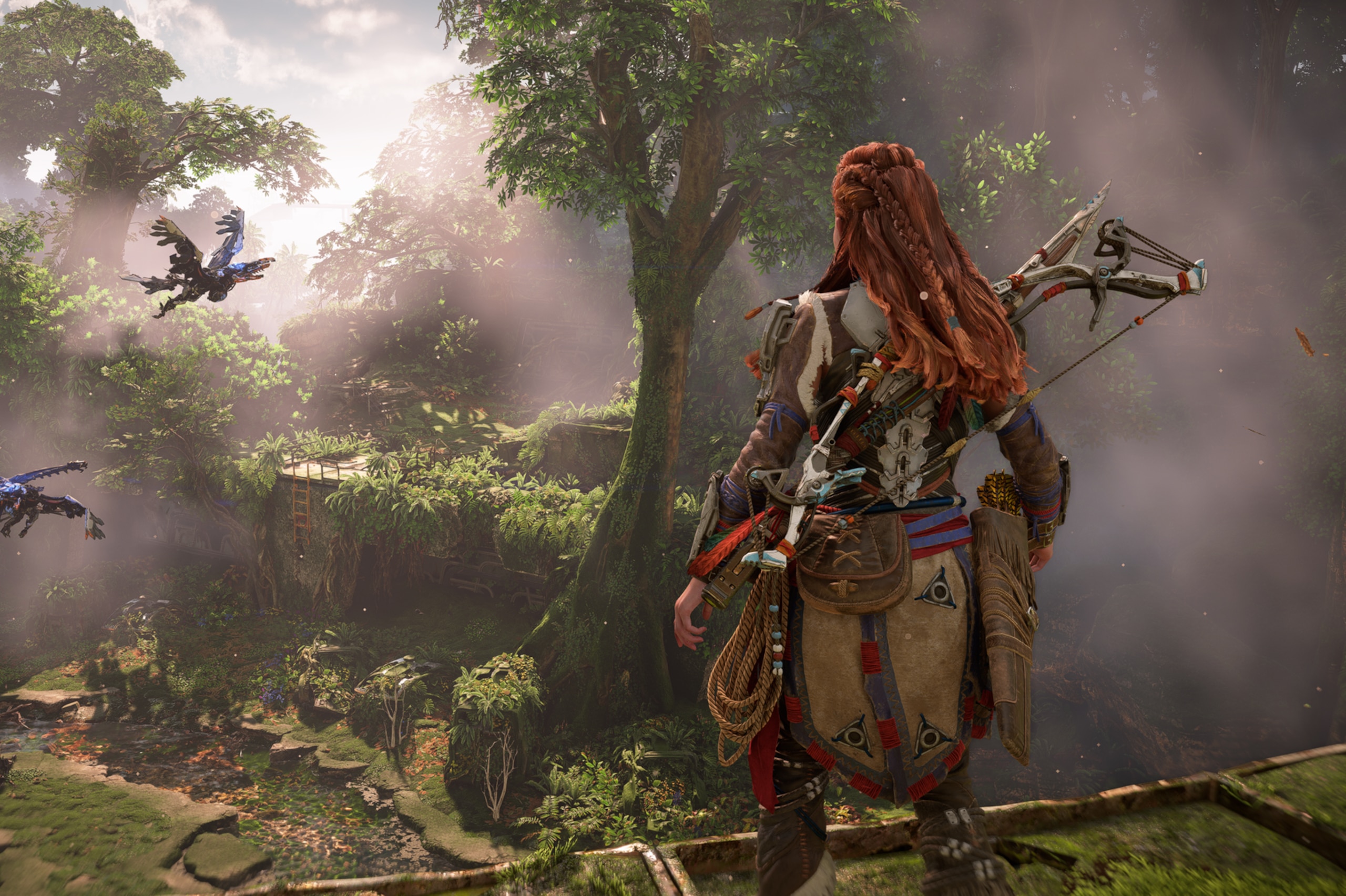
It starts up front with main character Aloy and the jaw-dropping setting, a post-post-apocalyptic world where humans aren't necessarily atop the food chain thanks to the presence of animalistic machines of all sizes.
.jpg?w=2560 "Chiefs Giants Football")
.jpg?w=2560 "AP Poll Top Five Week 9")

An open-world backdrop that takes the stage alongside a heartfelt story with unforgettable characters and places, Forbidden West's stellar across-the-board execution and sheer fun factor make it an early, obvious Game of the Year contender.
Graphics and Gameplay
It's almost cringe-worthy these days to hear a video game described as "breathtaking," yet it feels like the only applicable term for Forbidden West.
This is perhaps one of the first times it has ever been able to tell what is actual game footage and just a cutscene. Seeing Aloy crouch in some underbrush that gently sways the same way her hair does while she scouts out massive enemy machines is stunning, if even for a moment.
Forbidden West really excels in contrast. The beastlike machines found throughout the world, and certain technologically advanced locations, are incredibly distinct compared to human settlements that have been knocked back to tribal ways. Even the coloring—bright yellows and blues on the animal machines compared to muddy, muted textures in human settlements—is striking.
There are little treats and attention to detail all over the place. We've seen some before, like footprints left in the sand. But seeing everything in motion with the accurate physics system, a lighting system that just flexes its muscle (bright blues and yellow lights bouncing off floors is always a treat) and how it all blends makes for the most visually impressive open-world we've seen.
Forbidden West also boasts probably the best set of facial animations and lip-synching we've ever seen from a game. Even NPCs that don't have a major part to play are strikingly animated with mostly proper mouth movements. It can look awkward in some places, but there's a very real sense this is the best a game can achieve right now.
There's a similar give-and-take with Aloy's hair, weird as it sounds. It's a stunning feat of technology to see it in action and in cutscenes, almost a braggadocious flex from those that made it happen. But there are isolated incidents where it goes absolutely bonkers, or shifts around in a way that doesn't make sense. We're a long, long way away from when companies used to avoid long-haired or deeply animated hair on main characters because of tech limitations.
But even the presentation of conversations is splendid. Where most games zoom in on faces during talking, Forbidden West opts for a farther-back approach, which lets them animate the character's bodies and mannerisms as they talk, pace around, etc. It's a low-key thing that adds not just realism and reliability but makes it feel all the more next-gen. There's an emotional weight added to seeing the characters act so human, going from pacing to sitting down next to someone in an effort to comfort them.
Sound design is amazing, as expected when looping in superstars like Ashly Burch (Aloy) and Lance Reddick (Sylens). But that's an across-the-board thing, as again, even one-off NPCs turn in splendid performances. Sound out in the world can range from terrifying to downright wondrous and is never not immersive.
Exploring the world is, in a word, a blast. Much of the world is climbable vertically in an Assassin's Creed sort of way. And players won't have to spend lots of time trying to figure out what they can and can't climb because one click of the right stick helpfully highlights climbable surfaces in yellow.
There's a grappling hook (Pullcaster) and glider (Shieldwing) for the expected traversal mechanisms. And of course, there are mounts, which even early in the game, are easy enough to obtain. They, like the tools, control well. So too does underwater exploration.
There are a few hiccups here and there in traversal. It's not always going to be super obvious what Aloy can or can't do while climbing or what mounts will or won't go over. And hitting the square button to hop on a mount will never not feel weird for the sake of being different. But as a whole? Forbidden West is on par with any other game trying to do as much at once.
Where Forbidden West also happens to set itself apart is in combat. Aloy has an array of weapons and tools in her arsenal. How players choose to employ those is part of the fun, but a bevy of playstyles and approaches to any situation exists.
Chief among the things that separates the game from the rest here is the "Focus" mechanics and how it interacts with the machines.
Using the "Focus" scan on the right stick to get info on a machine before or during battle is a little akin to chess. After the scan, players can flick through the machine's different sections and get extensive info on each of the parts. They can highlight the machine as a whole, its tracks on the ground or even individual parts. They can also click a different button to pause the game and dive into the menu specific to that machine, getting droves of info.
From there, it's a laundry list of options. Aloy can use her staff, shoot bows, sling around different types of bombs or set traps, to name a few ways players can go. It all feels surprisingly good too. Melee strikes, especially while undetected stealth, feel weighty and inflict serious damage. The bow is as good as it has ever felt in a game, and the other weapons aren't far off, either.
The clever trick comes from figuring out how to tackle a certain encounter, if at all. A quest might ask the player to bring back a very specific part from a beast. That means scanning it to identify that part, then dissecting how to detach it. After detachment, it's a matter of figuring out how to get to the dropped part.
Overall, combat in Forbidden West is very strong as a great-at-everything experience. It feels good, and there are so many unique trappings baked into the experience that it never gets old to venture out and tackle some of the unique world's enemies. An applicable skill gap to climb only makes it more rewarding, too, because the scale and size of objectives to tackle only gets bigger and more awe-inducing.
Story and More
Players join Aloy's journey six months after the first game's events as she's tracking down a way to stop an ever-spreading Red Blight poisoning the land.
The game gets clever with nods and explanations toward the first game's events, but it's a little bit of shell shock for those unfamiliar with the world and characters. Still, it's hard not to get wrapped up in the intrigue of it all, especially when the characters are so good.
This isn't one of those games where players will have a hard time connecting with the main character, let alone the supporting cast. Aloy's got friends, and even the apparent enemies are engrossing. Much of it is the impressive mentioned technological feats and design decisions.
But some of it's just plain great, heartfelt writing. There are little characterizations that make Aloy and even one-off appearances by others incredibly endearing to the point of emotional investment. Her relationships with different people are incredibly varied and meaningful to the plot and understanding her, the protagonist.
It sure doesn't hurt that there are little RPG-lite dialogue options at times. They don't seem groundbreaking, but having a little sway over how Aloy reacts to a situation is a smart bit of player agency that doesn't hurt her overall characterization.
This extends to out in the world during routine, expected gameplay. Aloy will say things aloud based on the player's gameplay that make plenty of contextual sense. When she comes up out of cold water, for example, she drops a funny "That'll keep me awake" one-liner where other games might just keep things silent.
Beyond the main quest, the world has plenty of in-depth characterization and world-building of its own. A refreshing, measured pace to side stories and explorable areas on the map is a highlight of the experience. One early side quest features full-blown cinematics and story beats for just-met characters that feels worth the time investment for the story itself, not just the end reward for completing it.
That world isn't the typical apocalyptic video game setting either. Humans have advanced back out of the apocalypse in captivating ways, though Aloy will come across the tattered remains of certain real-world landmarks from the American West along her journey.
Towns and settlements themselves are also their own little characters. One place is a bustling market strife with political squabble. Another is merely rebuilding from the ground up slowly, eyes toward a potential enemy outside the walls. Dipping into a tavern, armorer's shop or something else, seeing all the NPCs, the attention to detail and hearing the background noise gives off a vibe of what a next-generation Witcher game could feel like.
Those towns house some of the usual open-world trappings, like a Gwent-styled game called Machine Strike, as well as fight pits. And going out into the world, players will find vistas to uncover, towers to climb, salvage to unearth and other open-world tasks that will feel familiar, but with a unique Horizon flavor. They're there if players want to do them and rewarding and unique enough to not get tedious, but players are also free to just mainline the story mode, too.
The progression system in the game is thankfully player-friendly. There's a rarity system like most games nowadays, but it respects the player's time. Upgrading weapons, crafting items, etc., requires parts from machines out in the wild, which encourages exploration and non-essential combat. There's a deep RPG system across six skill trees, too, giving players their choice of how to improve Aloy's skill set to a preferred playstyle.
While Forbidden West does give players nigh-endless options in combat, not every weapon feels equal. Taking the time to shoot the Tripcaster and set traps doesn't usually feel worthwhile, for example.
No matter what a player decides to use, the haptic feedback on the PlayStation controller is amazing and one of the best implementations we've seen. The sounds it makes aren't noisy and intrusive either, which is a plus.
All that aside, the game isn't without some issues. There are very rare graphical bugs, such as hair textures not loading properly. In one isolated instance, a body went haywire glitching all over the place next to a dead machine, which carried on in the background behind an otherwise serious cutscene. There would appear to be some missing sounds at times too, like when Aloy nearly loses her grip on a ledge. But these are small things, as overall, Forbidden West launches in a much, much better state than most games nowadays.
Kudos also goes to the developers for organically baking in a tutorial process that doesn't much feel like a tutorial at all. And for those entirely new to the franchise, in the menus, there's an extensive notebook section where players can review the how and why of pretty much everything in the game.
Speedrunning Tips
Horizon Zero Dawn was an unexpected speedrunning hit in large part because of the varied ways in which players can tackle the main story, never mind at a variety of different difficulty levels. There's a reason speedrunners are still posting world-record runs within weeks of Forbidden West's launch.
Early in Forbidden West's lifecycle, some of the strategies are as basic as it gets (for now). That means skipping dialogues and cutscenes. It also means making a habit of avoiding unnecessary fights, which is advisable in part because the player doesn't end up feeling too crunched for resources as they progress.
In time, good speeds will come down to a player properly memorizing the how and why of most missions and encounters. That's not as easy as it is in most games—they'll have to study up on which parts on which machines are vulnerable to what, which, extrapolated over a massive game, will be no easy feat.
But for now, obtaining a mount as often as possible and booking it to the next mission site is the objective of runs. There aren't a ton of reasons to engage in exploration or side quests that give out rewards that have little to do with how a player will tackle a given run, anyway.
Conclusion
There's very little to dislike about Forbidden West. The story or setting might not be for everyone, sure, but the surrounding characters, design decisions and sheer impressiveness of it all make it captivating nonetheless.
It's also just a breath of fresh air to see a game launch without major issues or controversies when players have started to get conditioned to expect a "fix it later" approach to releases.
Forbidden West is confident in what it is, unapologetically. Even players who have open-world fatigue could have a hard time staying away from this one once they get their hands on it, and for good reason.
At its core, Forbidden West is full of heart, top-of-the-industry trappings and an obvious boon of a release that paints a good picture of where the industry continues to head.
.jpg?w=2560 "Steelers Buccaneers Football")

.jpg?w=2560 "Steelers Roll Saints in Paris")

.jpg?w=2560 "NFL investigating Eagles")
.jpg?w=2560 "Updates from EVERY Game")
.jpg?w=2560 "5 Teams Eyeing Jonathan Taylor")