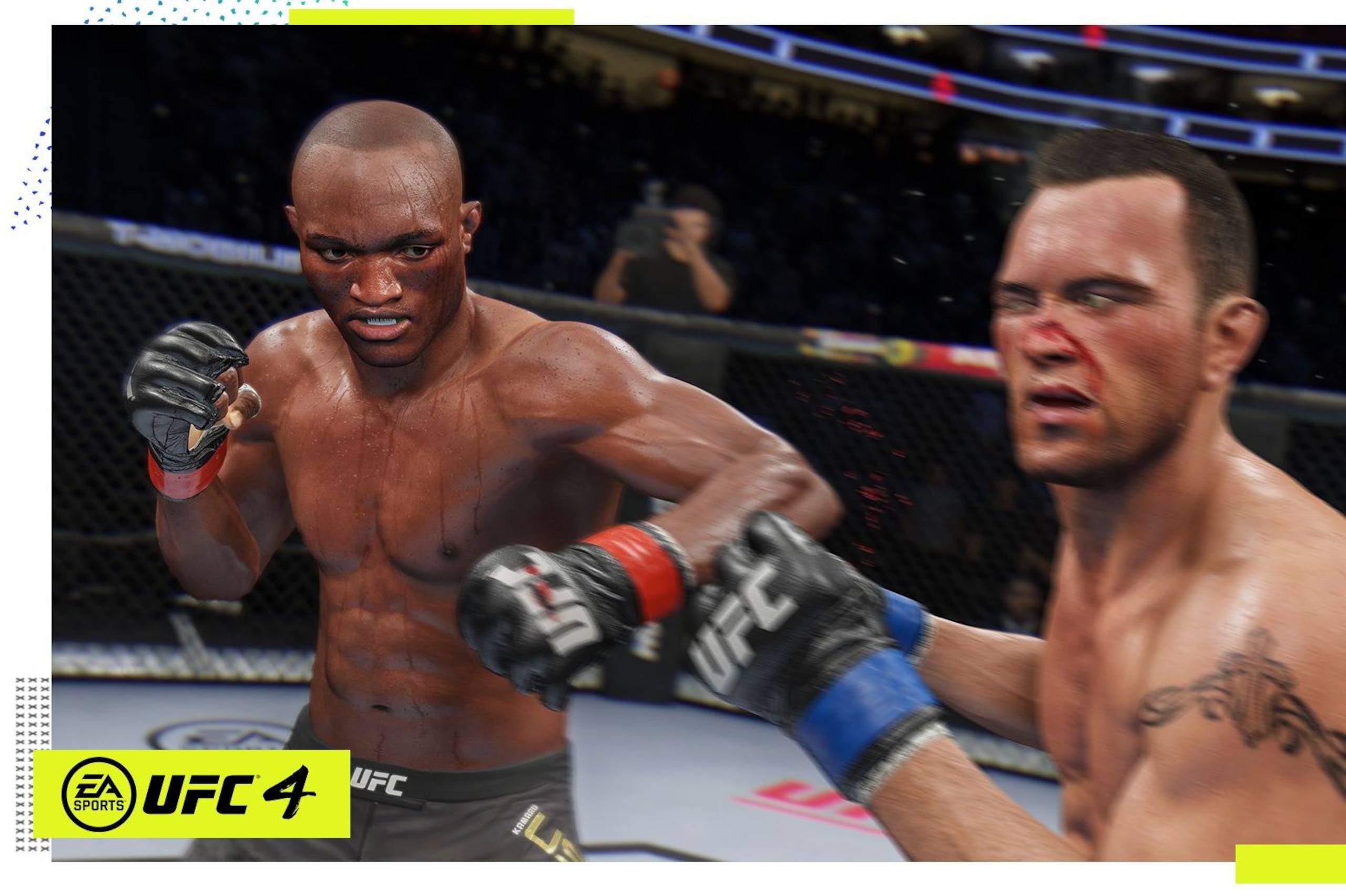


One of the first things players have to do in UFC 4 is take a whipping on the amateur circuit before the game builds them back up into a powerhouse with legendary potential.
The quick dip into career mode shows off excellent production values, slick camera cuts, social media integration and some of the revisions to gameplay a few years removed from the release of EA Sports UFC 3.
And it's all done with expert precision.

With Israel Adesanya and Jorge Masvidal on the cover, developer EA Vancouver delivers one of the more anticipated releases of 2020, promising a sports-game-best career mode and a suite of features helping it stand as one of the best sports games out there.
More often than not, UFC 4 delivers pinpoint blows with plenty of stamina left to use.
Gameplay
UFC 3 was a huge step in the right direction for a franchise that felt like it was really snowballing momentum into something special.
This was especially true thanks to just how fluid everything felt, especially when transitioning from, say, upright fighting to the ground game quickly. All a sequel needed to do was smartly innovate to make things even better, both in transitions and in approach to ease of use for players.
And to be blunt, UFC 4 can be staggeringly overwhelming at first. There are a ton of modifiers to press via trigger pulls in tandem with face buttons, face buttons to hold down at once—sometimes while holding modifiers too—and other asks of the player. Light taps on face buttons do quick strikes while holding them go for heavier, more exploitable strikes.
Not that the game isn't accessible. Players can largely just button-mash on certain difficulties still, provided they pay at least a little bit of attention to the stamina meter. It's critical for the game to still feature this pick-up-and-play potential for casual players, and it does so well.
Perhaps more importantly, if not impressively, is the feeling of achievement for progressively learning the complex mechanics and putting them to use against opponents.
The Real Player Motion Technology was a big talking point for this game's predecessor and is again here. It's especially apparent in takedowns. Out is the lone chance to counter those; in is a multiple-stage sequence that permits counters, strikes and more. It makes for a much more fluid experience, a comment about a singular important area that applies well to the whole of combat, too.
The ground game itself is equally as smooth. It's not overly difficult to get used to manipulating the left stick to enter transitions or outright get up off the mat.
As overwhelming as things can feel at times, it's important to clarify the controls are an improvement from past games. Players now have more control over what types of strikes they throw and the contents of combos. And grappling controls differ from the ground game just enough to feel different, if not feel like the player has more control than usual while grappling.
In short, it feels like EA Sports took its time with this one, and the result is an even better gameplay experience. There's a big hill to climb to master things, but it's rolled out smartly enough through the campaign mode that it is rewarding to keep at it.
Graphics and Presentation
We're at a point in a console generation where a sports game release needs to really nail the "broadcast" feel of events.
And UFC 4 does it quite well, with loud, well-detailed stadiums and a smooth performance at the announcer table backing things up.
There's something really important to be said for the lighting. Past games in the series were pretty bright in a way that felt video game-y. Not here—the lights dim when the bell rings. The crowd is still there in the background reacting, and the announcers are making calls so loud players can almost envision the spittle flying to the mat. But it's just the combatants in the Octagon illuminated well, giving off the big-fight feel the sport needs.
Big moments also get altered presentation. Stuns, wobbles, injuries and other big moments get highlighted by different colors and sounds jarringly invading the screen. In a good way, too, no matter how much it might sound like a bad thing to have. And replays aren't just these standard fare things anymore—slow-mo for key moments in the replay packages illustrates where things went right or wrong for the fighters in sometimes squeamish detail.
Because that's where UFC 4 is really king—the details. Sweat and spit fly. Wounds open and worsen. Abs visually contract even while the fighters stand still and pant between rounds. Muscles ripple with effort, and the sound design brings to life the devastating violence.
A game boasting so many weight classes and no helmets or anything to hide the athletes behind was never going to 100 percent nail every player model and proportion. That's still the case here, though there are notably fewer issues in this department this time out.
When UFC 4 does lose the excellent broadcast presentation, it does so in a brilliant manner. Channeling its inner Kimbo Slice, the game has a backyard fights mode that exclusively features stand-up combat with some really fun, varied environments outside of the makeshift Octagons. Call it the only organic way the game could've expanded beyond what might just be industry-best sporting presentation.
Esports, Career and More
Presumably, UFC 4 will have a healthy esports presence for a long time.
Leagues like ESFL ran competitive fights for the last game often, and based on early promotional events like the virtual fight card to celebrate the game's release, the game will have plenty of global online support.
The infrastructure seems apparent. The game's Online World Championships will house the scene for the most competitive of players. Otherwise, besides the obvious tournament upside, players can invite others to lobbies and tinker with match settings to spar. It's all ripe for a massive competitive side, especially with the right support for a game that could be the main UFC video game scene for more than a year.
Otherwise, online also features Blitz Battles, which is a fun romp of always-changing match rules. And Quick Fight is exactly what it sounds like, including a leaderboard.
Career mode is the big one. And it isn't exactly the typical sporting-game romp—and that's a good thing. Player agency is a big theme. Pick the disciplines to level up. Choose how to approach training camps and scout the opponent.
In a refreshing twist, just using a move levels it up, whether it's in practice or live fights. It's an organic way to approach what could've been a complex RPG-like system or something that dampened the whole experience. Leveling up leads to Evolution Points, a so-so name for a great idea. Those are the key to attribute points or a variety of perks that do the expected things like reducing stamina impact for moves.
The player-agency theme isn't exclusive to the physical either but rather a career-long thing. Players start on the amateur circuit and eventually work their way up to the UFC.
Or not.
Players can spend their entire careers in the WFA if they really want to do so. Their fighter progresses the same—they just won't get the big stage and international fame. Speaking of fame, it and social media play a role. It's funny to see another fighter bash the player's character on social media because said player decided to turn down a fight for one reason or another.
And deciding to go the Conor McGregor/WWE heel route is just too much fun and provides some additional intensity to matches. But being the good guy and keeping it respectful has its bonuses too, like luring fellow fighters to a player's gym to learn their moves and styles.
Again, it's a career mode that very much focuses on the long term. Injuries suffered because of practice mishaps or just sheer bad luck have a chance at recurring often. And from the sounds of it, a fighter's longevity at the very top of their game and actual length of their careers could be impacted by these details.
And career mode serving as a tutorial of sorts is as smart as it gets. This player-onboarding process slowly unrolls the complexities of the sport for players and doubly showcases some of the superb production values and intrigue that will probably encourage even players who don't care for single-player experiences to keep playing it just to see what happens next.
The folks at EA Sports could have just as easily dumped endless info on players in one little opening tutorial movie similar to an ice bucket challenge. Instead, the campaign tutors players in a certain discipline exclusively, then throws them into the Octagon against an opponent strong in that area.
This steady progression feels natural within the confines of the story, and it's a little easy to forget it's even happening. Which is fun too because slowly it becomes clear players end up pretty well-versed in the sport's complexities and can fend for themselves.
Overarching above and within all modes is a new star rating system. It's a little simplistic, but it does a good job of illustrating the overall fighter hierarchy and removes needlessly worrying about droves of different stats and how it impacts an overall rating. It seems more fit for a UFC game than most other sports games, at least.
There are a lot of little things to be excited about too. Updating player ratings weekly or after big events with help from Daniel Cormier means an ever-evolving game that mimics real life. And it's easy to presume the game will get droves of support post-launch, both in the competitive community and via more creative elements like those backyard fights.
Conclusion
It's a little fitting the game begins with slowly building the player up into something special. That's very much the story for this series here after the first two iterations felt a little robotic and the third hinted at something really special.
That something really special is here. MMA has a ton of crossover appeal to many sports fanbases, so looping in perhaps the most casual thing about a sports game—the campaign mode—as a training wheels of sorts is brilliant and done well.
UFC 4's campaign mode is right up there as the best in sports games outright. While complex, it doesn't take long to see why the controls were revamped a bit to suit a smooth-playing effort with plenty of potential longevity as one of the heaviest hitters on the market.