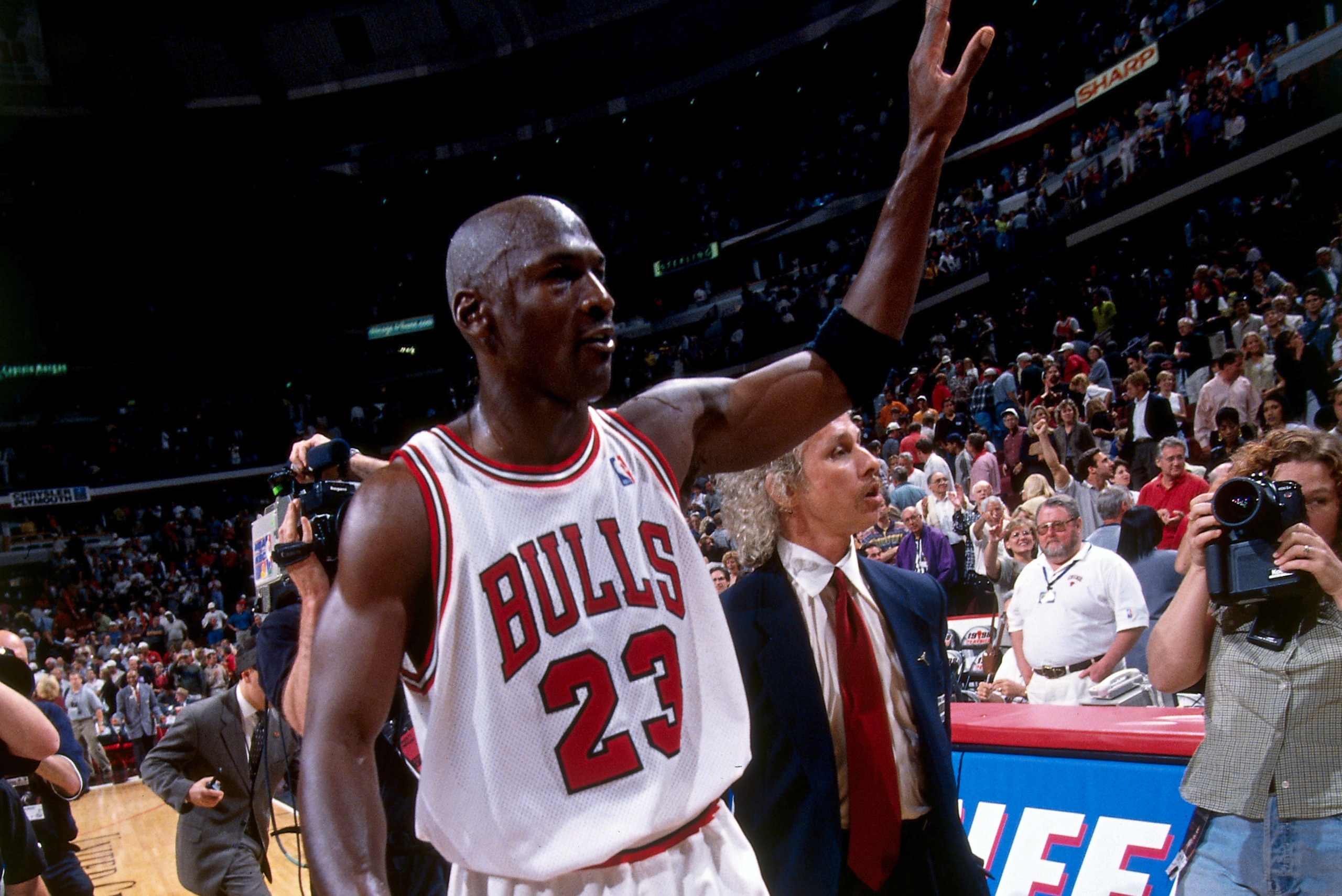


Michael Jordan isn't just arguably the greatest basketball player of all time. He's perhaps the most important person in NBA history as well.
But what if he never existed?
Would the Chicago Bulls have a title yet? What about all the teams Jordan knocked out of the playoffs? Who would have claimed the title as the best player in the 1990s or of all time? Would the NBA still be this popular?
While most will be forever grateful that Jordan picked up a basketball (save for maybe Craig Ehlo and Bryon Russell), it's both strange and fascinating to imagine what the NBA would have been like without the six-time champion who changed the league forever.
Bulls Aren't a Dynasty but Still Pretty Good
1 of 7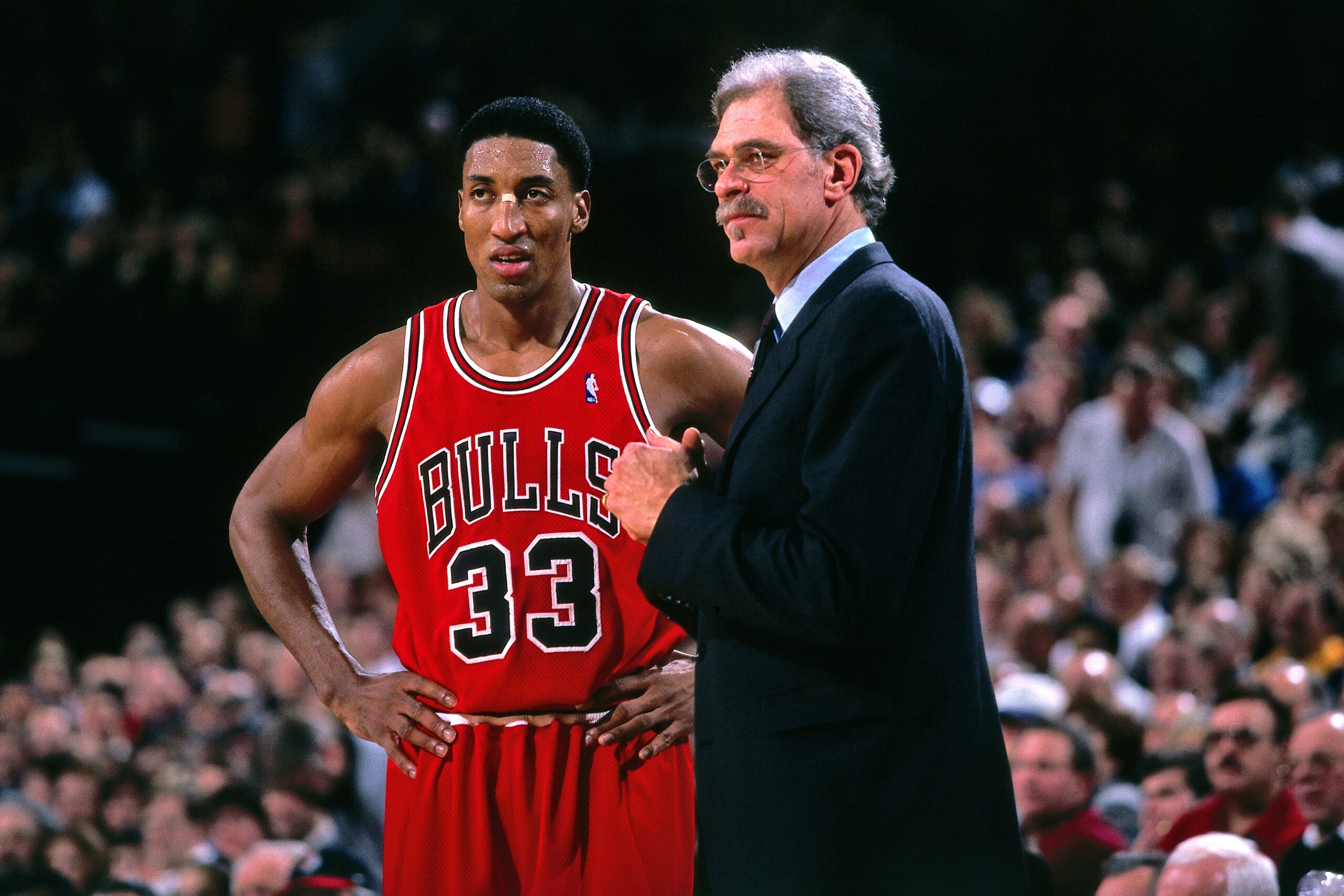
It's safe to say that without Jordan, there's no championship in Chicago.
That's no disrespect toward Scottie Pippen, Dennis Rodman, Horace Grant, BJ Armstrong or any other Bulls great that contributed to the pair of three-peats, but that group isn't title-worthy given all of the other talented teams in the league at the time.
The Bulls still would have been good, though.
No Jordan would have meant an increased role for Pippen, arguably the second- or third-best player in the NBA during his peak.
In the one full season Jordan sat out to play minor league baseball in 1993-94, the Bulls still went 55-27, a drop of just two wins from their 1992-93 title team. Pippen finished third in MVP voting to Hakeem Olajuwon and David Robinson, averaging 22.0 points, 8.7 rebounds, 5.6 assists, 2.9 steals and 0.8 blocks in 38.3 minutes per game.
Chicago swept the Cleveland Cavaliers in the first round before losing to the New York Knicks in seven games in the Eastern Conference Semifinals.
The Bulls' core without Jordan would have been good enough to make the playoffs, but the team would likely still be without a championship in its 54-year history.
Other NBA Players', Teams' Marketability Would Suffer
2 of 7
The phrase "a rising tide lifts all ships" applies to NBA players when referencing Jordan.
While Magic Johnson and Larry Bird helped spark league interest in the 1980s, playoff games were still being tape-delayed until 1986. The global footprint of the NBA was nonexistent compared to today, and the Los Angeles Lakers and Boston Celtics dominated what little basketball was put on TV in the U.S.
"Because of Michael being in the league, we went from one or two games a week on TV in the '80s to almost every night there was a game on," 14-year NBA vet and notable Jordan opponent Craig Ehlo told Bleacher Report.
"Even though Chicago wasn't on every night, I think because of him being in the league, it gave the NBA the marketing ability to market the other teams other than Chicago. When Bird and Magic played, there was always a Boston game on or Laker game on and very few teams in between. I think the NBA marketing ability for the rest of the teams was beneficial with Michael being in the league. If he never plays, I don't think they have that power to get the TV deals that they got."
Ehlo, who played for small-market teams like the Cleveland Cavaliers and Atlanta Hawks, noticed the popularity boom around Jordan and the Bulls.
The salary cap in Jordan's rookie year (1984-85) was set at just $3.6 million. By the time he retired for good in 2003, it had risen as high as $42.5 million. While plenty of other factors contributed to the dramatic rise, Jordan's brand and popularity drew in millions of viewers a year, leading to more lucrative TV deals and thus more revenue for the league to share.
The Dream Team Would Have Been the 2nd-Best Olympic Team Ever
3 of 7
The 1992 United States Olympic men's basketball team is considered the greatest group of American basketball talent ever assembled, going a perfect 8-0 en route to a gold medal by beating opponents by an average of 43.8 points.
The roster was loaded with Hall of Famers, from Magic Johnson and Larry Bird to Patrick Ewing, David Robinson and Charles Barkley.
Of course, the team revolved around Jordan.
Coming off back-to-back NBA titles and MVPs, Jordan still stood out in this group, averaging 14.9 points, 4.8 assists and 4.6 steals while starting every game. With Bird and Magic years removed from their prime, the team relied on him to set the tone in practices and games.
Take away Jordan, and this is no longer the greatest Olympic team of all time.
That honor would fall to the 2012 version of Team USA, which featured LeBron James, Kobe Bryant, Kevin Durant, Carmelo Anthony and Chris Paul.
This squad also went a perfect 8-0 with an average win differential of 32.1 points. James was in his prime at age 27, while Durant, Russell Westbrook and James Harden had just taken the Oklahoma City Thunder to the Finals, and Bryant was still averaging 27.9 points per game at age 33. The team's worst player was a young Anthony Davis.
If Jordan never played for the 1992 Dream Team, the 2012 version would have stolen the title.

Hakeem Olajuwon Would Be NBA's Best Player of the 1990s
4 of 7
While no one came close to Jordan's greatness in the '90s, there was still a ton of talent spread throughout the league.
This was especially true among big men as players like Karl Malone, David Robinson, Patrick Ewing, Charles Barkley and a young Shaquille O'Neal dominated the paint.
Even among this list, one player stood out.
Hakeem Olajuwon was a 12-time All-Star, MVP, two-time NBA champion and two-time Finals MVP who led the league in blocked shots three times and rebounding twice.
At his best, he anchored champion Houston Rockets teams in 1994 and 1995, averaging 30.9 points, 10.7 rebounds, 4.4 assists, 1.5 steals and 3.4 blocks while shooting 52.6 percent over two Finals runs.
Given the Bulls' dominance, the strong play of Olajuwon and the Rockets' back-to-back titles are often an afterthought when talking about basketball in the '90s.
If there was no Jordan, Olajuwon would have likely won multiple MVPs and would be talked about more in the GOAT conversations.
LeBron Would Be the Undisputed GOAT, Right?
5 of 7
While the GOAT debate will continue between Michael Jordan and LeBron James until the end of time, would no Jordan mean James automatically takes the crown?
In what we typically consider a two-player race, a whole other debate would have surely taken place.
The Kobe Bryant-LeBron debates likely would have raged, especially among those quick to count Bryant's five championship rings against James' three.
When comparing accolades, James would have been pitted against Kareem Abdul-Jabbar's all-time scoring record, six MVPs, six championships and 19 All-Star appearances. Fans would have screamed that both Wilt Chamberlain and Shaquille O'Neal were more dominant in their primes and that no one was ever going to touch Bill Russell's 11 rings.
The GOAT talk could have also included Larry Bird, the greatest small forward in history before James, and Magic Johnson, the player who James is most commonly compared to with his size and passing ability.
Of course, theatrics matter too.
As Bleacher Report's Howard Beck wrote in a 2019 GOAT debate:
"By the time Jordan retired for a second time in 1998—having won six titles in eight years and become the NBA's first global rock star—there was no longer much of a debate. It wasn't just the stats and rings. It was the way he got them. No one had ever electrified a crowd the way Jordan did."
While James would have been pitted against a variety of all-time greats, adding Jordan to the mix at least limits the debate to two.
6 Titles Are Split Up Between Multiple Teams
6 of 7
Jordan and the Bulls eliminated many championship-hopeful teams in the postseason, both in the NBA Finals and along the way.
Chicago took down the Los Angeles Lakers, Portland Trail Blazers, Phoenix Suns, Seattle SuperSonics and Utah Jazz (twice) in the Finals, meaning all of those teams would argue they'd have an extra title (or two) if there was no Jordan.
That's assuming one of the Eastern Conference teams that Jordan took out earlier wouldn't have been better, of course.
"I would give Cleveland at least two of them. I would give the Knicks two of them. Indiana, Houston already won two and was very good. No question Utah, once they got [Jeff] Hornacek to go with an established [John] Stockton and Malone. They would have gotten a couple, definitely," Ehlo told Bleacher Report.
The Cavaliers won 57 and 54 games in 1991-92 and 1992-93, respectively, before getting knocked out by Chicago in the playoffs. The Knicks went 60-22 in 1992-93 before Jordan sent them home in the Eastern Conference Finals. Indiana won 58 contests before losing to the Bulls in the 1998 East Finals as well.
With no Bulls dynasty, there wouldn't be any other dynasties, either, but rather a collection of titles to be spread around.
Legacies Are Changed Forever
7 of 7
How would our perceptions of players change if Jordan never existed?
Notable Jordan victims like Craig Ehlo and Bryon Russell would likely be remembered more as quality starters for the Cavaliers and Jazz, respectively, rather than highlight-reel casualties we've seen over and over again.
Players like Karl Malone, John Stockton, Charles Barkley and Patrick Ewing might go from "some of the best players to never win a championship" to simply "some of the best players."
Kobe Bryant would be remembered as the greatest shooting guard of all time.
The phrase "Pippen to his Jordan" wouldn't exist; "Rodman to his Pippen" possibly would've taken its place. We wouldn't have been graced with one of the best memes of all time, either.
While Jordan's legacy is perhaps the most famous of any player to ever step foot on a basketball court, he's altered the legacies of countless others around him as well.
.jpg?w=2560 "Grading WWE Raw 🔠")
.jpg?w=2560 "🚨 Davante Out 6-10 Weeks")
.jpg?w=2560 "Purdy Becomes Highest-Rated QB EVER 🤩")
.jpg?w=2560 "Analyst Apologizes to Hurts")