

NFL Draft 2019: Best Team-Player Fits from Round 1
Every NFL team that made a selection during the first round of the 2019 draft Thursday night believes it has found an ideal fit. However, not all team-player fits are created equally.
Whether a player perfectly matches a team's need, or a scheme perfectly matches a team's new player, some fits are better than others.
Here are the best team-player fits from the first round of the 2019 NFL draft.
Nick Bosa to 49ers at No. 2
1 of 9
Think the 49ers were serious about juicing up their edge pass rushing this offseason? After trading for Dee Ford last month, the 49ers used the second overall pick on Nick Bosa, who should provide an ideal pressure-creating complement opposite Ford of the vastly improved San Francisco defense.
The 49ers defensive line is now Avengers-level stacked. Ford and Bosa join Arik Armstead, DeForest Buckner and Solomon Thomas in a talented and versatile front that could make life hell for quarterbacks in 2019 and beyond.
Bosa was widely considered the top edge-rusher in the class.
"We felt like that was a piece that we still could use, another edge guy," 49ers general manager John Lynch said, per Nick Wagoner of ESPN. "We have Dee on one end, and now we have that other end. And we can come at people in waves. When that happened, that final decision, it just kind of kept getting stronger and stronger. I think, for weeks, we've solidified that."
The 49ers could now be a legitimate candidate to lead the NFL in sacks in 2019. Combine a big increase in production from the edge-rushing group and the long-awaited return of quarterback Jimmy Garoppolo and running back Jerick McKinnon, and the 49ers are quickly trending toward being a serious postseason contender in the NFC.
Quinnen Williams to Jets at No. 3
2 of 9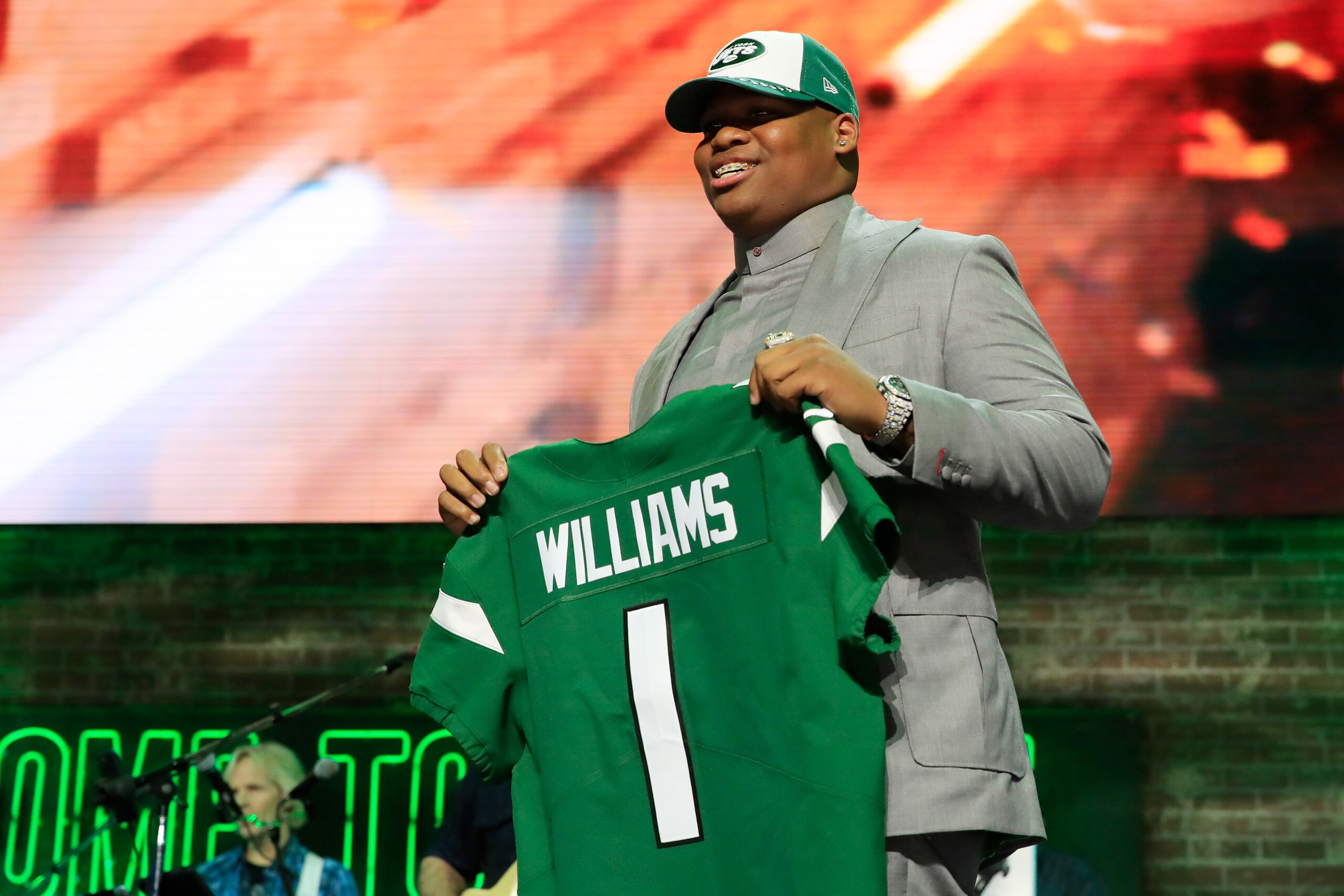
Any time you can get the best player in the draft with the third overall pick, it's a win. Quinnen Williams is a wrecking ball of a player who will both be a star and make everyone around him better, especially once the scheme is molded around him.
It's easy to be reminded here of Aaron Donald and the Rams, who took the Pitt star in the 2014 draft. Guess who was the defensive coordinator then? Gregg Williams, who is now the new Jets defensive coordinator.
Suddenly, the Jets defense looks menacing, especially up the middle. Combine Williams with Leonard Williams up front, newcomer C.J. Mosley at linebacker and Jamal Adams at safety, and the Jets have the start of something really good.
Ed Oliver to Bills at No. 9
3 of 9
Talk about hitting a home run. The Bills went into the draft needing help rushing the passer and at defensive tackle, and they were able to stay put at No. 9 and still get one of the most disruptive interior defenders in the draft class.
Defensive coordinator Leslie Frazier can now plug in Ed Oliver next to Star Lotulelei and Jerry Hughes along the defensive line and let him attack as a penetrating, gap-shooting defensive tackle. Oliver's days of taking on double- and triple-teams as an out-of-place nose tackle are over, making it possible he'll quickly emerge as a star interior disruptor.
In fact, we will likely look back on this draft and wonder how Oliver was still on the board at No. 9. Don't be surprised if he puts up Geno Atkins-like numbers for the Bills. He's going to be that disruptive against the run and pass in Frazier's scheme.
And what about the poor Detroit Lions? Can you imagine taking a tight end before Aaron Donald (Eric Ebron, 2014) and Oliver (T.J. Hockenson, 2019)?


.jpg?w=2560 "Cardinals Giants Football")
Devin Bush to Steelers at No. 10
4 of 9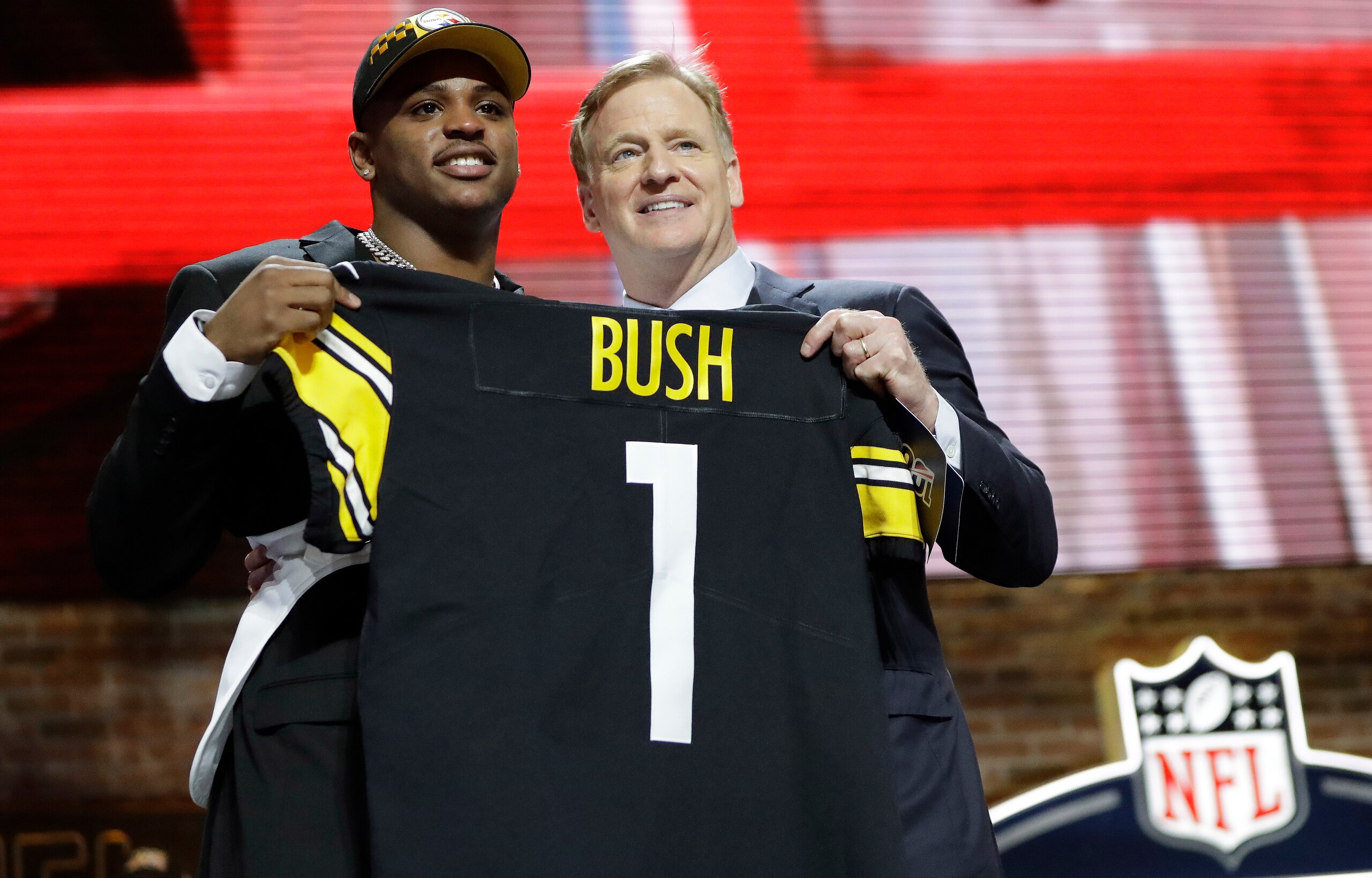
Several teams looked like strong fits for Devin Bush, the small (5'11", 240 lbs) but hyper-athletic and instinctive linebacker from Michigan. But arguably no team will give Bush a better chance at becoming an instant NFL star than the Steelers, who moved up to No. 10 to get him.
Not only are the Steelers stacked along the defensive line, providing cover for Bush to make plays all over the field, but they once maximized the production of Ryan Shazier, who will now help Bush find his way as a starting linebacker in the middle of the Steelers defense.
In fact, Bush and Shazier are similar players. They are both undersized but elite athletes who can run, hit, cover and blitz. That skill set is often maximized in the Steelers scheme, which asks its linebackers to do a little bit of everything.
At the height of Shazier's powers, he was producing high numbers of tackles, pass breakups, tackles for losses, sacks and quarterback hits. Bush likely won't need long before he's stuffing the stat sheet for the Steelers too.
Brian Burns to Panthers at No. 16
5 of 9
The Panthers lost Julius Peppers to retirement this offseason, but they've replaced him with Brian Burns, another athletic marvel.
He might not be on the same level as Peppers, one of the most freakishly athletic and productive pass-rushers of his generation, but Burns brings a combination of elite testing numbers and college production to Carolina, giving him a terrific chance to emerge as a Pro Bowl rusher.
According to Pro Football Focus, Burns led all draft-eligible edge-rushers in total pressures last season. Combine that production with a 6'5" frame and a 4.53-second 40-yard dash, and Burns has the makings of a hell-raising player.
A strong class of defensive players in front of him allowed Burns to last to No. 16. The Panthers will look like big winners of this draft if Burns turns into a consistent, sack-producing rusher.
Garrett Bradbury to Vikings at No. 18
6 of 9
The Vikings were desperate to find a legitimate starter along the offensive line in this draft. They've found exactly that in Garrett Bradbury, who many pegged as the No. 1 center in the class.
Not only does Bradbury have the experience to be a Day 1 starter and the athleticism to be an ideal fit in the Vikings' zone blocking scheme, but he'll also allow Pat Elflein to move to guard, maximizing Elflein's abilities and further strengthening the interior of the line.
The Vikings offensive line still isn't rock-solid, but it's a lot better to end Thursday night than it was to start it. Bradbury is the reason why. Sometimes, the obvious call is the best call.
Darnell Savage to Packers at No. 21
7 of 9
The Packers came into Thursday night with a big need at safety, a vital position in Mike Pettine's defense. Despite signing Adrian Amos in free agency, the Packers still lacked an interchangeable safety capable of roaming the deep half, covering slot receivers, attacking downhill against the run and making plays on the ball.
Good thing Packers GM Brian Gutekunst traded up to No. 21 to get Darnell Savage, because the Maryland star checks all the boxes presented above.
Savage has speed (4.36-second 40-yard dash), playmaking ability (22 pass breakups, eight interceptions), cornerback-safety versatility and fearlessness as a tackler.
In fact, it's easy to look at Savage and see shades of Damarious Randall, the Packers' first-round pick in 2015 who played out of position at cornerback for three years in Green Bay. He's now a solid starting safety in Cleveland.
Maybe taking Savage will give the Packers a do-over on Randall and an answer next to Amos at safety.
Andre Dillard to Eagles at No. 22
8 of 9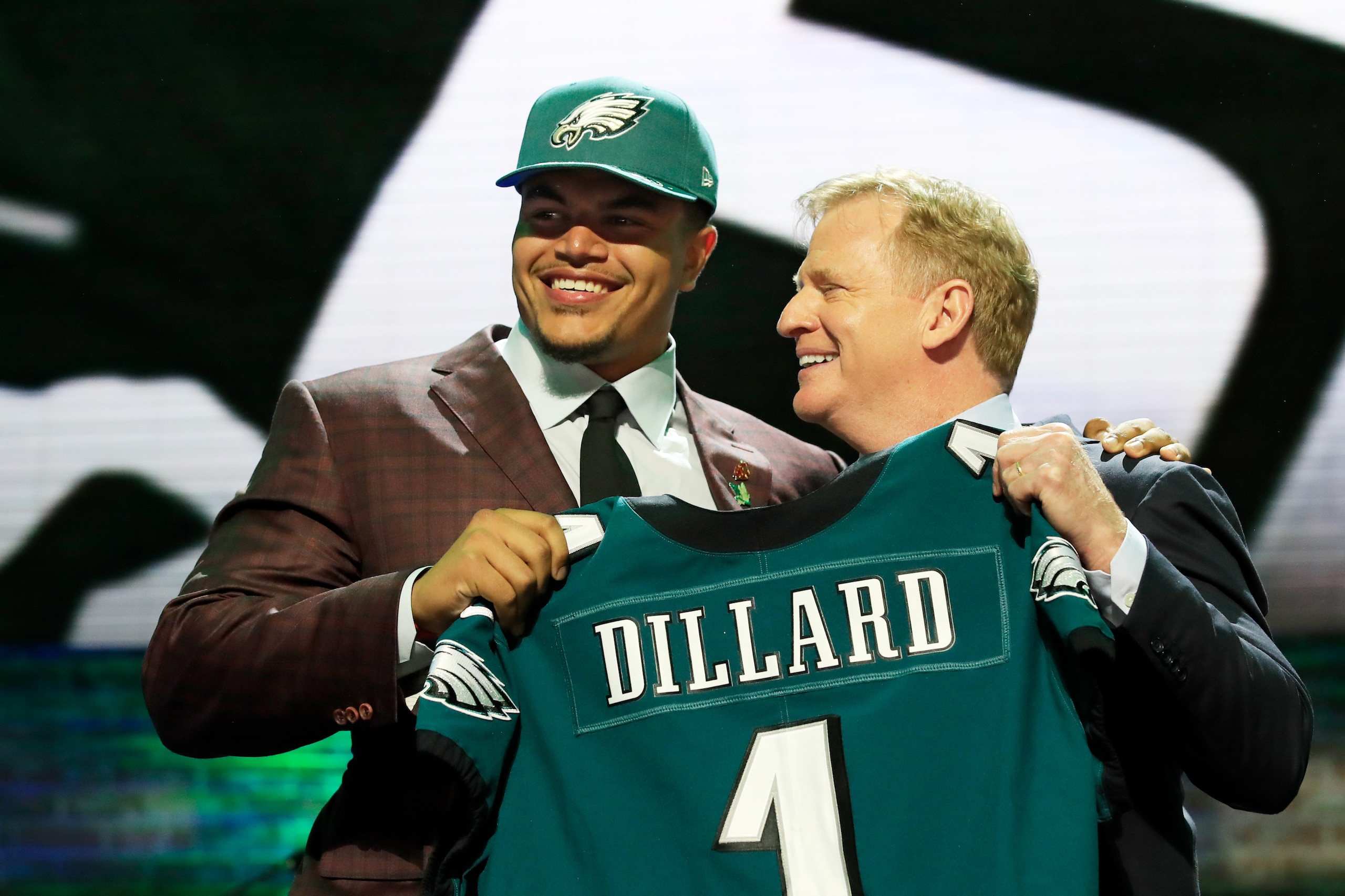
Not only were the Eagles able to trade up to get arguably the top pass-blocking offensive tackle in the draft, but the current makeup of their roster will allow Andre Dillard a chance to learn and develop behind Jason Peters, one of the game's best left tackles.
This is how good teams stay good. Peters turned 37 in January and is running out of good years. Instead of waiting to address the need until it became pressing, the Eagles found the long-term answer now, providing both an early insurance policy behind Peters and his future successor.
And Dillard could probably use a little time behind a solid veteran. He's entering the league after playing in Mike Leach's Air Raid offense, so adjusting to a whole new system will take time. But Dillard is now in an ideal place to maximize his ability over the long haul, and the Eagles have much-needed security along the offensive line.
Jerry Tillery to Chargers at No. 28
9 of 9
How do the Chargers keep plucking these perfect fits in the first round, despite not picking in the top half? Last year, they stole eventual All-Pro safety Derwin James at No. 17. This year, they snagged Jerry Tillery at No. 28, providing the defense with a dominant interior rusher to plug in between Joey Bosa and Melvin Ingram.
Tillery might be 6'6" and 295 pounds, but he ran under 5.0 seconds in the 40-yard dash with a 7.45-second three-cone drill at the combine, showing rare quickness and movement ability at his size.
It won't matter if the Chargers want to play a three- or four-man front. Tillery has the length and power to play on the end of a three-man front and the quickness and penetrating ability to play inside in the 4-3. He's going to be productive at both spots, especially with the talent around him.
If the Chargers defense was missing anything going into 2019, it was more production from the interior of the defensive line. Tillery should fix that problem in a major way.
.jpg?w=2560 "Jets Dolphins Football")


.jpg?w=2560 "Ward Nearly Walks Out of Presser ▶️")