

Mets Trading Noah Syndergaard After Robinson Cano Risk Would Be Colossal Error

There's a fine line between being bold and being reckless. The New York Mets might be threatening to hop from one side of it to the other.
For now, the Mets are on the bold side of it. They've agreed to acquire eight-time All-Star second baseman Robinson Cano and closer Edwin Diaz, who led Major League Baseball with 57 saves in 2018, in a trade with the Seattle Mariners.
According to Jon Heyman of Fancred, New York is also getting $20 million and sending Jay Bruce, Anthony Swarzak and three prospects—outfielder Jarred Kelenic and right-handers Justin Dunn and Gerson Bautista—to Seattle.
TOP NEWS

Brewers Complete Comeback In Game 2

World Series Game 2 Highlights 🎬

Next MLB Players to Sign $200M Contracts 💰
Given that they're coming off an 85-loss season, this should be the part where the Mets are advised to keep adding now that they've committed to contending in 2019. Instead, they apparently must be advised not to recklessly subtract Noah Syndergaard.
According to Mark Feinsand of MLB.com, new Mets general manager Brodie Van Wagenen is keeping a trade of Thor on the table even after the Cano-Diaz blockbuster:
This isn't the first time Syndergaard's name has come up in trade speculation, and that may not be because a whole bunch of teams around MLB are thinking wishfully.
Per Kiley McDaniel of FanGraphs, it's Van Wagenen who's "motivated" to move the flamethrowing 26-year-old:
There might be a specific scenario in which trading Syndergaard makes sense. But as far as questionable logic goes, the general concept blows the Cano-Diaz trade out of the water.
Whether the Mets did well in the Cano-Diaz trade is plenty debatable in its own right. Even once the $20 million from Seattle and the $36.5 million owed to Bruce and Swarzak are factored in, New York is still adding $63.5 million in guaranteed money to its books. Per MLB.com, the Mets are also giving up their No. 3 (Kelenic) and No. 4 (Dunn) prospects.
The headliner coming back is a 36-year-old who was suspended 80 games for violating the performance-enhancing drugs policy in 2018 and whose contract won't end until 2023. In the long run, even the addition of one of MLB's best relievers may not tip the deal in the Mets' favor.
Still, at least you can see where they're coming from.

Van Wagenen made it clear in October he and the organization want to win in 2019. That is a defensible position on two fronts: There's something of a power vacuum in the National League East, and the Mets at least have a foundation to build on.
Said foundation is the team's starting rotation. Jacob deGrom won the NL Cy Young Award on the strength of a 1.70 ERA, and Syndergaard (3.03), Zack Wheeler (3.31) and Steven Matz (3.97) contributed to the team's 3.54 starters' ERA for 2018.
What the Mets lacked was reliability in their offense and their bullpen. The former ranked 12th in the NL in OPS and runs. The latter had a 4.96 ERA and committed more meltdowns than any NL bullpen.
Despite reservations about his age, contract and suspension, Cano can still hit. He has an .848 career OPS and 311 home runs to his name, and he actually hit better after his suspension (.860 OPS) than he did before it (.825 OPS). Any more of that, and he'll be a strong anchor for the New York lineup in 2019.
Diaz, meanwhile, is as electric as they come. The 24-year-old is coming off a 1.96 ERA, and he's whiffed 38.8 percent of all the batters he's faced. So it will go for him as long as he has his devastating fastball-slider combination, and the Mets bullpen will be that much better for it.
In short, the Mets are a win-now team that made a win-now move. To that end, it's awfully hard to make sense of why they might be committed to moving Syndergaard next.
The plan, it seems, is to flip him for one or more impact players and then fill his spot with an equal or greater talent. If the first part of that plan isn't a long shot, the second certainly is.
Syndergaard's NL-best 97.4 mph fastball is just one weapon in an arsenal of sizzling stuff. Throw in good control, and it's no accident he boasts a 2.93 career ERA and 4.9 strikeout-to-walk ratio. The former ranks fourth among pitchers who've tallied at least 500 innings since 2015. The latter ranks sixth.
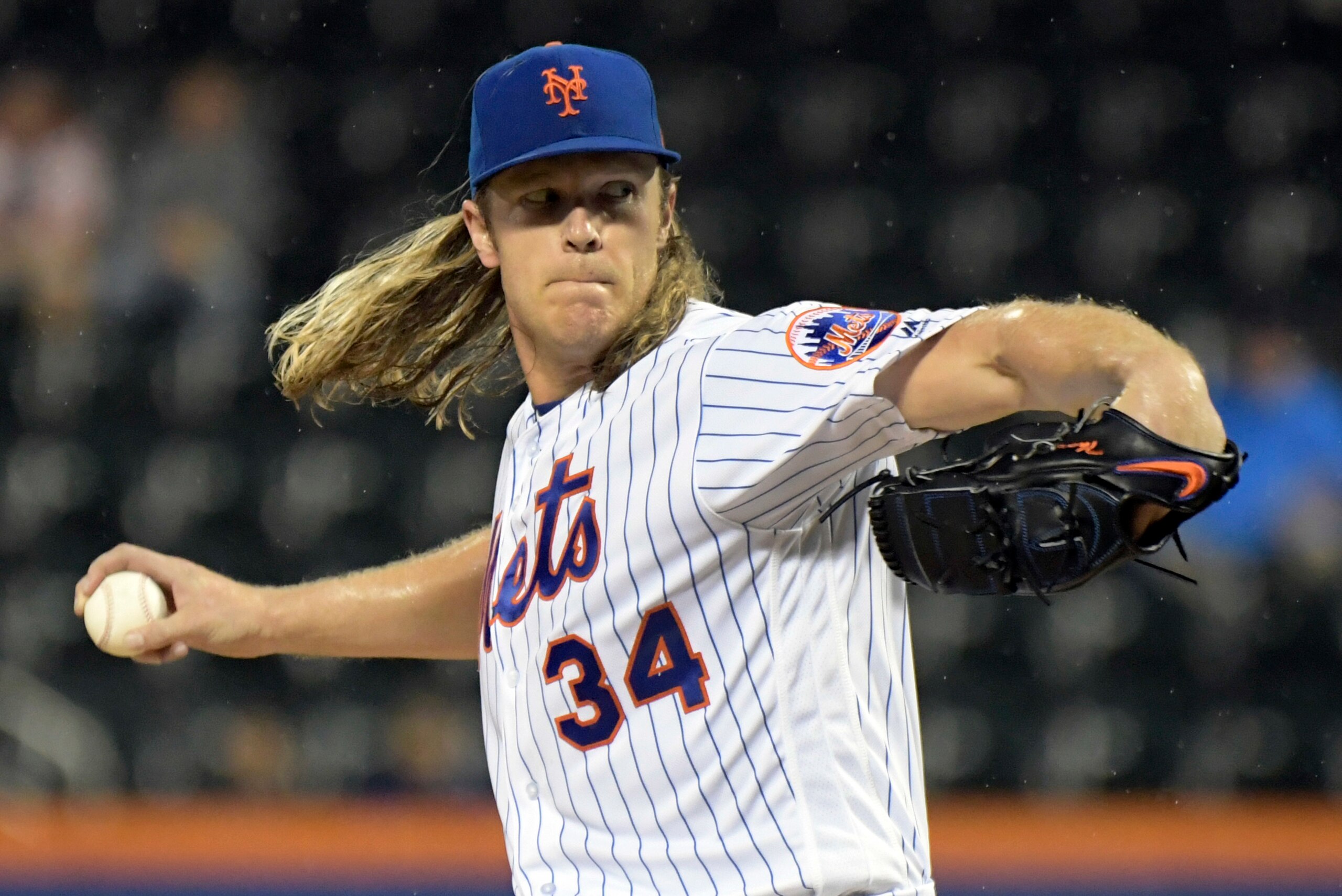
The one black mark on Syndergaard's record is his durability, or lack thereof. He's yet to make more than 30 starts or pitch more than 183.2 innings in a season.
It's possible that is the main driver behind Van Wagenen's determination to move Syndergaard, who was formerly a client when he was an agent for Creative Artists Agency. The idea may be to cash in his trade value before injuries undo it completely.
The alternative is to simply hold on to Syndergaard and hope he builds on his already impressive resume.
That would be a far-fetched idea if he were fresh off a significant injury, but he isn't. He learned the right lessons—i.e., that bulking up maybe wasn't such a great idea—from the lat tear that limited him to seven starts in 2017. And while he only logged 25 starts and 154.1 innings in 2018, that was because of fluky disabled list stints: one for a strained finger ligament and another for hand, foot and mouth disease.
It's also not as if the Mets would shed a huge financial burden by moving Syndergaard. Per MLB Trade Rumors, he's projected to earn only $5.9 million in arbitration for 2019. That's pennies for a pitcher of his ability, and there's only so much his pay can rise through 2021, after which he'll hit free agency.
As it is, Roster Resource projects the Mets' 2019 payroll at $132.3 million—well under where they opened 2017 ($154.4 million) and 2018 ($150.6 million). There should be enough room for a catcher, outfielder and/or starter even if they're unwilling to push the envelope. If they are, even Bryce Harper or Manny Machado is a possibility.
In short, keeping Syndergaard and continuing to build a contender are not mutually exclusive goals. Rather than aim to knock down a complex pattern of dominoes, the Mets ought to keep it that simple.
Stats courtesy of Baseball Reference and FanGraphs.

_0.png?w=2560 "Unranked Teams Cause Chaos in Rankings 📊")

.png?w=2560 "Week 8 Winners & Losers 📊")
.jpg?w=2560 "Jonathan Taylor Landing Spots 📍")




