

On the Road with Barcelona Fans as They Invade Madrid for Copa del Rey Final
Saturday, 4:50 a.m.
If you're a Barcelona fan, you have to get up at an ungodly hour to travel across Spain for the Copa del Rey final against Sevilla in Madrid.
I've hooked up with several Barca "penyes" (which is Catalan for supporters' clubs) to make the eight-hour journey by coach for the match at Atletico Madrid's stadium, the Wanda Metropolitano. We meet in Vilafranca del Penedes, a mid-sized town in wine country an hour's train ride southwards from the city of Barcelona.

.jpg?w=2560)
It's one of the forbidding things about travelling to matches in Spain—it's a big country, more than three times the size of England, so you have to negotiate large distances to get to away games; there is a high-speed train network connecting Spain's cities, but ticket prices are prohibitively high, the fans tell me, which rules out travelling by train.
The Copa del Rey is special in this regard—more than 20,000 fans from both Barcelona in the north-east and Seville, which is in the south, will make the hike to Madrid in the centre of the country for the final. Normally, you might only get 200 Barca fans travelling for, say, a La Liga match against Real Madrid at the Santiago Bernabeu stadium.
As we gather in the dark, the most noticeable aspect of the travelling Barca fans is the demographic spread—they range in age from teenage boys and girls to middle-aged men and a 69-year-old woman. This is a family affair.
I'm introduced to various fans making the journey, including Pere, which is Catalan for Peter. It is joked—half-seriously—that I can call him "Peter" but not "Pedro," the Spanish equivalent. On the bus, people talk to each other in Catalan. Like all Catalans, they can switch effortlessly into Spanish or Castellano.
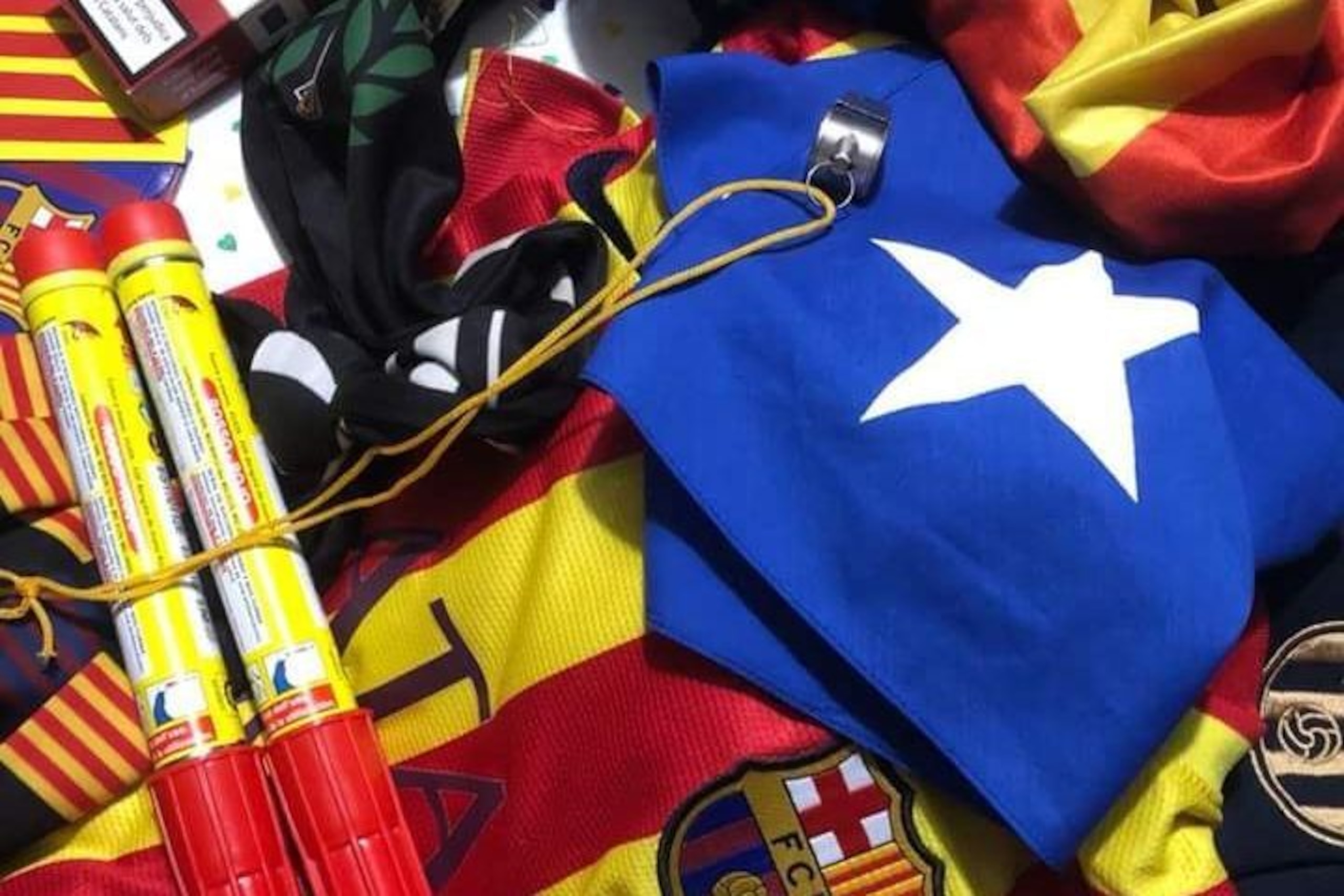
The Catalan language is more than a dialect. It's a mix of French and Spanish, and its widespread use—including in the public school system—is one of the hallmarks of the region's drive for independence.
The Catalan language is part of the fabric of FC Barcelona. It's used in the club's communications. At Barca press conferences, or in the mixed zone after games, even a player like Luis Suarez, a Uruguayan who has only been with the club for a few years, will field questions in Catalan and respond in Spanish.
7:30 a.m.
After knocking a couple of hundred kilometres off the journey, the coach pulls off the motorway to a service station area.
More than a dozen other Barca fan coaches have also pulled in. We dismount for a breakfast of champions—crates of sparkling wine, known as "cava" in Catalonia, and boxes of "bocadillos" (baguettes with ham, cheese or "fuet," a type of dry-cured Catalan sausage) are unfurled from the hold under the coach and mounted on tables. We tuck in.

8:30 a.m.
Back on the bus, the singing starts, led by a cohort at the back. There are a few staples from the songbook, including "Un dia de partit" (A day of the match) and "El Cant del Barca."
Everyone knows the lyrics to the club's anthem "El Cant del Barca," which is played over the speakers before and after games at the Camp Nou, Barcelona's stadium. The hymn concludes with a rousing call to arms: "Tenim un nom el sap tothom (we've got a name that everyone knows): Barca, Barca, Baaaarca!"
Later in the night, Barcelona's mosaic behind one of the goals at the Wanda Metropolitano, which was organised by FC Barcelona's marketing department, will use these words as its centrepiece: "Barca, Barca, Barca."
It's also a play on a famous 1968 essay published by Manuel Vazquez Montalban, a star left-wing intellectual in Catalonia, entitled "Barca, Barca, Barca," which publicly aligned for the first time—during the Franco dictatorship—the club with Catalonia's radical left.
9:47 a.m.
As we pass by one of the huge black metallic bulls that are sprinkled along many of Spain's motorways, Jaime, a Barca fan, lets out a groaning boo. The first wooden roadside bull, which was designed by a graphic artist called Manolo Prieto, was erected on the Burgos-to-Madrid motorway in 1957, per The Independent.
The bull is a contentious symbol in Spanish football. Catalonia became the first mainland region in Spain to ban bullfighting, following a regional parliament vote in 2010 (which was overturned in 2016, per Time magazine).
Barca fans wear Catalan flags with a black donkey superimposed on them draped over their shoulders at matches. The Catalan donkey was co-opted decades ago as the region's unofficial symbol; the donkey's characteristics are in marked contrast to the bull, which is synonymous with cities in the south of Spain like Seville and Madrid—Real Madrid fans, for example, wear Spain flags with a black bull superimposed on them at games.

10:15 a.m.
There is a draw on the bus to predict the score for the match. There are no dissenters: all 67 voting predict a Barcelona victory.
10:45 a.m.
I fall into conversation with Ivan Monterrubio, a 22-year-old who's in his final year of a business studies course at university. He's a goalkeeper who spent time studying in Missouri and Oklahoma on a football scholarship.
He's travelling with his brother, David, 18, and their dad, Xavi, who went to his first Barcelona match back in 1976 against Valladolid. Ivan says that "at least" 75-80 per cent of the fans on the coach would be in favour of Catalan independence. "My family are down the middle. It's complicated," he says.
During the week before the match, the president of La Liga, Javier Tebas, said it would be "verbal violence" if Barcelona fans whistled the playing of the Spanish national anthem before the final. Many Barca fans have packed a referee's whistle in their kit for the match for this very purpose. "To insult [the Spanish national anthem] is to disrespect millions of Spaniards and Catalans who have respect for the flag," said Tebas, per Diario Sport.
Later at the match, Barca fans will have yellow scarves, yellow T-shirts and yellow banners in solidarity with political prisoners, confiscated by Spanish national police and security on entering the stadium, per El Nacional.
Ivan shows me his match ticket for the final, which he got through a contact at the Spanish Football Federation. He's a member of Almogavers, one of Barcelona's most prominent supporters' clubs.
He pays €15 for his annual membership card with Almogavers and €150 for his season ticket behind the north-end goal at the Camp Nou, which is good value considering Arsenal fans pay on average £891 (€1,020) for their season tickets, per the Telegraph.
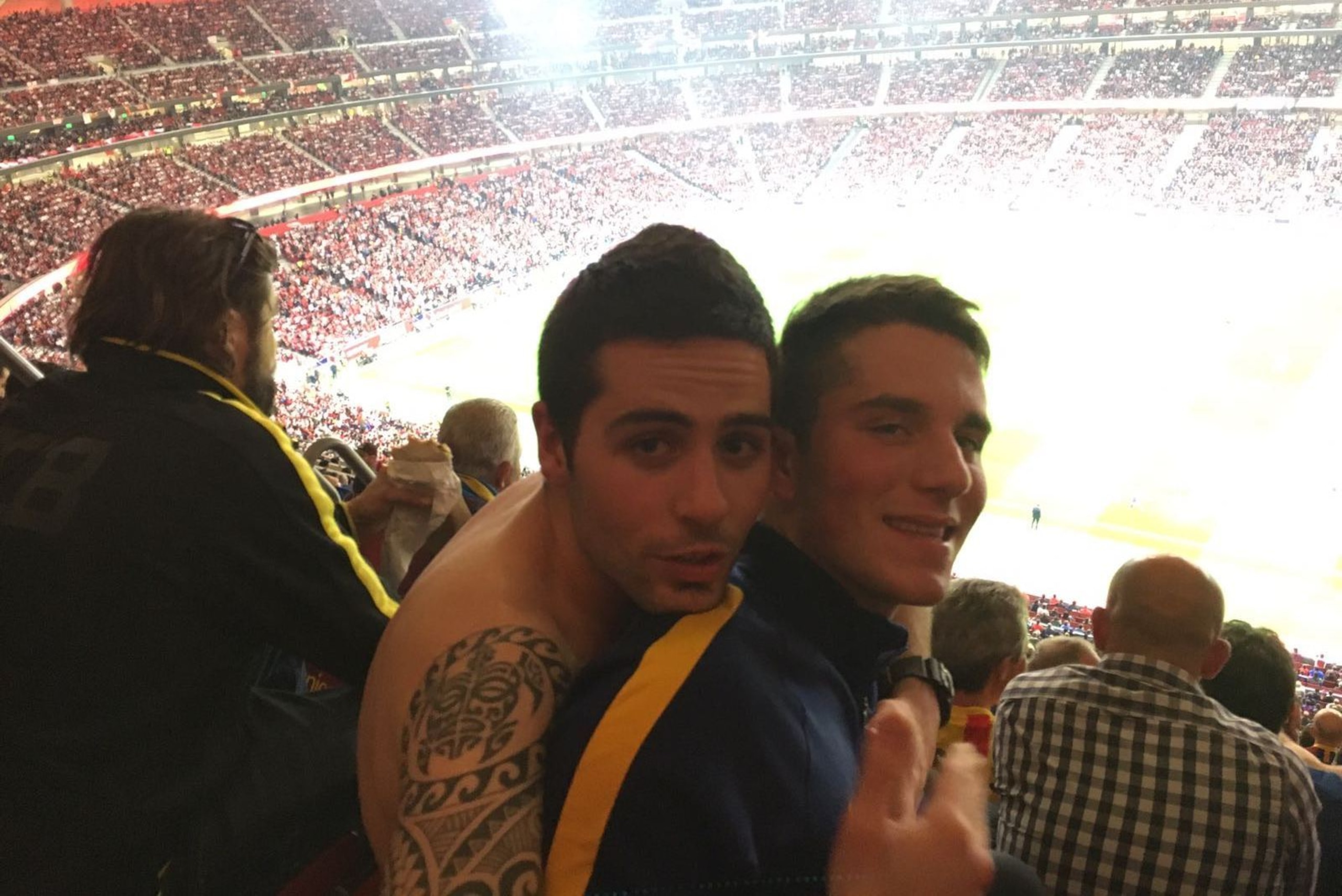
1 p.m.
At around 1 p.m., the coach arrives at the Feria de Madrid, so the bulk of fans can pick up their tickets for the final. The group from the coach split up.
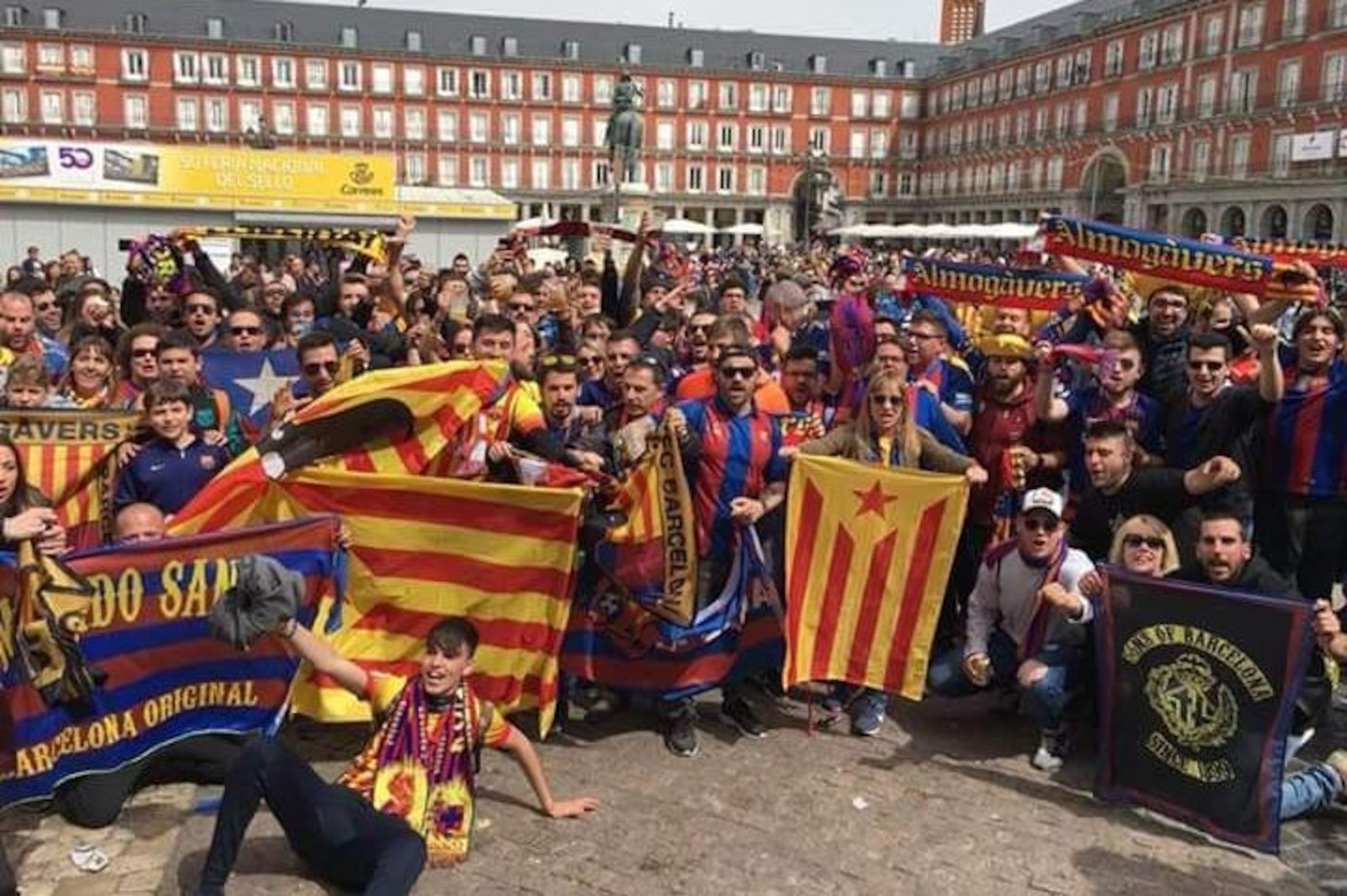
Some fans head to the official Barcelona fan zone, which is about a kilometre from the Wanda Metropolitano. Instead, I head back into the centre of Madrid by metro with Ivan and his mates. They go straight to the bars around Plaza Mayor and do a bit of a pub crawl.
Plaza Mayor is hopping. Sevilla and Barca fans stand around singing and chatting. The occasional flare goes off. The afternoon disappears quickly.
4:15 p.m.
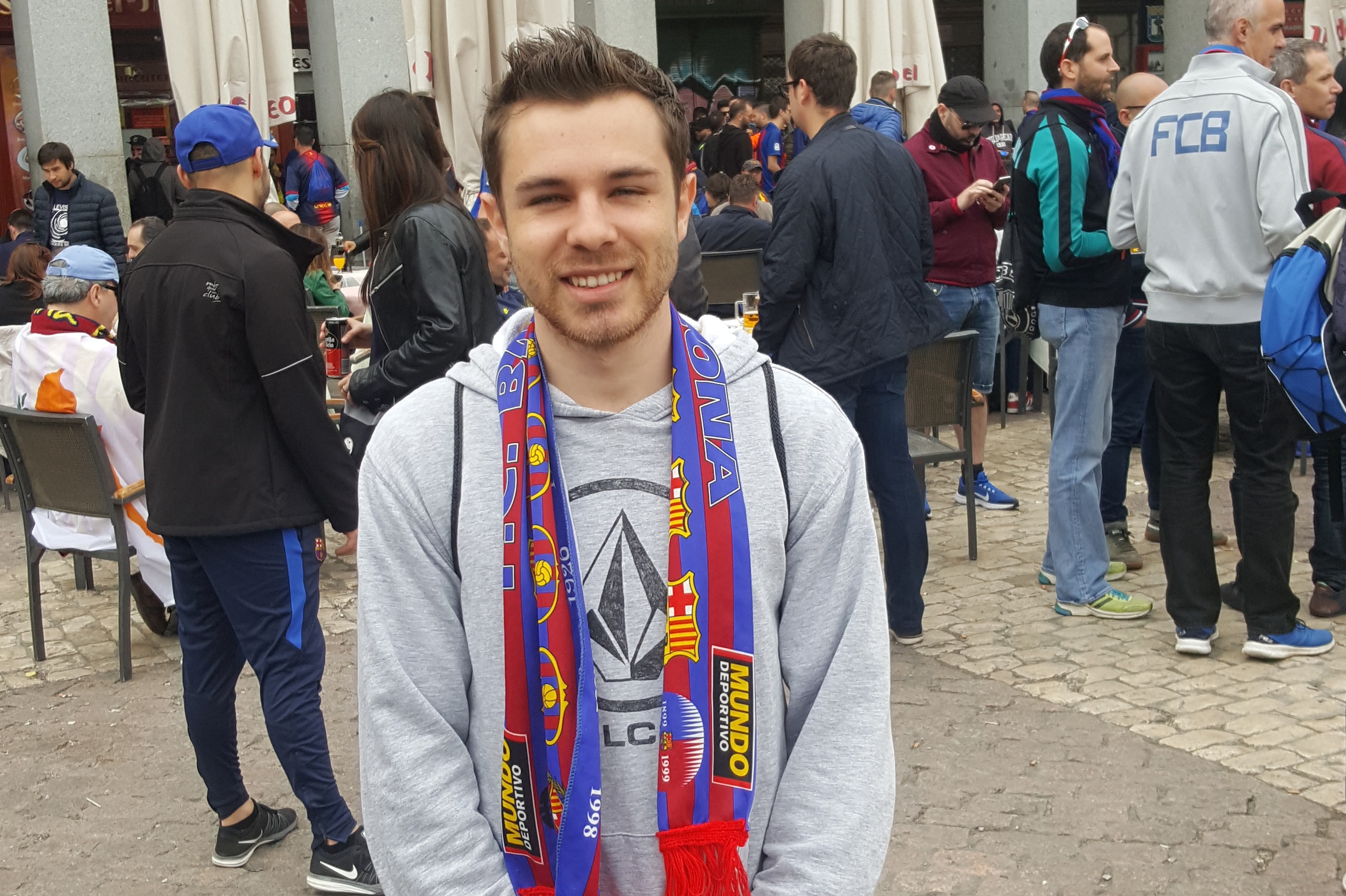
I get chatting to Javi Tuduri, 23. He's spent the last seven years working as a ball boy for Barcelona's matches at the Camp Nou.
By day, he's an economics student at the University of Barcelona. By night, he gets paid €7 an hour for his four-hour shift. It's a nice job on the side. He explains that ball boys aren't allowed to speak to a player unless they're spoken to. He shrugs, accepting it's the professional thing to do—the players can't be distracted from their work.
Javi's station on the pitch is right beside where Barca's coach Ernesto Valverde patrols his technical area. Javi was on duty the night of the 2015 Copa del Rey final between Barcelona and Athletic Bilbao when Lionel Messi scored the most famous goal in recent Copa del Rey history, a slalom right through Athletic's defence that began close by Javi on the halfway line.
"The celebration for that goal was different," he says. "Fans are used to Messi scoring. He does incredible things and people just accept it as being normal, but that night the stadium was pumped because it was a final. It was amazing."
6:33 p.m.
Over in Sevilla's official fan zone, which is walking distance from the Wanda Metropolitano, it's fiesta time. It's set up like a music festival—featuring a stage where live bands play, merchandise stores and food stalls.
People from Andalucia in the south are infectious company—"muy sympatico." When I turn to speak to people, I'm quickly invited to have a beer or some spirits and to share food from their hampers.
Sevilla fans are no strangers to days like this. Members from the "Mi Tio Tenia Razon" Sevilla supporters club, for example, are at their 17th cup final match with the club since 2005. (Their name "My uncle was right" is taken from the answer to a question raised in the lyrics to a club song when a kid asks his uncle who is the best football club, and he replies: "Sevilla FC.")
When I ask one of its members, Luis del Castillo, about Sevilla's relationship with Barca, he laughs: "There is no relationship." Then he answers: "Nah, nah—we have to say we put away politics completely. We are followers of football. Barcelona has a component about politics that we don't like, but apart from this, it is a fantastic club. They have the best player in the world."
21:30 p.m.
As the game kicks off, I take refuge in a Real Madrid supporters' club on the south side of the city close to Rayo Vallecano's stadium. I'm keen to take the temperature of Real Madrid's fans at the invasion of Sevilla and particularly Barca fans to their turf for the day of a cup final.
Before travelling, I phoned several Real Madrid supporters' clubs in Madrid to see if I could watch the game with them. There was surprise at the suggestion. There was no appetite to watch a likely Barcelona coronation.
"If Real Madrid isn't playing, we won't be watching the game," a director from the Primavera Blanco supporters' club told me. "Hala Madrid … y nada mas!" (Up Madrid … and nothing else!), he said, quoting the club's anthem.
Meanwhile, at the El Capote y La Montera supporters' club, there were only three Real Madrid fans at the bar sitting around to watch the match, excluding the barman and a couple of women who gabbed at the end of the bar and were oblivious to the match on television.
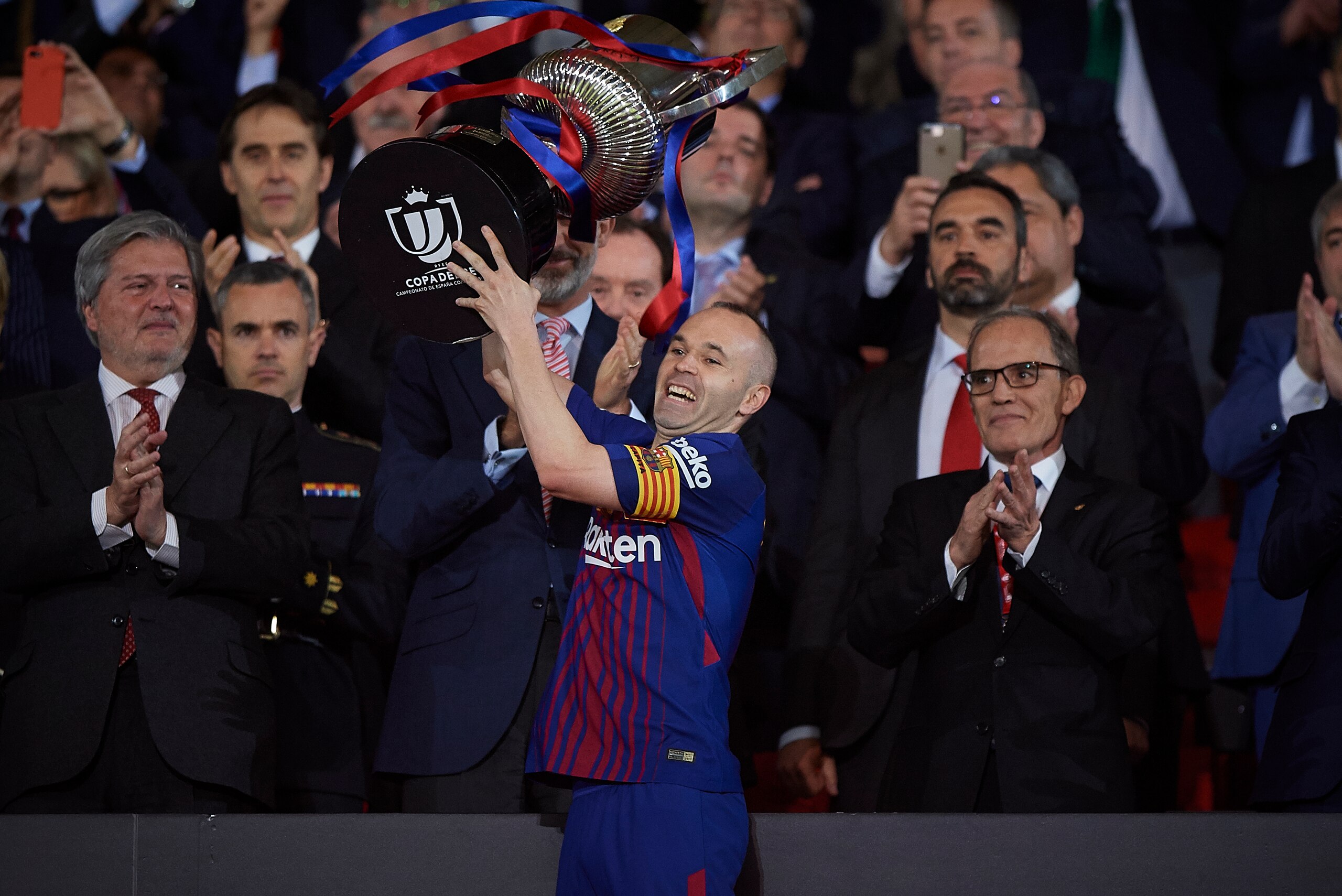
When Julio Salinas, who played for Barcelona on Johan Cruyff's Dream Team in the early 1990s, was introduced as the studio analyst for Television Espanola, and one of the guys sitting at a table ridiculed him for speaking like a duck.
It was an unusual atmosphere in the booze can. When Barcelona's goals flew in—Barcelona ended up winning the match 5-0—they were met with silence and glum, inscrutable faces.
When I chatted to the barman, Jose, at half-time about the whistling of the Spanish national anthem, which was featured in a news bulletin on the TV, he was disgusted.
"I'm from Atletico, but it's still disrespectful for Spain. F--king cules (the nickname for Barcelona fans)," he said while slapping the back of one hand in the cup of his other hand.
Sunday, 00:30 a.m.
Before boarding the bus back to Barcelona with the fans from Vilafranca del Penedes, the mood was jubilant as we polished off the last of the cava and bocadillos. People were tired and hoarse but quietly satisfied that some ghosts from the fall in Rome a couple of weeks earlier—when Barcelona were surprisingly knocked out of the UEFA Champions League quarter-final on away goals (4-4 on aggregate) following an epic 3-0 second-leg win by AS Roma—have been laid to rest.
As the coach snaked its way out of Madrid en route for home, the fans gave their song "Un dia de partit" a final, battle-weary rendition: "…I'm a supporter of Barca/I'll always love you!/Ale, ale, aleeeee/Ale, ale, aleeeeeeee…"
All quotes and information obtained firsthand unless otherwise indicated.
Follow Richard on Twitter: @Richard_Fitz

.jpg?w=2560 "Rams Eagles Football")
.jpg?w=2560 "Bijan's INSANE 1st Half 🤩")

.jpg?w=2560 "Injury-stricken Seahawks signing veteran RB")

.jpg?w=2560 "2 NFL Officials Suspended")
