
The Most Difficult Decisions of the 2018 NFL Offseason
The Kansas City Chiefs gave us an early answer to one of the significant quarterback questions of the 2018 offseason when they agreed to trade Alex Smith to the Washington Redskins. Yes, they're moving on from Smith even after his standout 2017 season, and the Patrick Mahomes era will begin.
But that one answer led to many more questions since Kirk Cousins is likely to hit the open market. He's now the giant looming question mark in an offseason filled with them, especially around the quarterback position.
The Minnesota Vikings might be in on the Cousins bidding, but first they need to make a difficult decision on the future of Case Keenum after his swift ascent to stardom. The Denver Broncos and Arizona Cardinals face perhaps the most glaring quarterback holes and should be the most active teams in free agency and on the trade market. And while the Pittsburgh Steelers and New York Giants probably have their veteran passers returning in 2018, they still have tough calls to make about the future.
Then there's the Buffalo Bills, who need to finally stop dancing around their dislike of quarterback Tyrod Taylor and do something about it. There will be challenging calls at other positions too, including what the Green Bay Packers do about their logjam of overpaid and underproducing veteran wide receivers, whether the Dallas Cowboys should cut top receiver Dez Bryant and what direction the Steelers will go with running back Le'Veon Bell.
There are a lot of moving parts to any NFL offseason, and the machinery is just kicking into gear. Here's a deep dive into the toughest upcoming decisions that will shape rosters for 2018 and possibly beyond.
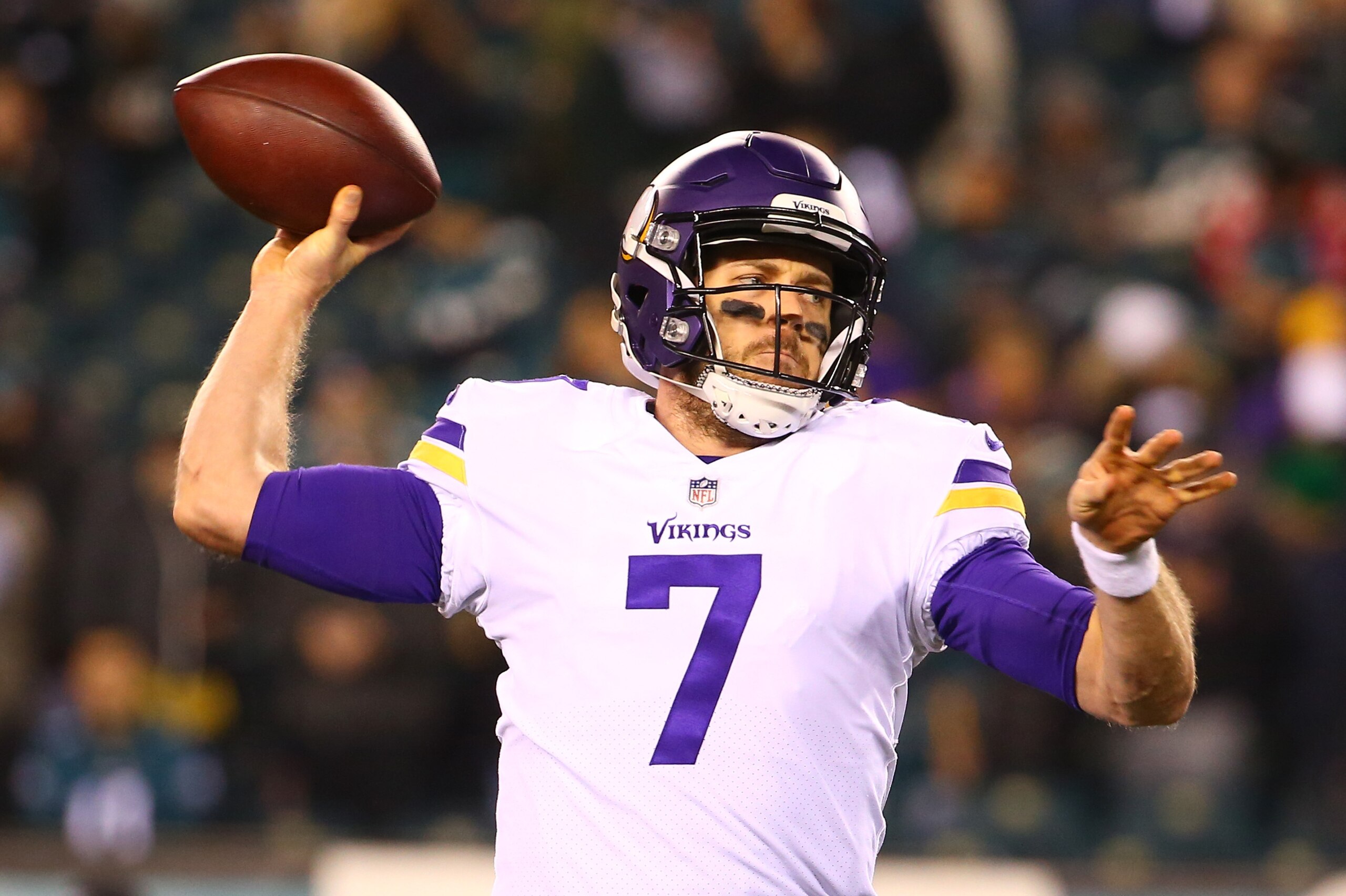
How Will the Vikings Handle Their Void at Quarterback?
1 of 10
The strange journey of the 2017 Vikings will carry over into the offseason.
The Vikings won the NFC North and came within one win of the Super Bowl after Sam Bradford, their starting quarterback out of training camp, started only two games. He didn't even make it to halftime in the second of those.
Initially, the offense kept chugging without Bradford because of rookie running back Dalvin Cook's brilliance (444 yards from scrimmage over his first four games). But then he tore his ACL, which shifted the focus to quarterback Case Keenum, who at the time was an unproven journeyman.
But the Vikings offense rolled merrily along as Keenum quickly shed the Jeff Fisher stink tied to him after a flameout with the Los Angeles Rams in 2016. The soon-to-be 30-year-old gave a team rooted in defense and a punishing rushing offense exactly what it needed.
He kept drives going with pinpoint accuracy and completed 67.6 percent of his passing attempts with a rating of 98.3. And even better, he didn't make many mistakes while throwing 22 touchdown passes with just seven interceptions.
But he could be gone as a free agent. Normally, that wouldn't cause panic and hair-pulling because Minnesota could plug either Bradford or Teddy Bridgewater in and keep plowing ahead. But they'll be free agents too, which means the Vikings are the rare team with a hole at quarterback that was just among the NFL's final four.
The real question is whether they believe in Keenum enough to pay him like a cornerstone and not a backup who stepped in and had a nice run. Keenum has earned a raise, and this may be his only shot at one.
There's been some discussion about Minnesota applying the franchise tag to him, as NFL Network's Ian Rapoport reported Jan. 21. In 2017, the franchise tag value for quarterbacks was $21.3 million, and in 2018, it will likely increase to about $23.6 million, as CBSSports.com's Joel Corry calculated.
Keenum may have regularly made impressive throws while developing great chemistry with Vikings wide receivers Stefon Diggs and Adam Thielen. But such a commitment, or anything close to it, would be substantial for a quarterback who didn't blossom until his age-29 season.
Minnesota has its core defensive pieces locked up for 2018, and Cook should recover from his knee injury. So a team that didn't succeed solely because of its quarterback might be better off going with cheaper options in Bradford and Bridgewater and letting them fight for the starting spot.
Or they could throw every damn dollar they have at Kirk Cousins.
Will the Giants Give Odell Beckham Jr. the Money He Deserves?
2 of 10
The New York Giants have taken a confusing approach with megastar wide receiver Odell Beckham Jr. So confusing that it could lead Beckham to enter the final season of his rookie contract without any long-term assurances.
Beckham's 2017 season ended with a fracture ankle. But in just four games, he caught 25 passes for 302 yards and three touchdowns.
When healthy, he was the same dynamic receiver who exploded for three straight 1,300-yard seasons to begin his career, and each year came with double-digit touchdown receptions too. In 2017, he became the fastest receiver to reach the 300-catch mark, needing just 45 games to get there.
Also, the 4,122 receiving yards Beckham piled up from 2014 to 2016 stand as the second-most in the first three years of a player's career behind only Randy Moss, according to Pro Football Reference.
He's a generational talent. Sure, there may come a time when Beckham's talent fades and his off-field behavior stands out even more, which is where Dez Bryant of the Dallas Cowboys is now. But Beckham is just 25 years old and has time to mature.
Any behavioral concerns should fade because he's a transcendent player. He's certainly not a player a franchise should aggravate by hesitating to make a long-term commitment.
Prior to the 2017 season, Beckham told Uninterrupted he wanted to be the league's highest-paid player. That seems like an unrealistic goal since the Steelers' Antonio Brown, the league's highest-paid receiver, has a paycheck that slots him into a tie for 20th overall ($17 million annually). To the surprise of no one, quarterbacks occupy the top 15 on that list.
Still, at minimum, Beckham's talent and youth should lead to a resetting of the wide receiver market as he easily passes Brown to become the richest player at his position. It may just be a matter of time until that day comes.
How Will the Cowboys Handle DeMarcus Lawrence's Future?
3 of 10
On the surface, the DeMarcus Lawrence decision looks like simple dot-connecting for the Cowboys. They need to sign their young defensive end to a long-term extension and will use the time before free agency to land on the right number.
But finding that number can be tricky, and even more so with Lawrence.
The 25-year-old emerged in 2017 with 14.5 sacks, nearly double his previous career high. The former figure also tied for the second-highest total in the league behind only the Cardinals' Chandler Jones, who had 17.0.
Lawrence isn't just a one-year wonder or a pass-rusher who suddenly found motivation in a contract year. He also had a solid season in 2015, when he recorded eight sacks and 55 tackles.
The problem is what happened during the past two offseasons.
Lawrence needed back surgery after two consecutive seasons. In 2016, the procedure zapped him of his explosiveness, and a four-game suspension didn't help either. He finished with only one sack in nine games.
In 2017, his recovery was clearly smoother, and Lawrence rebounded well. However, there's surely still at least mild concern about his long-term effectiveness.
That apprehension might complicate contract talks. But as Dallas vice president Stephen Jones recently told Drew Davison of the Star-Telegram, the team is dedicated to securing its prize pass-rusher for many years and not just one season.
"Our first goal is to sign him to a long-term deal, obviously," Jones said. "To me, the only reason you use a franchise tag is to hopefully protect yourself if you can't get a long-term deal signed that you like. That's normally the route we like to go."

.jpg?w=2560 "Steelers Saints Football")
.jpg?w=2560 "Rams Raiders Football")
Will the Steelers Give Le'Veon Bell the Market-Resetting Extension He Wants?
4 of 10
Le'Veon Bell made a statement prior to the 2017 season that sounded a little greedy at first. Upon further review, it made a whole lot of sense.
At the time, he was slated to play under a franchise tag that paid him $12.1 million. The soon-to-be 26-year-old told NFL Network's Ike Taylor (via NFL Network's Mike Garafolo) that he wants to be paid like a No. 1 running back and a No. 2 receiver.
In 2016, Bell finished fifth in the league with 1,268 rushing yards even after he missed four games. He also finished second among Steelers pass-catchers in targets (94), receptions (75) and yards (616).
Then Bell went out and did it again. In 2017, he was the NFL's third-best rusher with 1,291 yards, and his 106 targets and 85 receptions were the second-highest totals for Pittsburgh, while the latter figure was the 10th-highest in the league. He was the only player at a position other than wide receiver to crack the top 10, and he recorded 655 receiving yards, third on the Steelers and the second-highest total of his career.
So Bell's idea of how he should be valued doesn't look outlandish at all. Instead, it seems downright reasonable, even if it will reset the running back market.
Being paid like the top running back means besting the $8.3 million earned annually by Devonta Freeman of the Atlanta Falcons. Combining Freeman's yearly salary with, for example, Mohamed Sanu's—the Falcons' No. 2 wideout, whose contract pays $6.5 million annually—would lead to a deal with an average annual value of $14.8 million.
That's slightly more than what Bell would be projected to earn if Pittsburgh tagged him for a second straight season ($14.5 million).
If the Steelers have trouble coming to terms with paying Bell substantially more than every other running back, they should remember he's a running back in name only. In truth, Bell is a hybrid offensive weapon who's entering his prime years. In this era of the NFL, we haven't yet put a price on a player with his skill level.
Is It Time to Draft Ben Roethlisberger's Successor?
5 of 10
Prior to the 2017 season, Steelers quarterback Ben Roethlisberger was thinking long and hard about whether it'd be his final year.
Before training camp, he told Ed Bouchette of the Pittsburgh Post-Gazette that retirement would be on the table and that his wife wouldn't mind if he walked away.
Fast-forward to January, and his outlook has swung in the opposite direction.
"He told us three [more] years," Steelers center Maurkice Pouncey told ESPN.com's Jeremy Fowler. "He says he wants to play out his contract, so we'll see."
Wanting to play out your contract and wanting to play three more years are two different things. The 14-year veteran has two years left on his deal and is due to make $12 million in both 2018 and 2019.
Which means there's a two-step process if Roethlisberger is to play through his age-38 season. The first is obvious: He needs to keep playing at a reasonably high level, just as he did for most of 2017, when he averaged 7.6 yards per attempt with a passer rating of 93.4.
The second is a little more difficult: Pittsburgh needs to trust that a quarterback who's endured plenty of injuries in his career can stay productive as he approaches the age of 40. It needs to trust him enough to commit to him financially during a time when other team needs will surely hover.
So, at some point in the middle rounds of the 2018 draft, it'll be time for the Steelers to draft a viable successor, a developmental quarterback who can be groomed over several seasons. Ideally for the team, at the end of 2019, it will face the best kind of quarterback problem: deciding between an effective though aging and expensive veteran and a promising and much cheaper backup.
Do the Giants Believe Eli Manning Has 'Years Left'?
6 of 10
The Giants had a lot of problems in 2017, but aging quarterback Eli Manning didn't crack the top three.
Their defense regressed severely and allowed 373.2 yards per game, which ranked 31st in the league. The wide receiver chart was decimated by injuries, most notably to Odell Beckham Jr., who played only four games. Manning didn't get much support from a rushing offense that averaged just 96.8 yards per game (26th).
Oh, and a quarterback who isn't exactly getting more mobile with age was exposed too often behind a weak offensive line.
But there's reason for optimism, and a belief that even at 37 years old, Manning might still have something left to offer a fresh offense. His new head coach, Pat Shurmur, sure seems to think so and recently told Dan Duggan on NJ Advance Media that Manning has "years left."
Shurmur might actually believe that, and if New York merely stays healthy in 2018, that would give its veteran passer a boost.
But if the Giants really think Manning is their man for at least the next two seasons, then it could be hard to justify if they take a quarterback with the No. 2 overall draft pick. It'll be even tougher to stomach, however, if they pass on the rare opportunity to select a young signal-caller who could be the next franchise cornerstone.
In a quarterback-rich draft, the Giants will have their pick of whomever the Cleveland Browns don't take, which likely means anyone not named Sam Darnold.
Passing on a chance to select Manning's successor could become a catastrophic decision in short order. Just ask the Browns about that Deshaun Watson guy who isn't on their roster.
Will Tyrod Taylor Be the Bills' Quarterback in 2018?
7 of 10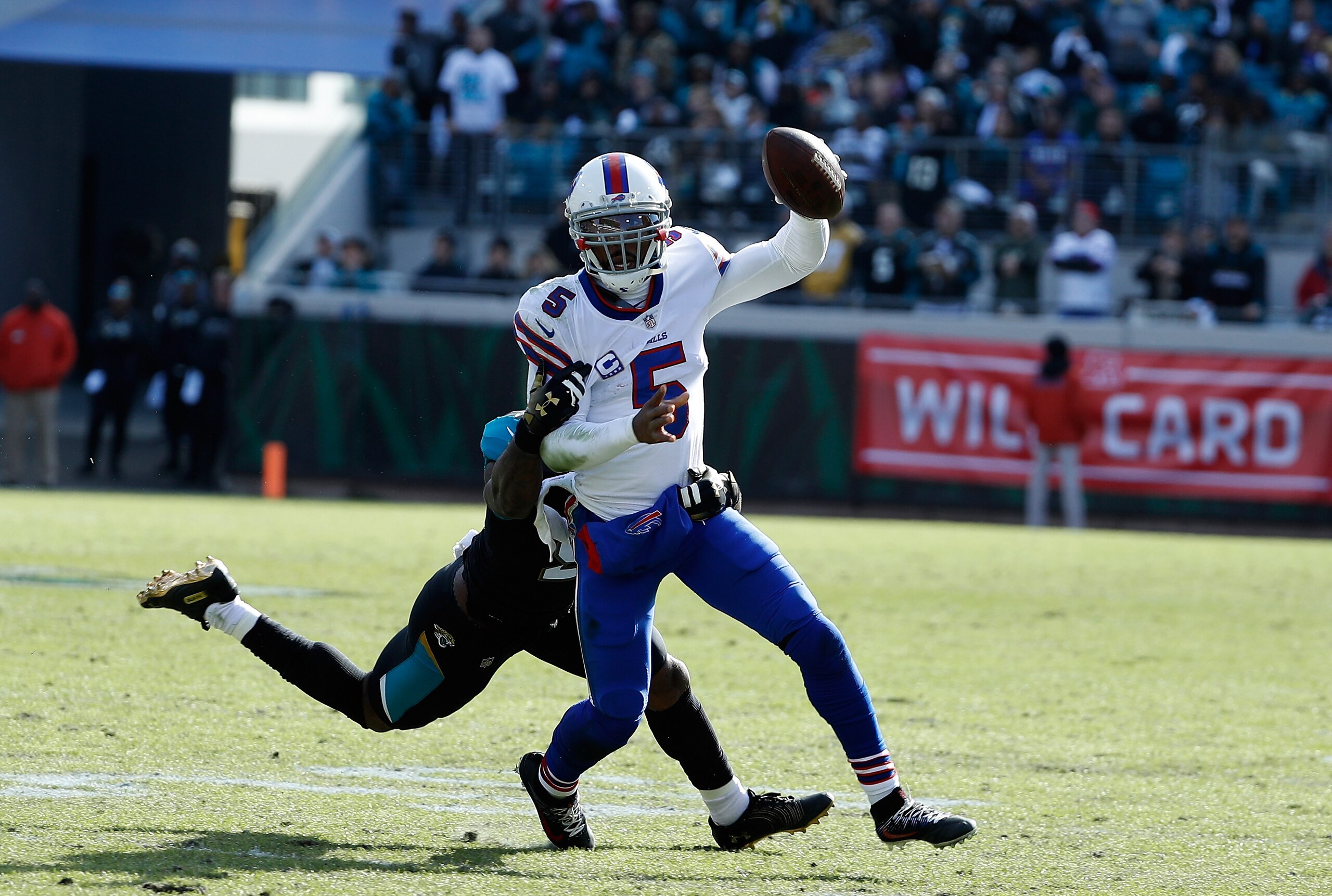
There's a place in the NFL for Tyrod Taylor. It just probably won't be with the Bills in 2018.
A quarterback who can create plays while scrambling and is careful with the ball will always have some value. The ideal fit for someone of that description is a team with a strong defense and a stronger rushing offense.
Buffalo only checks one of those boxes. LeSean McCoy, a six-time Pro Bowler, finished fourth in the league with 1,138 rushing yards and piled up 1,586 yards from scrimmage. But its defense ranked 26th, allowing 355.1 yards per game. That meant Taylor was often relied on to push the ball downfield and lead his team back from deficits. And putting the ball in Taylor's hands too much doesn't end well.
He can have long, painful bouts of inaccuracy. He was overwhelmed multiple times during the season by defenses that didn't leave many holes in coverage. His most notable such dud came in the Bills' playoff loss to the Jacksonville Jaguars, as Taylor averaged just 3.6 yards per pass attempt.
Incredibly, his indecisiveness in the pocket contributed to three games in which he was sacked six or more times. Taylor also averaged only 186.6 passing yards per game in 2017, and his passer rating fell for the second straight year (from 99.4 in 2015 to 89.7 in 2016 to 89.2 in 2017).
He doesn't throw many interceptions, tossing only five in 457 attempts in 2017, including the playoffs. But that's partly because he isn't trusted to take many risks, which is why Bills head coach Sean McDermott wouldn't commit to Taylor for 2018 when he spoke to Joe Buscaglia of WKBW in Buffalo on Jan. 23.
The Bills would take a cap hit of $18.1 million if they bring back Taylor. That's a massive boulder attached to a mediocre quarterback and money Buffalo would surely rather spend on Kirk Cousins.
Has Muhammad Wilkerson Played His Last Game for the Jets?
8 of 10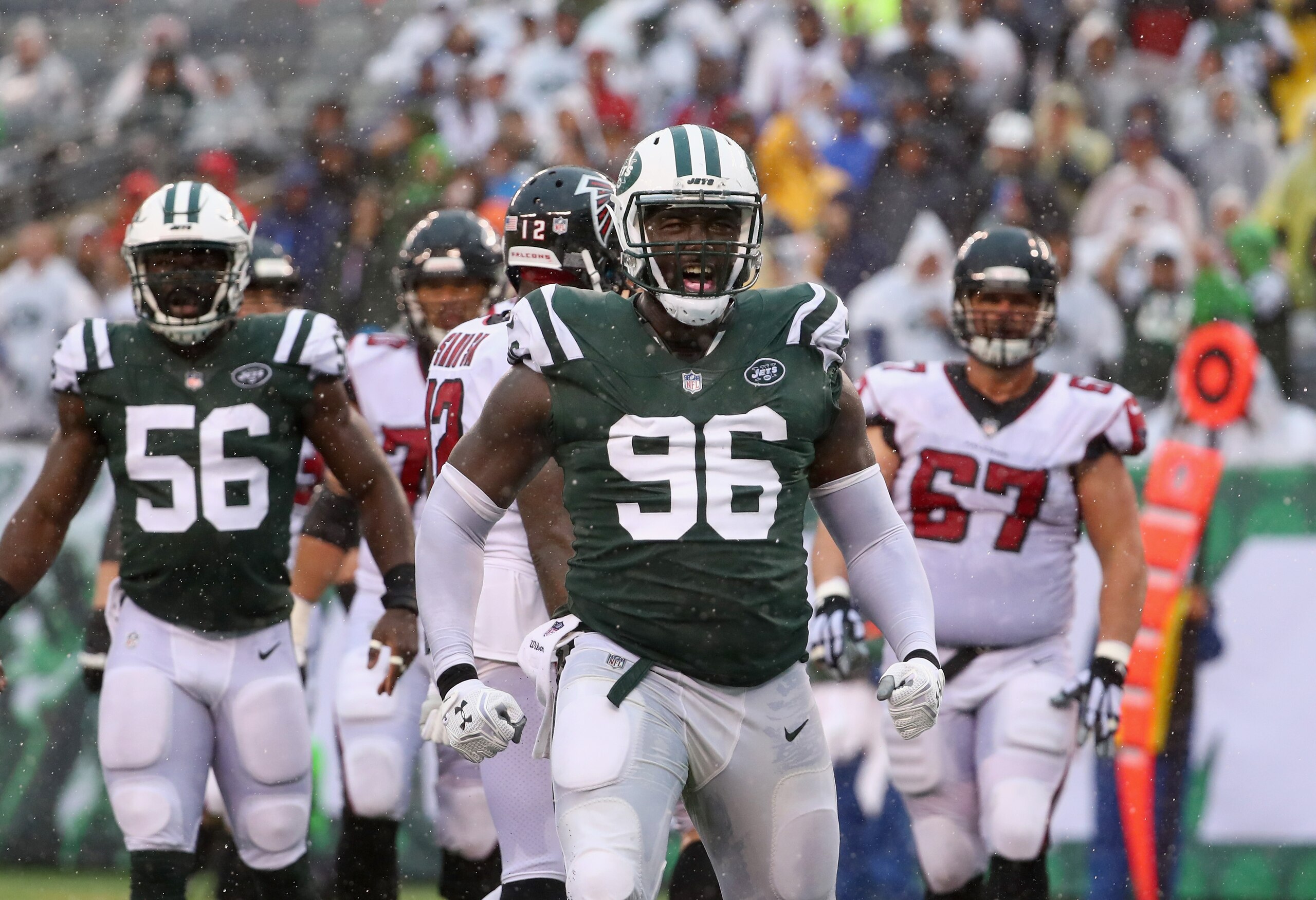
Muhammad Wilkerson is maddening for a lot of reasons.
First and foremost, the New York Jets defensive end is just 28 years old and has plenty of talent. He's logged two double-digit sack seasons and is only two years removed from the most recent one, when he recorded 12 sacks and added to his then-budding reputation as a fierce all-around defender with 64 tackles and seven passes defensed.
That standout season in 2015 led to a five-year contract worth $86 million with $36.8 million guaranteed. So, Wilkerson has robbed the Jets of precious salary cap cash for a couple of seasons, logging just eight sacks in that span. But his off-field behavior is what made his departure feel inevitable.
The 2011 first-round pick has been chronically late to team meetings and sometimes didn't show up at all, according to Connor Hughes of NJ Advance Media. Teams give a lot of rope to talented players, especially one like Wilkerson, who has proved he can get after the quarterback. But New York's patience wore thin, and Wilkerson was inactive for the final three games of 2017.
Maybe there's still a faint hope for Wilkerson to salvage his standing with the Jets, though Hughes reported he'll be cut. Maybe he can convince them that he'll change and return to his 2015 form.
But even if he did, Wilkerson would have to sign off on a significant pay cut. With his recent performance, there's no way New York can bring him back at anything near his slated 2018 salary of $16.8 million.
It's far more likely Wilkerson will be released, which would save the Jets $11 million in cap space. Then he'll become another team's problem.
Should the Cowboys Move on from Dez Bryant?
9 of 10
Dez Bryant is not the first brash and outspoken wide receiver. Not long ago, the likes of Randy Moss, Terrell Owens and Chad Johnson were often shown yelling, pacing and pom-pom waving.
That act can sometimes get tiresome, and if you ask Cowboys executive vice president Stephen Jones, patience for Bryant's antics is wearing thin. But complaints about the charismatic wide receiver's behavior are never really about the conduct itself.
What's really at play is that Bryant's performance can no longer make up for his personality. It was much easier to overlook his sideline flareups when the reward was Pro Bowl-level production.
Bryant gave Dallas contributions on that level annually from 2012 to 2014. He was one of the league's top-tier receivers then and scored 41 touchdowns during that stretch. He also recorded three straight seasons with 1,200 receiving yards.
That earned him a five-year contract worth $70 million, but at no point since he signed the pact in 2015 has Bryant come remotely close to earning it.
Injuries can be partly blamed for two of his last three sputtering seasons, as Bryant missed a combined 10 games in 2015 and 2016. He had easily his worst 16-game season in 2017, however, finishing with just 838 receiving yards and 12.1 yards per reception.
So, it'll be difficult for the Cowboys to justify paying him the $12.5 million he's owed in 2018—a figure tied for the league's second-highest base salary among wide receivers.
Bryant responded to the pay cut question by saying, "Hell no, man," when asked about it Dec. 27, per David Helman of DallasCowboys.com. And Cowboys owner Jerry Jones said Jan. 23 he expects Bryant to stick around in 2018.
But something has to give for that to happen because there's no way Dallas—which has only $20.6 million in projected cap space—can afford to pay for top wideout production and get much, much less.
What Should the Packers Do with Randall Cobb and Jordy Nelson?
10 of 10
At first, it seems unwise to make a serious judgement on any pass-catcher in the Packers offense following a season in which they had to chase Brett Hundley's wobbly throws.
But there was such a wide gap between the production of Davante Adams and that of Jordy Nelson and Randall Cobb.
Adams signed an extension Dec. 29 that will pay him $58 million over four years, with $30 million guaranteed. The 25-year-old showed he's worth that money by logging his second straight double-digit touchdown season in 2017. He did that while accumulating 885 yards, which is especially impressive considering Hundley, who started nine games, averaged only 166.9 passing yards per contest.
But now Green Bay has a tough decision to make. There's only so much money it can reasonably allocate to its wide receivers, and both Nelson and Cobb are carrying dollar sign-shaped anchors.
Nelson will turn 33 years old in May and is coming off a season in which he did only slightly more than nothing. He finished with 482 receiving yards and averaged 9.1 yards per reception, but he's slated to make $9.3 million in 2018.
Then there's Cobb, who has one year left on a four-year contract extension worth $40 million. His production has fallen off dramatically too, and that can't all be blamed on Hundley's presence in 2017. Cobb has posted two straight seasons with fewer than 700 receiving yards but is slated to earn $8.6 million in 2018.
The Packers have other needs to address and only $21.2 million in available cap space. They can't afford to pay two vastly underperforming wide receivers. If the team can't agree on restructured contracts with Nelson and Cobb, then one of them will have played their last game in Green Bay.
The decision isn't as easy as it might seem. Nelson is much older (Cobb will turn 28 in August), but he's only one season removed from a 1,257-yard, 14-touchdown campaign.
All contract and salary cap information courtesy of Spotrac.com.
.jpg?w=2560 "Cowboys Packers Football")
.jpg?w=2560 "Titans Ravens Football")

.jpg?w=2560 "🚨 Week 8 AP Top 25 Poll")
.jpg?w=2560 "Mahomes Told Teammate to Leave Meeting")

