
Ranking Every Golden State Warriors Player After Free Agency
The Golden State Warriors are back from 2017 NBA free agency with all their most important players in hand and a few new wrinkles in the formula.
They're going forward with their top seven minute-getters from last season, two intriguing additions from the free-agent market and perhaps yet another act of draft-night larceny.
The Dubs have done nothing to alter their position atop the basketball landscape, save perhaps for strengthening it. But how have the inner dynamics changed with multiple players on new contracts or in new positions?
That's an interesting question, and one we'll examine here by ranking all members of the 14-man roster based on their talent and importance.
Nos. 14-11: Looney, Bell, Jones, Casspi
1 of 7
No. 14: Kevon Looney, PF
Looney has a guaranteed contract for 2017-18, yet his immediate future is far from settled. If the Warriors choose to fill their final roster spot—they have a minimum offer "on the table" for JaVale McGee, assistant general manager Larry Harris told 95.7 The Game—Looney becomes a potential trade-or-waive candidate if the team needs flexibility.
Looney has already had two hip surgeries since being the 30th pick in 2015, and he moves like it. He's also failed to command consistent playing time. He totaled only 43 minutes from March to June, then finished sixth on the summer league squad, trailing two players who won't be on the regular-season roster.
No. 13: Jordan Bell, PF
If McGee doesn't return, the Dubs will have an immediate opening for a third center. That isn't a massive role, but with Zaza Pachulia and David West both on the wrong side of 33, there will be a handful of minutes up for grabs every night.
Even as a second-round rookie, Bell has a chance to collect them. The Pac-12 Defensive Player of the Year boasts the versatility and athleticism needed to anchor Golden State's small-ball units. The 22-year-old is also older than Looney, Damian Jones and Patrick McCaw, so Bell has more seasoning than most rookies. But given Jones' size and familiarity with the system, he'll probably get the first shot at filling the role.
No. 12: Damian Jones, C
No Warrior will be watching McGee's free agency closer than Jones. A return would mean virtually no minutes for Jones' second year. An exit could put the sophomore in line for a significant rotation spot.
"They mention in the meetings that I have an opportunity ahead of me," Jones said, per Bay Area News Group's Anthony Slater. "Just got to work hard to maximize that."
Jones is the closest McGee clone in the frontcourt. The 22-year-old is an excellent athlete for a 7-footer, his wingspan stretches 7'3 ¾" and, if he improves his awareness and assertiveness, he could offer a more complete package. The skills are still raw, but they potentially include shooting out to the mid-range, defensive switching on perimeter players and even some distributing.
His rookie effort was slowed from the start by a torn pectoral suffered in June 2016. But his campaign ended on a high note with D-League player of the month honors in March (17.6 points, 7.8 rebounds per game) and a sampling of postseason experience (21 mop-up minutes over four games).
No. 11: Omri Casspi, SF/PF
Casspi almost fits what the Warriors do a little too well. He's a long, savvy swingman who can hit open shots, guard multiple positions and thrive in transition. That's the Golden State archetype, which both sets up Casspi for a smooth transition but also may make it difficult for him to stand out.
Productive minutes won't be a problem. He has buried at least 47 percent of his shots three years straight—on offenses without nearly as much as firepower—and 40-plus percent from three during two of them. The only question is how much playing time he'll get, since Golden State has a host of usable wings and a big block of the power-forward minutes reserved for Draymond Green and Kevin Durant.
Nos. 10-6: West, McCaw, Pachulia, Young, Livingston
2 of 7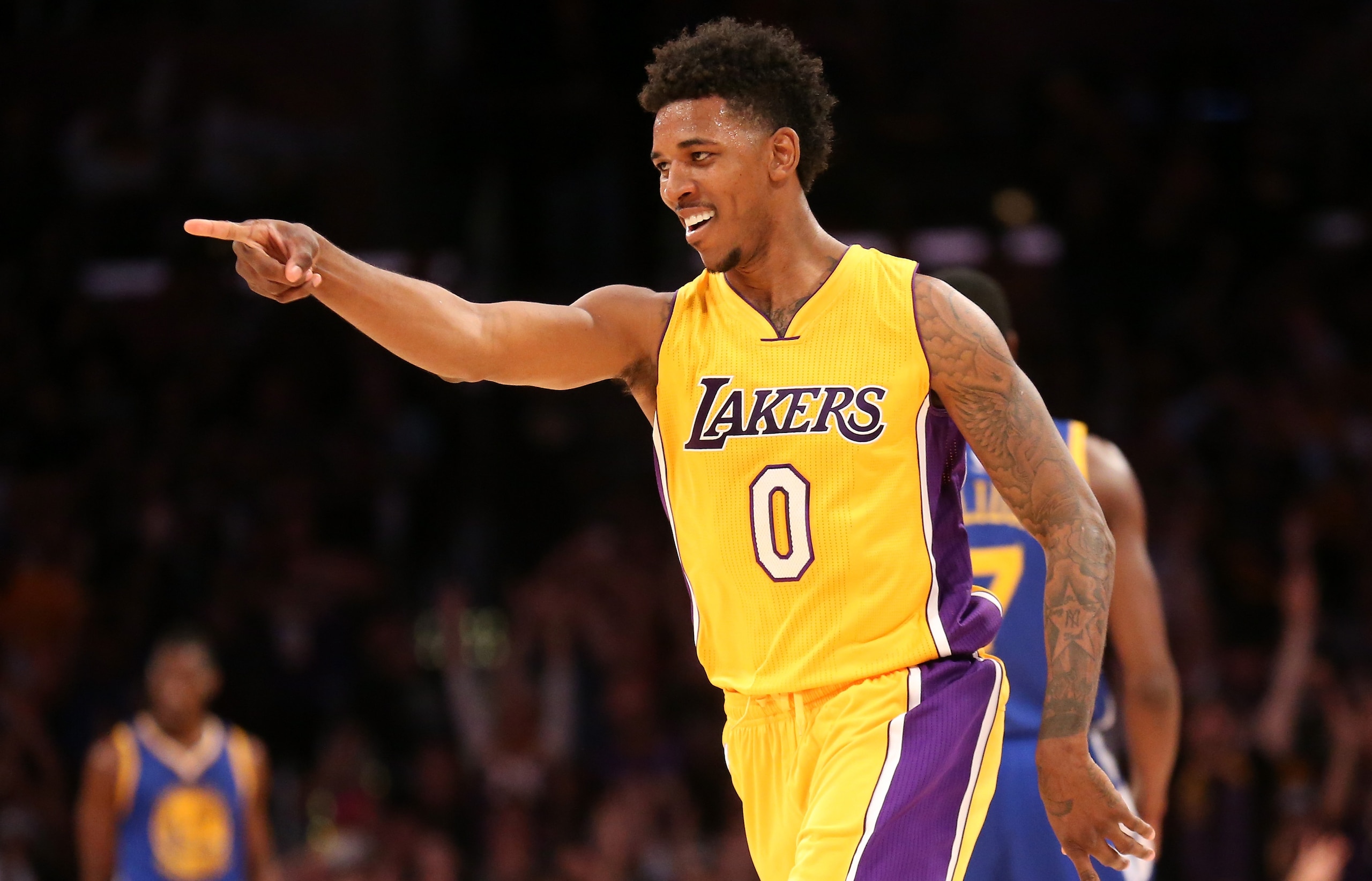
10. David West, PF/C
West, who has more than $90 million in career earnings, had a chance to ride off into the sunset with a championship ring on his finger. But he's running it back for a second season in the Bay because his first featured a seamless transition to a new team and the ideal system for his skills.
He logged a career-low 12.6 minutes per game and could see that number keep falling as he further depletes what weren't elite levels of athleticism to begin with. But his brains and his brawn both have substantial value. He will once again be one of the bench unit's primary passing hubs—6.4 assists per 36 minutes, third-highest on the team—and an interior enforcer.
9. Patrick McCaw, SG
McCaw outlasted his primary competition for playing time last season—the still-unsigned Ian Clark—and yet, minutes may be more difficult to find this time around. The wings look even more crowded now with Shaun Livingston and Andre Iguodala back, and Casspi and Nick Young joining the fold.
McCaw rarely resembled a rookie during his freshman year, making 86 appearances (23 of them starts) between the regular season and playoffs. He followed that up by leading Golden State's summer-leaguers in minutes (29.4), points (20.0) and assists (2.6). He looks ready for extra floor time; it's just a matter of whether that's available.
8. Zaza Pachulia, C
The fifth Beatle of Golden State's opening group, Pachulia is steady almost to the point of stodgy—save for a couple of exceptions. But the big man works best when he's boring. He's neither a consistent scorer, nor the most reliable finisher, but he's a master at using his muscle as a screen-setter (6.9 screen assists per 36 minutes, fourth overall) and a glass-cleaner (11.6 rebounds per 36 minutes, tops among the returners).
He isn't an indispensable piece of the puzzle. While it helps to have him absorbing a lot of the interior banging, Golden State's small-ball lineups can force traditional bigs off the floor. His starting spot and consequential minutes warrant this ranking, but the fact he isn't a closer—seventh in clutch minutes last season—keeps him from climbing any higher.
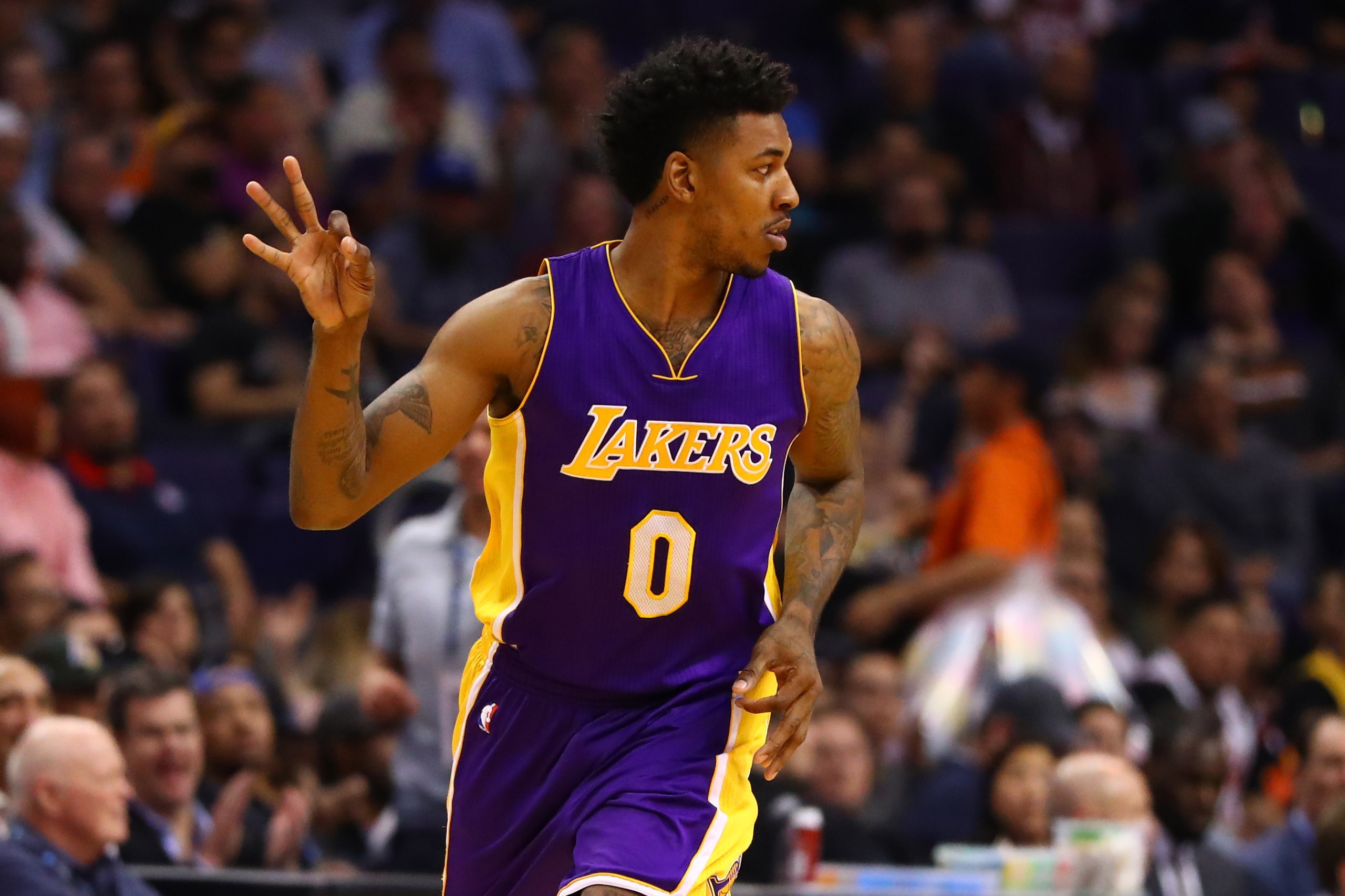
7. Nick Young, SG
Young's 2016-17 season was nothing short of a career resurrection. He went from a waive-and-stretch candidate to an elite three-point marksman—one of seven players to average at least 2.5 triples on 40 percent shooting—and a more willing defender than he'd ever been.
The 32-year-old has a great chance to keep climbing in 2017-18. Golden State should have a sizable role available with a need for second-team scoring and non-All-Star shot-creation. Young, in turn, moves down opponents' defensive game plans and into an offense that generated the most catch-and-shoot scores last season (33.7 points per game).
"I've never been on a team where I get so many open shots," Young said, per Slater. "I've always had to create for myself. But they're not (going to be) paying attention to me; they'll be paying attention to those guys."
6. Shaun Livingston, PG
The Warriors spent last season making Livingston look as unnecessary as ever—giving him the fewest minutes he'd played in Golden State (17.7), then trimming them again in the postseason (15.7). But as soon as free agency opened, they cemented their belief that he's essential to their goals by giving him a three-year, $24 million deal.
His stats don't always stand out, but he's a stabilizer. He can carry the offense in spurts with shrewd decision-making and an absurdly effective post game. His length and mobility are critical components of Golden State's swarming defense, and his calm demeanor holds a special importance inside the locker room.
No. 5: Andre Iguodala, SF
3 of 7
The Warriors lost their negotiations with Andre Iguodala. He never seemed the biggest flight risk, but he created enough uncertainty that Golden State escalated its contract offers from two years with a $12-14 million salary and a partial guarantee in the third season to a fully guaranteed three-year, $48 million pact, per USA Today's Sam Amick.
In doing so, though, Golden State may have won the summer. FiveThirtyEight's Neil Paine explains:
"Iguodala was the most meaningful wild card in Golden State's offseason, and his return was of outsize importance to their chances next year. It's not the summer's splashiest move, or its most transformative in terms of sheer wins and losses. But if the Warriors are champions again, it might prove to have been the most important."
The Warriors have enough stars to overwhelm their rivals, but Iguodala's presence helps seal this squad's place as an all-time power.
He plays the way every glue guy should. He has a remarkable ability to read what his team needs and recognize what his skills will allow. The end results are high efficiency and precious few mistakes—52.8 percent shooting, Association-best 4.5 assist-to-turnover ratio.
His minutes need closer monitoring than ever, and even then, he seemed to pace himself over the course of last season. But he's ready when he's most needed. He had the Finals' best plus/minus at plus-60; no one else cleared plus-40.

No. 4: Klay Thompson, SG
4 of 7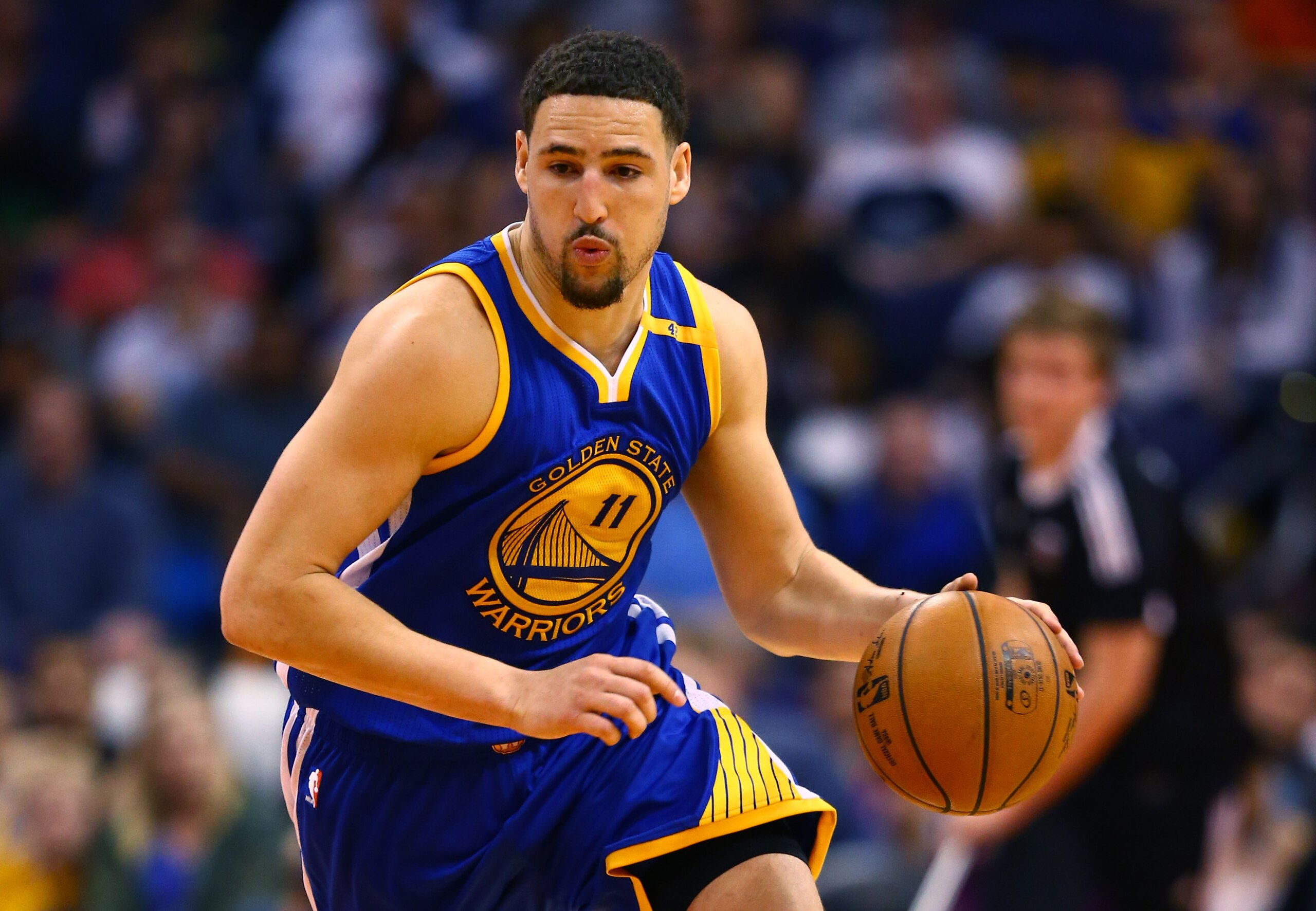
It should be ridiculous to think of Klay Thompson—an in-prime player selected to each of the last three All-Star teams—as anyone's fourth option, but he's not moving ahead of the top three superstars.
That's why when anyone speculates about the end of these Warriors as we know them, they target Thompson as the likely odd man out.
"It certainly feels like Thompson is just kind of stuck into the rest of the structure," CBS Sports' Matt Moore wrote. "He's jammed into the side. They just don't need Thompson. He's good, great even. He's just not necessary for what they're being successful with."
The logic isn't hard to follow. While Thompson can be an incendiary scorer, Stephen Curry and Kevin Durant are historically proficient. And as well-regarded as Thompson's defense is, it's not in the same class as that of the reigning Defensive Player of the Year, Draymond Green.
If the Warriors had to sacrifice a star, Thompson would be the one to go. But since they don't, they can have him fill essential roles at both ends of the court.
The ideal backcourt mate for Curry must be able to defend both guard spots, and Thompson does that as well as anyone. The best complementary scorer for Curry and Durant would be someone who doesn't dominate the ball but does demand constant attention. Thompson scored 60 points on 11 dribbles and has the second-most threes, with a top-15 all-time accuracy rate, since entering the league.
No. 3: Draymond Green, PF
5 of 7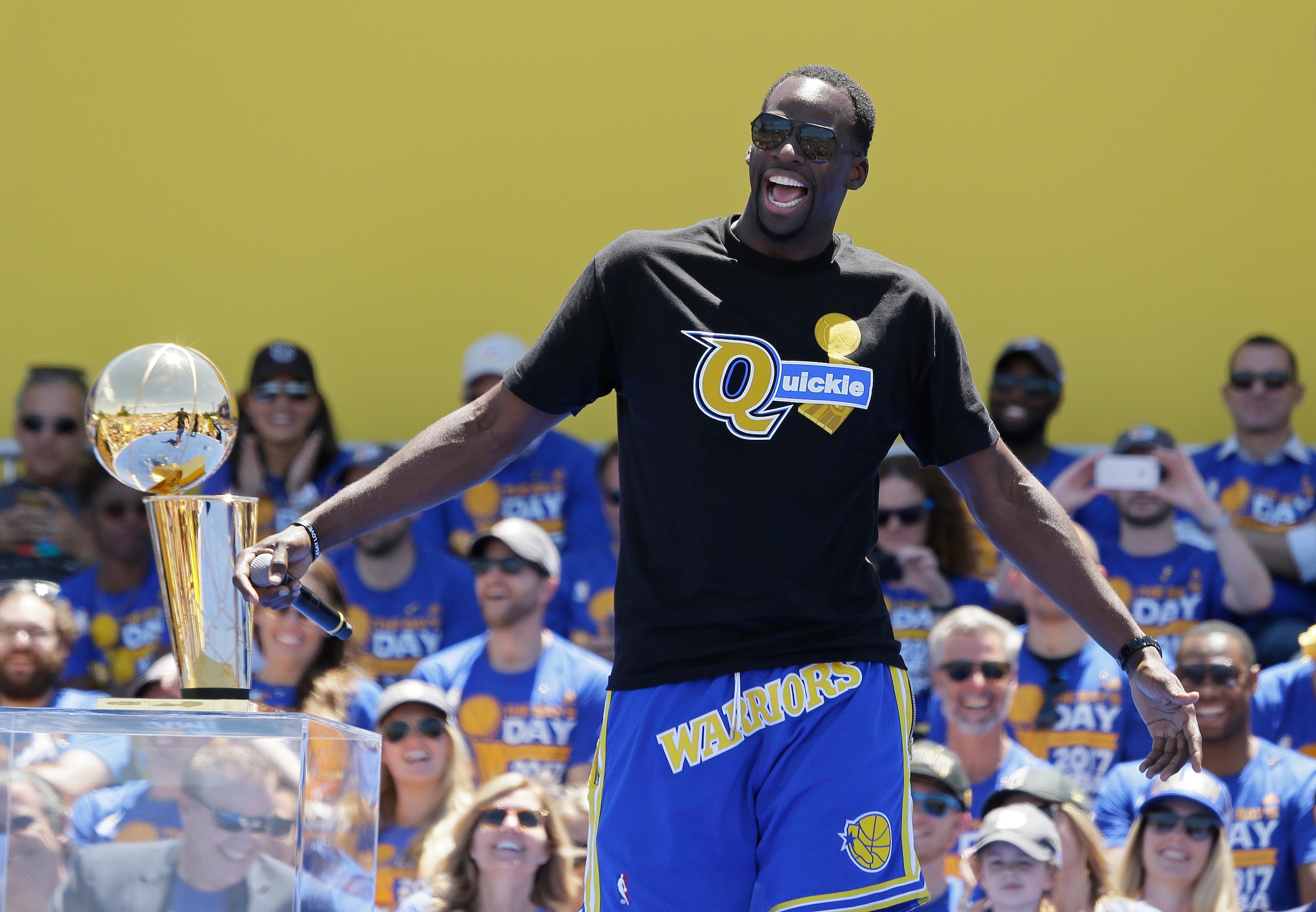
After back-to-back runner-up finishes in the Defensive Player of the Year voting, Draymond Green left no drama this time around. He collected 73 of the 100 first-place votes and, as Connor Letourneau of the San Francisco Chronicle observed, earned at least that many:
"He made five defensive plays in the last minute of one-possession games that helped seal victories. In a Feb. 10 win at Memphis, Green posted the first triple-double in NBA history without double-digit points. He was the first player since Dwyane Wade in 2008-09 to record at least 150 steals and 100 blocks in a season. When Green was on the floor, Golden State allowed six fewer points per 100 possessions than when he sat."
Green is responsible for Golden State's defensive magic.
The secrets of the small-ball success start with his lateral quickness, length, instincts and tenacity. He just led the league in steals while splitting his time between power forward and center, and he had a top-five field-goal percentage against at the rim among volume defenders. He's not overpowered by strength or speed, making him one of the only players capable of defending all five positions.
Plus, he's an asset on the offensive end (though, not enough of one to crack the top two here). His playmaking prowess—team-high seven assists per game—allows him to pick apart defenses when teams throw two defenders at Curry on high screen-and-rolls.
No. 2: Stephen Curry, PG
6 of 7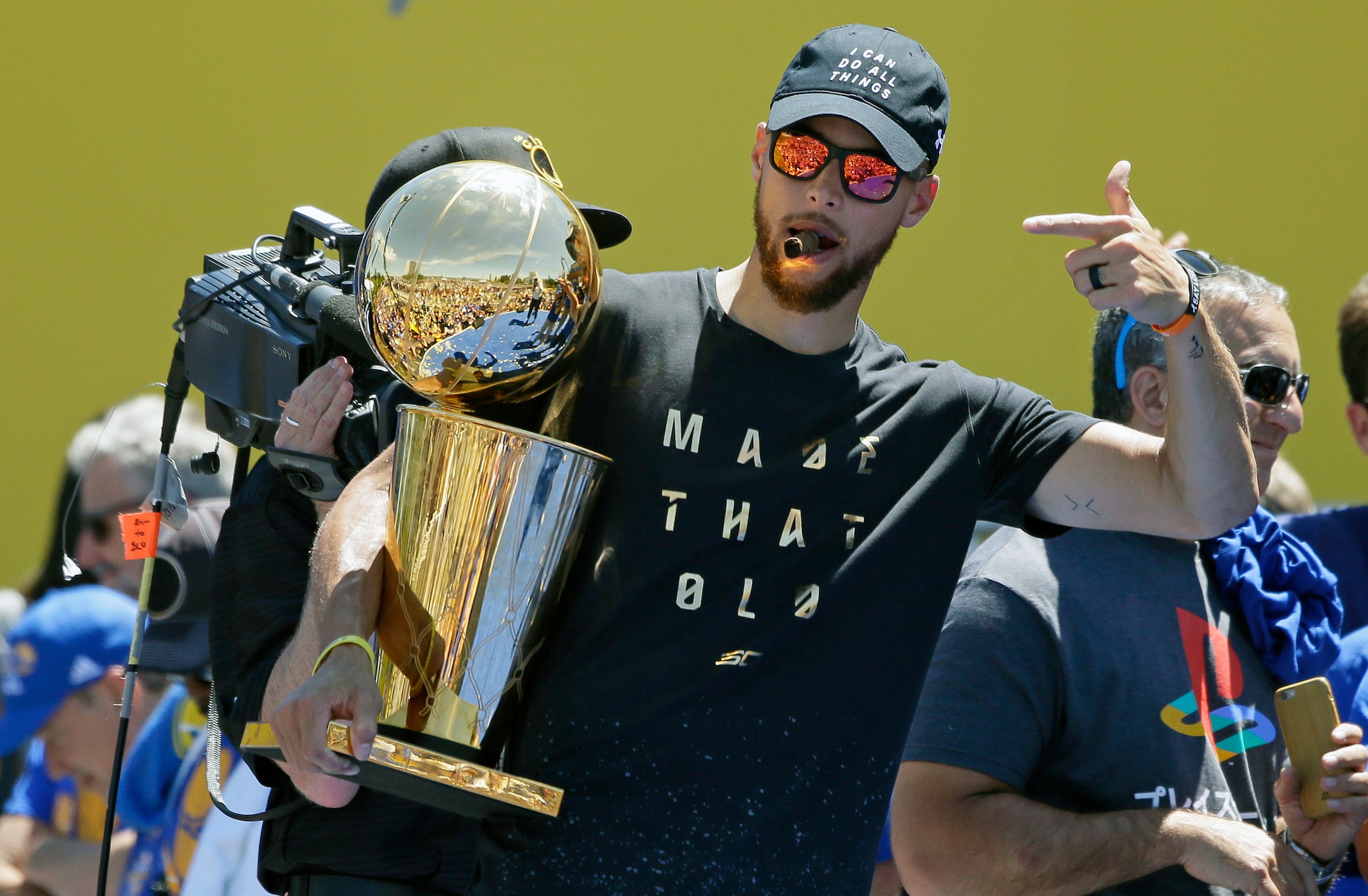
The distinction didn't last long, but early in free agency, Curry inked what was the biggest contract in NBA history—five years, $201 million. And more impressive than the money itself is the absence of any sticker shock.
"He's certainly earned it," Bleacher Report's Josh Martin wrote. "Without Curry, the Warriors might still be stuck in their decades-long doldrums. Instead, they're flying high while the rest of the league is giving desperate (perhaps futile) chase."
If a max contract—or supermax, in this case—exists, it's made for a player like Curry.
He has powered the Warriors to three straight Finals and two world titles, pocketing a pair of MVP awards along the way. He has led the league in triples five straight years, and despite being only 29 years old, he already has the 10th-most career makes (and the third-best career percentage).
His ability to shoot from anywhere off the dribble dismantles all defensive principles. That's why when he's on the court, the Dubs look unbeatable. He had the season's best plus/minus by a mile (plus-1,015, second was plus-820) and the club's widest on/off split (plus-17.2 net rating with him, plus-1.0 without).
So why doesn't he grab the top spot? Because the Warriors have two offensive machines, and the other also happens to be a dynamic defender.
No. 1: Kevin Durant, SF
7 of 7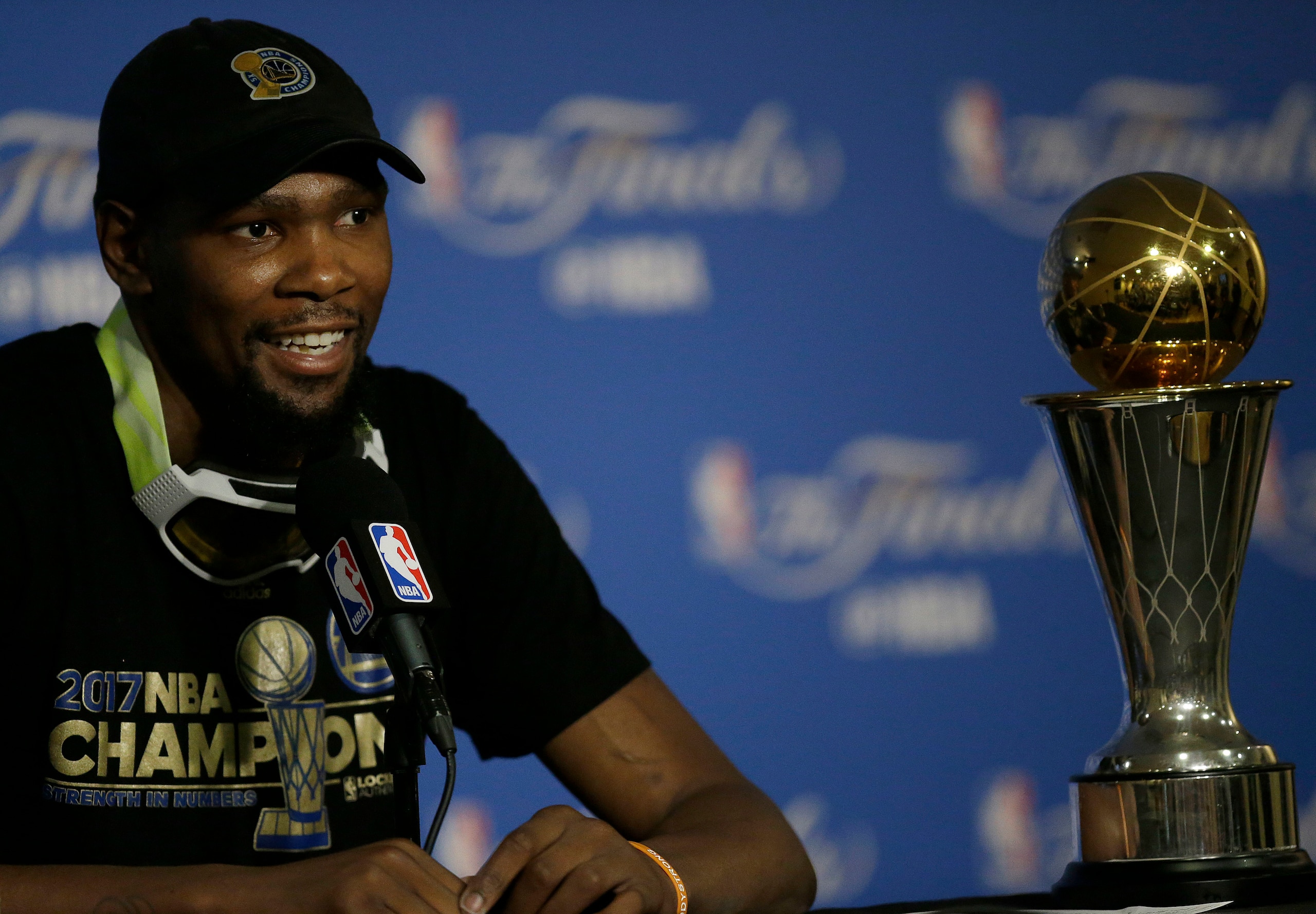
Remember back in 2013 when Durant told Sports Illustrated's Lee Jenkins how he was sick of being second? And then, how he proceeded to stampede his way to the MVP award while coming as close to LeBron James' throne as anyone has since the King's ascension?
Well, last season's version of Durant was a more complete version of that player.
"There has never been a player in NBA history with his combination of size, athleticism and shooting ability," The Ringer's Jonathan Tjarks wrote. "He's the endpoint in the evolution of the game: a big man who can shoot, handle and pass like a guard and a guard who can rebound, defend and block shots like a big man."
Durant not only shot a career-best 53.7 percent, but he also bettered his career point-per-minute rate (27.0 per 36, up from 26.2). Both his rebounds (8.3) and blocks (1.6) were personal bests, despite the fact he played fewer minutes than ever (33.4). The win shares per 48 minutes metric viewed him as the league's most important player (.278).
Even when factoring in Curry's range, Durant is the tougher cover based on his unprecedented size and skill combo. Shift the focus to defense and rebounding, and his advantage grows over his MVP teammate.
But the Warriors are the real winners here. Good luck finding another top two, top four, top six or top 14 stronger than this.
Unless otherwise indicated, all stats from Basketball Reference or NBA.com.
Zach Buckley covers the NBA for Bleacher Report. Follow him on Twitter: @ZachBuckleyNBA.
.jpg?w=2560 "Grading WWE Raw 🔠")
.png?w=2560 "Allen's BRUTAL 1H Stats 🫤")
.jpg?w=2560 "Monday Night Raw Blog 🔴")
.jpg?w=2560 "Aaron Donald Fights Bills OL😳")