

Picking a Best AC Milan XI Using Only 1 Player of Each Nationality
The story of AC Milan and nationality is a complex one. While their foundation had much to do with Englishmen such as Herbert Kilpin, they rejected the idea of accepting foreign players in the early 1900s. This, in turn, led to an internal schism and the formation of another club, Inter Milan.
Eventually, however, Milan would accept international players once again. Indeed, their successes have been intertwined with the importation of exceptional talent from outside of Italy.
Their four Scudetti in the 1950s had a lot to do with the Swedish Gre-No-Li trio of Gunnar Gren, Gunnar Nordahl and Nils Liedholm. Their first European Cup win came thanks to the goals of Jose Altafini, who was born in Brazil. Their domestic and continental dominance throughout the late 1980s and early 1990s was inspired in part by a trio of Dutch icons in Frank Rijkaard, Ruud Gullit and Marco van Basten.


Without these players, Milan would have found trophies harder to come by. It would also be a lot harder to put together a Rossoneri XI with just one player per nationality, which is exactly what we here at Bleacher Report have done.
Criteria
Before we get into the selections, some ground rules. The players are sorted by the country for which they have played international football, not their country of birth—so we can't play Clarence Seedorf under the flag of Suriname to free up an extra Dutch spot.
We are also held to a workable formation—no 2-3-5 here—and we will deploy a tried-and-trusted 4-4-2.
Goalkeeper: Dida (Brazil)

Traditionally, Milan have relied upon Italian goalkeepers. Past greats such as Lorenzo Buffon, Fabio Cudicini, Enrico Albertosi, Sebastiano Rossi and Christian Abbiati were all born on the peninsula, as was current No. 1 Gianluigi Donnarumma.
Consequently, in order to consider other Italian players elsewhere in this team, Dida was virtually guaranteed to be the chosen goalkeeper.
The Brazilian spent his first few years with Milan on loan elsewhere or on the substitutes' bench. It wasn’t until 2002-03 that he established himself in the starting lineup, taking advantage of an injury to Abbiati. Strong, commanding and with excellent reactions, he went on to make over 200 appearances for the club.
Right-Back: Thomas Helveg (Denmark)
The chosen formation for this team is the 4-4-2 as used by Arrigo Sacchi, and the right-back position within this side’s four-man defensive line belongs to Thomas Helveg.
The Dane, along with German striker Oliver Bierhoff, joined Milan from Udinese in 1998. They were soon followed by head coach Alberto Zaccheroni, under whom they went on to enjoy a stunning maiden year in red and black.
Within Zaccheroni’s favoured 3-4-3 system, Helveg operated on the right as a wing-back. From this position, his attacking instincts and crossing ability were indulged, as the Rossoneri lifted the Scudetto in 1998-99. He remained a regular during the following two seasons before departing for city rivals Inter.
Centre-Back: Marcel Desailly (France)
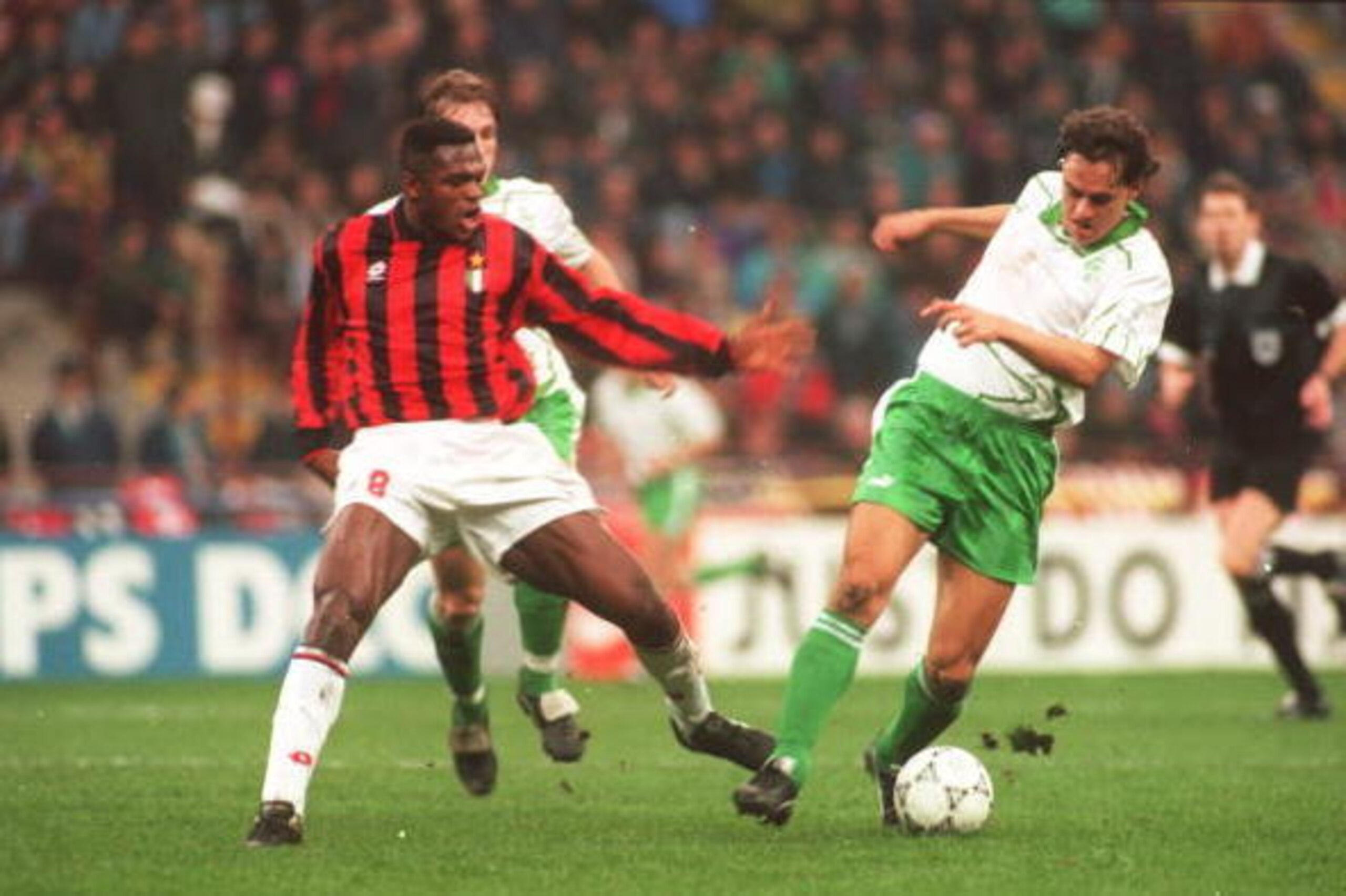
Before and after his spell with Milan, Marcel Desailly was renowned for being an assertive, athletic centre-back with an outstanding reading of the game. This is the position he will fulfil for this team, although during his time at the San Siro, he played mostly as a defensive midfielder.
The Frenchman’s tactical intelligence, indefatigable running and aggression made him the defensive barrier then-coach Fabio Capello needed, and his display in the team’s 4-0 win over Barcelona in the 1994 Champions League final was unforgettable.
Centre-Back: Franco Baresi (Italy)
It wasn’t easy to choose one from the vast array of Italian icons throughout Milan’s illustrious history. Paolo Maldini became a symbol for his loyalty, versatility and quality, while Gianni Rivera was one of the country’s finest playmakers. However, in selecting this team, it was important to consider competition.
There are some fine non-Italian left-backs and attacking midfielders to have played for the club over the years, though this is less the case at centre-back. With Dida between the posts, Thiago Silva isn’t an option here. And Kakha Kaladze doesn’t quite fit in among the legends mentioned elsewhere in this post.
As such, Franco Baresi partners Desailly at centre-back.
A mean marker and tough tackler who also possessed a fine touch and technique, Baresi was one of the best all-around central defenders to grace the sport.
Left-Back: Karl-Heinz Schnellinger (Germany)
Historically, German footballers have had more success with Inter than with Milan. At one point or another, some of the country’s best have represented the Nerazzurri, including Karl-Heinz Rummenigge, Andreas Brehme, Lothar Matthaus and Jurgen Klinsmann.
In this sense, Karl-Heinz Schnellinger is in the minority. A German international and elite player, he moved to the city of Milan to play for the Rossoneri in 1965. Comfortable on the ball, a sound passer and a reliable defender, he went on to become a pivotal member of Nereo Rocco’s European Cup-winning side in 1969.
Right Wing: Dejan Savicevic (Yugoslavia)
There were few things that Dejan Savicevic couldn’t do with a ball at his feet. The Montenegrin was a sumptuously gifted attacker with an audacity and dribbling skill that befuddled the most organised of defences.
His time with Milan is remembered mostly for his goal in the 1994 Champions League final win over Barcelona. Capitalising on a misjudgement from a defender, he lobbed Andoni Zubizarreta from an acute angle to make the score 3-0.
While his relationship with Savicevic wasn’t always a good one, even a stern defensive coach such as Capello found a way to incorporate the player’s silky skills.
Central Midfield: Frank Rijkaard (Netherlands)
Of the three Dutchmen to join Milan in the late 1980s, Rijkaard came last; by the time he signed in 1989, Gullit and Van Basten had already arrived. But over the proceeding five years, he would arguably be more influential than his more attacking colleagues.
An all-around central midfielder capable of both creating and destroying, Rijkaard was a one-man microcosm of Total Football. Fluid, dynamic and technically superb, he was the ideal man for Sacchi’s side.
Central Midfield: Zvonimir Boban (Croatia)
Because of the limitations on the number of non-Italian players permitted in Serie A squads at the time, Zvonimir Boban spent his first year as a Milan player on loan at Bari. However, he returned in 1992 and immediately began to impose himself upon the first team.
The Croatian was a midfield conductor with an impressive passing range. He was also flexible and could perform ably on the right side of midfield, centrally and in an advanced role behind the strikers.
Left Wing: Rui Costa (Portugal)

This is where things become difficult. Having already picked Dida, there is no place for the brilliance of Kaka or the incision of Leonardo in this position. And with Baresi in defence, the great Rivera has to be omitted. The same goes for Gullit and Seedorf because of the inclusion of Rijkaard.
With options limited, the left-wing spot goes to the wizardly Rui Costa.
Truthfully, the Portuguese never quite lived up to expectations in Milan. He signed in 2001 for a £28 million fee after enjoying seven seasons in Serie A with Fiorentina, but he was unable to replicate his Viola form at the San Siro. Indeed, he didn’t score a single league goal for the Rossoneri during his first two seasons with the club.
However, with his low socks, elegant style and mazy dribbling, he occasionally worked wonders before being succeeded as the team’s trequartista by the aforementioned Kaka.
Striker: Gunnar Nordahl (Sweden)
Milan have a wonderful history of sharpshooting finishers, but none matched the record of Swedish talisman Nordahl. After joining in 1949, he went on to find the net at an astonishing rate. In just under eight seasons, he ensured his place in history as the club’s all-time leading goalscorer, with his 221 unchallenged to this day.
Powerful, fast and strong in the air, he also had good anticipation and an accurate strike. It was these traits that allowed him to break records and that give him a spot in this lineup ahead of Andriy Shevchenko and fellow Swede Zlatan Ibrahimovic.
Striker: George Weah (Liberia)
He may not have been the most consistent of scorers, but George Weah has to be in this team. First, he lacks competition from Liberian compatriots. Second, he was one of the finest all-round attackers Milan have ever had.
He scored 58 goals with the club between 1995 and 2000. However, his strikes stood out not for their quantity but their quality. His goal from an opposition corner against Verona left an indelible mark, not just on Milanisti, but on the football world as a whole.
Now it’s your turn. Have we made the right choices? Who would make your AC Milan XI made up of one player per nationality? Comment below with your opinions!



.jpg?w=2560 "Jonathan Taylor Landing Spots 📍")





