

Phil Mickelson's Outcry for Ryder Cup Change Carries Americans to New Heights
American celebrations have happened so infrequently over the past quarter-century at the Ryder Cup that nobody could remember the partying particulars of the U.S. team's most prominent player.
Sure, everybody knows Phil Mickelson plays golf as a left-hander, often at the highest levels.
Sunday night at Hazeltine National in Chaska, Minnesota, the world was reminded that when he parties like a savage, it's as a righty.

.jpg?w=2560)
Two years after he put his reputation on the line following yet another Ryder disaster, the 46-year-old Hall of Famer led the Americans to their second victory this millennium, making 10 birdies in his singles match as the Yanks cruised to a 17-11 victory outside Minneapolis.
As part of the U.S. task force that was established on the plane flight home from a blowout loss in Scotland two years ago, Mickelson has for the past 20-plus months exclaimed to anybody who would listen that the Americans' process was busted and required a complete overhaul.
The points system was revamped, the qualifying periods overhauled and the wild-card picks were pushed back to later in the year. This Ryder Cup would be the players' event, with the dozen Americans involved in nearly every detail.
More than any other player, Mickelson, who played in his 45th Ryder match to extend his American record, has his fingerprints on it.
"If I made a decision, Phil agreed with it," U.S. captain Davis Love cracked to reporters on the 18th green. "Whether he really agreed with it or not, he went along with it."
Two years earlier, Mickelson infamously staged a minor insurrection following the team's 16.5 to 11.5 whipping at Gleneagles, controversially calling out captain Tom Watson for failing to involve players in most of his decisions. Ahead of the latest Ryder Cup, Mickelson lodged a complaint against the management style of Hal Sutton, his captain in Michigan in 2004, creating more bad headlines and even more added pressure.
"The pressure started when some dumbass opened his mouth two years ago," he said during the team press conference.
Yet once the matches began Friday, Mickelson played as well as he had in years, finishing with a 2-1-1 record and claiming a half-point in an epic duel with old foe Sergio Garcia in a match that generated an incomprehensible 19 combined birdies.
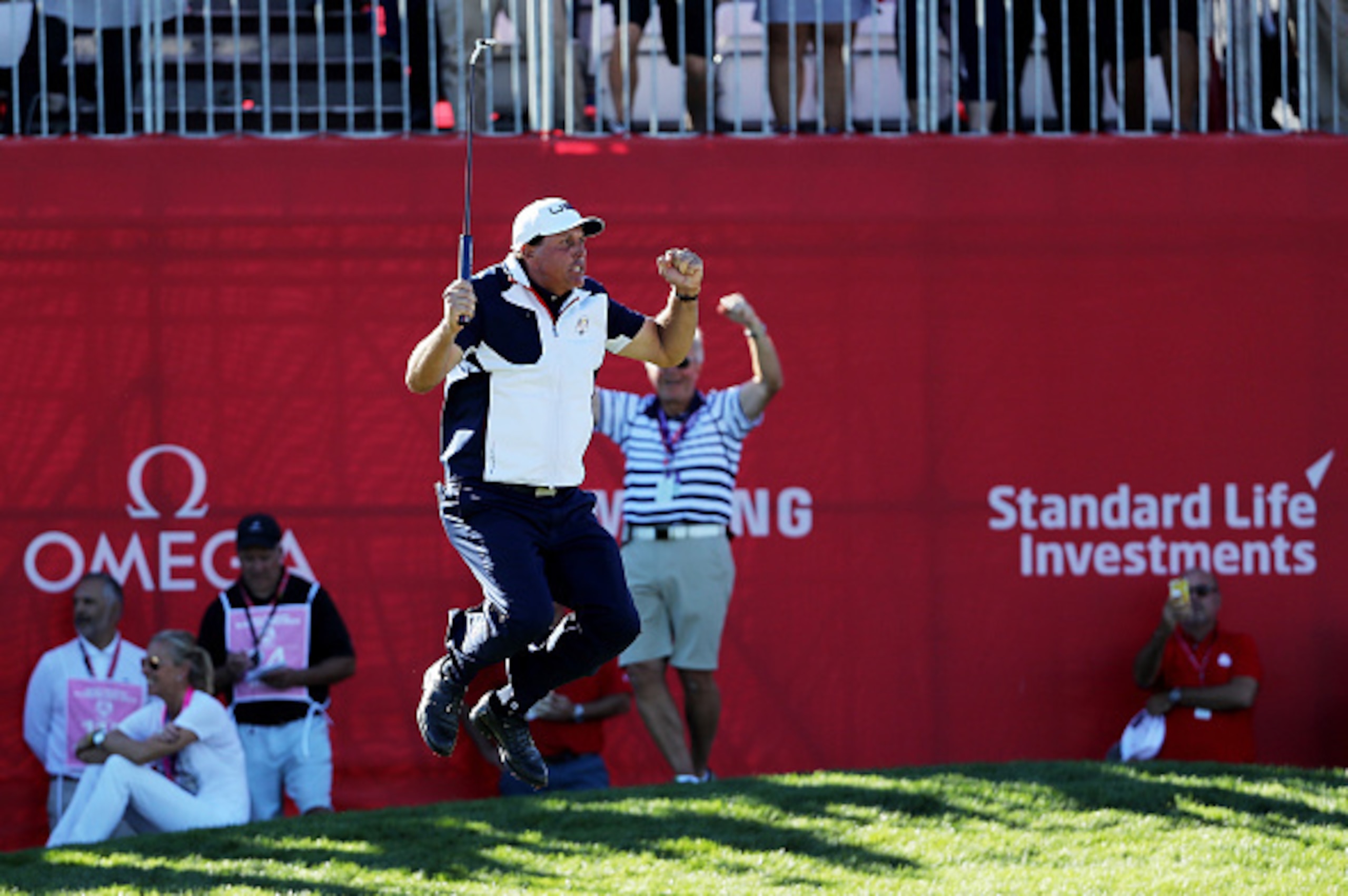
Whether it was elation or relief, Mickelson leaped into the air after he made a 15-footer for a birdie on the last hole, which secured a half-point for the Americans, bringing back images of his similar skywalking episode after winning his first major at the 2004 Masters.
This victory meant nearly as much. Mickelson said before the tournament that he'd never felt more pressure. Perhaps it was because he was so invested in the Americans' systemic redesign.
Whatever the reason, the Yanks won for only the second time since 1999 and by the largest winning margin since the team's 1981 win in England, a 18.5 to 9.5 blowout.
"These guys are some incredibly talented players, and when they are put in the right environment, like you saw...the last three days, the U.S. team brought out their most amazing golf," Mickelson told NBC Sports after his half-point gave the Yanks a 13-10 lead. "And we're bringing home the Ryder Cup because of it. I know these guys have had this level of performance in them for some time."
So too did plenty of others who preceded them. Regardless of whether it was the task-force redesign or simply a matter of having a deeper team playing on home soil—or some combo therein—it was finally the Yanks' turn.
Not that there weren't some nervous moments.
Roughly 100 minutes into the singles session, as the final twosome teed off on the first hole, the Americans weren't leading in a single match. The lyrics seemed as annoyingly familiar as the ubiquitous Euro theme song of "Ole, Ole, Ole."
This time, unlike at Medinah four years ago, when the Yanks blew a four-point lead on the final day, the U.S. didn't tank. By then, Rory McIlroy and Patrick Reed were staging an epic front-nine battle that fans will be recalling for decades, with Reed again serving as the team's emotional lighting rod.
In one stretch, the two played hole Nos. 5 to 8 in a combined nine-under, culminating with Reed dropping in a birdie putt to match McIlroy's putt a few moments earlier. Reed turned to McIlroy, wagged a finger, and the Northern Irishman broke out laughing.
McIlroy, who carried the European team for much of the week and played in all five sessions, couldn't keep up with Reed, whose breakthrough performance will not soon be forgotten. Reed won the match 1 up with a birdie on the 18th to finish 3-1-1 for the tournament.
Playing in Minnesota, they produced a blizzard of "ahhhs" on a front nine that featured pyrotechnics and theatrics in equal measure. It was absurdly good. Reed did everything but stand in the middle of the green in gladiator attire and scream, "Are you not entertained?"
Bubbling over the match, Reed said, "It's the first time I have really played in front of the home crowd, and to have these guys do what they did, [to] have the team come together and, when we're down, having this crowd pick us up, cheering our names, it just gets you going and keeps you going. It builds even more momentum and more confidence over the putts."
McIlroy, placed in the first match off the tee in an attempt to generate some Hail Mary momentum for the Europeans, who were down by three points entering play, hadn't smiled all day until he watched Reed's antics on the eighth green.
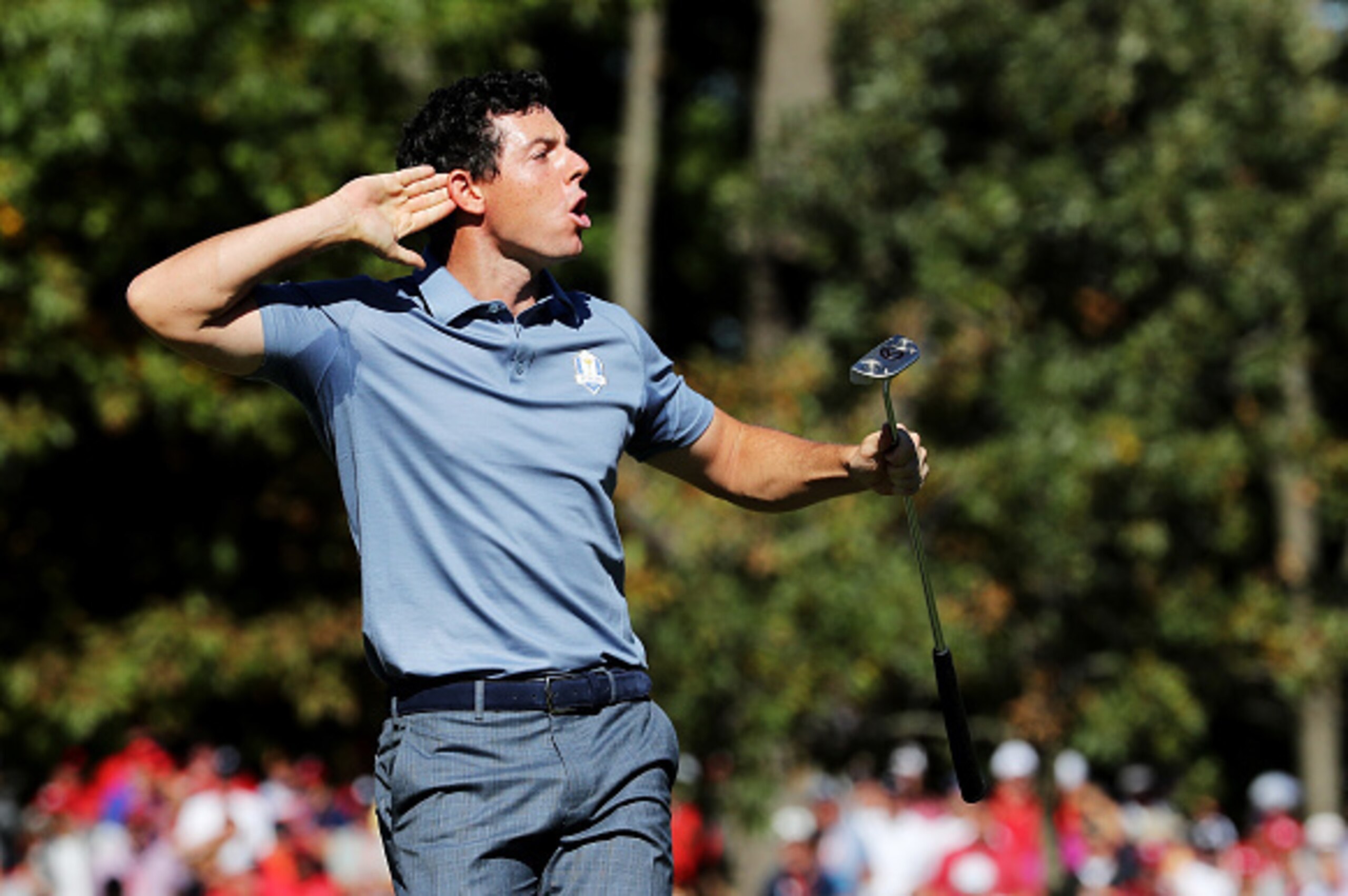
"I knew what I needed to do right from the get-go," McIlroy said. "For the first eight holes, I was in there pretty well and just sort of ran out of steam. It's been a long week, and I didn't have quite enough at the end to stop him.
"It was all played in the right spirit. Yes, we mocked each other a little, but at the same time, it was all in good fun. No problems with Patrick at all. He's been immense this week."
How good was it? McIlroy played a four-hole stretch in four-under, yet he could not seize the lead.
In another moment the task force will relish, the final man added to the 12-man team scored the clinching point. Thanks to an overhaul to the wild-card system, the U.S. didn't name the recipient of the last of four wild-card spots until Sept. 25.
Ryan Moore, who lost in a playoff to McIlroy in the PGA Tour season finale and never expected to receive the call, was given the nod and scored the point that secured the U.S. victory.
Moore, who had a sterling amateur career that included U.S. Amateur and U.S. Public Links titles, again found match play to his liking.
"There's something simple about it," Moore said of the mano-a-mano format. "You're just trying to beat one guy."
Moore's new baby seemed to relish his dad's role in Sunday's win, providing a nice impression of a typical Reed expression after the victory was confirmed:
American captain Love, whose team rolled over and died on the final day at Medinah four years ago, admitted there was plenty of pressure to produce this time around given the team's administrative makeover.
"I'm proud of these guys—they had a lot of pressure on them the last two years," Love told NBC. "Every time we picked a guy, there was more and more pressure and more questions. I'm proud of the way every one of them played. Unbelievable golf."
The task force was frequently subjected to sarcastic remarks and ridicule by critics who questioned the merits of the Ryder makeover. Stars such as Tiger Woods, Jim Furyk and Mickelson all played a role in the redesign, though Lefty was widely believed to be the most active and invested in the process.
As he watched his teammates finish off the Europeans in decisive fashion, Mickelson told NBC the 12 players would share "a memory and life experience that we'll cherish forever."
Or at least until 2018, when the matches are played outside of Paris and the transatlantic circus begins all over again.
Steve Elling covers golf for Bleacher Report. You can follow him @EllingYelling. All quotes taken from the television broadcast unless otherwise indicated.


.jpg?w=2560 "Viral Rams Coach Vid 🖕")

.jpg?w=2560 "Injury-stricken Seahawks signing veteran RB")
