
The (imaginary) votes are in, and your 2016 Olympic all-tournament group basketball team is now here.
These picks are based purely on what we've seen in Rio thus far; Overseas and NBA reputations were not taken into account. Tournament participants frustrated with this ruling can email the International Olympic Committee, which, in addition to having no say on this matter, reports all athlete inquiries, however pivotal, as spam.
Our team will consist of 12 players: five starters (two backcourt, three frontcourt), a sixth man and six reserves evenly split among the backcourt and frontcourt. Certain positional designations will be ignored. Kevin Durant, for instance, is categorized as a guard. He is a lot of things—including a listed 6'9" 7-footer—but he is no guard. We will throw him, and others in his situation, into the rightful frontcourt pool.
You've waited and waded through five games per qualifying squad to reach this point. Congratulations. We've never been prouder of you.
Just make sure you don't fall off the edge of your seat now that you're here.
Backup Backcourt
1 of 8
Facundo Campazzo, Argentina
One player ranks in the top five of points, assists and steals per game among all guards during group play in Rio.
Hint: It isn't Stephen Curry.
It is Facundo Campazzo. Argentina's pocket-sized point guard (5'11") is averaging a categorically ridiculous 16.4 points (fifth), 5.2 assists (fifth) and 2.6 steals (first) through five outings. If not for even-more-ridiculous performances by a pair of other backcourt dudes, Campazzo would earn a starting nod.
Nando de Colo, France
Nando de Colo looks like he should have been an NBA All-Star based on the Olympic stage.
His 15 points and 2.6 assists per game during group play are nice, but his shooting slashes are even better. He waltzes into the quarterfinals hitting 60 percent from the floor overall, 36.4 percent from deep and a perfect 100 percent from the foul line.
Let's get "#NandoBucketsdeColo" trending, shall we?
Matthew Dellavedova, Australia
Perhaps you thought Matthew Dellavedova would bring his pestering antics down a notch or 10 while playing with Australia. Or maybe you, knowing better, figured he would go full-on gnat.
Dellavedova has paired his tournament-leading 8.6 assists per game with a 50 percent clip from downtown. He is swarming the ball on defense, like always, and helped bring Australia within minutes of an upset over Team USA—a near-miss from which the United States hasn't officially recovered.
No, we're not saying, verbatim, Dellavedova burrowed a hole in Team USA's heads and is responsible for their shaky play against Australia, Serbia and France. We're merely summarizing it between the lines, in invisible ink, under the assumption that you're good at following breadcrumbs.
Honorable Mentions: Manu Ginobili (Argentina), Marcelo Huertas (Brazil), Kyrie Irving (USA)
Backup Frontcourt
2 of 8
Carmelo Anthony, USA
You knew this was coming. Carmelo Anthony is now the United States' all-time leading Olympic scorer, but he's also so much more, as NBA.com's John Schuhmann underscored:
"Put Carmelo Anthony in a USA uniform, have him play the four, let him play off of other NBA stars, and you have the most lethal weapon in Olympic basketball history, and an entirely different player than the one that has played for the Denver Nuggets and New York Knicks over the last 13 seasons.
"
Anthony enters the quarterfinals averaging 15.2 points, 5.0 rebounds and 2.4 assists while putting down more than 44 percent of his triples. He staged a one-man rescue mission during Team USA's win against Australia, and the leadership he exhibits over a cast of superstar egos (and Harrison Barnes) has been hailed to no end.
In all likelihood, Anthony's days of earning All-NBA honors are behind him. His last nod came during 2012-13, right before the New York Knicks, as they do, imploded. But who needs more of those (he has six) when you have our hypothetical all-Olympic basketball placement?
Yi Jianlian, China
Watching China play is mostly tough. It's the only team to wrap the group stage without a win, and its losses came by an average of almost 30 points.
Still, Yi Jianlian does work on the offensive end. He is one of three players to tally more than 20 points per game, and his lackluster rebounding splits (eight per 40 minutes) are offset by 46.7 percent shooting from beyond the arc.
Too bad China's Rio stay has come to a close.
Luis Scola, Argentina
Olympic Luis Scola is the best Luis Scola in the history of all versions of Luis Scola.
Ever the underappreciated glue guy, Scola used the group stage as his own personal playground. He is averaging 14.8 points on 52.8 percent shooting, including a 47.1 percent showing from long distance, and collecting more rebounds per 40 minutes (10.5) than Andrew Bogut (10).
Facundo Campazzo, Manu Ginobili and Andre Nocioni receive a lot of love for their roles in Argentina's medal-hopeful march. But Scola is equally important to what it does, and without him, Argentina wouldn't stand alone, next to Team USA, as one of two squads with a legit Big Four.
Honorable Mentions: Andre Nocioni (Argentina), Boris Diaw (France), Ike Diogu (Nigeria)
Sixth Man: Patty Mills, Australia
3 of 8
Australia's Patty Mills is a lot like the San Antonio Spurs' Patty Mills: loads of scoring, mixed with some playmaking and ill-advised decisions, along with even more scoring.
The cardinal difference between the two? Australia's Patty Mills enjoys a greener green light and fewer lectures/hoarse growls/death stares from Gregg Popovich.
Mills' 20.5 points per game are the second most of any chucker in Rio, and what he lacks in defensive consistency, he makes up for with loose-ball chase-downs. His efforts in transition are particularly entertaining: hesitation dribbles and hop steps trick plenty of defenders, and his off-rock activity is rivaled only by an active pinball.
To Australia's credit, its game is very much responsible for Mills' success. The team runs him off a ton of screens, and Andrew Bogut is clearing paths to the basket with off-action picks of his own when Mills is on-ball.
Case in point: During his 30-point explosion against Team USA, "Patty Mills used just 9 total dribbles to set up his 11 made FG vs Team #USA," per Project Spurs. That makes him perfect for sixth-man duty, no matter what kind of international team we're building.
.jpg?w=2560 "Seahawks Chiefs Football")


Backcourt Starter: Mantas Kalnietis, Lithuania
4 of 8
If the "MVP of Olympic Group Play" award were an actual thing, it would go to Mantas Kalnietis. He is having one of those Olympics where you have to remember international play is not a barometer for every other basketball league.
Through five appearances, Kalnietis is averaging a mind-blowing 19.2 points on 64.8 percent shooting (not a typo), plus a 47.8 percent three-point clip (also not a typo), to go along with 8.0 assists, an Olympic-lording 2.6 steals and infinite style points.
At 6'5", the 29-year-old is basically a shooting guard masquerading as a point guard who could probably defend most small forwards if his wingspan (6'5") were more impressive.
The Lithuania offense is pumping in under 80 points per game—the worst of any quarterfinals team—but Kalnietis is pretty much holding down the fort on his own. Just two of his running mates are averaging in double figures, and no one else is cracking 12 points per game.
Nevertheless, we cannot lose sight of what we're watching. So say it with me, three times: I will not tweet about how the Philadelphia 76ers should have maxed out Kalnietis. I will not tweet about—actually, screw it.
Kalnietis is the superhero playmaker Philly needs, context of his domination be forever darned.
Backcourt Starter: Bojan Bogdanovic, Croatia
5 of 8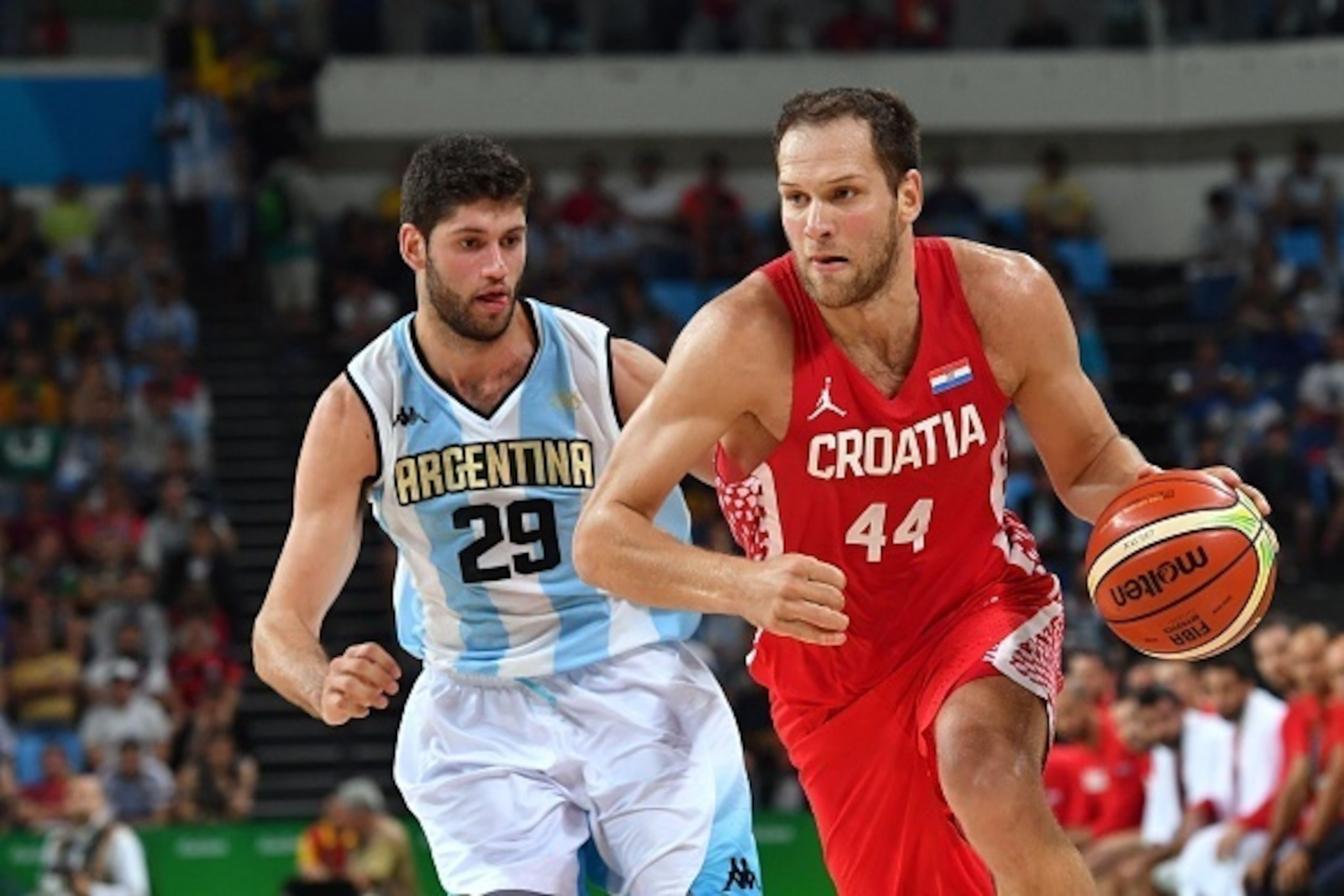
How good has Bojan Bogdanovic been in Rio? So good, "Iso Bojan" may end up being the Brooklyn Nets' most efficient offensive play call next season.
Relax, I'm kidding. (Scans Brooklyn's roster again.) OK, so it turns out I'm only half-kidding.
Bogdanovic leads all Olympic participants with 24.8 points per game. He is shooting better than 51 percent from the floor overall, and there's a 68.5 percent chance Carmelo Anthony has texted him for offensive tips over the last two weeks.
"Bogdanovic's three-pointer has been a weapon, as he's draining 43.8 percent from beyond the arc, hitting 4-of-6 against Lithuania on Monday," Cory Wright of the Nets' official site wrote. "He's hit three or more threes in four of the five games and is getting to the stripe as well, picking up 6.8 points per game via foul shot."
Scoring is admittedly Bogdanovic's lone job. But that's by design.
Croatia's primary ball-handlers—Krunoslav Simon and Roko Ukic in particular—exist to find him wide-open threes and weak-side isolations, and there aren't too many other pure scorers on the roster (shoutout, Dario Saric).
It's a bad idea to read too much into Bodganovic's first five outings. And yet, it would be a shock if he doesn't finish as the NBA's leading scorer next season Rio's top points-piler, regardless of when Croatia's Olympic journey ends.
Frontcourt Starter: Kevin Durant, USA
6 of 8
Kevin Durant is quietly torching the (offensive) competition in Rio—insofar as anything Durant does can be kept quiet.
Though he disappeared in Team USA's quasi-collapse versus Australia (4-of-16 shooting), he has been mostly spectacular. His 16.8 points and 3.4 assists are pedestrian numbers compared to his stateside production, but he's not even logging 30 minutes per contest.
Plus, Durant is currently flirting with the elusive (and definitely impossible) 60/60/90 shooting slash. He is burying more than 60 percent of his field-goal attempts, including three-pointers, and need only drain 17 consecutive free throws to reach 90 percent efficiency at the charity stripe.
That Durant is averaging more than three assists amid limited touches is equally incredible. Kyrie Irving (six) and Kyle Lowry (four) are the only Team USA participants with more, so Durant is sharing the ball nicely for someone jacking up fewer than 10 shots per tilt.
Carmelo Anthony is the emotional, been-there-done-that alpha on the United States bench, and his on-court performance puts him in the conversation for rights to "Second-Best Player on the Team" honors.
But make no mistake, Durant is this country's best player, and it's not even close.
Frontcourt Starter: Dario Saric, Croatia
7 of 8
Dario Saric's Olympic exploits are for everyone—but mostly Sixers fans. As his soon-to-be head coach Brett Brown told the Philadelphia Inquirer's Mike Sielski after Croatia's win over Spain:
"I know what we're going to get in Dario. I also think the evolution of his game is as clear to me as what his present game is. He's not an NBA, A-plus athlete, but he's highly skilled in a bunch of areas. He's highly intellectual in a bunch of areas. The evolution of his shot, the evolution of his mind - those things, when you've seen him in Croatia or Istanbul, it's not really that different. I feel like what you see is what you get, and I like what you see.
"
Saric's efforts in Rio are, in one made-up word, superincredibleohmygodsogood. His three-point shot is on the fritz (26.3 percent), but he's putting in 12.8 points on a tidy 43.1 percent shooting per game. Joe Ingles and Boris Diaw are the only forwards averaging more assists, and Saric is hauling in more rebounds per 40 minutes (8.5) than Spain's Nikola Mirotic (8.4).
And we can't forget about his last-second block on Pau Gasol during that win over Spain. Croatia was up by two inside two seconds to play, and Gasol's potential game-tying bunny looked like it would find nylon. While Croatia wouldn't necessarily have needed that victory to advance, Spain eventually had to win its final three games to sneak out of the prelims. So, in essence, Saric almost single-handedly ruined the medal hopes of an entire nation.
Sixers fans should be appropriately giddy about his NBA debut next season. Saric is flashing all the trimmings of an ideal playmaking 4: size, rebounding, passing, handling, quick(ish) defensive feet, sweet(ish) shooting and semi-consistent rim protection.
Here's hoping Philly's epic frontcourt logjam doesn't pigeonhole him to the 3 and, thus, make a Rio-style rookie season next to impossible.
Center: Pau Gasol, Spain
8 of 8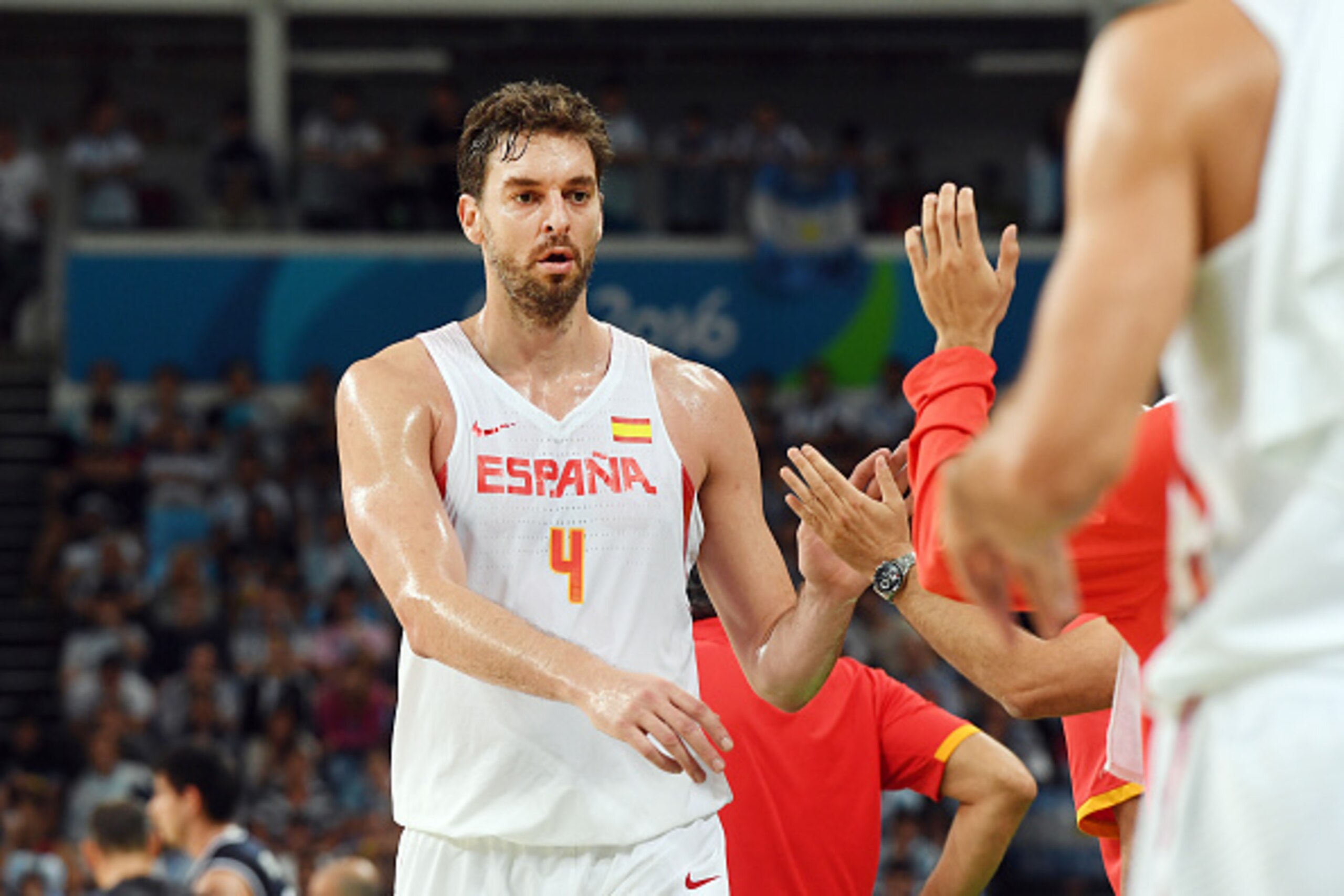
No Marc Gasol? No Serge Ibaka? Yeah, that's been a problem for Spain. It dropped its first two games and needed to remain perfect through its final three to salvage fast-fading medal hopes.
Fortunately for Spain, it has Pau Gasol. He is still pretty good at this whole basketball thing.
The 36-year-old ranks fourth among all Olympic hoopers in scoring (19.4 points), first in rebounds (8.8) and second in blocks (2.0). His 3.2 assists per 40 minutes are low for him, but Spain has needed him to score, not facilitate.
And score he has—efficiently, too.
Gasol is drilling 53.6 percent of his shot attempts, and the shorter three-point line has opened up his game even more. He is draining 60 percent of his three-balls (9-of-15) and posting the highest overall efficiency rating among centers.
Free-throw woes notwithstanding—56 percent from the foul line, two big freebie misses against Brazil, etc.—Gasol has been a reliable bright spot for a squad trying to stave off a dreaded "underachieving" label that would stick with it for at least another four years. He is playing like the best big man of the tournament by far, and Spain's dreams of a third-consecutive medal finish are alive because of it.
Stats courtesy of FIBA.com. Dan Favale covers the NBA for Bleacher Report. Follow him on Twitter, @danfavale.