2016 Summer Olympics: Day 8 Winners and Losers
Rio de Janeiro said goodbye to Michael Phelps, whose infant son, Boomer, can finally take those huge earphones off.
Phelps' last swim in the 2016 Olympics—which might be his final Olympic swim ever—was the men's 4x100-meter medley relay. Fittingly, he got a gold-medal send-off as his butterfly, Ryan Murphy's backstroke, Cody Miller's breaststroke and Nathan Adrian's freestyle combined for an Olympic-record time of 3:27.95. Britain won silver and Australia won bronze.
That's five golds and one silver in Rio for Phelps, 31, who, with 23 gold medals, is the most decorated Olympian in history. He has said he won't be back for Tokyo 2020, per Martin Rogers of USA Today. Rival Ryan Lochte and longtime coach Bob Bowman won't say for sure, because Phelps has "retired" before.
Whether or not he's done, Phelps leaves the U.S. team in great shape. Proof was the women's medley relay, which also won gold with three first-time Olympians on Saturday.
Freestyler Simone Manuel, who added 50-meter individual silver Saturday to her 100-meter gold, anchored the relay, which included Olympic rookies Lilly King (breaststroke) and Kathleen Baker (backstroke), along with veteran Dana Vollmer (butterfly). Earlier in the day, another Games rookie, Connor Jaeger, took silver in the men's 1,500 with a new American record of 14:39.48.
On the track, Jamaica's Shelly-Ann Fraser-Pryce handed off the women's 100-meter sprint title to...another Jamaican, Elaine Thompson, who finished in 10.71 seconds. London Olympic champion Fraser-Pryce took bronze in 10.86 seconds and American Tori Bowie squeezed in for silver with a time of 10.83. American Jeff Henderson won surprising gold in the long jump.
We could go on. But instead, read on for what else happened on Day 8 in Rio.
Winner: U.S. Women Rowers
1 of 10
One of the hardest things to do in sports can be winning when everyone expects you to.
The U.S. women's eight, perhaps the most dominant team to compete in the Games, won Saturday. It made history with its third consecutive Olympic gold medal and extended its win streak of major titles to 11.
The women's eight has not lost a world or Olympic title since 2006. One member of the team, Elle Logan, became the first female rower in U.S. history to win three Olympic titles.
Great Britain won silver, and Romania won bronze.
Just before the race, two-time Olympian Gevvie Stone won her first medal, a silver, in the women's single sculls. Australia's Kim Brennan won gold, holding off Stone's late charge, in 8:22.82. China's Duan Jingli took third.
The rowing program was postponed two days due to heavy wind. Saturday's conditions were much calmer.
In the eights, the U.S. women were challenged until about halfway through the 2,000-meter course. The U.S. boat edged ahead at about the 1,000-meter mark and kept increasing its lead, winning by 2.49 seconds.
It's tradition to throw the winning coxswain, Katelyn Snyder in the this case, into the water. But the U.S. team refrained, presumably due to reports of polluted water.
Loser: Diving's Underwater Cameras
2 of 10
The diving pool was back in business Saturday, hosting the women's three-meter springboard event.
Officials closed the pool Friday morning for several hours, trying to fix the problem stemming from Tuesday, when the water had turned from standard blue to green.
Officials insisted the water was safe, even though some divers complained about the nasty smell and eye itchiness, per CBS Sports' Robby Kalland.
U.S. diver Abby Johnston is calling it "The Swamp," per the Associated Press (via NBCOlympics.com).
At first, some believed the problem to be algae. But the explanation given at Saturday's press conference was that hydrogen peroxide had been mistakenly added to the chlorinated water. One or the other is used for keeping the water clean, not both.
That prompted the gold medal of Olympic quotes, from Rio official Mario Andrada: "Chemistry is not an exact science," he said, per the Associated Press report.
The fix: "filters and time," per the Washington Post's Liz Clarke. On Saturday, the water improved to blue-green, so murky that NBC didn't even bother with underwater cameras.
However, they gave up on trying to fix the bigger, adjacent pool used for water polo and synchronized swimming. They will drain the nearly one million gallons of water and replace it, hopefully in time for Sunday's start of synchro, where athletes and judges need to see underwater.
WInner: Swimmer Joseph Schooling
3 of 10
You might know Joseph Schooling, the Singapore swimmer who shockingly beat Michael Phelps and other silver medalists Chad le Clos and Laszlo Cseh to win the 100-meter butterfly on Friday, got $1 million ($740,000 U.S.) from his home country for winning the gold.
But did you know Schooling, a rising junior and All-American at the University of Texas, wouldn't have been able to keep it and his NCAA eligibility if not for a little-known rule change made only last summer?
Schooling is a rich young man, thanks to the NCAA rule, which became effective Aug. 1, 2015, that allows international students to keep Olympic gold-medal bonuses from their home countries.
Compare that to U.S. athletes, whose government provides little funding to the Olympic movement. A gold medal in Rio earns them $25,000 from the United States Olympic Committee, according to Forbes' Chris Smith.
That means Phelps, with his 23 golds, will have earned $600,000 in USOC bonus money in his career, less than Schooling did in one night.


Loser: Justin Gatlin
4 of 10
As the track and field events kick into gear, the doping issue—already rearing its head in swimming with Lilly King calling out Yulia Efimova for her two doping positives—was expected to intensify.
It didn't take long for Justin Gatlin, another two-time violator who served a ban, to set himself up as the bad guy Saturday.
He told reporters he didn't know who King was, and he had served his time and deserved to be in Rio. King said he didn't.
Not that Gatlin, who ran faster than gold-medal favorite Usain Bolt by about a half-second in Saturday's 100-meter preliminaries, needed to portray himself negatively. Others were already doing that. Besides King, Sebastian Coe, head of the International Association of Athletics Federations (IAAF), has said Gatlin winning gold in Rio would make him "queasy," per Sporting News' Sean Deveney.
Gatlin, who ran a 9.80 100-meter race in the U.S. Olympic trials, is considered the top threat to two-time Olympic champion Bolt.
Semifinals and finals for the 100-meter race are set for Sunday.
Gatlin's comments came at about the same time as the announcement that Russia's lone track entrant, long-jumper Darya Klishina, was yanked from the Games, per Reuters' Karolos Grohmann and Jack Stubbs.
Russia's track and field athletes were banned from the Olympics in the wake of an investigation showing the country conducted a massive state-sponsored doping program involving the past Olympics and World Championships.
Klishina was initially allowed to compete because she based her training in the U.S.
Winner: U.S. Swordswomen
5 of 10
The U.S. women's saber fencing team defeated Italy, 45-30, to win bronze. It is the U.S. team's fourth medal of the Rio Olympics.
Russia defeated Ukraine, also 45-30, to win gold.
But a symbolic history was made on the medal stand, when Ibtihaj Muhammad became the first American to wear a hijab while receiving an Olympic medal.
Muhammad, from Maplewood, New Jersey, was part of a four-woman team that included Mariel Zagunis of Beaverton, Oregon, Dagmara Wozniak of Avenel, New Jersey, and replacement athlete Monica Aksamit of Matawan, New Jersey.
Zagunis is the most decorated U.S. female fencing Olympian with four career medals.
Because team events rotate, women's saber has been contested only twice, the first in 2004, when the team event debuted at the Games.
Loser: Hope (Solo) and Sportsmanship
6 of 10
U.S. soccer goalkeeper Hope Solo is "unlikely" to be sanctioned for calling Sweden's players "cowards" after Sweden's upset win in Friday's quarterfinal, said Mark Adams, a spokesman for the International Olympic Committee, per Martin Rogers of USA Today.
The IOC can punish athletes it considers to have damaged the Games' reputation. For instance, the organization is investigating a judo athlete from Egypt who refused to shake the hand of an Israeli opponent.
“I think it’s unlikely,” Adams said, per Rogers. “It falls I think into the category of sportsmanship. Things are said in the heat of the moment. Clearly passions run very, very high and people say things they regret. We would just call for people to treat their opponents with sportsmanship and respect during these Games.”
Meanwhile, Solo received heavy criticism for her comments and past transgressions.
Solo was incensed about Sweden's strategy to pull back into a defensive shell rather than opening up the game, per Sport Illustrated's Grant Wahl.
Sweden's game plan to defend and try to score on the counterattack was drawn up by former U.S. coach Pia Sundhage. Sweden and the U.S. tied 1-1 in regulation before Alex Morgan and Christen Press missed their shootout tries.
It is not yet known if the U.S. Soccer Federation plans to take any action against Solo for her remarks.
Winner: Christoph Harting, Discus
7 of 10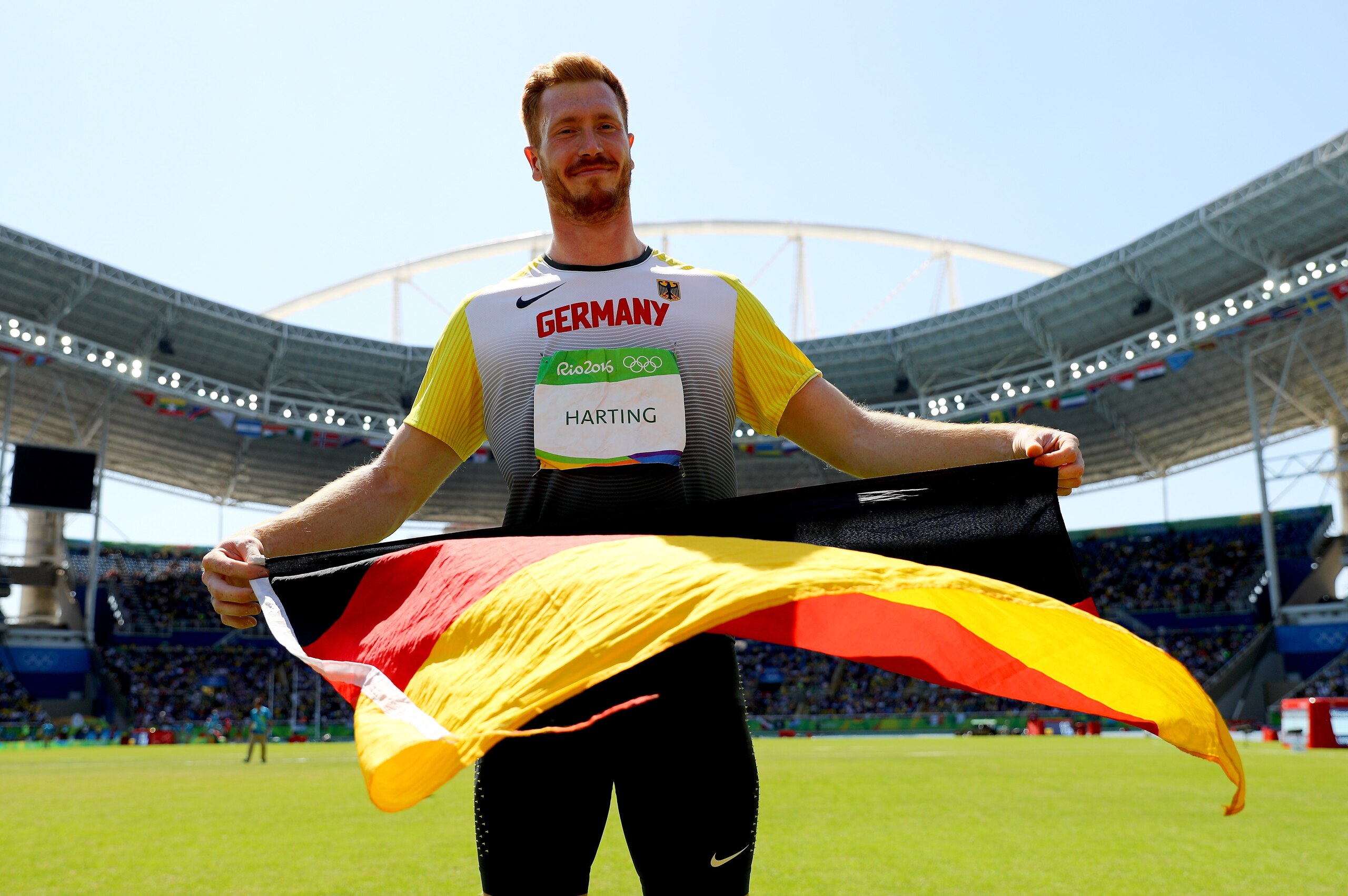
Germany's hopes for discus gold were crushed when defending Olympic champion and Rio favorite Robert Harting, suffering with a back injury, failed to qualify for the final.
So the 31-year-old watched from the stands, cheering on younger brother Christoph, 25, who was happy to reach the final.
But Christoph wound up surprising them both, unleashing the biggest heave of his life on his final throw, 68.37 meters (224.3 feet), to win Olympic gold.
Poland's Piotr Malachowski led until Harding's massive throw and wound up with silver. Another German, Daniel Jasinski, took bronze.
Besides gold, the 6'9" Christoph seems to share little, personality-wise, with his extroverted brother, a national star who won three straight World Championships and was known for yanking off his shirt after wins and an outspokenness on anti-doping.
Following his Olympic win in Rio, Christoph initially refused interviews, saying he didn't like to answer questions and wasn't "a PR person," per DW.com's Ross Dunbar.
Loser: Rafael Nadal, Tennis
8 of 10
It's tough to call Rafael Nadal a loser. He's been hurt. He seems to love playing in the Olympics and, in Rio, was trying to match his 2008 gold-medal triumph. He's a 14-time Grand Slam champion and all-around popular guy on tour.
But even when Nadal loses, like he did to Olympic giant-killer Juan Martin del Potro, 5-7, 6-4, 7-6 (5) in Saturday's semifinal, he wins. It was a spectacular three-hour match that left 2012 bronze medalist Del Potro sprawled on the court.
Del Potro, who upset No. 1 Novak Djikovic in the opening round, will play No. 2 seed Andy Murray, the London's 2012 gold medalist trying, like Nadal was, to pull off an unprecedented second Olympic gold in singles. Del Potro and Murray will play a best-of-five format for the gold Sunday.
Murray is on a hot streak himself, winning 17 straight to match a career best. He defeated No. 4 seed Kei Nishikori of Japan, 6-1, 6-4. Nadal and Nishikori will meet for the bronze medal Sunday.
Del Potro's ranking plummeted to No. 141 after three wrist surgeries. He and Nadal's match saw several delays between points as the chair umpire pleaded for quiet from boisterous Argentine and Spanish fans.
Winner: Argentina Men's Basketball
9 of 10
Argentina, 3-1 in a tough Group B, is shaping up to be a possible challenger for the struggling U.S. for Olympic gold.
Forged by a preliminary bracket that includes Croatia, Lithuania and Spain, Argentina rallied—twice—in the late going to defeat bitter rival and Olympic host Brazil, 111-107 in double overtime Saturday, celebrating like it had just won Olympic gold.
Extra security was hired, and top players from each side were enlisted to remind the crowd before the game's start to keep violence from erupting between fans from the South American neighboring countries.
The result was a gem. Argentina, which famously won gold in 2004 and bronze in 2008, trailed late in the back-and-forth game until Andres Nocioni hit a three-pointer with 3.8 seconds left to force the first overtime. Brazil's Leandro Barbosa put his team up in the second OT, but Argentina star Manu Ginobili hit two free throws after a huge offensive rebound to seal the win.
"Unbelievable game," said Ginobili, who won four NBA titles with the San Antonio Spurs, per the Associated Press' Tom Withers. "The rivalry is amazing, but sometimes it doesn't mean that the games are like this. Today was ridiculous."
Argentina next faces Spain in group play Monday.
Loser: Fateful Footholds
10 of 10
Tripping up on the Olympic track usually means you're doomed. But two Olympians did that on Saturday, and they found a way to succeed anyway.
Mo Farah accidentally tripped over his friend and training partner, Galen Rupp, partway through the 10,000-meter race. A stricken Rupp—he and Farah finished one-two in the memorable 2012 Olympic 10,000-meter race—slowed and tried to pace Farah back to the pack.
Farah, startlingly, not only worked his way back but won gold with his characteristic devastating kick in the final 200 meters. Rupp, whose best event is to come in the marathon, finished fifth.
In the women's 3,000-meter steeplechase, Ethiopia's Etenesh Diro got clipped from behind and her right shoe partially came off. She stopped and tried to get it back on—causing a slowdown—but couldn't. She wound up taking it off and later jettisoned her sock, too.
Diro ran the remaining three laps on the rough-surfaced track—over immovable barriers and into the notorious water jump—before finishing seventh, footsore and crushed because she didn't make the final.
But following a protest, she and two runners affected by her shoe adventures—Ireland's Sara Treacy and Jamaica's Aisha Praught—were allowed a berth in the final.

.jpg?w=2560 "LA Premiere of \"Chad Powers\"")