Summer Olympic Events That Attract the Most Controversy
Bribes. Rigged equipment. Doping.
Actually, that was all part of the ancient Olympics, where a statue of Zeus couldn't deter athletes from skirting the rules to get that extra edge.
"If Hercules was vulnerable, why not human athletes?" classics professor Hugh Ming Lee told Reuters.
So perhaps we shouldn't be surprised when drug tests force us to rewrite the medal counts in track and field, weightlifting, cycling or any other sport. And maybe we should expect referees and judges to leave us befuddled at times, whether they're cheating or simply unable to keep up with the less than legal actions in front of them.
Some events have the propensity to make news beyond the day of competition. Some are obvious, but some are unexpected.
Shot Put: Doping and Delays
1 of 7
The USA Track and Field trials opened with a touching moment: Shot-putter Adam Nelson was awarded his gold medal from the 2004 Olympics.
Yes, 12 years after the fact. Ukraine’s Yuriy Bilonoh had the gold, but his doping sample was retested using new technology in 2012. The IAAF stripped Bilonoh and 2004 women’s bronze medalist Svetlana Krivelyova of their medals in 2013. Russia’s Irina Korzhanenko had already been stripped of her gold.
New Zealand’s Valerie Adams won gold in the ring in 2008. She won another after the fact in 2012 when Nadzeya Ostapchuk tested positive.
Canada’s Dylan Armstrong got his 2008 bronze medal in 2014, after Andrei Mikhnevich was disqualified.
Drug testing is getting better, but will athletes continue to be able to call themselves medalists for a short time?
Or as Nelson told the Orange County Register: "How [many] times did it happen before that we didn’t find out?"
Equestrian: Jumping and Doping
2 of 7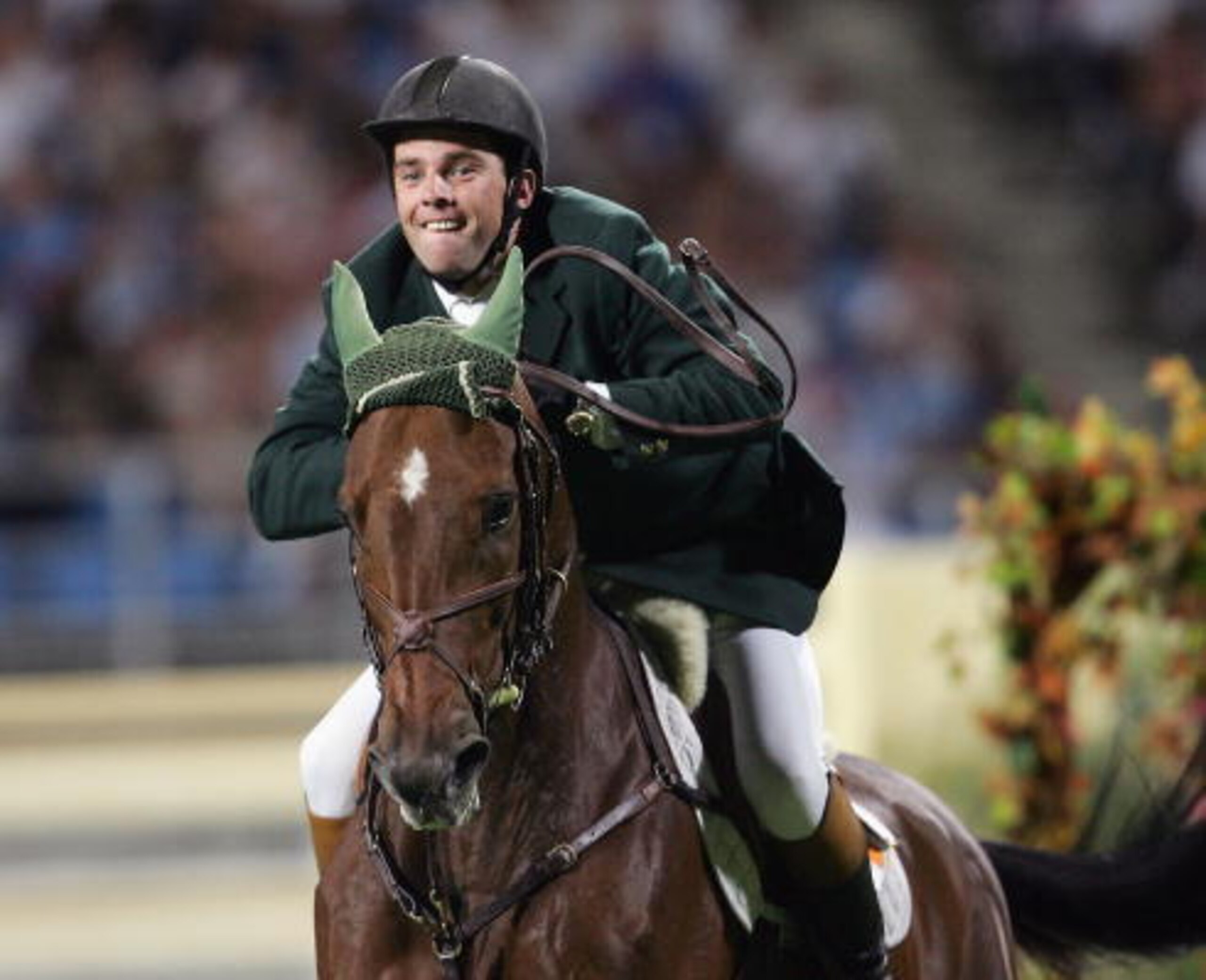
Wait, really? Yes.
In 2004, Ireland’s Cian O’Connor lost his medal when his horse, Waterford Crystal, tested positive. And then things got strange, RTE reported: "The horse's B or second urine sample was later stolen in the UK but examination of the B blood sample confirmed traces of the banned drug normally used as anti-depressants by humans."
Equestrian’s governing body was satisfied that O’Connor didn’t deliberately cheat. But the medal was gone.
The sins ran deeper for Germany, the original team jumping winners in 2004. They were downgraded from gold to bronze when Ludger Beerbaum’s horse tested positive for an anti-inflammatory drug. Five years later, Germany disbanded its entire Olympic equestrian team.
Beerbaum told a German newspaper his attitude was that "anything that wasn't found out was allowed," according to Deutsche Welle's translation.
In 2008, it was Norway’s turn to lose a bronze medal in team jumping when a horse tested positive for a pain reliever.
Badminton: Not Supposed to Be THAT Bad
3 of 7“Farcical scenes in the final group stages,” wrote Peter Walker and Haroon Siddique of the Guardian of the London 2012 Olympic badminton tournament.
Maybe we could blame the format. If players can get an advantageous draw by losing, why wouldn’t they?
But perhaps the Chinese, South Korean and Indonesian athletes should’ve looked like they really wanted to play and win instead of looking like they had suddenly forgotten how to play. The spectators were not amused.
Insiders weren’t all that surprised. A Badzine investigation found roughly 20 percent of matches between Chinese competitors were not completed.


.jpg?w=2560 "NBA Gambling Charges")
Boxing: Never Leave It in the Hands of the Judges
4 of 7
Will they ever get the judging right?
Any judged sport is bound to have a little bit of controversy. Diving and gymnastics require judges to have the vision of fighter pilots and the sports knowledge of an NFL assistant coach spending 70 hours a week in the film room.
But boxing is where we get the lion’s share of puzzling decisions. Josh Ashdown of the Guardian named Roy Jones Jr.’s loss in the 1988 final among its most stunning Olympic moments. The New York Times' Peter Alfano detailed the startling decision to disqualify the dominant Evander Holyfield in 1984.
Even the obvious decisions can elude boxing officials. Authorities overturned a decision and sent referee Ishanguly Meretnyyazov back to Turkmenistan after a bout in which an Azerbaijani fighter hit the canvas six times in one round.
“[The federation] overturned the result late on Wednesday night, saying Meretnyyazov should have counted at least three knockdowns and stopped the bout,” the Guardian's Ian McCourt reported.
Boxing will have a new scoring system this time, using the 10-point must system from pro boxing and MMA. But it still relies on humans.
Fencing: Modern Tech, Arcane Rules
5 of 7
Fencing has enviable technology. Suits and swords that trigger bright lights when a valid “touch” is made, a system taekwondo copied. Fencers can call for video replay to sort out disputes in a sport in which the swords move faster than the eye can see.
And yet...
Hungarian referee Joszef Hidasi was kicked out of the 2004 Games and suspended for two years after making what the fencing federation deemed to be six errors in the gold-medal match in team foil.
A stranger situation arose in 2012, when Korean fencer Shin A Lam lost an epee semifinal amid the most confusion over timekeeping since the Soviet Union "beat" the USA in the 1972 men’s basketball final.
Korea appealed, and due to some arcana of fencing rules, Shin was forced to sit on the piste in front of the crowd and the TV cameras while the appeal process played out. ESPN’s Jim Caple said he would sit in protest at his pub in solidarity.
But the strangest fencing moment may have come in the 1976 modern pentathlon, when a Russian competitor rigged up an electrical device to register hits in what Simon Burnton of the Guardian called “the most infamous case of sporting skulduggery in Olympic history.”
Handball: Qatar Plays the Import Market
6 of 7
Meet Qatar’s national handball team: Bertrand Roine, Borja Vidal, Goran Stojanovic, Jovo Damjanovic, Zarko Markovic…
No, Qatar doesn’t have a long-standing reputation of welcoming families from the former Yugoslavia and elsewhere in Europe. The small, wealthy country hosted the 2015 World Championships and figured that as long as they were hiring Pharrell Williams and Gwen Stefani to sing, they might as well convince a few players to switch nationalities.
“Athletes switching nationalities happens in plenty of sports,” Slate’s Stefan Fatsis said. “But the landscape of Qatar’s imports—from Spain to Cuba to Tunisia—was pretty audacious.”
Qatar rode its team of ringers to a stunning second-place finish. Then it hosted the 2015 Asian Qualification Tournament and stomped its way to an Olympic berth, opening with a nail-biting 49-9 decision over Uzbekistan and clinching a trip to Rio with a 28-19 rout of Iran.
Water Polo: What Happens Underwater...
7 of 7
What you see above the surface is only part of the story. If you’re a man playing top-level water polo, consider wearing a cup. If you're a woman, maybe you should dress in layers. Heather Petri told the New York Times' Sam Borden she spent part of an Olympic game topless after an opponent tore her swimsuit.
And that might not help, especially if the countries competing are in serious conflict outside the Games. Consider the 1956 water polo semifinal between Hungary and the Soviet Union, which has its own Britannica entry under the heading "Blood in the Water."
Bottom line: If athletes are brutally fouling each other in basketball, where everything is visible, what do you suppose they’re doing when most of their bodies are blurred by the water line?



.png?w=2560 "Week 8 Winners & Losers 📊")

.jpg?w=2560 "Aikman Blasts Cowboys WR 🫣")
.jpg?w=2560 "Jonathan Taylor Landing Spots")