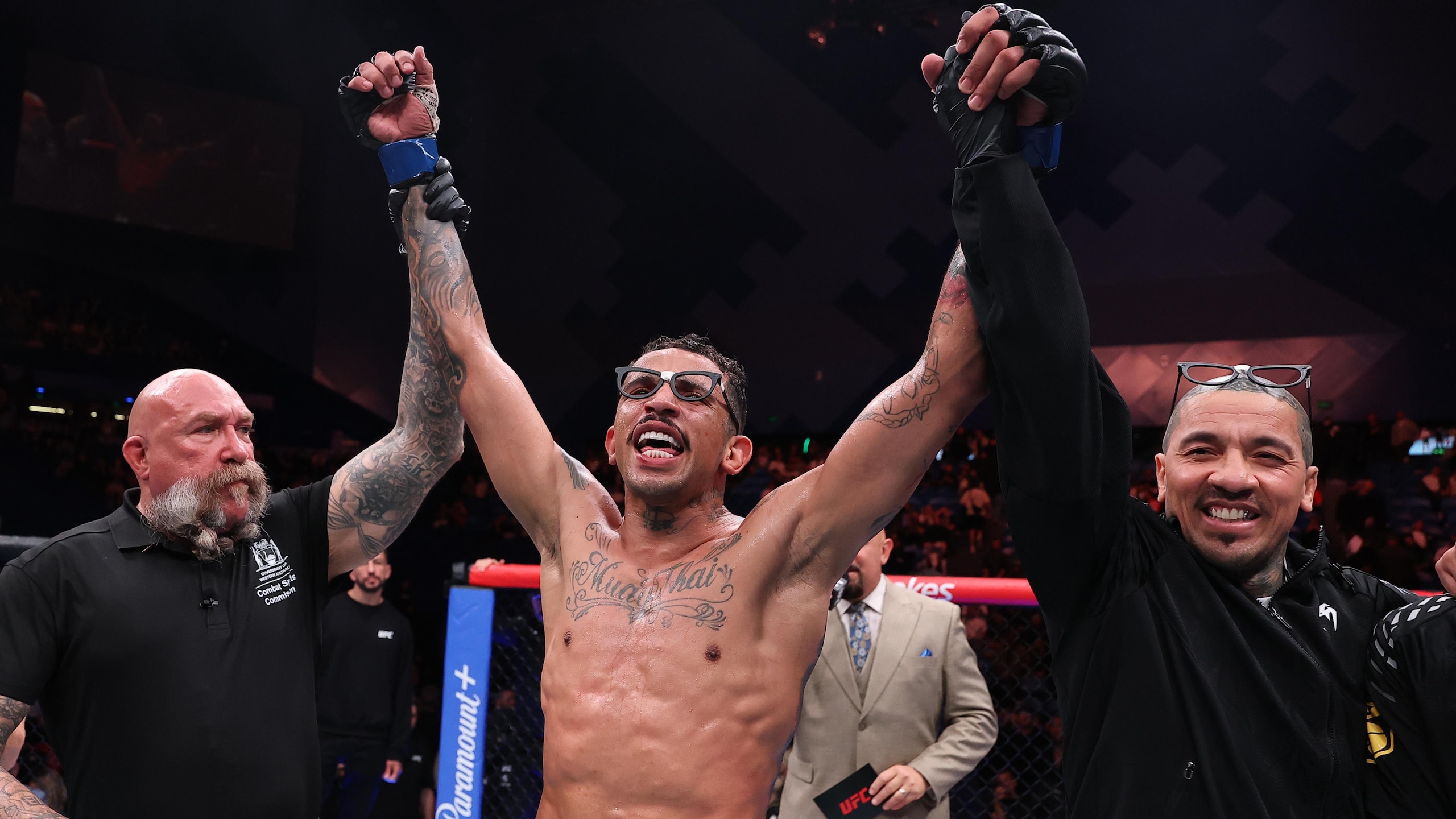
Is Brad Keselowski Peaking at Just the Right Time?
The latest Sprint Cup victory of Brad Keselowski wasn't a testimony to great racing. It was a testimony to how many aspects of being a race driver Keselowski does well.
A week after winning in Daytona Beach with bold defensive verve, Keselowski won in Sparta, Kentucky with ethanol fumes. At age 32, the Rochester Hills, Michigan native is in his natural prime, and that could be the central theme in a second Sprint Cup championship campaign.
The relative hare who lost to the relative turtle was Carl Edwards.
TOP NEWS

🚨 NC State Fires Head Coach

Malachi Toney Sets ANOTHER Record
.jpg?w=2560 "NBA Gambling Charges")
Malik Beasley Negotiating Plea Deal (AP)
"I thought he was out of fuel and he wasn't," runner-up Edwards said of Keselowski. "He played it perfectly. He let me get to him and then stood on it. I had a shot at it. I just wasn't able to do it."
If there had been a script, only the creative powerhouses at Disney could have written it. It seemed more like the ending of a Love Bug movie than the 18th race of a NASCAR Sprint Cup season of 36.
This sixth visit of the Cup to 1.5-mile Kentucky Speedway was bizarre enough to suit the track's history. It had been reconfigured and repaved. The tire provider, Goodyear, erred on the side of safety with a hard compound that made the four contact strips between car and track perilous, mistakes costly and passes hard.
As Keselowski said:
"I would say that the cars are—the new rules package makes them harder to drive and requires more precision as a race driver—and I can appreciate that about the race...You're just trying to survive (Turns) 3 and 4. Every time you go in there on a restart it's as hairy as it can get. It's extremely challenging, for sure, to go into that corner in a pack and try to make it out of there. I think we saw quite a few times we didn't.
"
Out of 11 caution flags, 10 were for wrecks. Until the very end, cars skidded into walls at almost regular intervals: Laps 11, 32, 54, 81, 88, 93, 152, 161, 172 and 194. The fans drinking beer must have considered that convenient as the crashes afforded numerous opportunities for pit stops of their own.
"This race is challenging because the biggest thing you have to deal with is all the grip you have," Kyle Busch, who finished 12th, said, "until you don't have any."
| Wins | Top-5s | Poles | Avg. Finish | Laps Led |
| 2014 | 2014 | 2014 | 2016 | 2014 |
| 6 | 17 | 5 | 9.2 | 1,540 |
Then, for the final 68 laps, it was "all clear," which raised the unexpected and decelerated specter of fuel mileage. One reason the wrecks stopped was that most of the cars started going slower. Keselowski drove "the little engine that could," and he managed to cross the finish line with his cylinders humming, "I think I can, I think I can."
Keselowski led 66 of those green flag laps. He fought his war with expert attrition. Matt Kenseth passed him for a lap, then ran out. Carl Edwards traced him down from more than 10 seconds back, only to come up .175 of a second short.
For once, the cars whizzing around a race track were grouped the same as vehicles making their way down an interstate highway: muscle cars here, SUVs there, a few school buses and a pickup truck in flames at the rest area.
Different speeds. Different tactics.
Yes, unlucky fans in "platinum parking" had to hitch a ride home, but that's more a story of local interest.
At the halfway point of the Sprint Cup season, eight races away from the glorious Chase for the Sprint Cup, Keselowski may not have proved he drives the dominant car every week. But he's proved that he is capable of winning in almost every possible way.
"He's one of the best in the business at saving fuel," Keselowski's crew chief, Paul Wolfe, said.
"It's a testimony to the adaptability and the talent of the people who work on these cars in Mooresville," Walt Czarnecki, executive vice president of that city's Penske Racing base, said.
"We're professional race-car drivers," Keselowski said. "It shouldn't be easy. It wasn't tonight. It was very, very difficult. You had to be certainly very, very smart."
Keselowski will have to be smart to navigate the shoals and eddies of the 10-race Chase. For him, it's a shame it doesn't start next week in Loudon, New Hampshire. He, Wolfe and Penske Racing seem fully armed and ready for combat.
At the moment, Keselowski is first in victories (4) and the Chase standings, by virtue of them. He's second in points by nine (to Kevin Harvick), but points mean nothing to him, thanks to the victories. He's won two in a row. He's won by domination, by strategy and by luck. He'll need all those in the Chase.

At the moment, Keselowski is the favorite, but is it even wise to be this prosperous this early? What does the discerning race team do now?
Does it try to keep popping out wins, even though, until the Chase, the practical benefit is limited? Does it save its best equipment for those final 10 races? Does it experiment on technical innovations that may provide the trial and error that can precede a title?
What's more important between now and the scheduled Chase blastoff on September 18 in Joliet, Illinois? Preparation? Or momentum? Keselowski likely aspires to both. He's won this rodeo once, in 2012.
Could that have been four years ago?
Presuming that the favorite to win the championship is the driver who seems to drive the fastest car at the Chase's beginning is a dubious hypothesis. Its convoluted progression—three elimination rounds, different kinds of tracks, arbitrary timing—requires speed, efficiency, teamwork and luck.
Keselowski has demonstrated three of the four and excels in the only variable at the moment. He had just enough fuel to win at Kentucky. His timing was only minutely superior to Edwards.
The victory was not undeserved. It was astonishingly skillful and conveniently lucky.
Follow @montedutton on Twitter.
All quotes are taken from NASCAR media, team and manufacturer sources unless otherwise noted.
.jpg?w=2560 "Aikman Blasts Cowboys WR 🫣")

.jpg?w=2560 "Jonathan Taylor Landing Spots")