

Dustin Johnson's Green-Finding Savvy Sets Stage for Either Merriment or Misery
The swaggering, unique gait of Dustin Johnson, when he's prowling the fairways and contending at another tour event, is the stuff that makes fans and broadcasters wax poetic, if not comedic.
It's been variously characterized as panther-like, serpentine and akin to a slow saunter.
The latter, in particular, fit the bill on Friday.
TOP NEWS

New NFL contenders starting to emerge after Week 4
.jpg?w=2560 "Cardinals Giants Football")
NFL investigating 2 referees for separate viral exchanges

Deion Playbook Found at Hotel
Despite playing the purportedly toughest course in the U.S. Open's tournament repertoire, the 31-year-old cruised through 36 holes while hardly breaking a sweat to claim a share of the lead at four under par with unheralded rookie Andrew Landry.
Continuing his seemingly predictable assault on the major-championship leaderboards, the lanky South Carolinian heads into the weekend at Oakmont Country Club seeking his fifth top-10 finish in the last six Grand Slam events—and more importantly, his first win.
Johnson, who has let a trio of majors slip through his hands in the final round, including last summer's shocking meltdown on the final hole of the U.S. Open outside Seattle, put together one of the most memorable days of his career from tee to green, finishing with one bogey and rounds of 67 and 69.
The world No. 6 mashed the so-called Oakmonster into submission off the tee, ranking second in the field in driving distance (318.75 yards) and first in greens in regulation (31) as he piled up surgical, stress-free pars in buckets. In fact, while others chopped and hacked their way around, Johnson's only real point of frustration centered on the dozen or so realistic birdie chances he didn't convert.
Still, as fellow top-10 players such as Jason Day, Rory McIlroy and Rickie Fowler have dog-paddled to stay in range of the 36-hole cutline on the rain-soaked venue, Johnson made the venerable Oakmont venue look surprisingly easy, crushing one laser-beam drive after another, and throwing darts with his irons.
After missing his first two greens of a two-round day, he hit the next 25 putting surfaces in succession. He also reeled off 27 bogey-free holes in a row to start the event before the streak was snapped midway through his second round. All this on a penal, white-knuckle course that averaged 74.24 strokes in the first round and 73.77 in the second.
"I felt like I played really well all day," Johnson told Fox after the round. "Hit it well, drove it well, hit a lot of good iron shots, gave myself a lot of good looks at birdies."
All true. Of course, Johnson's superlative play is hardly unfamiliar territory at this point in the week. Johnson leads the PGA Tour in first-round scoring average, and he ranks third in scoring in the second round. Just like recent majors have proved, though, the weekends have been a different story. He ranks outside the top 50 on both weekend rounds, which explains why he's labored to close out titles at times.
But the data isn't nearly as damning as the empirical evidence.
Facts are, if majors were 71 holes long, D.J. would likely have a couple of Grand Slam titles by now. He held a one-shot lead at the PGA Championship in 2010, then sprayed his driver on the 72nd hole into the gallery, unwittingly committed a penalty and missed a playoff by a shot.
Last year, after hitting two massive shots on the par-five 18th at the U.S. Open's closing hole, he faced a 12-footer for a winning eagle. As millions watched in shock, he instead three-putted to miss a potential playoff by one, all but handing the title to Jordan Spieth.
Even Friday began in familiar fashion. On his first par-five hole of the week, he knocked the ball on the fourth green in two with a pair of huge shots and then three-putted for par, conjuring more memories of the final moments at Chambers Bay. But if Johnson has proved anything over his nine-win career, it's that he has a mercifully short memory.
His first round was so stress-free, he only faced one par putt longer than six feet and converted it. The second 18 were nearly as uneventful, outside of a poor tee shot into a ditch on the first hole, his 28th of the day, which ended his run of bogey-free holes.
Through it all, though, Johnson missed so many putts from short range, it became difficult to watch at times. In his second round alone, he missed nine birdie putts from inside 15 feet.
"I didn't roll in too many putts, but I hit a lot of good putts, then made a couple of crucial par saves," he told Fox.
Over the arc of a long day, others of his ilk shadowed him on the scoreboard, which was festooned with quality ball-strikers who also don't have commensurate short games—or a win at a major—including Lee Westwood, Henrik Stenson and Sergio Garcia. Every one of them has flirted with multiple majors, just like Johnson, though not nearly as often lately.
Johnson, in fact, held the lead after the first round at Chambers Bay last year, too, and was a shot out of the lead at the halfway mark. He improved by a shot this time around.
"If I keep driving it like I am, I'll be tough [to beat]," he told Fox.
Five-time major winner Phil Mickelson, who didn't win a Grand Slam title until he was 33, said that urgency and frustration tends to roil the belly as time passes.
"The longer it goes, the more challenging it becomes," Mickelson said this week. "But [Johnson] still has a few more years before he really—before it's crunch time. I think 33 is really the cutoff, so he's OK, time-wise."
Johnson, a frequent practice partner of Mickelson, surely appreciated the attempt at self-deprecating levity.
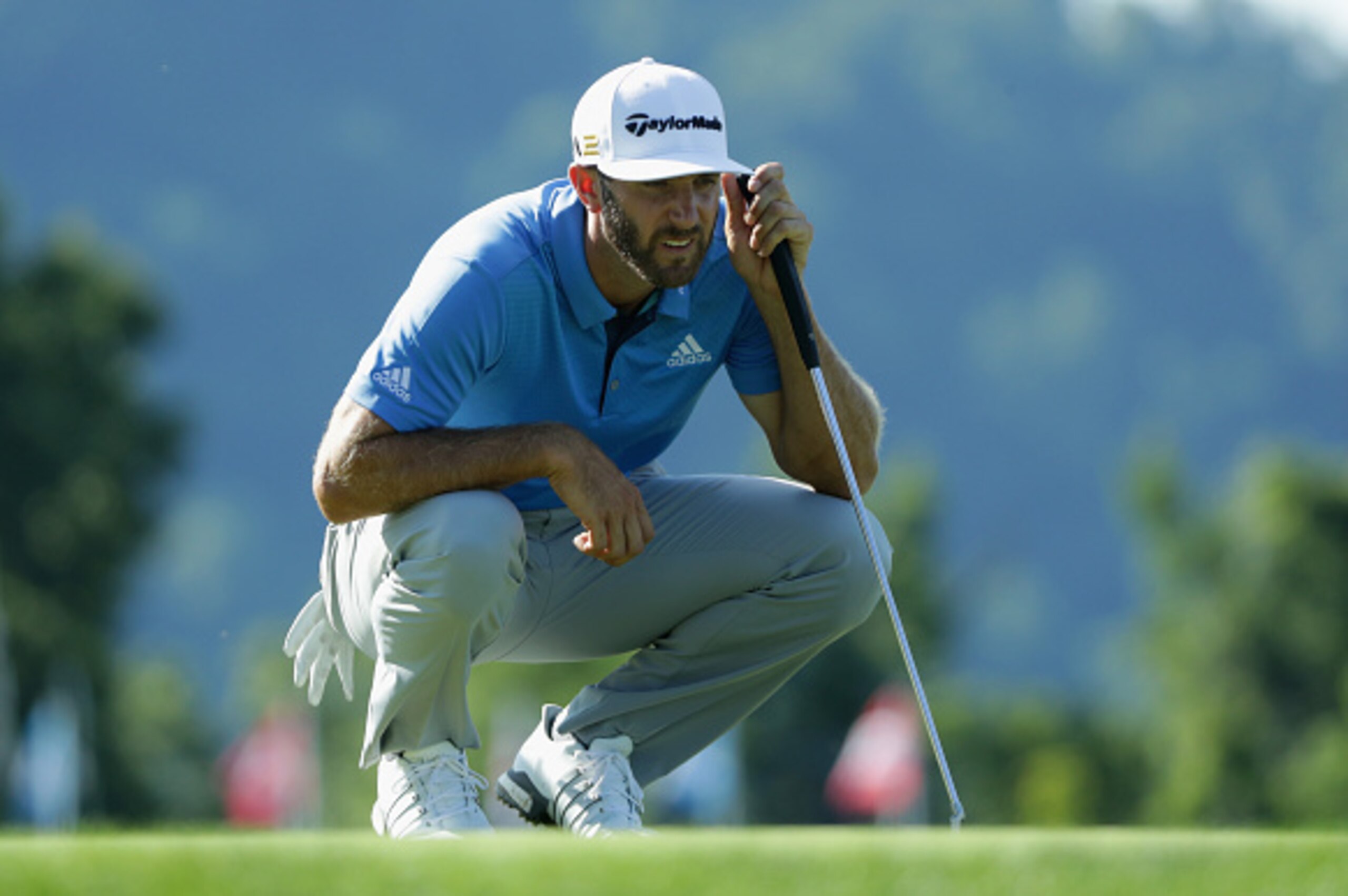
"But the longer it goes, the more you start thinking about it," Mickelson said. "The more it's discussed, the more you start thinking about it. The challenge is really on Friday and Saturday nights, when you have opportunities and you start putting that self-imposed pressure, because then you never play free.
"You never play with a kind of a loose attitude, where we all play our best."
Externally, Johnson seems unflappable most of the time. But even the most loosely wrapped characters accrue scar tissue after a few too many train wrecks. On the cusp of his return to an event where he's twice had chances to win—he held the 54-hole lead at the 2010 Open at Pebble Beach, too—Johnson was a bit defiant when the topic of his Chambers Bay horror was revisited.
"I don't know if anyone's aware of it, but I've played 20 freaking tournaments since Chambers Bay," Johnson said two weeks ago at the Memorial Tournament (per CBS Sports). "It's not that I'll be OK. I am OK.
"I'm playing the Memorial, so I've got a lot of other things to worry about than the U.S. Open. I'll worry about it when I get there."
He wasn't fretting over much on Friday, where he was forced to play two rounds because of the rains that washed out most of the play on Thursday, when only nine players finished.
He's been flirting with a breakthrough all spring. He finished fifth last week in Memphis, was third at the Memorial and has eight top-10 finishes this season. His play in the majors has been just as notable, as evidenced by these numbers Golf Channel's Justin Ray crunched:
Over and over, Johnson underscored Friday just how far he can mash it when he wants to. On the par-five 12th, the longest hole in majors history at 684 yards on the scorecard, he slammed a 3-wood approach to within five yards of the front edge of the green in two. It was playing at 635 yards on Friday, but into the wind.
On the next, a 164-yard par-three hole, he hit a towering, rain-making pitching wedge to within six feet and then converted for birdie to move into a share of the lead. Even among the longer hitters, Johnson is a unique beast who clearly enjoys taking long walks to his vaporized tee shots.
After a notable start to his career, all that's left is to complete a certain Sunday stroll—this time with a major-championship trophy in hand.
Steve Elling covers golf for Bleacher Report. You can follow him at @EllingYelling. All advanced stats are from the official U.S. Open website.
.jpg?w=2560 "Hill Injury Update Football")
.jpg?w=2560 "Titans Giants Football")
.jpg?w=2560 "Tyreek makes another cryptic post amid Chiefs rumors")


.jpg?w=2560 "Greenlaw Talks Payton Exchange")
