Spain's Thiago Alcantara Ready to Emulate His Famous Brazilian Father Mazinho
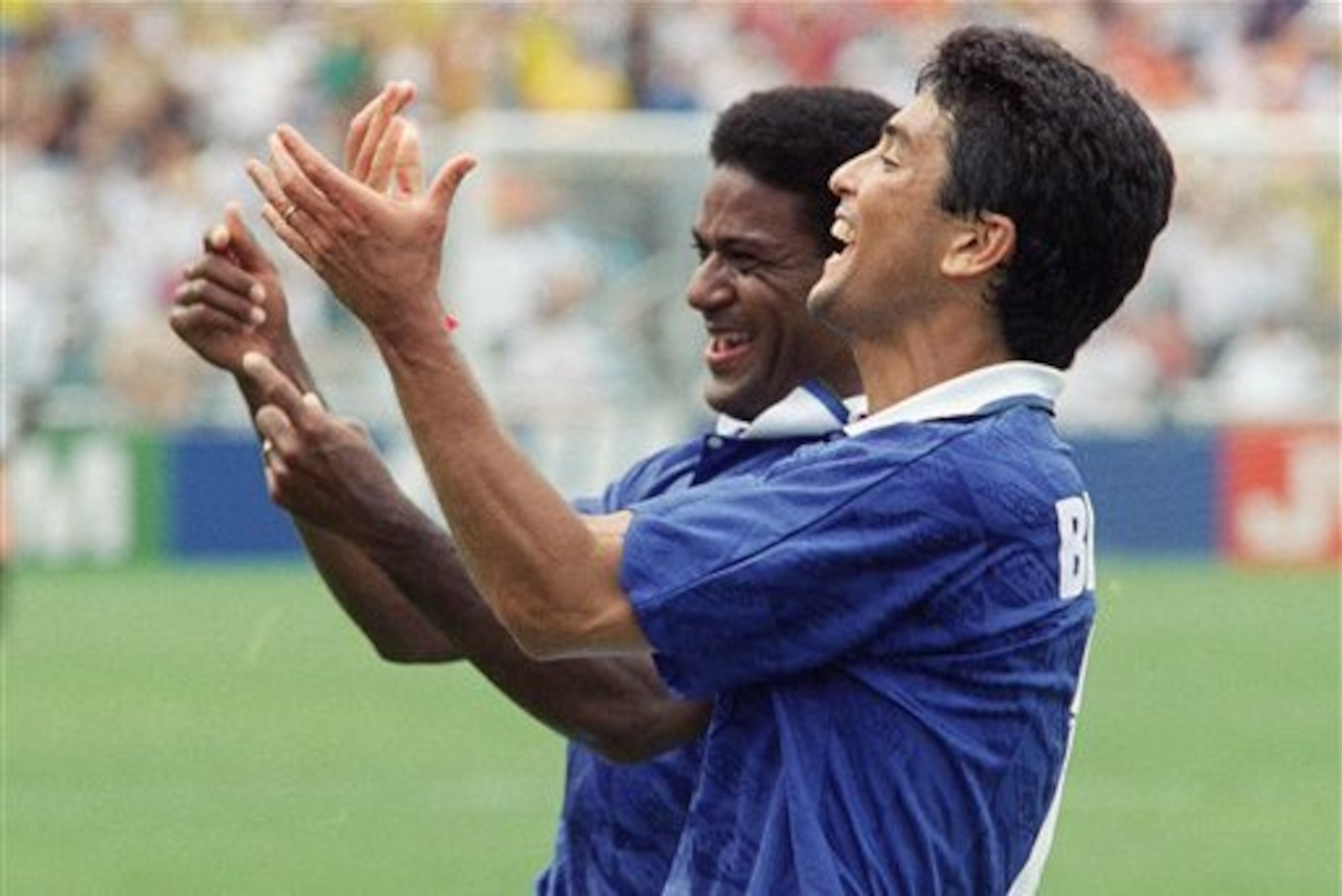
It’s one of the most iconic celebrations in football history. Bebeto had just scored Brazil’s second goal in the 3-2 win over the Netherlands at the 1994 World Cup in Dallas. He ran to the touchline, tucked his elbows into his chest and rocked an imaginary baby to commemorate the birth of his son two days earlier.
Team-mates Mazinho and Romario soon joined him. The three of them rocked imaginary babies in unison before breaking off and hugging each other.
Mazinho, full name Iomar do Nascimento, understood the joy of the moment. He already had two boys. The older one, three-year-old Thiago, would go with his dad to watch his training sessions at Spanish club Valencia.
TOP NEWS
World Cup Stocks Up/Down 🤔
Gavi: Don't Punish Argentina 🤔
World Cup's Most Disappointing Players 😬
When they'd come home, Thiago would put out shoes all over the floor and dribble around them with an indoor ball as though they were cones, his mum, Valeria Alcantara, told ESPN Brazil. He wanted to copy Mazinho, and Rafinha, his one-year-old brother, was too little to kick a ball around with.
“All he wanted to do was copy his dad,” she said. “He was his hero.”
When Thiago was five, Mazinho moved to Vigo and the whole family joined him there, according to Thiago's website. They all returned to Brazil when Mazinho made his last move, to Vitoria. While he lived in Bahia, where Vitoria is based, the rest of the family lived in Rio de Janeiro. There, Thiago had a buddy to hang around with: Rodrigo Moreno, whose father Adalberto, a former Flamengo full-back, was Mazinho’s best friend. The kids were so close that everyone assumed, wrongly, that they were cousins.
The boys went to school together, where they played futsal. They also played in the same kids' team.
“They were always together,” Adalberto told Luis Miguel Hinojal of El Pais. “At one school tournament, the director of another school complained. He had said that it was impossible that two kids could be so good, play with such quality, and just happen to go to the same school, and be in the same class.
"We were accused of pulling a fast one and had to show the paperwork where it was actually written that my son and Thiago were indeed mates in the same class at school."
Three years after Mazinho's 2001 retirement, the family were on the move again, back to Vigo, Spain, where Mazinho set up his own football school, called Paterna, and brought over Adalberto to run it. That meant Rodrigo came, too. All three kids played at the school.
When Mazinho asked Celta Vigo if they would sign his boys, the club said their youth teams were already full, according to the newspaper Faro de Vigo. So he took them to another local club, Ureca, where he presented Thiago as “a very technical midfielder” and Rafinha as a goalkeeper.
Youth coach Javier Lago soon realised that both players were special, although he did push Rafinha into the outfield.
“I trained him when he was 11 until he was 13, and he was already talented when he was a kid,” Lago, speaking of Thiago, told Bleacher Report. “I still remember when he passed the ball with his chest after receiving a long kick from the goalkeeper. At that age, most kids are scared of the ball. They don’t pass with their chests like Thiago did!”
Lago said his dribbling was prodigious but came at a price. Against the best opposition, Thiago would sometimes try to do too much. He played either as a central midfielder in a 4-4-2 or behind the strikers in a 4-3-3.
In training sessions, Lago would pick himself in the strongest team while Thiago would always play for the weaker side.
“We were against each other, and when Thiago got the ball, he isolated me and took me on in a one-versus-one," Lago says. "I knew his dribbles, but on this occasion, he left me on the floor with a new dribble. It was the same one that Romario once did against Alkorta in a Clasico match.”
Lago’s team played one match against Celta Vigo, which Mazinho and some former Celta team-mates decided to watch from the stands. Ureca’s standard move from a corner was to play it short to Thiago on the edge of the box, and he would whip in a cross. This time, he shot from the edge of the area and it flew into the top corner.
The Celta first team rose to applaud the opposition goal and then playfully ripped into his dad: “Celta had the wrong Mazinho!” they told him.
According to Faro de Vigo, the brothers’ nickname was the "Mazinyets," and local journalists purred at their talent.
“Everyone has the imprint of their parents in their DNA,” wrote M. Romero and V. Chilet in the newspaper Levante El Mercantil Valenciano. “These might be genes that decide whether someone has blue eyes, curly hair or big feet. The lineage of the Alcantara-Nascimento has in its genes a special gift, an enviable quality that makes them stand out over others in sports.”
It was not all down to Mazinho. The boys’ mother was a professional volleyball player who represented Brazil 25 times, per Faro de Vigo.

“Mazinho and I have always shared a fighting spirit and we wanted to teach that to our children, both for life and for sport,” Valeria told Faro de Vigo. “I always tell my children to work hard if they want to go far; you have to train as you play, to want to achieve, and that once you reach a good level, rather than stop and be satisfied, you have to work even harder than before.”
When he was 11, Thiago gave a sweet interview to Portal Barra, a Brazilian website, which asked him what it was like being the son of Mazinho. “It’s good,” he replied. “I can watch games in good stadiums, meet important players and still have the chance to enjoy my life.”
In the same interview, he said his favourite position to play was as an attacking midfielder and that the Brazilian martial art capoeira was another passion of his. “But I want to be a footballer. I don’t want to do anything else.”
Thiago had two coaches to answer to during this period. Mazinho, who would watch from the stands and talk about the games and certain situations afterwards, and Lago, whose job as Ureca boss was to “make the team play well without the kid showing off.”
By the time he was 13, there was a buzz around Thiago, though Lago warned against the publicity he was getting: “I don’t believe it is such a good idea for him to be in the papers and have such publicity. In the end he’s just a kid,” he told local paper La Voz de Galicia.
Mazinho was less worried. “He will know how to get on in the world of football without problems,” he said in the same article. “He is a very mature boy. Not like me aged 13! But there’s nothing special that I’ve taught him. I have done no more than watch his matches and tell him what worked and didn’t. I don’t know if it's natural genius, but he and his younger brother have a special coordination.”

Word of his talent had not quite spread back to Brazil, though. Mazinho phoned the Brazilian Football Confederation to alert them.
“I personally called the CBF asking for information and letting them know that in Spain there were three kids who could be very useful for Brazil’s youth teams: Rodrigo, Thiago and Rafinha,” he told El Pais.
“They told me their policy was not to call up players who were outside Brazil. A pity, not for my sons, but for the quality that the three had.”
It was clear that Thiago was outgrowing Ureca. “He was born to play football,” Ureca club president Juan Diaz told Faro de Vigo. “He towered above everyone, from a technical, physical and maturity standpoint.”
Diario AS reported that Mazinho wanted a job as a scout based in Galicia when he offered Thiago to Real Madrid and Barcelona in 2005. Real said no, but with Fran Merida having just left Barcelona to join Arsenal—following in the footsteps of Cesc Fabregas—Barca was on the lookout for young midfield talent and signed the 14-year-old Thiago. Mazinho got his job, too.
"It was one of the most painful moments of my life,” Valeria told Faro de Vigo. “I knew full well that if my children wanted to succeed, there would come a moment of them leaving me and no longer being at home. That moment came.”
Thiago needed time to get used to playing for Barcelona’s Cadete B side along with Gai Assulin, Marti Riverola and Marc Bartra.
“When Thiago arrived he was used to being the main protagonist whenever he had the ball,” La Masia coach Fran Sanchez told the Barcelona website about his May 2009 senior debut.
“Bit by bit he has learned to put his talent at the disposition of the team. That makes him a better player now than when he arrived. I believe he is the most ‘virtuoso’ player with the ball. When he has the ball at his feet he is incredible; he can do anything.”
Some of Thiago’s finest moments in a Spain shirt have come at major tournaments. He scored in the 2011 UEFA European Under-21 Championship final, his 40-metre free-kick sealing a 2-0 win over Switzerland.
In 2013, as captain, he was at it again, scoring a hat-trick in the 4-2 final win over Italy. One of the first players he embraced after the final whistle was his cousin, Rodrigo, who had come off the bench to play the last 10 minutes.
Rodrigo has also played for Spain’s senior side but has dropped out of contention after struggling at Valencia this season.
Playing in Spain was never in doubt for Thiago because of the Brazil association's policies. That he has made fewer than 10 appearances for La Roja is down to a wretched run of ankle and especially knee injuries that kept him out of Euro 2012 and the 2014 World Cup, as well as sidelining him for more than a year of club play.
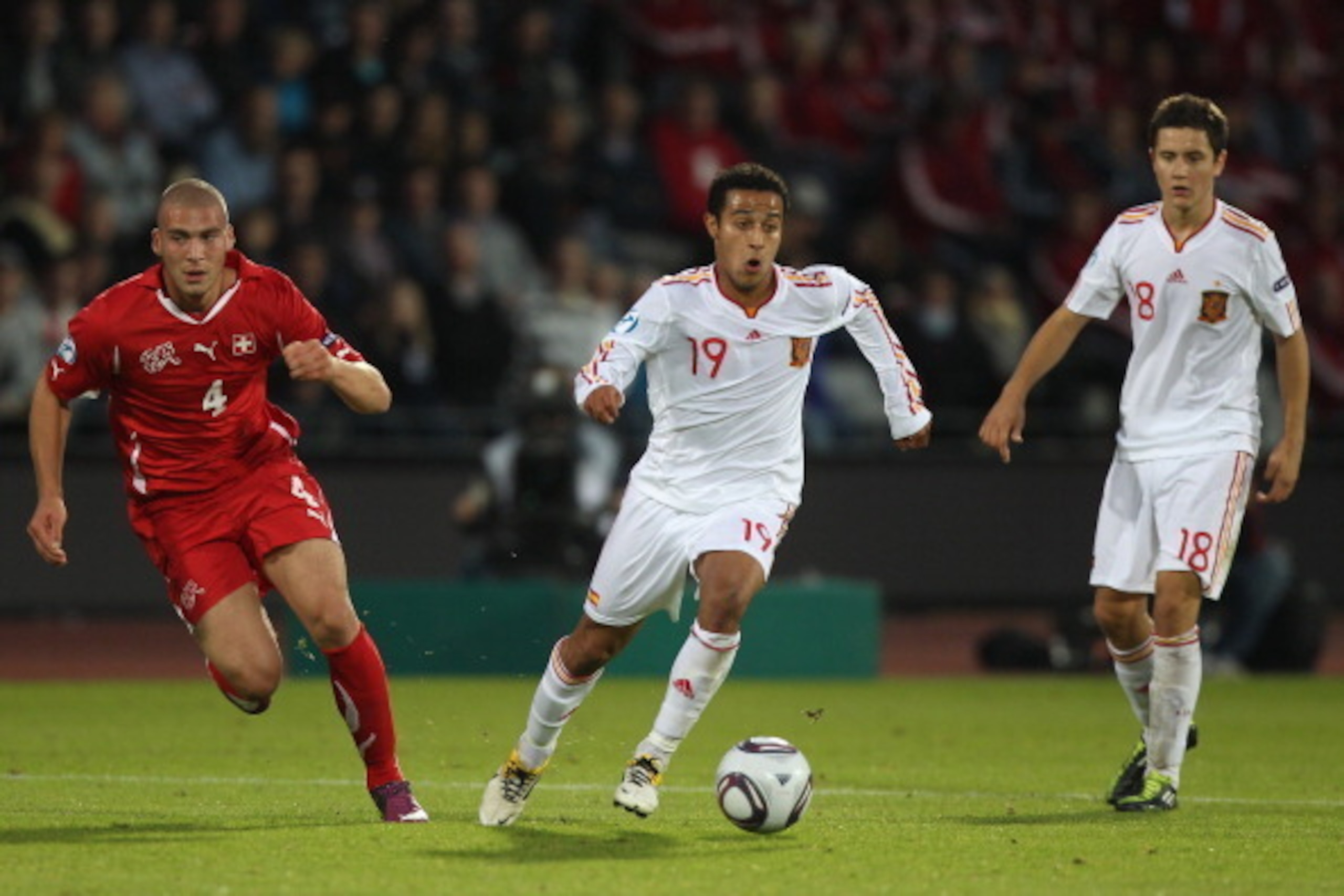
When he returned, he gave notice of his talent—and showed why Manchester United wanted him before he moved to Bayern Munich in 2013—with goals home and away in the 2015 UEFA Champions League quarter-final win over FC Porto. He made 27 Bundesliga appearances this season in the Bavarians' latest romp to the Bundesliga title but was regularly rotated in the midfield.
Now that Pep Guardiola has left Bayern and joined Manchester City, there's been speculation that Thiago might want to make the same move, though the German newspaper Bild (h/t Joe Mewis of the Mirror) quoted him saying, "There is no truth in the rumours saying I will follow him."
As for Rafinha, the Brazilian FA relaxed their rules on early-years training and called him up last September. He scored in his second appearance, a 4-1 win over the United States.
Valeria told Faro de Vigo that Rafinha is responsible and more like her, more Brazilian in his outlook. Thiago is the more introverted of the two, and is a typical older sibling.
Football association rules aside, that might be an indication the brothers are where they should be: Thiago playing for Spain and Rafinha for Brazil.
After missing Spain’s last two tournaments, this is Thiago’s chance to begin to make his mark on the international stage. That he has the chance to do so is not just down to Mazinho’s genes.
Except as noted, all quotes obtained firsthand. Thanks to Federico Bassahun for translation help.
.png?w=2560 "Ranking the Best Shooters of All Time 🎯")



.jpg?w=2560 "Jettas Talks Vikings QB Battle 🗣️")