Buying or Selling the Draft Decisions for Some of CBB's Top Stars
To go pro or not to go pro—it's a decision every college basketball player must make at this time of year.
The NBA is the ultimate goal for every player, and for the best of the best, the opportunity to declare early for the draft is hard to resist. Thanks to a change in NCAA rules that now allows players to "test the waters" after each year with the ability to back out, the number of draft declarations is through the roof.
According to NBC Sports' Rob Dauster, almost 100 players have put their name up for consideration with the deadline to declare looming on April 24.
Here we're only weighing in on the decisions of players who have either signed with an agent (thus ending their college career) or announced their intention to return to school. Those who haven't gone public with their decision or who have declared but didn't go the agent route are still TBD in our book.
Those who don't sign with an agent can withdraw their name from consideration by May 25, 10 days after the NBA Draft Combine ends.
We've also stayed away from some players who were considered locks to turn pro after this season, such as Providence's Kris Dunn, Duke's Brandon Ingram and LSU's Ben Simmons, and who did nothing during 2015-16 to make that likely predetermined decision an unwise one.
Grayson Allen, Duke
1 of 11
Staying or Going: Staying
Had Grayson Allen opted to turn pro, no one would have questioned the decision based on his effort. He's a high-energy player who no doubt would have been drafted and made the most of what limited minutes he earned as a rookie in the NBA or thrived in the Development League, where he could ball out without reproach.
Or he could return to Duke for another year and focus on improving on defense, which he'll need to do to hang around in the NBA as anything more than a relief option.
Allen averaged 21.6 points per game in 2015-16 as a sophomore, with his points coming from all over. He shot better than 50 percent on twos and 41.7 percent on threes while getting to the line seven times per game, never afraid to draw contact. But that's also the way he defended, resulting in an ugly 107.6 defensive rating.
Duke coach Mike Krzyzewski isn't known for preaching lockdown defense, but another year at the college level can provide Allen a more comfortable environment in which to get better.
The Verdict: Buying
Dwayne Bacon, Florida State
2 of 11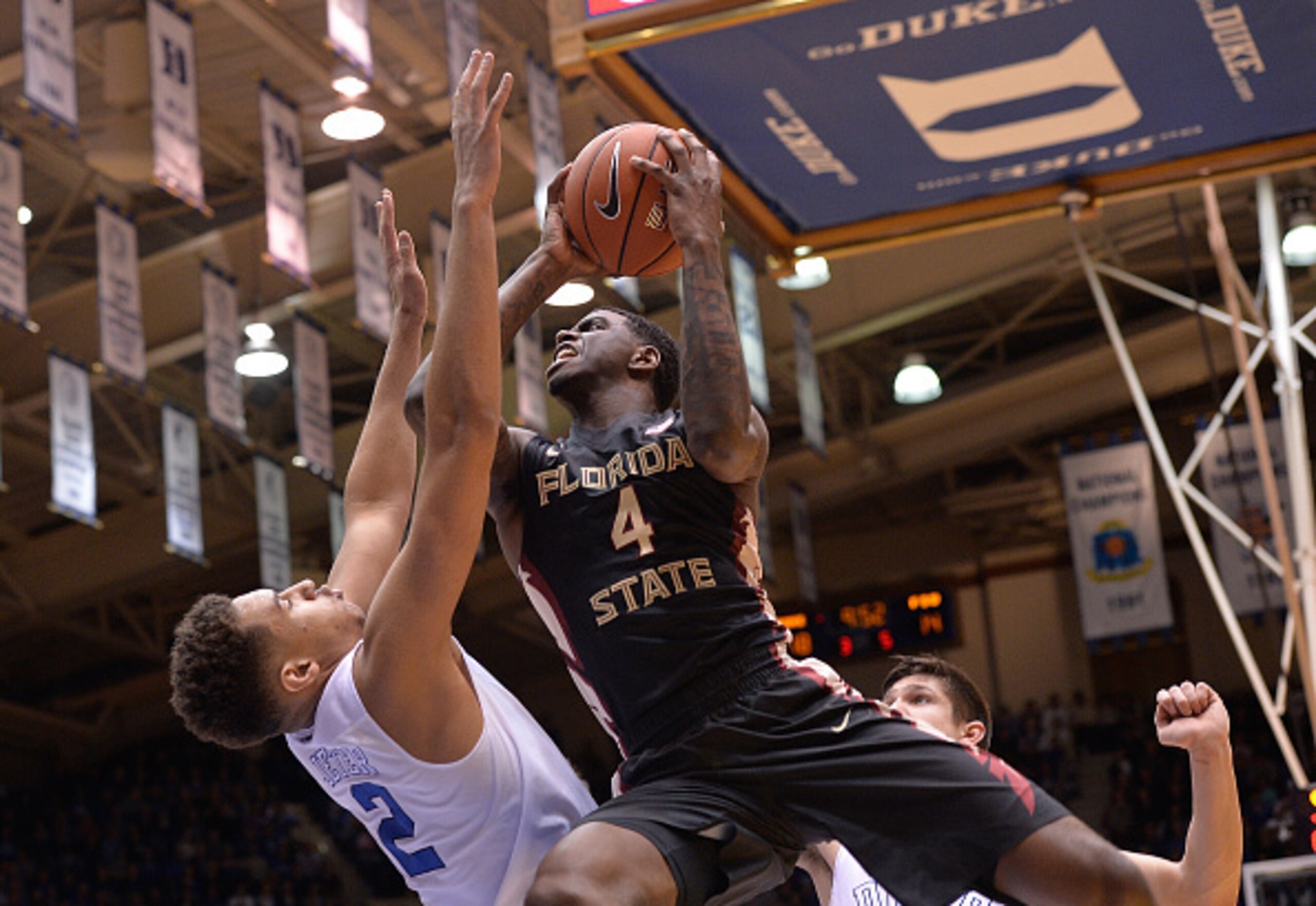
Staying or Going: Staying
Dwayne Bacon was part of one of the best freshmen duos in the country, pairing with Malik Beasley to score 31.4 points with 11.1 rebounds per game. They were two of the 15 freshmen in Division I to average 15 points and five rebounds in 2015-16, per Sports-Reference.com, and the only ones who were teammates.
But while Beasley declared for the NBA draft and signed with an agent, Bacon pulled out of consideration in late March. Per a statement on Twitter, he did so to help Florida State reach the NCAA tournament—the Seminoles went to the NIT in 2015-16.
"I look forward to maturing and becoming a better player this spring and summer," Bacon wrote.
By coming back, the 6'7" Bacon will be able to show he can be just as good on his own as he was playing alongside Beasley. And if he can get the 'Noles into the NCAA tourney, that figures to help his stock, though not as much as becoming a more efficient scorer will. He shot 44.7 percent overall but just 28.1 percent on 114 three-point attempts.
The Verdict: Buying
Thomas Bryant, Indiana
3 of 11
Staying or Going: Staying
All but one of the 14 freshmen who entered the 2015 NBA draft ended up getting picked, a pretty strong success rate. Eight of those were lottery choices, and all 13 were taken in the first round.
There's no guarantee the same will happen this year, and Thomas Bryant decided not to take any chances. Wanting to be a lottery pick but projected by an anonymous NBA executive, per ESPN.com's Jeff Goodman, to "likely be a back half of the first-round guy" had he entered the 2016 draft, Bryant is instead returning to Indiana for his sophomore year.
That's great for the Hoosiers, who have seen far too many of their promising young players jump ship and are losing top scorer Yogi Ferrell. They could also lose junior Troy Williams, the second-leading scorer, if he doesn't pull out of the draft. Assuming that happens, Bryant will become a much larger part of the offense than he was this past season.
He averaged 11.9 points per game and shot 68.3 percent, including 70.7 percent on twos. Few of his shots came outside the paint, so unless Indiana plans to run its offense through the post, there's not much room for Bryant to grow, and there's no assurance he'll be able to replicate his freshman efficiency.
The Verdict: Selling

Deyonta Davis, Michigan State
4 of 11
Staying or Going: Going
The first Tom Izzo-coached one-and-done player since Zach Randolph in 2001, Deyonta Davis had a freshman year similar to Z-Bo's. And Davis could someday have as productive a pro career as Randolph, who didn't do much in his first two NBA seasons before becoming a star.
That's what whoever ends up drafting Davis relatively early—DraftExpress has him going 13th overall, while ESPN.com's Chad Ford lists him at No. 15—is hoping will happen, because to this point, all Davis has going for him is upside. The 6'10", 242-pound freshman's numbers (7.5 points, 5.5 rebounds and 1.8 blocks in 18.6 minutes per game with a 59.8 percent field-goal rate) were good but not outstanding.
Davis started 16 of Michigan State's final 17 games, but he was still second fiddle on the interior to senior Matt Costello. Had he come back, he'd have been able to show what he could do without backup, but instead he'll need to develop under less forgiving conditions in the pros.
"He is just starting to tap his true potential," Izzo said in a statement, per Jeff Eisenberg of Yahoo Sports.
The Verdict: Selling
Kay Felder, Oakland
5 of 11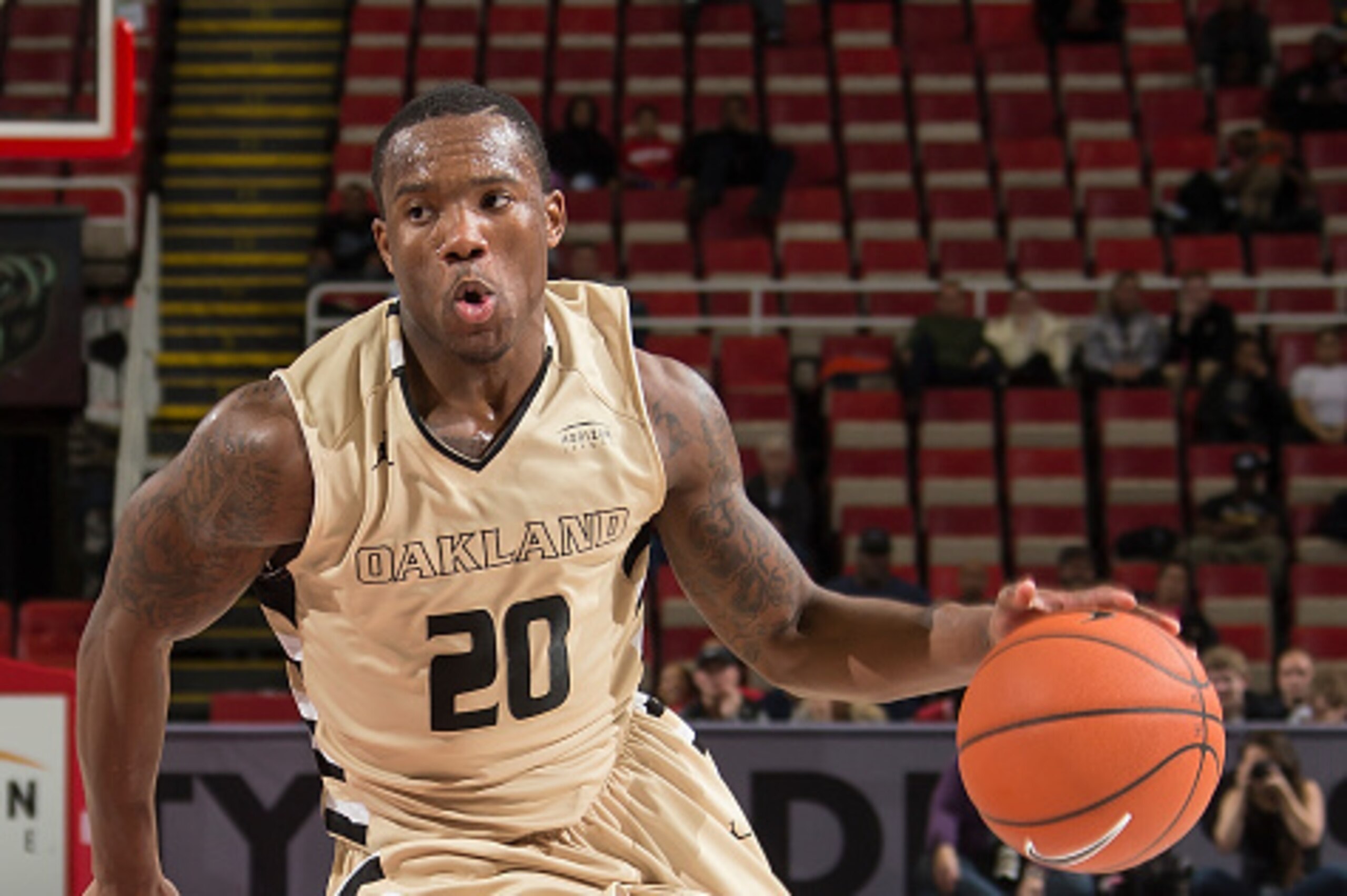
Staying or Going: Going
The only people in college basketball who aren't sad to see Kay Felder go are those associated with Oakland's opponents in the Horizon League and anyone else who was in line to face the Golden Grizzlies in 2016-17. Everyone else is going to miss one of the most exciting players in the game.
The 5'9" guard averaged 24.4 points and 9.3 assists as a junior, ranking third and first, respectively, in the country in those categories. The only player in Division I to score more points in 2015-16 was Oklahoma's Buddy Hield, though the 947 points Felder produced either himself or through his passes were tops in the nation.
Felder is one of eight players since 1994-95 to average better than 20 points and seven assists in a season, and not surprisingly, most of those guys were 6'0" or shorter. Only J.J. Barea (who did it twice) and Damon Stoudamire parlayed such college production into a solid NBA career, but other diminutive players like Nate Robinson and Isaiah Thomas have made it thanks to their boundless energy and drive.
Though he's already shined on TV, Felder is the kind of player who will look even better at the combine and in team workouts. He may not get drafted, but the same would probably be the case after graduating, and he's going in with plenty of momentum off a monster season.
The Verdict: Buying
Brannen Greene, Kansas
6 of 11
Staying or Going: Going
NBA teams make their own determination on things like character and attitude when they interview a player during the draft process, so what happened during his college years probably won't matter. That could work in Brannen Greene's favor, since it felt like he spent the entirety of his three seasons at Kansas in coach Bill Self's doghouse and never got to fully develop as a player.
The Jayhawks played 109 games from 2013-16, and Greene wasn't involved in 16 of those. He failed to log 10 minutes in 41 of 93 appearances, including 12 this past season, when he also served a five-game suspension for attitude issues. After dunking in the final moments of a blowout win over Kansas State, he played just one minute the following game.
For his career, the 6'7" guard averaged just 4.6 points per game while shooting 42.2 percent from three-point range. As a junior, he made 31 of 63 threes—the skill that he'll need to rely on to make it at the next level.
Wanting to leave Kansas is understandable, but transferring elsewhere for his final season of eligibility was apparently never an option. His father told Eisenberg that "he wanted to be known as a former KU basketball player."
Greene might have been better off either sticking it out with Kansas, or, if that wasn't an option, going to another school where he could flesh out his entire game. Instead, he'll have to get by on a three-point stroke that came and went throughout his career.
The Verdict: Selling
Daniel Hamilton, Connecticut
7 of 11
Staying or Going: Going
The strength and flaw of this past season's Connecticut team was that it didn't have that one guy opponents had to worry about going off. Four Huskies averaged between 12.3 and 12.8 points per game, though all were just as capable of scoring in single digits as they were of putting up 20-plus.
Daniel Hamilton was supposed to be that explosive player, one who had a solid freshman year that figured to serve as a springboard for 2015-16 and then the NBA. Yet the 6'7" wing sort of skipped that middle step and thus is heading into the draft with a weak recent resume.
He averaged 12.5 points, 8.9 rebounds and 4.7 assists after going for 10.9 points, 7.6 rebounds and 3.7 assists as a freshman. However, his shooting percentage remained woeful at 38.7 percent, and he dipped to 33.1 percent on three-pointers after making 34.3 percent the year before.
Hamilton was better at the end of the season, averaging 16.9 points, 8.9 rebounds and 3.4 assists on 42.6 percent shooting and 37.8 percent from beyond the arc over his final eight games, but that stretch couldn't have been what prompted him to declare and sign with an agent. This feels like a predetermined move, one he wasn't willing to sway from even with the lack of momentum.
The Verdict: Selling
Skal Labissiere, Kentucky
8 of 11
Staying or Going: Going
Speaking of foregone conclusions, we challenge you to find a legitimate expert who expected Skal Labissiere to play more than one season at the college level. His decision to turn pro was as unsurprising as those of Brandon Ingram and Ben Simmons, even after he had one of the most disappointing seasons of a top high school prospect in recent memory.
That wasn't going to change anything, though. Labissiere was at Kentucky only because he had to be, and in hindsight, he'd have been better off following the path taken by Thon Maker (who spent a fifth year at a prep school before entering this year's draft). That way, he'd have been able to avoid having his noticeable flaws exposed at the college level.
Instead, Labissiere is entering the draft process with his stock on the way down. DraftExpress has him going 10th overall, which is still high, but most mock drafts had him as a top-three or -four pick prior to the season. That was before he averaged 6.6 points, 3.1 rebounds and 1.6 blocks in 15.8 minutes per game, regularly getting knocked off his spot while defending or setting up for a rebound.
The 6'11" Labissiere wasn't strong enough for the college game and won't be physically prepared to compete in the NBA for at least another year or two, but even with his struggles at Kentucky, he's still considered a major prospect. Some team is going to give him a lot of money to try to live up to his potential, and if he doesn't get there, he'll at least have gotten paid.
The same can't be said if he stayed at Kentucky another year and failed to improve—or, even worse, if the Wildcats' next batch of frontcourt players bypassed him in the rotation.
The Verdict: Buying
Domantas Sabonis, Gonzaga
9 of 11
Staying or Going: Going
Domantas Sabonis is the son of a former NBA player, arguably the best who has ever come from Lithuania. But while Arvydas Sabonis didn't come to the U.S. until he was 31 (and had played 14 years in European pro leagues), Domantas Sabonis honed his skills the last two seasons at Gonzaga to get himself ready for the next level.
And that two years was more than enough to show that the son will probably have a much longer NBA career than the father, who played seven seasons for the Portland Trail Blazers.
The 6'10", 231-pound Sabonis averaged 17.6 points and 11.8 rebounds per game this past season, helping the Bulldogs reach the Sweet 16 for the second year in a row. He shot 61.1 percent after shooting 66.8 percent as a freshman, though he nearly doubled his field-goal attempts. Sabonis also fixed his foul shooting, which was his biggest shortcoming, going 76.9 percent from the line in 2015-16.
If he had been 19-year-old coming straight from Europe, Sabonis would likely be a candidate to be "stashed" overseas or worked in slowly during his rookie year. Instead, he is one of the more NBA-ready players among underclassmen, the kind who probably won't start but will serve as a valuable and versatile frontcourt player.
The Verdict: Buying
Allonzo Trier, Arizona
10 of 11
Staying or Going: Staying
Allonzo Trier was the No. 13 player in the 2015 recruiting class, according to 247Sports' composite rankings. The dozen prospects above him have either declared for the NBA draft or are expected to, and seven have signed with agents. Had Trier opted to declare, he'd have gone full bore without any consideration to return.
"I’m an all-in type of person," Trier said, per Ryan Kelapire of SB Nation. "If I decide to do something, I’m going to put my all into it, and I didn’t want to be one foot out the door, and one foot in with this university and this basketball team. … If I didn’t want to win and come back to be a leader and try to bring this team to a Final Four, I wouldn't be here."
That's a heady and mature response for a player who could have been a first-round pick had he left after his freshman season, one that saw him average 14.8 points per game on 46.6 percent shooting. His response also shows he already knows what he has to work on in his game and didn't need to go through an evaluation process to find out.
The 6'4" guard averaged 7.7 free-throw attempts per 40 minutes, showing a willingness to go into traffic to score. That aggressiveness may be the way he separates himself from the pack on next year's Arizona team, one that's bringing in four 5-star prospects, including three on the perimeter.
The Verdict: Buying
Stephen Zimmerman, UNLV
11 of 11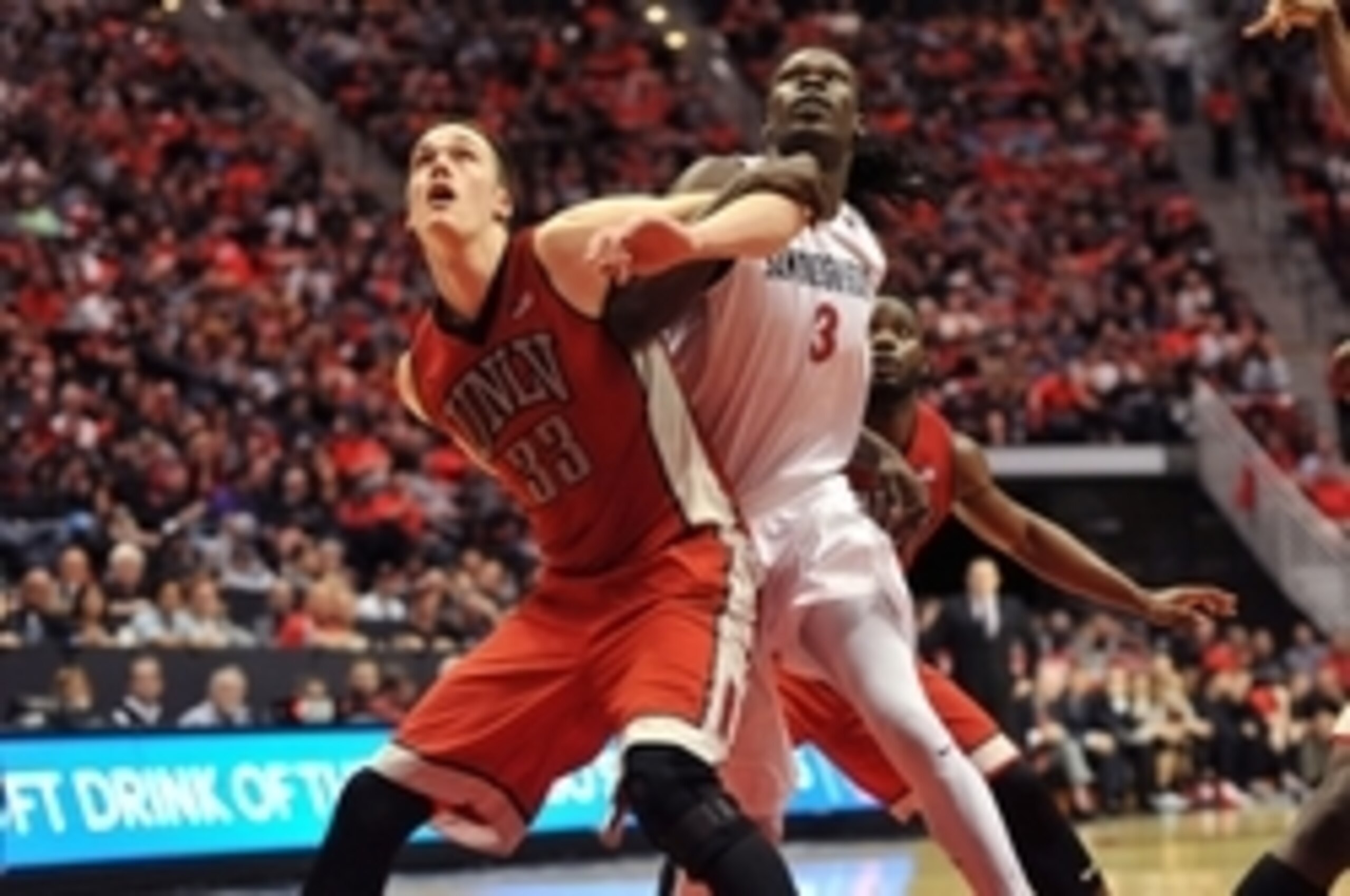
Staying or Going: Going
It took a midseason coaching change for Stephen Zimmerman to become a regular part of UNLV's offense, but by then, the Runnin' Rebels were already on their way toward a disastrous season. It's not surprising the 7'0" freshman center bolted as quickly as he could, almost as if he knew further program drama was on its way.
Zimmerman declared March 28, the day after Chris Beard accepted the vacant head-coaching position and 18 days before Beard then left to take the Texas Tech job.
It's understandable that Zimmerman didn't want to be part of whatever UNLV is going to be in 2016-17, but it would have helped if he'd showed a little more during his brief college career. He averaged 10.5 points and 8.7 rebounds on 47.7 percent shooting, though most of his double-digit scoring games came after Dave Rice resigned and was replaced in early January by assistant Todd Simon.
Zimmerman is a late first-round pick in DraftExpress' projections, which could put him in line to be taken by a team currently in the NBA playoffs. That makes a stint in the NBA D-League possible, which in many ways might be like another year at the college level.
The Verdict: Selling
All statistics courtesy of Sports-Reference.com unless otherwise noted. All recruiting information from 247Sports unless otherwise noted.
Follow Brian J. Pedersen on Twitter at @realBJP.

.jpg?w=2560 "Chiefs, Steelers Eye WR Trades")