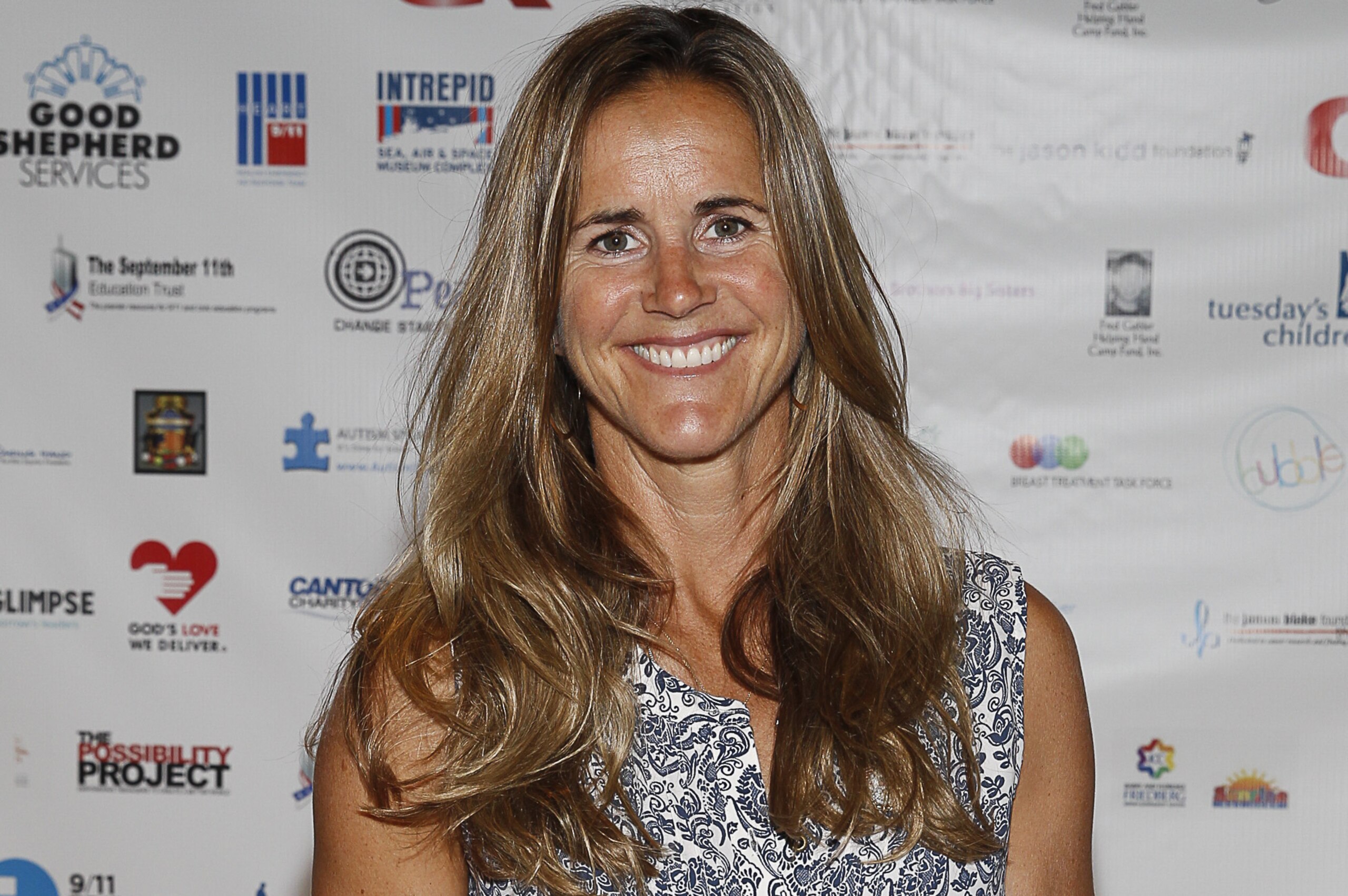

Brandi Chastain Announces Decision to Donate Brain to CTE Research
Brandi Chastain, one of the most influential and recognizable figures in the history of women's soccer, announced Thursday that she has agreed to donate her brain to Boston University for research related to chronic traumatic encephalopathy (CTE).
According to John Branch of the New York Times, Chastain's brain will aid in researchers' attempts to definitively prove that heading the ball can lead to brain trauma.
CTE can only be detected in brains of the deceased, and it has never been found in the brain of a female athlete. Per Branch, the 47-year-old Chastain is hopeful that her donation can help make a long-lasting impact on the research of brain injuries:
TOP NEWS
Broadcaster sorry for false LeBron rumor
Peyton Manning's Son's CFB Offers

Stephen A. Apologizes After Lane Johnson Comments
"If there's any information to be gleaned off the study of someone like myself, who has played soccer for 40 years, it feels like my responsibility — but not in a burdensome way. People talk about what the '99 group did for women’s soccer. They say, "Oh, you left a legacy for the next generation." This would be a more substantial legacy — something that could protect and save some kids, and to enhance and lift up soccer in a way that it hasn't before. That was the impetus for saying yes. If we can learn something, we should. And I won't need it.
"
Chastain is most famous for her World Cup-clinching goal in a penalty shootout in 1999 for Team USA against China. Her jersey-ditching celebration remains one of the most memorable in the history of sports as well.
According to Branch, Chastain believes she suffered multiple concussions over the years:
"There are definitely days when I turn a corner and I'm like, "Why did I come into this room?" I have definitely, from time to time, thought, "Hmmm, I wonder if this is connected to the past 40 years of playing sports." Soccer wasn't the only thing I played. It's crossed my mind. I do wonder about the ramifications over the next 20 years when I should be fully functioning and still doing things I like or want to do. I try not to get hung up on those things, because it doesn't really matter at this point. You just don't know.
"
While CTE research has seemingly come a long way among male athletes, particularly in football, Chastain's decision could prove to be a game-changer.
In addition to increasing awareness surrounding head injuries in soccer, she may prove to be the flag-bearer for female athletes in that regard as well.
CTE discussion seems to have a greater impact on the general public when big names are involved, and due to her standing in women's soccer, Chastain has an opportunity to help improve safety measures for future players for many generations to come.
Follow @MikeChiari on Twitter.
.jpg?w=2560 "Vikings Football")
.jpg?w=2560 "Cowboys Texans Football")

.jpg?w=2560 "5 NFL Players Getting Trade Buzz")