

Assessing Each of the Premier League Top 4's Biggest Tactical Weakness
The Premier League title surge, it seems, is going to be a four-horse race. If we rule out Manchester United on account of their being both 12 points off top spot and perennially on the cusp of implosion, we’re able to whittle it down to a quadruple of sides.
Leicester City, the leaders, lost on Sunday against third-placed Arsenal, though who knows how that game would have ended up had Danny Simpson not got himself sent off early in the second half—the Foxes were 1-0 up when the numbers were even.
Tottenham Hotspur catapulted themselves into the race with an exceptional 2-1 victory over Manchester City later that day—following in the footsteps of Leicester, who won 3-1 at the Etihad Stadium the weekend before—and represent arguably the most reliable side in the division.

.jpg?w=2560 "Cardinals Giants Football")
.jpg?w=2560 "Jets Dolphins Football")
There are still 12 games to play, so there’s plenty of time for these clubs to tango when it comes to swapping league positions. With just six points separating first and fourth, it genuinely is anyone’s game.
We’ve heard all about the strengths of these teams; from Tottenham’s multifaceted approach play to Leicester’s killer channel runs, the positives have been exhaustively listed. What, though, is the biggest weakness each team exhibits? What should each manager be concerned about—and attempt to shore up—as we enter the home straight?
4. Manchester City: Poorly Protected Centre-Backs
Playing centre-back for Manchester City can’t be fun. Much is made of their reliance on Vincent Kompany, but even with him in the lineup they can be carved open—it’s just that he’s the one most able to make the last-ditch intervention to preserve a clean sheet.
The defensive line’s openness and outright vulnerability is not a new problem, and before this season, when Kompany was enduring a horrid 18-month stretch of form, it was made to look even worse in patches because of the Belgian’s errors. He’d continually step out and miss challenges, creating a bigger hole, but he’s regained the ability to locate the ball.
Still, the chances are coming, and it’s because the line isn’t protected properly. Manuel Pellegrini won the Premier League in his first season in charge, 2013-14, thanks to some wonderful free-flowing football. But from the second campaign onward, teams have cottoned onto the space they leave in front of the defence.

Fernandinho has been fantastic this season, but a combination of his midfield colleagues’ slack efforts and Pellegrini’s bizarre tactical twists have left him with a lot to do. It isn’t that difficult to counter-attack City, and Fernandinho can only cover one half of the pitch (or one man).
When City matched up with two in midfield against Leicester, N’Golo Kante tore them to shreds. When City went on the attack against Everton in the Capital One Cup semi-final, Nicolas Otamendi travelled 40 yards from goal to confront Ross Barkley—only to go to ground, create a gap and allow him to find the bottom corner.
Questions over Yaya Toure’s work ethic prevail—perhaps that’s why Pellegrini moved him into the No. 10 position against Tottenham—while Fernando cannot put together a consistent 90 minutes, let alone a stretch of games.
If you hack away at City’s centre, you’ll find it surprisingly soft and inviting.
3. Arsenal: Low Balls in from Byline Area; Stretching FB/CB Channel
The obvious way to get at Arsenal is to counter against them, but that’s a bit vague. Looking at the chances they’ve conceded over the last month or so, there’s a particular type of attack they are guilty of allowing over and over.
The Gunners push their full-backs high to maintain width, with Hector Bellerin’s speed a threat in behind on the right flank and Nacho Monreal’s excellence in possession making him a superb outlet. Arsenal average 55.8 per cent possession in the league, per WhoScored.com—just 0.2 percent off category leaders Manchester United—and they build slowly, averaging the highest number of build-up passes (293) per goal.
Leicester City, AFC Bournemouth and Southampton have all, in succession, found joy in the channels between Arsenal’s full-backs and centre-backs. It’s not necessarily a case of exposing Per Mertesacker’s lack of pace but launching runners in behind into the spaces the full-backs leave.
The way Arsenal’s central defenders react shapes the way attacking moves pan out. Laurent Koscielny is especially adept at filtering out and defending wide of his usual zone, and Francis Coquelin drops in to protect the centre.
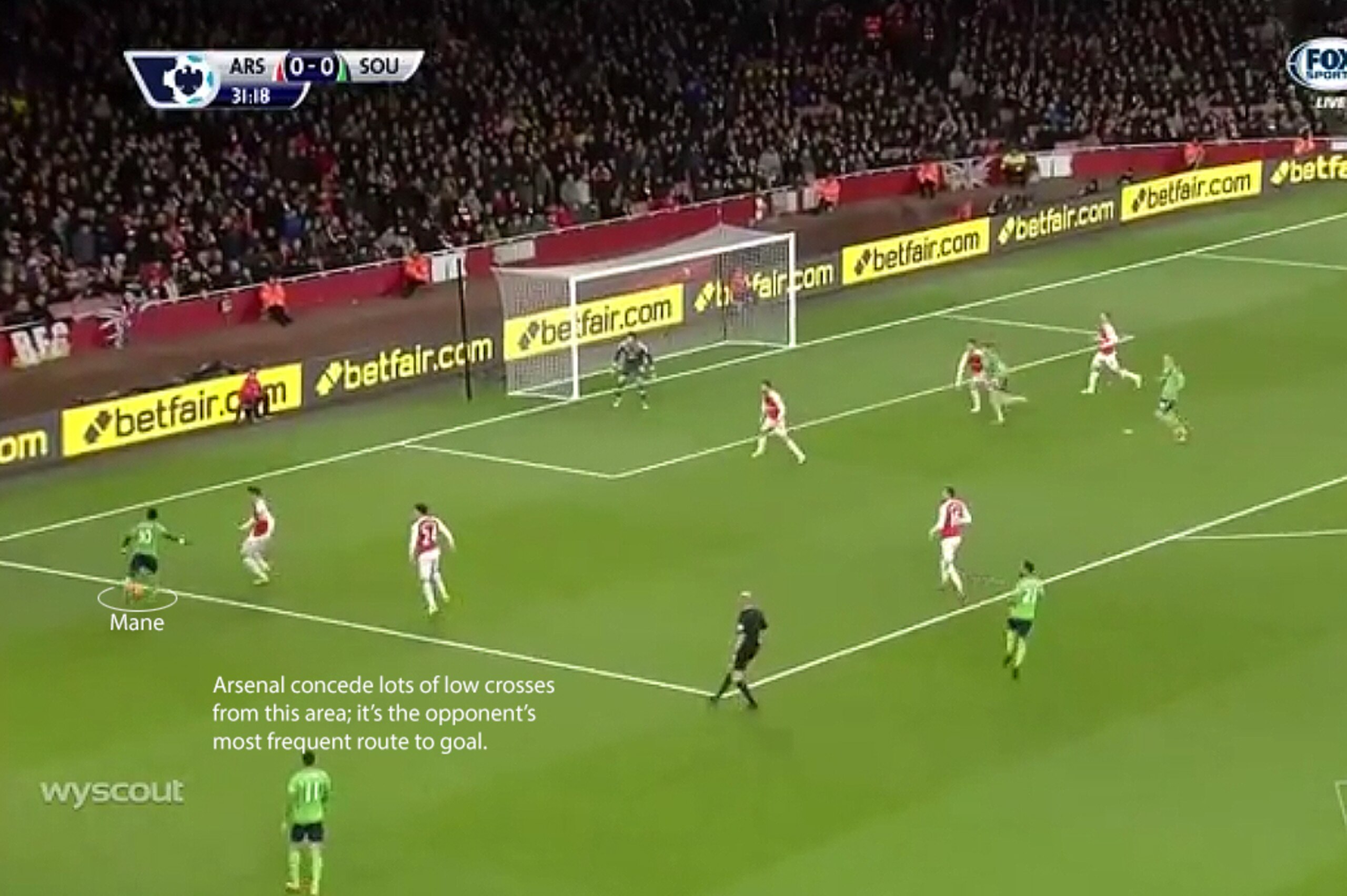
It leaves the winger with space to run into straight ahead but little room to cut in. By the time they’ve reached the box, the full-back has dropped back in to block a U-turn, and there’s really only one route to goal: a low cross into the box from the byline.
Petr Cech is excellent at his near post, so this isn’t a weakness in the sense it’s a method by which Arsenal concede a lot, but it is the way in which they give up the most space, and it is the most reliable route to a chance for the opposition.
2. Tottenham Hotspur: Set Pieces
How to pick apart the league’s best defence? Tottenham have conceded a league-best 20 goals in 26 matches, three fewer than Arsenal and, for comparison’s sake, 30 fewer than league-worst Sunderland and Norwich City.
Toby Alderweireld and Jan Vertonghen have been the division’s best centre-back partnership this season; Kevin Wimmer has been excellent stepping in for the latter. Manager Mauricio Pochettino has four full-backs on rotation to maintain freshness, and Eric Dier provides the sort of steely shield in front of the defence Kompany and Otamendi could only wish for.
But there is a slight weakness to their game, and surprisingly, it comes in the form of set pieces. Balls into the box, be it from corners or free-kicks, have not been convincingly cleared by Spurs for months, and a high percentage of their goals conceded come from them.
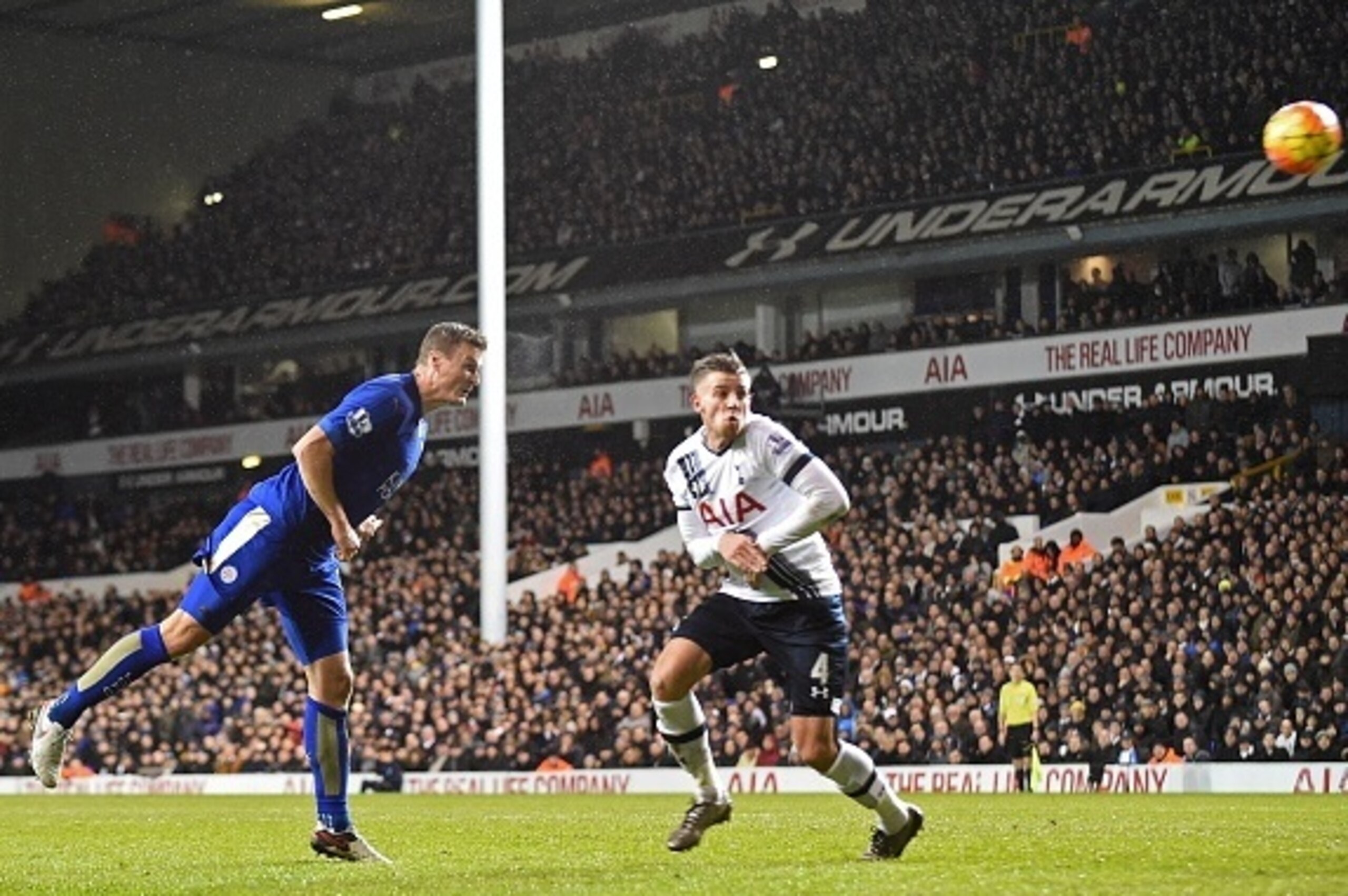
Despite a distinct size disadvantage, Manchester City got their heads to the first ball over and over against Pochettino’s men on Sunday, creating two chances in the process. Leicester’s winner at White Hart Lane in January came from Robert Huth beating Alderweireld in the leap, while Newcastle's Aleksandar Mitrovic bundled home from a free-kick in December.
It’s a strange reality, as Alderweireld and co. are so threatening when attacking set pieces—the Belgian himself either scores or comes close to it in almost every game—but if there is a way to get at Spurs, it’s via this medium.
1. Leicester City: Narrow Defence Invites Crosses
Leicester City’s loss to Arsenal threw up an extremely surprising weakness: They struggle in the air. Olivier Giroud won a whopping 12 aerials against Wes Morgan and Robert Huth, knocking the equaliser down for Theo Walcott to score, and Danny Welbeck headed home the winner in the 95th minute.

The narrow defensive set the Foxes use invites crosses. Under pressure they set up camp just outside their 18-yard line and pull the full-backs in to defend the flanks of the centre-backs.
This, naturally, invites crosses because there is space to be found on the wings. Arsenal swung in 50 crosses, according to WhoScored.com, an abnormally high number when compared to their recent games against AFC Bournemouth (27), Southampton (33) and Chelsea (22).
Leicester’s setup is actually similar to the one Atletico Madrid have used when digging in against pass-happy opponents. Atleti tuck the full-backs in and allow crosses but do what Leicester don’t: win the headers and clear their lines consistently. That's not surprising when you consider Los Colchoneros’ centre-back partnership is Diego Godin and Jose Gimenez.
| Wes Morgan | 57% |
| Robert Huth | 59% |
| Vincent Kompany | 85% |
| Virgil van Dijk | 73% |
| Toby Alderweireld | 57% |
| Jonas Olsson | 73% |
Morgan and Huth, it turns out, don’t rank well when stacked up against other Premier League centre-backs when it comes to measuring aerial efficiency. They are both big, hulking presences, but they’re nowhere near as dominant as you’d think.
They came under increased pressure against Arsenal when their side was down to 10 men, but the defensive approach against the bigger sides is the same. If more sides realise Huth and Morgan—despite appearances—may be vulnerable defending crosses, they may have some joy.
Statistics courtesy of WhoScored.com.
.jpg?w=2560 "Titans Ravens Football")



.jpg?w=2560 "NFL investigating 2 referees for separate viral exchanges")