

The 'Stop Doing That' NBA All-Stars
Though populated by many of the world's best and most versatile athletes, the NBA is still mostly a league of specialists.
Optimizing an offense depends on slotting uniquely skilled players into roles that emphasize their strengths and minimize their weaknesses. Things can go awry when guys drift out of their lanes, though it's not always the fault of the player when inefficiency crops up. Flawed systems, weak support and poor coaching all contribute as well.
Using NBA.com's play-type data from Synergy Sports, it's pretty easy to see who's drifted a bit too far.
TOP NEWS

Pic of LeBron's Helicopter Commute 🚁

Duren Calls Out 'False' Rumors
Trade Idea to Give Warriors Alternative All-Star Upgrade 🏀
These are the players who'd be so much better if they'd only stop doing that one little thing.
Andre Drummond
Post-Up Offense
It sure looks good when it works, doesn't it?
Andre Drummond ranks third in the NBA with 291 post-up possessions, a total comprising 28.7 percent of his offensive touches.
Despite that volume, he's one of the least efficient post-up options in the game, shooting 40.5 percent from the field and averaging 0.73 points on such plays. That's good for 37th among the 41 players who've posted up at least 100 times this season.
Even if dumping the ball down to the block is no longer en vogue, there's still some sense in the Detroit Pistons trying to develop Drummond's post game.
If he were to ever become a threat to draw a double-team, there'd be value for an offense that loves to spread the floor with four three-point threats around the perimeter. Kick-out chances would be plentiful.
Unfortunately, it's difficult to imagine Drummond ever reaching a level of efficiency that might draw a second defender, mainly because any single opponent who gets into trouble can just foul him, putting the NBA's worst free-throw shooter on the line.
Secondly, Drummond doesn't have the look of someone who'll develop the skill and timing to ever make that pass out to the perimeter anyway.
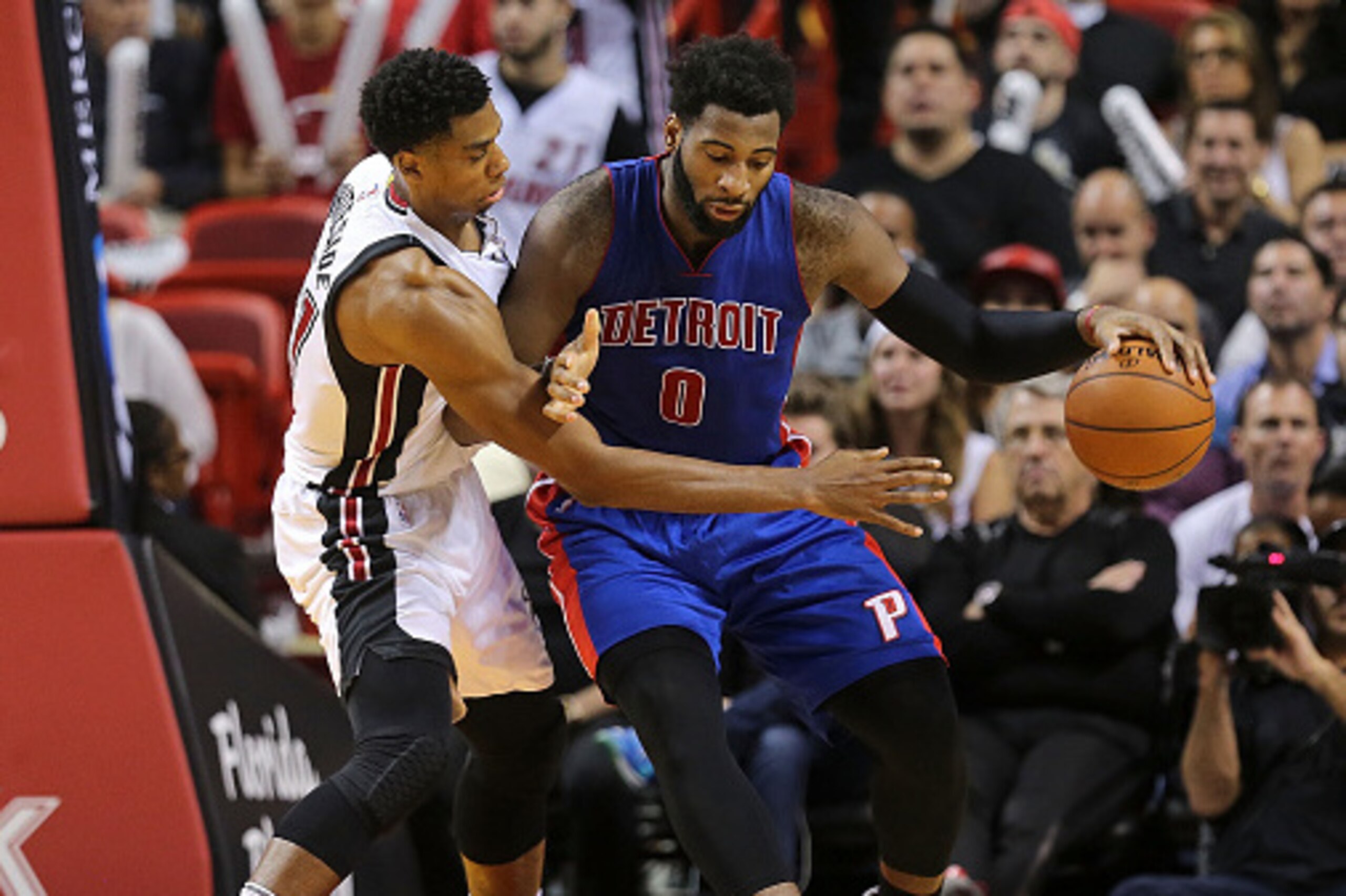
He's attempted 242 shots on his 291 post-up touches this season, which means he's getting rid of the ball about 17 percent of the time.
Particularly frustrating: A simple Drummond pick-and-roll achieves many of the same goals (sucking in the defense, threatening the lane, etc.) with a far higher success rate. The UConn product is a monster as a roll man, ranking third in points per play among high-usage (at least 100 plays) rollers.
He gets fouled a lot in those situations, which isn't ideal. But getting the roll man the ball—something the Pistons do on just 5.7 percent of their offensive plays—could help Stan Van Gundy develop this team into the high-efficiency version of the 2010 Orlando Magic he'd like it to be.
Pick-and-Roll Ball-Handling
We could have picked on Emmanuel Mudiay here, the worst of the high-volume options among pick-and-roll ball-handlers. But the guy's 19 years old, and what else is he supposed to do? A shaky jumper means spotting up isn't much of an option, and a 25.6 percent turnover rate on pick-and-rolls means dishing isn't a great idea either.
Plus, Jameer Nelson has been nearly as bad, which suggests maybe there's something systemically wrong with the Denver Nuggets' scheme or personnel outside of the point guard position.
We'll go with John Wall, who has used 458 plays as a pick-and-roll ball-handler, ranking sixth in the league. But at 0.69 points per play, he's 81st out of 94 players who've logged at least 100 such plays.
That's bad...and kind of confusing. Because he can do things like this:
Wall has speed to spare and tremendous vision, which should help him turn the corner and make efficient plays. But his supporting cast hasn't been all that effective when he's set them up for looks out of the pick-and-roll.
Bradley Beal's sporadic presence in the lineup is a critical factor here, and Washington's spacing hasn't gotten the boost it wanted by downsizing more frequently at power forward.
At the same time, Wall's shot selection is part of the problem. He takes plenty of mid-range jumpers when he keeps the ball, and he's not good at those, hitting 34.2 percent of his shots from 10 to 16 feet. Chris Paul gets away with a similar approach because he shoots 50.7 percent from that same distance.
Wall, who doesn't draw fouls in droves—he has a 4.4 percent shooting-foul rate on pick-and-rolls—can't make a living from the elbows.
The fix here would seem to be better spacing that, in theory, might allow Wall a few more cracks at the rim. As it is, the Wizards get only 0.94 points per spot-up shot, which ranks them in the 31st percentile.
Better supporting marksmanship could help Wall improve his efficiency, but a lot of this is on him. He has to either get to the cup or knock down those in-between shots.
Spot-Up Shooting

The good news is that only about 15 percent of LaMarcus Aldridge's shots come by way of the spot-up. The bad news is that his efficiency ranks 135th out of 137 players who've attempted at least 100 such shots this season.
Part of the problem is Aldridge's reliance on the long two.
He's 0-of-12 from beyond the arc this season, which comes as a bit of a surprise—especially after shooting a career-best 35.2 percent on 105 attempts last year.
With so many jumpers coming inside the three-point line, Aldridge's efficiency is basically doomed.
It's no surprise that his effective field-goal percentage is 37.6 percent on spot-ups this year, though this may be a necessary evil for the San Antonio Spurs, who have to find ways to accommodate a player whose skills require some ball-stoppage.
Post-ups have been highly successful for Aldridge, whose 0.96 points per play rank him in the 80th percentile there. San Antonio would probably like to avoid the even more pronounced stagnancy that results from touches on the block, but that clearly seems like the way to go if getting LMA his shots is a priority.
Of all the "Stop Doing That" players we've listed so far, Aldridge's failings matter the least. On balance, he's posting the third-highest effective field-goal percentage of his career while playing some of his best defense ever.
The guy just won Western Conference Player of the Week.
"Well, LaMarcus is feeling more and more comfortable all the time as the season progresses," Spurs head coach Gregg Popovich told Michael C. Wright of ESPN.com after Aldridge scored 36 points in a Feb. 3 win over the New Orleans Pelicans. "I thought he was magnificent at both ends."
Things are good. But maybe they could be even better if Aldridge would excise the standstill jumpers or fire them from behind the three-point line.
Julius Randle
Isolation
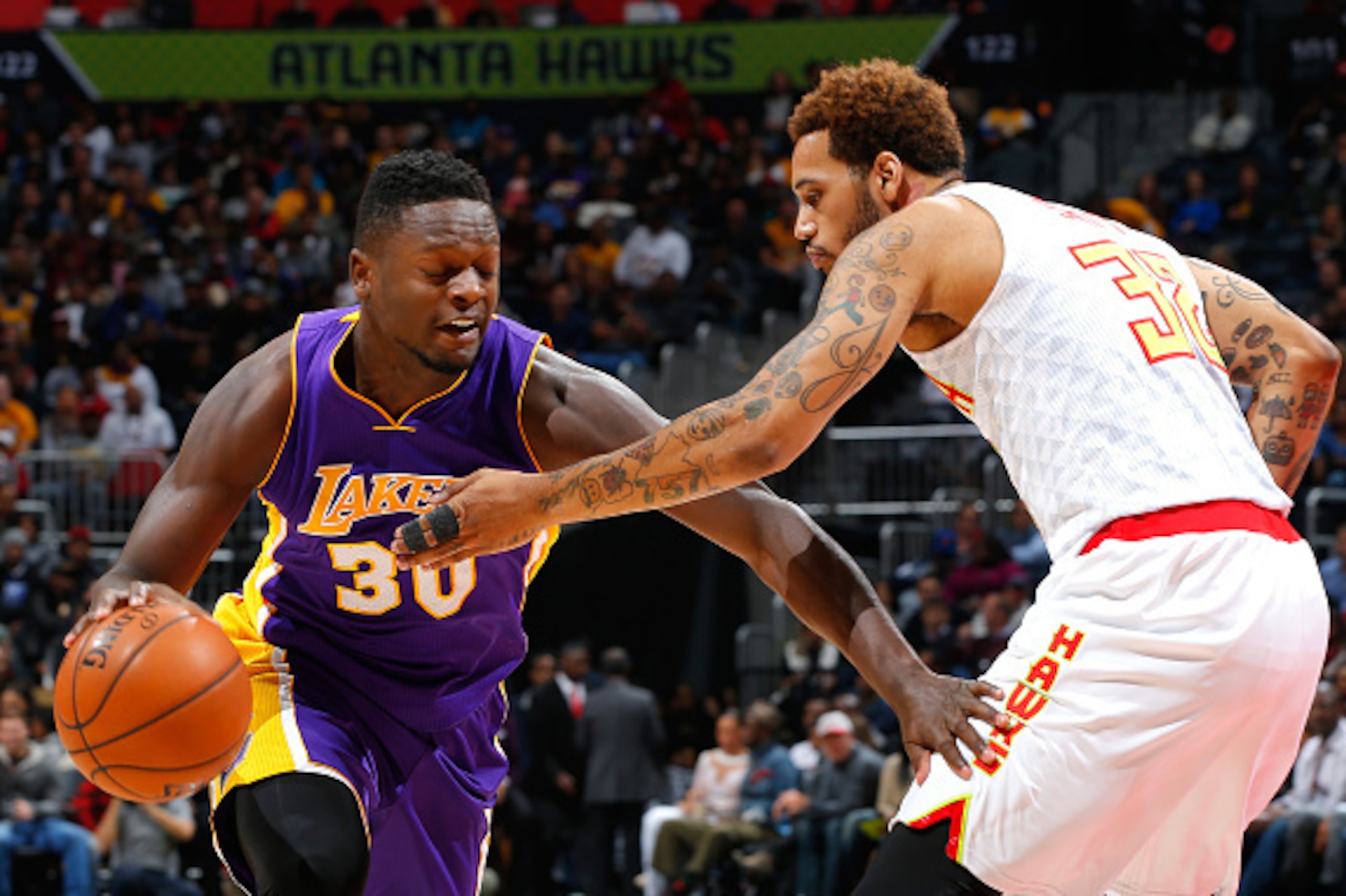
The Los Angeles Lakers rookie ranks ninth in the NBA with 163 isolation plays but sits in the 24th percentile in efficiency with a points-per-play average of just 0.65.
This is a problem for Randle, who has clear value in other areas but devotes—or, given the Lakers' directionless scheming, is allowed to devote—22.4 percent of his plays to iso sets.
Only James Harden and Carmelo Anthony isolate a larger percentage of time.
Isolations are generally inefficient, but part of the issue with Randle is specific. He's extremely left-handed, so opponents can bank on him coming back to his favored finishing hand whether he drives right or left. The result of that predictability is often awkward:
Passing might help, as Randle is quick enough to get into the middle against opposing bigs whenever he wants—or at least it would help if he didn't have more turnovers than assists on the season.
This is far from a hopeless situation. Randle is making progress on a daily basis, according to Mike Trudell of Lakers.com:
Randle is effectively a rookie and should be given a chance to grow. He's obviously gifted as an athlete. If he limited his touches (for now) to cutting, offensive board-crashing and the occasional full-court push in transition, he could ratchet up his efficiency.
Hopefully, whoever's in charge of the Lakers next season will pare down Randle's responsibilities.
Follow @gt_hughes on Twitter.
Stats courtesy of NBA.com and Basketball-Reference.com and are current through games played on Monday, Feb. 8.



.jpg?w=2560 "NFL investigating 2 referees for separate viral exchanges")
.jpg?w=2560 "OBJ Calls Out Giants 😳")


.jpg?w=2560 "Tyreek makes another cryptic post amid Chiefs rumors")
.jpg?w=2560 "Ward Nearly Walks Out of Presser 😳")