Australian Open 2016: Updated Prize Money Payouts from Melbourne
For the fifth time in the last six years, Novak Djokovic is starting his season with a multimillion-dollar bonanza. The world No. 1 took down Andy Murray in straight sets Sunday for his sixth Australian Open title, once again slamming the door on the Brit's quest to win Down Under.
Murray has made the final in Melbourne, Australia, five times, with Djokovic holding him at bay on four of those occasions. The pair has gone head-to-head in the last two finals, with last year's competitive match being followed by a romp in 2016.
Djokovic started out of the gate hot, taking the first set, 6-1, in only a half hour. Murray battled back valiantly in a hard-fought, 80-minute second set that Djokovic ultimately won, 7-5, on a break. The third set followed a similarly competitive nature, but the match was already over; no one's taking three straight sets from Djokovic in Melbourne. He finished things up in a 7-3 tiebreak.


"First of all, I have to pay respects [to] Andy and his team for another great tournament," Djokovic said, per Matt Wilansky of ESPN.com. "You're a great champion and a great person who is very professional, and you'll have more opportunities to fight for this trophy."
| Winner | Angelique Kerber, Novak Djokovic | $3,800,000 |
| Runner-up | Serena Williams, Andy Murray | $1,900,000 |
Djokovic will walk away with a prize of $3.85 million. The men's and women's tournaments pay the same, so Angelique Kerber is also in for the biggest payday of her career. Kerber earned her first major championship Saturday, taking down Serena Williams in a three-set thriller. The German played with an admirable sense of restraint, committing only 13 unforced errors and forcing Williams to beat herself.
Williams, who was looking for her 21st major championship, double-faulted six times and made 46 unforced errors. While she had 47 winners and was the obvious aggressor throughout, Williams' form just wasn't there. Only 53 percent of her first serves went in play, and she actually lost more of her second-serve points than she won.
"It's interesting. I mean, every time I walk in this room, everyone expects me to win every single match, every single day of my life," Williams said, per Jim Caple of ESPN. "As much as I would like to be a robot, I'm not. I try to. But I do the best that I can. I try to win every single time I step out there, every single point, but realistically I can't do it. Maybe someone else can, but I wasn't able to do it."
It'd be an understatement to say Kerber's win was a surprise. Not only did she topple Williams, but she was triumphant in a tournament where she's typically floundered. Kerber had never made it past the fourth round in any of her eight previous appearances in Melbourne.
She was eliminated in the first round last season and was seemingly on her way to the same fate this year. Misaki Doi took the first set and ran Kerber to a tiebreak in the second set before the seventh seed righted her ship just in time to avoid the upset.
“I was with one leg in the plane for Germany," Kerber said, per Nick McCarvel of USA Today. "I take my chance to be here in the final and play against Serena. My dream come true tonight, on this night. My whole life I was working so hard and now I can say that I’m a Grand Slam champion… it sounds so crazy.
“I’m really enjoying this moment right now. This is the best two weeks of my life, my career. I had goosebumps when I was playing on the court."
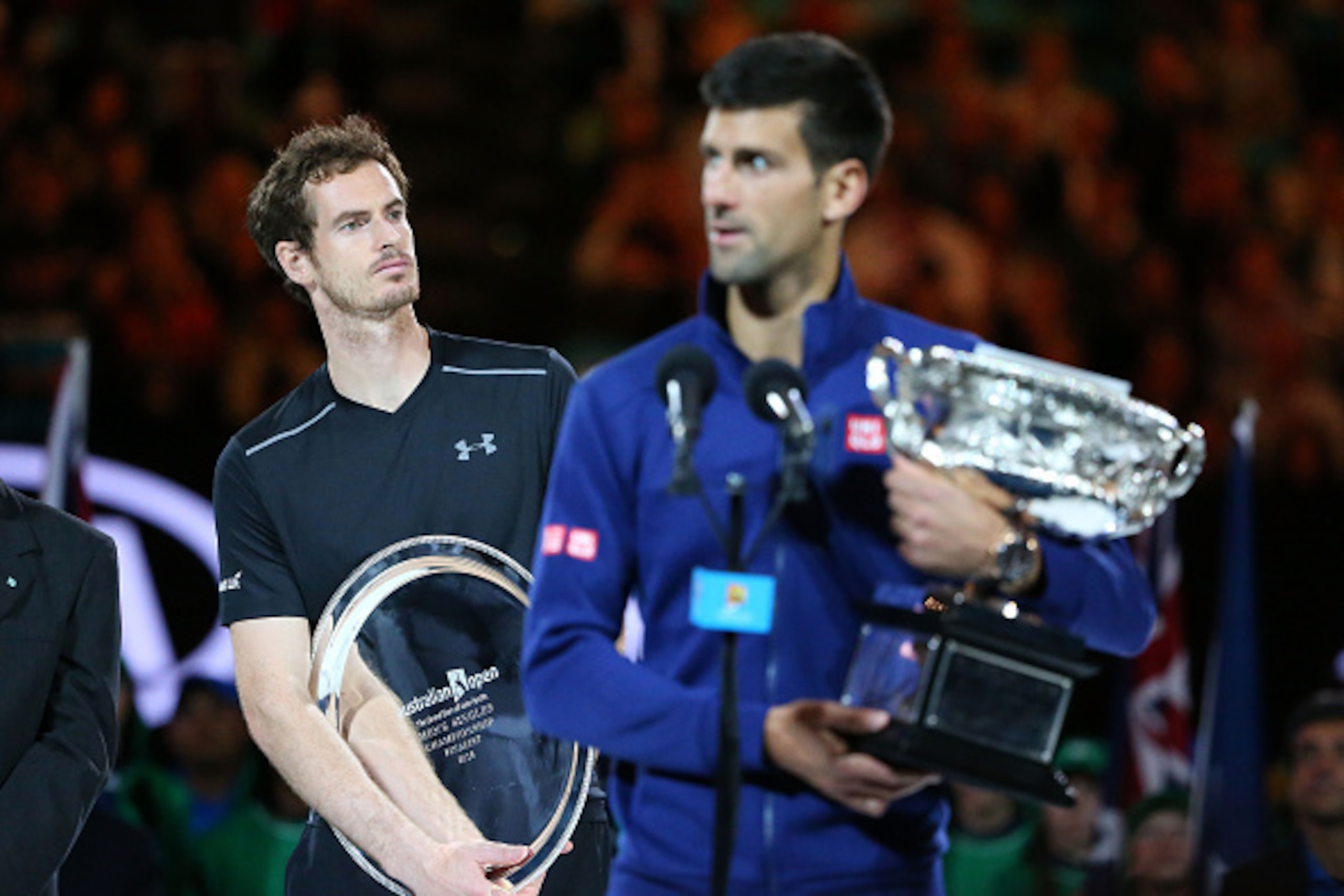
If you're beginning to feel bad for Williams and Murray for missing out, well, don't. Both are still coming home with prizes of $1.9 million, which isn't the worst earnings report in January history. Murray is well-acquainted with those runner-up checks. He's now 2-7 in Grand Slam finals, and you have to wonder how many titles Murray would have taken in a different era.
Barreling toward his 29th birthday, Murray has the unfortunate distinction of being the fourth wheel in the Djokovic-Roger Federer-Rafael Nadal era. That trio ranks among tennis' best players in history. Djokovic's title was his 11th Grand Slam, moving him into a tie for fifth all time. Federer is the all-time leader with 17, and Nadal is tied with Pete Sampras for second with 14.
Murray's two titles allowed him to avoid the Best Who Never Won One moniker, but it's hard not to wonder how he would have fared in an alternate universe.
.jpg?w=2560 "Texans-Mixon Released Football")
.jpg?w=2560 "Commanders Eagles Football")

.jpg?w=2560 "Viral Rams Coach Vid 🖕")

.jpg?w=2560 "Mahomes' Wife Trolls Kubiak 💀")