Houston Texans vs. Miami Dolphins: What's the Game Plan for Miami?
The Miami Dolphins hope to make history on Sunday by defeating the Houston Texans for the first time ever.
This embarrassing factoid comes after seven tries by seven different Dolphins teams. Save for their two meetings in 2011 and 2012, each game has followed the same pattern: one where the game is up for grabs going into the fourth quarter before the Texans capitalize on a few Dolphins mistakes and wind up victorious.
Interesting how this game has followed that same script despite the fact that Miami had a different quarterback in every matchup. In fact, Houston's average margin of victory is 6.7, and it would be a lot lower had it not been for the fact that they defeated Miami by 10 and 20 points respectively in their last two match ups.
TOP NEWS
.jpg?w=2560 "Colts Football")
Jonathan Taylor Landing Spots
.jpg?w=2560 "NFL Paris Football")
NFL House in Paris Closes for Protests (AP)
.jpg?w=2560 "Seahawks Chiefs Football")
Trevon Diggs Cut by Seahawks
It's been three years since the last time these two teams met, and a lot has changed with both teams. Here's a look at the game plan for Miami as they try to finally beat the Houston Texans.
Offensive Game Plan

The names on the Texans defense are scary.
On the front line itself you have Vince Wilfork and J.J. Watt, a scary combination that includes the best nose tackle in the NFL for the last decade and a player who might be this generation's biggest defensive superstar.
The linebackers are a good crew as well, led by Brian Cushing and Whitney Mercilus, featuring Jadaveon Clowney, who is without a sack thus far in 2015 yet per Pro Football Focus looks good with a grade of 9.3 against the run.
The defensive backfield is filled with great talent as well, good enough that first-round pick Kevin Johnson, a player contending for Defensive Rookie of the Year, comes off the bench (he still has accounted for 297 snaps).
This defense, on paper, should be an elite top-10 defense, and they have been for most of this decade.
Yet they're ranked 22nd in the league in points allowed per game at 25.8. They don't tend to allow a lot of yards, though—they're ranked 11th, allowing 348.8 yards per game.
How do you attack this team's defense, one that's as middle-of-the-pack as it gets?
Ball control.

This might seem counter-intuitive when you consider that the Texans are better against the run (allowing 109 yards per game and an average of 3.8 yards per carry) than they are against the pass (allowing 239.8 yards per game and 12 touchdowns), but it also cuts down on risky plays.
Houston's defense is designed to disrupt and produce turnovers. They're not doing that very well, as through six games they have only forced five turnovers for the season, all interceptions. To go six games without recovering a fumble requires a lot of bad luck (Miami recovered two in their last game).
As the Dolphins defense can tell you based off of last week's successful play in Tennessee, it only takes one game for luck to change on defense, which is why the goal should be to minimize it.
First step is committing to the run game like they did last week. We saw how successful the offense is once the run game is clicking, and there's no reason to think that can't happen again against a team that's not too different in terms of scheme.
Second step means protecting Ryan Tannehill. The run game working is one way to do that, the other way would be to play primarily out of a two-tight-end set. Not only should Dion Sims get significant playing time, but Jake Stoneburner should as well when the time comes to sit Sims out for a spell.
Believe it or not, the Texans have only nine sacks on the season, which is only two more than the Dolphins. We all saw how the Dolphins defense played on Sunday, getting six sacks in one afternoon.
Houston is more than capable of doing that, which is why protection should be the main objective.
Defensive Game Plan
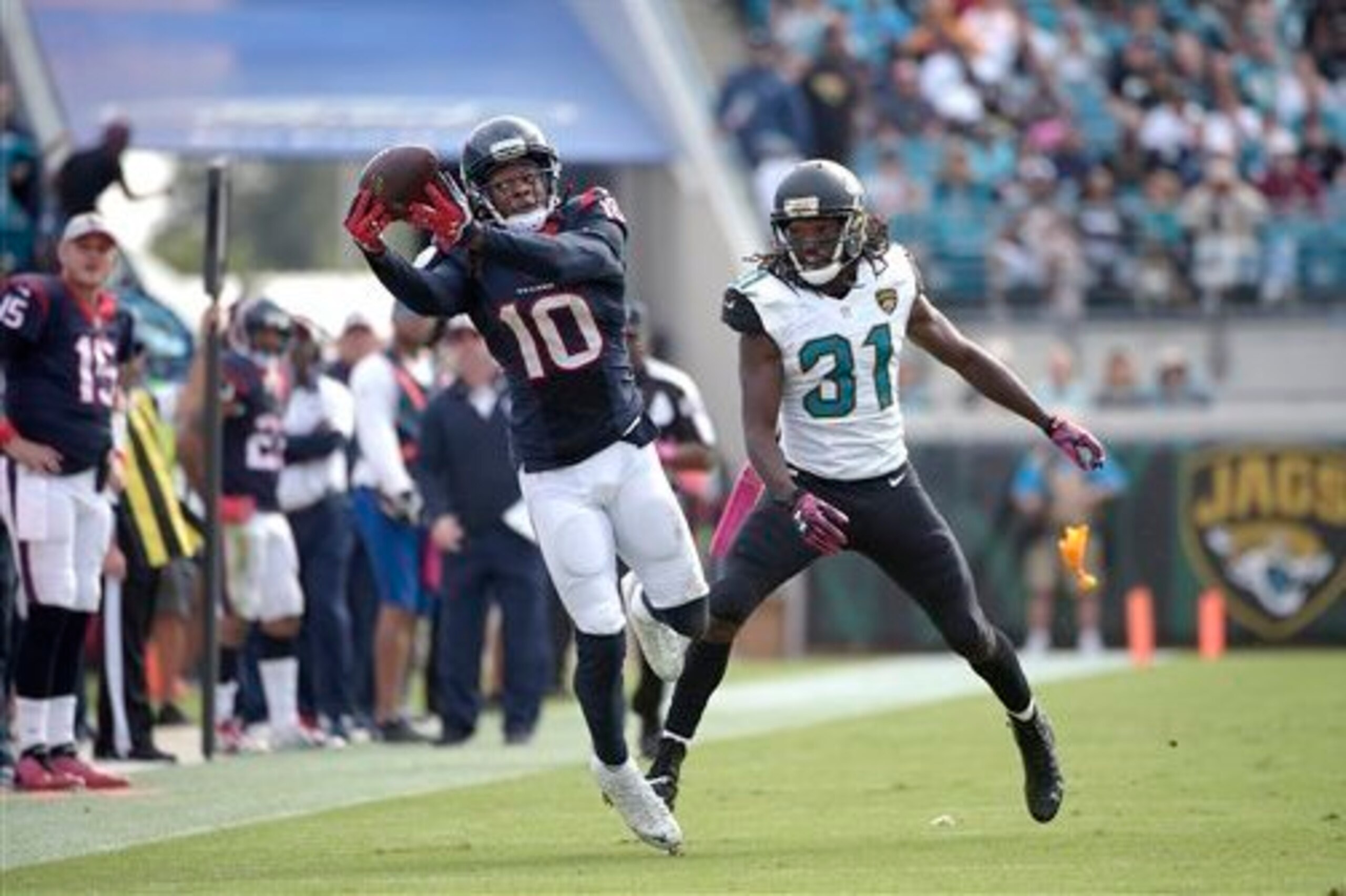
Houston's offense is an explosive one, despite the fact that it's run either by Brian Hoyer or Ryan Mallett.
The Texans rank sixth in yards gained with 393.8 per game, but they only manage to score 21.3 points per game (in fairness, that's still better than the Dolphins).
Houston looks like it has a prolific pass offense but that's because it has had a habit of falling behind early, needing to pass the ball to catch up. A good reason for that is turnovers, as they have 10 for the season—six of them interceptions, four of them lost fumbles.
They do a decent job protecting their quarterback, only allowing 10 sacks. Their main weakness on offense is running the ball, but that might change as Arian Foster works himself back into shape.
Getting to the quarterback will be the challenge, but that will require some help from the secondary. Houston's biggest offensive star is wide receiver DeAndre Hopkins, who leads the NFL in receiving yards and has had four consecutive games of 100-plus receiving yards (with at least 145 yards receiving in the last three games).
If Miami can bring the same physicality up front against Houston that they did against Tennessee, the defense should be able to bring down Houston's offense—an offense that, save for Hopkins, looks like fool's gold when you look at the yards gained.
Key Players and Matchups

The first key player for Houston is DeAndre Hopkins, whom I already mentioned above. The big question for Miami's secondary is who will cover him.
While it would make sense to pin Brent Grimes on Hopkins, Hopkins' size might make that a challenge. Jamar Taylor will get his shot at Hopkins more likely than not, but expect safety help coming from Michael Thomas or even Reshad Jones.
The right side of Miami's offensive line has to be ready for J.J. Watt. The right side already saw an improvement with the addition of Billy Turner, who should help Ja'Wuan James when it comes to blocking not just Watt, but also Jadaveon Clowney (who will likely be coming behind him). This makes Dion Sims more important, as he'll take the right side and will be used to block early and often.
The most important player for the Dolphins will be Ryan Tannehill. His pass attempts will likely be closer to the 29 he attempted against Tennessee than the 40-plus he attempted in previous games, but those passes have to have an impact. He also can't afford to get his passes tipped at the line (a problem that was first exposed in his debut game, against the Texans), and his pocket awareness has to be sharper than it has ever been.
Prediction

I've been correct three times this season and incorrect twice. In other words, take any prediction I make with a grain of salt.
I trust this team to be tougher despite the fact that there is only one game of evidence. However considering that one game of evidence is against a team similar to the Texans, I somewhat have a good bead on this team for this week.
Miami's run game should continue to play well, especially against a Texans run defense that you don't get a lot of yards from per carry, but can wear down over the course of the game.
The run game will set up the pass, and for the second straight week, you can expect a Tannehill deep ball completion, maybe even two.
Houston's offense should be exposed this week as one that's filled with empty calories but no real bite. Outside of Hopkins, this isn't a good unit, and that will show.
Dan Campbell will move to 2-0, the Dolphins will return to .500, and for the first time ever, the Dolphins will beat the Texans.
Prediction: Dolphins 24, Texans 10
Statistics courtesy of NFL.com, advanced statistics courtesy of Pro Football Focus unless otherwise noted.
.jpg?w=2560)

.jpg?w=2560 "Malik Beasley Negotiating Plea Deal (AP)")