

The Complicated Legacy of Floyd Mayweather Jr.
Floyd Mayweather Jr. dropped to his knees as the final bell rang on his career, a lackluster bout against an overmatched Andre Berto his last offering to an increasingly fickle fanbase. The relief on his face was palpable. The emotion, still present as he stood with Jim Gray in the ring after the fight, seemed real, not an artifice created for a rapt audience watching reality television.
Mayweather had done it. At some point, he had focused his career on this end goal. While a win over Berto was hardly even worth celebrating in its own right, wins worth celebrating had long since ceased to be the driving force for a fighter obsessed with legacy.
TOP NEWS

J-Dub Suffers Gruesome Injury
Contenders starting to separate themselves after Week 7

Geno Explains Wilson Exchange
Rather than glorious victory, Mayweather has spent four years fighting like a man driven merely to avoid loss. It's a subtle difference, maybe, but a key reason a fighter of such obvious genius and skill leaves many feeling cold, as ESPN.com's Brian Campbell explained:
"Once again, Mayweather failed to win over the fans as he wrapped a career that often lacked sincerity—both in his response to criticism and in the true message of his marketing and matchmaking.
"
The fact that Mayweather has been able to so often tiptoe the flames without getting burned has been a credit to his masterful skills. Yet it has been that same reluctance to stand directly in the fire that has left just enough doubt regarding how good he truly is.
When Mayweather critics wonder at what might have been, it's less a case of hate and more a sad lament. The Mayweather who fought Diego Corrales in 2001 could truly have been exactly what he claimed to be—the best ever.
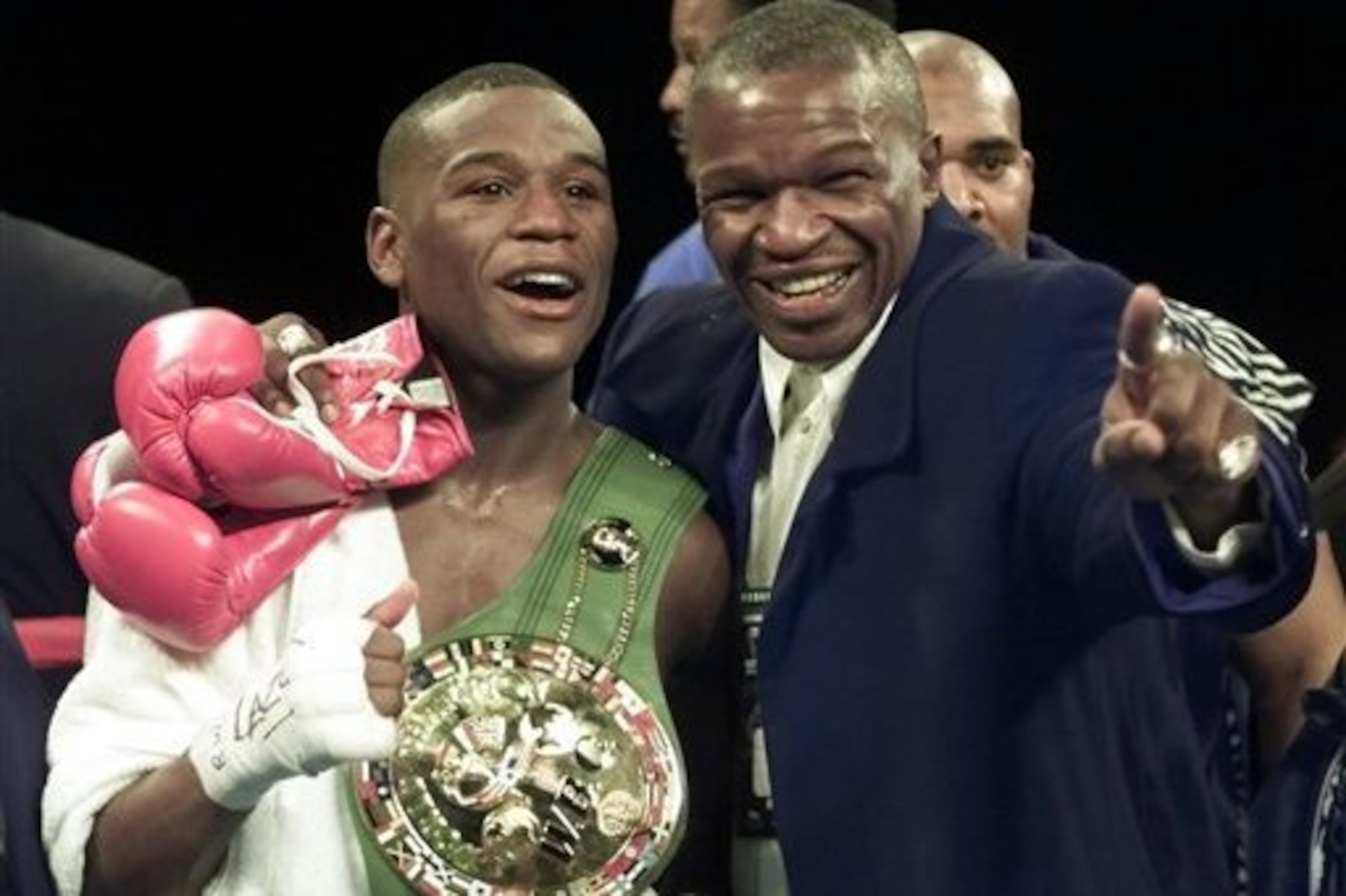
That night, against the top fighter in his division at the height of his own Hall of Fame powers, Pretty Boy Floyd simply dominated. Corrales, himself a great fighter, looked like a rank amateur, his hands and feet both too slow by a factor of 10. It was almost heartbreaking to see him so helpless, as Mayweather danced and dropped punch after punch in brutal fashion, eventually handing Corrales his first loss in the ninth round.
"I don't think I've seen an exhibition of boxing like this since Willie Pep," HBO's unofficial scorer told the world during the fight. "This kid is unbelievable, great legs, great speed, unbelievable ring-generalship. I mean he's got tremendous presence in that ring, Floyd Mayweather knows where he is, every minute of this fight."

Others, like Mayweather's promoter Bob Arum, had a more contemporary comparison in mind—the great "Sugar" Ray Leonard. Like Leonard, Mayweather had rare gifts in the ring and a beautiful smile. But unlike Leonard, he wasn't adept at hiding his many demons from the world.
By 2001, the Pretty Boy mask was already slipping. Would "Sugar" Ray Leonard argue publicly with his family and kick his own father out of his Las Vegas home? Would he call a generous offer of $12.5 million from HBO a "slave contract"?
It was obvious early that Mayweather was no Leonard, who was more than happy to let Mike Trainer handle his business affairs. Floyd wanted a more active role in his own career, pushing back against Arum and his inability to help Mayweather become the kind of star he alone knew he could be.
"I had a game plan from the very beginning," Mayweather reminisced at the post-fight press conference. "I always knew what I wanted to do—be outspoken, be one of a kind."
Mayweather, of course, was proven right. He believed in himself when no one else did. When he bought his way out of his contract with Arum, he quickly went about establishing a new role. Gone was the man trying on an ill-fitting Sugar Ray costume. In his place was the preeminent villain of his day. Rather than try to hide the cracks, as Yahoo's Kevin Iole explained, Mayweather revealed himself to the world in all of his imperfect glory:
"He portrayed himself as an over-the-top, ostentatious character who knew no bounds. He changed his nickname from “Pretty Boy” Floyd to “Money May,” and he’d boast incessantly about his wealth and what it did for him.
It was a clever way to attract mainstream attention and expand beyond the comparatively small boxing audience.
He became a celebrity much the way Paris Hilton and Kim Kardashian became celebrities. It wasn’t so much for any particular talent, because the mainstream doesn’t care much for boxing talent. It was because of the opulent lifestyle he portrayed.
"
As Mayweather's image changed, so did his style in the ring. The Floyd from the Corrales fight was almost unrecognizable in the Berto bout. A brilliant fighter who used his deft footwork to deliver punishing punches was a distant memory. In his place was an old man with brittle hands doing his best to simply stymie his foes.
| Muhammad Ali | 56 | 5 | 37 |
| Floyd Mayweather Jr. | 49 | 0 | 26 |
| Sugar Ray Robinson | 175 | 19 | 108 |
| Joe Louis | 66 | 3 | 52 |
| Roberto Duran | 103 | 16 | 70 |
| Jack Johnson | 73 | 13 | 40 |
| Rocky Marciano | 49 | 0 | 43 |
| Henry Armstrong | 151 | 21 | 101 |
| Willie Pep | 229 | 11 | 65 |
If sports is an analogue for war, Mayweather has been in retreat for eight years, content to survive while leaving the enemy standing on the field of battle. He stopped Ricky Hatton in 2007 and hasn't finished a single foe since, unless you count his sucker-punch knockout of poor Victor Ortiz. Like Berto, most Mayweather victims look more perplexed than punished, forced to admire the efficacy of what he does, if not the artistry.
"I beat all the top guys in the sport for 19 years and I’ve been a world champion for 18 years. I had an incredible career," Mayweather said at the post fight press conference. "It’s all about that IQ. I’m 10 steps ahead of every fighter. I take whatever your best attribute is, I take it away from you and make you resort to doing what you don’t want to do."
The sweet science is the art of hitting without being hit. But all too often Mayweather forgot the first half of that equation. His fights devolved into a boring slog, Mayweather gliding around on the ropes, landing a quick punch as his opponent tried in vain to trap him, culminating with Floyd grabbing hold of a clinch.
Then the dance began anew.
"You hear so many things throughout a 19-year career. 'All he did was hold.' 'All he did was run.' 'He’s cocky.' 'He’s arrogant,'" he said after the fight, unrepentant. "...And if you all believe that, you’re dumb to believe it."
It was an act that quickly grew old. Fan displeasure, coming to a boil after several dull performances and a new focus on his abhorrent life outside the ring, spilled over in May with the Manny Pacquiao fight. It was a dream match that became a nightmare for many, a fight that reached peak excitement, according to Sports Illustrated's Chris Mannix, with a pre-fight dispute over credentials:
"Mayweather will be remembered for winning this fight, even though this fight will not be remembered. There will be no Mayweather-Pacquiao II, no further collaboration between HBO and Showtime, two competing networks that make the interactions between the Montagues and the Capulets look civil by comparison. Mayweather and Pacquiao will go their separate ways, and they should: As much as everyone wanted to see it happen, no one wants to see that again.
"
Raised on a diet of Marvin Hagler, Roberto Duran and, yes, Leonard, fans weren't accustomed to watching a fighter so intent on minimizing contact. In what might have been boxing's last audition with the American mainstream, Mayweather delivered what he always delivered, a performance somehow both dazzling and infuriating at the same time.
He's managed to reinvent boxing, become obscenely rich and write his own ending. And as great as it was for Floyd, it was bad for fans and bad for the sport. For the first time in boxing history, the best fighter of his generation leaves the sport worse than he found it. As he walks into the sunset, that will be Mayweather's true legacy.
Jonathan Snowden covers combat sports for Bleacher Report.
.jpg?w=2560 "Rams Raiders Football")
.jpg?w=2560 "Steelers Saints Football")


.jpg?w=2560 "🚨 Week 8 AP Top 25 Poll")
.jpg?w=2560 "Blockbuster Trade Idea To Shake Up the Eastern Conference 🎇")