Sports Franchises That Will Try Anything to Sell More Tickets
Sports franchises benefit from the romanticism of athletic competition because the pageantry easily obscures the business of running a team. Regardless of a team’s financial standing, the prevailing narrative gravitates toward all matters sports-related. The news cycle is expected to churn out stories about new players who could be difference-makers, the injury situation and locker-room politics. But, if the biggest headline is about a team's ability to pay the bills, fan angst and chaotic press conferences are sure to follow.
Ultimately, a sports franchise is a business, and even though a multitude of factors influence a team's economic welfare, ticket sales and attendance are the most public of indicators. If people aren't buying tickets, then a team almost certainly isn’t thriving.
Ticket sales don’t just fill seats; they’re bringing people into the venue to spend money. Regardless of a rookie’s upside or preseason prognostications—if a team can’t sell tickets, then the problem runs far deeper than any individual position battle or offseason storyline. A failure to sell tickets is failure to inspire hope; if no one is interested in seeing what happens on the field, then it’s panic time.
These are sports franchises that will try anything to sell more tickets.
Charlotte Hornets
1 of 12
It seems the Charlotte Bobcats' many sacrifices were necessary to create a better reality for the Charlotte Hornets. In January the Hornets announced that, thanks to rising attendance, they were raising ticket prices (a relatively modest) five percent. It was an enviable position to find themselves in as a franchise, given how badly they were struggling just years ago.
Following a lockout-shortened 2011-12 season, in which they won just seven games, the Bobcats, who had the best odds at winning the No. 1 pick in the NBA draft lottery, offered up a "buy one, get on free" (BOGO) deal on season tickets. Sad as that was, at least it was aimed at improving games' long-term attendance. The same cannot be said of some of their other Bobcats-era promotions.
In February 2012 the Bobcats offered a free ticket to every fan in attendance at a game against the Philadelphia 76ers if the home team made a single three-pointer in the fourth quarter. One blogger, Corey Inscoe, called it, "The saddest promotion ever. Thanks, Bobcats." At least he said thanks.
A few months later in May, team COO Fred Whitfield announced a continuation of their "Pay-the-Pick" promotion on season tickets, which began earlier that month. Basically it allowed fans to purchase season tickets for $1-$4 dollars per game, depending on the results of the NBA draft lottery.
As previously mentioned, the Hornets seem to be reaping the benefits of the Bobcats' sacrifices. Although we won't know for sure how successful their efforts have been for another year or two.
Jacksonville Jaguars
2 of 12
The Jacksonville Jaguars get picked on a lot because they’ve only been in existence for two decades, the last 15 of which have been a seemingly never-ending exercise in futility. Considering that unfortunate reality, fans in Jacksonville actually show up to home games in greater numbers than they probably should.
But just because they don’t have the NFL's worst attendance, doesn’t mean ownership is above desperation tactics in unloading tickets. The most egregious of which was the not as good as it sounds free-beer promotion in September 2013. Sure, getting drunk would take the edge off being subjected to Blaine Gabbert, but fans were limited to two brews each.
One year later the Jags’ marketing wizards were at it again, this time offering up “a discount on concealed weapons permit classes for” season ticket holders. Now, if you’re thinking beer-and-guns sale tactics are too obvious to avoid becoming fodder for internet mockery, well congratulations! You’ve clearly been on the internet before.
Atlanta Thrashers
3 of 12
Considering the Thrashers lasted just over a decade in Atlanta before being relocated to Winnipeg in 2011, obviously their desperation marketing, which really bottomed out in 2010, did nothing to stop a ship that was destined for the bottom of the ocean from sinking. As is the case with a number of NHL teams in the South, attendance in Atlanta, and the financial problems that go along with it, was a problem from the very beginning.
Any early enthusiasm for the Thrashers was largely dead by 2008. By the time the team was staging elaborate publicity stunts involving the mascot in December 2010, it was a classic “too little, too late” scenario. Although nothing the mascot could have done would have compared to the cynical marketing ploy the team was accused of two months earlier.
That season, via ads in the Atlanta metro area, the Thrashers had been touting the fact that they had five black players on their roster, “tying the 2000-01 Edmonton Oilers for the most black players on one NHL team.”
While the team insisted they were not trying to “exploit” those five guys for marketing purposes, there’s just something about the idea of a sports franchise potentially prioritizing race above talent that doesn’t sit especially well.

.jpg?w=2560 "Texans-Mixon Released Football")
.jpg?w=2560 "Commanders Eagles Football")
Miami Dolphins
4 of 12
Right or wrong, there is no question that a perception exists of sports fans in Miami that isn’t very flattering. That idea was further cemented by an Emory University study conducted by Mike Lewis and Manish Tripathi of Emory Sports Marketing Analytics. The results of which were released in July. Relying on “market outcomes, like attendance, prices, and revenues,” the study found the Cowboys to have the “best” fans in the NFL, with the Dolphins have the “worst.”
It would be fair for ‘Fins fans to point out the team’s abject putridness since Dan Marino retired in 1999. Not that the comically predictable series of wild-card and divisional losses since 1986 were anything great, but it was certainly a less tragic era than the current. The Dolphins’ desperation peaked somewhere between 2011 and 2012.
In 2011 it was revealed the team had hired a “third-party” debt collector to aggressively track down and menace hundreds of season ticket holders who had “failed to make payments on their high-end tickets.” It doesn’t matter how hard up a franchise is, using strong-arm tactics to chase down your own fans is never a good look.
Neither is an NFL team in Miami hosting a reunion of the 2009 Florida Gators, who play 336 miles away in Gainesville, which is what the Dolphins, who share a field with the Miami Hurricanes, did in October 2011. It was a ridiculous idea that was met with as much, or more, consternation in Florida as the rest of the country.
The team’s decision to sign Chad Ochocinco in 2012 was another low point, but not low enough to prevent them from making ill-advised and costly desperation free-agent signings an annual affair—chief among them, Mike Wallace and Ndamukong Suh.
Speaking of low points! The Dolphins' appearance on Hard Knocks in 2012 was arguably the worst to date, except for Houston Texans’ defensive end J.J. Watt, who said he picked up Miami’s snap count from the show during a Pro Football Talk television interview (via PFT's Mike Florio).
A few years ago Dolphins ownership was desperately trying to convince Miami-Dade County voters of the benefits a new football stadium would offer. Today they are desperately trying to convince them how great the old stadium is. Accepting this might be as good as it gets is a lesson worth learning in Miami.
University of Akron
5 of 12
No offense to the mighty Zips, but it’s probably fair to say students at the University of Akron probably don’t choose the school because it’s an unstoppable athletic juggernaut. Mostly because, ya know, it isn’t. That may be why the university needed a little extra incentive to get the student body properly enthused about Akron’s race to the middle of the MAC season in February 2015.
Their “Student Appreciation Program” didn’t just offer a discount to students who attended basketball games; it actually paid them to show up. With three home games remaining in the season, all against MAC opponents, the university gave “students $5 on their Zip Cards for each game they attend[ed] plus another $5 if they get to all three.”
It may not have been cash money, but the Zip Card “can be used at on and off campus eateries and stores by University students.” Despite the scheme reeking of the desperation associated with sagging numbers, Akron insisted the promotion was all about boosting what was its best attendance since 2004. Still, though, actually paying warm bodies to occupy seats isn’t pretty uncommon.
The pinch with Akron’s too-good-to-be-true offer was that it was (huzzah!) probably too good to be true. Apparently, “the offer [was] only good if student attendance [reached] 800 at each game.”
Tampa Bay Buccaneers
6 of 12
Much like the San Diego Chargers, 2012 was seemingly the pinnacle of the Tampa Bay Buccaneers' hailstorm of turdball marketing ploys to unload tickets.
They must have been feeling particularly desperate with that season marking a decade since they lucked into a Super Bowl against the Raiders. Blackouts had become a consistent problem in Tampa Bay since 2009—just days ahead of the first game of the 2012 season, the Bucs “had 19 of its past 21 home games blacked out.”
Lowering the threshold for blackouts that summer didn’t change much—the team offered 50 concessions discounts, free parking in various lots and a commemorative Ronde Barber gym sack just to get fans to come to the home opener. A month later the Bucs were reduced to selling deeply reduced tickets (with a $25 concessions voucher) via a cardboard voucher at Tampa area Costcos.
The Buccaneers' bad business model extends well beyond their empty stadium and crappy football team.
In November 2014, a Tampa Bay Times investigation revealed the team had been employing homeless “recovering" alcoholics and drug addicts to work concessions at Raymond James Stadium. In lieu of compensating workers directly, the Bucs paid an exceptionally shady ministry, which offered shelter and meals to the men, while taking their Social Security checks and food stamps to cover costs.
University of Michigan
7 of 12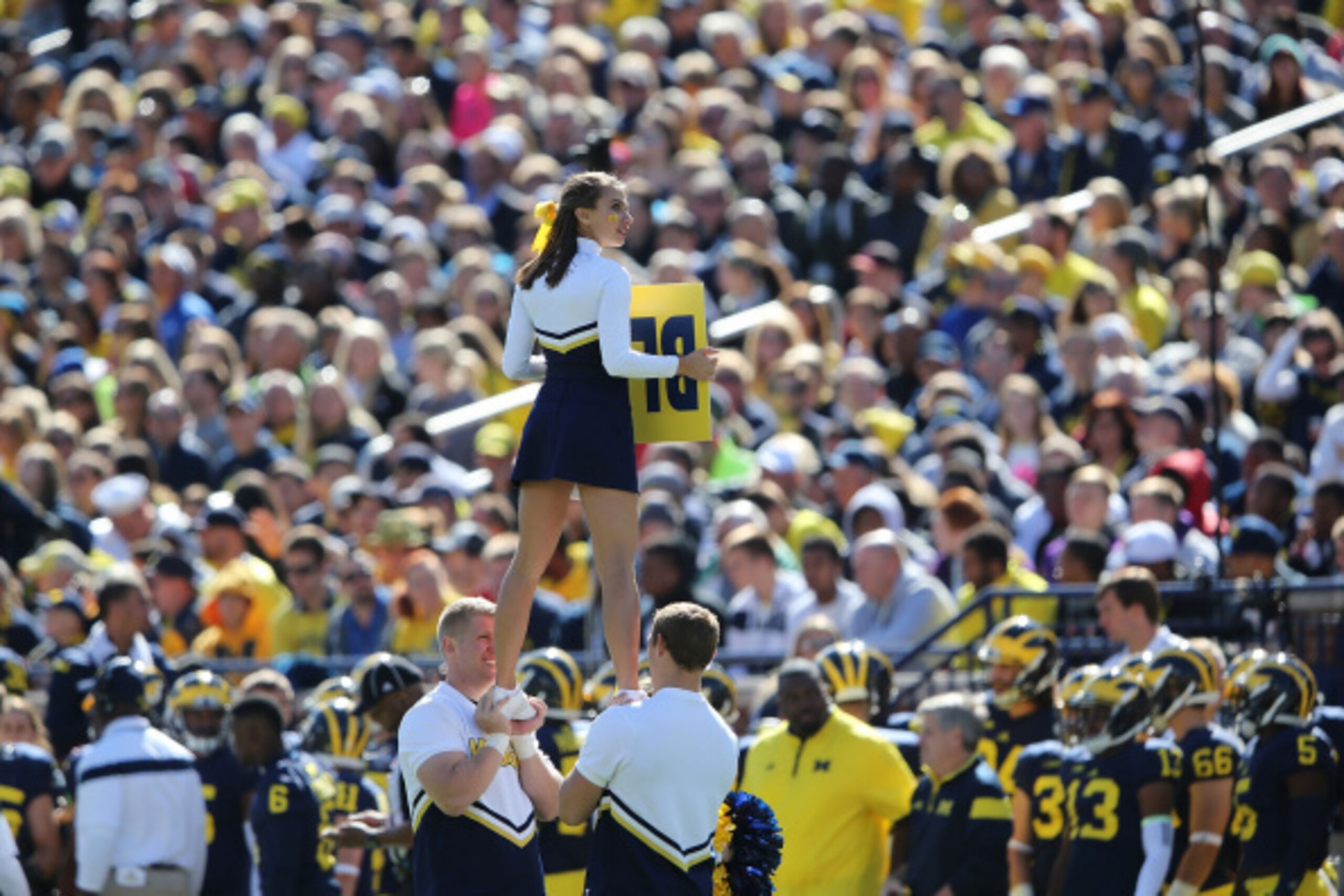
Boasting a current seating capacity of 107,601, reduced from a previous high of 109,901, on game day Michigan Stadium holds the entire population of Ann Arbor, save for about 10,000 stragglers. With seating having been added no less than four times since 1927, the recent reduction was only the second instance of subtraction. While the university didn’t necessarily address the decision directly, it’s hard to believe the attendance struggles experienced by the increasingly mediocre Wolverines’ in 2014 weren’t the main catalyst.
The first sign of trouble came ahead of Michigan’s late September game against Minnesota. It was like they just knew the Wolverines were going to lose 14-30 to the Gophers—how else can you explain local convenience stores giving away two tickets ($150 face value) to the game with a purchase of a Coke product ($3 face value)?
When word of the promotion got out, Michigan immediately went into damage-control mode. The deal was quickly pulled, and they insisted the whole thing was the result of a simple miscommunication with a valued corporate partner.
Given how bad the lopsided promotion looked for the program, the denial wasn’t especially fervent. In April, the Detroit News revealed that Michigan giveaways to preserve their 258-game steak of 100,000-plus crowds was not uncommon, but actually became the norm last year.
“There were 62,879 free tickets distributed during the 2014 season that accounted for roughly 8.6 percent of attendance, a sharp increase from the previous season, when 2.8 percent of the attendance came from comp tickets.” The final regular-season game against Maryland was particularly egregious, with 17,000 free tickets distributed.
Clearly Michigan decided to put all their eggs in the Jim Harbaugh basket after last season. They were able to lure the former 49ers coach back to the college ranks by throwing no less than $40.1 million in guaranteed money at him, in addition to generous incentive bonuses and perks like access to the university’s private jet for personal travel.
San Diego Chargers
8 of 12
With the Chargers playing in one of the worst stadiums in the country and a constant threat to leave San Diego for Los Angeles, it should come as no surprise that the team has been dealing with ongoing attendance issues for years. Desperate last-minute ticket unloading in order to avoid a local television blackout has been the norm—last season was the first year without a blackout since 2009. They’re cleared through 2015, but only because NFL owners approved a one-year suspension of the blackout policy.
Though times have been tough in San Diego for awhile, 2012 marked a particularly low point in this department. Early in that season the Chargers were embarrassed when it was revealed they were actively marketing tickets to division rival Chiefs fans.
A few months later, in December, desperate to avoid another blackout, the team decided to hawk their wares on Groupon.The deal was for one end-zone ticket and a $20 concession voucher for $68—a whopping savings of $8.25 off the ticket's face value and basically two free beers.
It was not nearly enough incentive for fans to buy up the 13,000-plus unsold seats and avoid the blackout.
Arizona Sundogs
9 of 12
The Arizona Sundogs are actually the defunct, currently nonexistent, NHL minor league affiliate of the Phoenix Coyotes, a team that would run screaming from the Grand Canyon State's sun-baked deserts if they had any clue what was good for them. But whereas the Coyotes remain a miserable monument to mediocrity in the desert, at least the Sundogs were willing to go out on a limb in order to attract attention to their miserably failing operation.
The Sundogs started thinking outside the box in August 2013, with a promotion that promised (then) general manager Chris Presson (and a few others) “would remain atop a 33-foot scissor lift until 300 season tickets were sold.” Initially Presson thought the stunt would take 2-3 days, but nobody seemed to take notice until the event had dragged on through Day 5.
Dubbed “Whatever it Takes,” the promotion ended up taking substantially more than the franchise had first anticipated—they finally met their goal on Day 6 (h/t Deadspin.) Given how lackluster the fan response was in 2013, the Sundogs’ decision to up the ante in 2014 was equal parts stupid and inspired.
In June both GM Presson and majority owner Brad Fain agreed to be buried alive until the team sold 300 season tickets. They were put in an “eight-foot container with a grated cattle guard on the top, allowing for air circulation and the opportunity for fan interaction.” Though it’s not clear, exactly, what their time frame was, 10 days later the team had reached their goal, and the fellas emerged from their crypt.
The most stunning event of all was the fact that the Sundogs completely ceased operations a month later.
Tennessee Titans
10 of 12
As of the 2014 season, the Tennessee Titans were still bragging about a sellout streak dating back 16 years. The bragging would be understandable for any team, but for a Tennessee team that has been living in the gutter since 2009, who could fault them for talking up the one thing they could hang their helmets on?
The only issue, as it turned out, was that the whole thing was an elaborate scam.
The Titans had been keeping the supposed sellout streak alive in recent years, thanks to a shady deal with a professional scalper, Cole Rubin. The team would sell Rubin tickets (at a massive discount) to more popular regular-season games in exchange for him buying and unloading seats to surefire turds like the annual football equivalent of slipping on a banana peel against the Jaguars.
Team executives attempted to deflect the accusations by insisting the practice is prevalent in the NFL, but they ran into some issues with hypocrisy. Ticket scalping by fans is prohibited in and around the taxpayer-funded stadium, with the Titans reserving the right to prevent fans from “transferring their personal-seat licenses to ticket brokers.”
Their embarrassingly desperate and impressively deceitful con hasn’t just earned them the stink eye from fans, it’s also attracted the the taxman's dead-eyed gaze.
Miami Marlins
11 of 12
When it comes to desperation to get fans in the gate, it doesn’t get much sadder than the Marlins. After fleecing taxpayers for a brand-new stadium that will ultimately cost billions, just months after it opened in 2012, the Marlins promptly sold off every member of the supposedly competitive team they were building to be competitive in Miami.
With the team battling it out annually in the NL East basement, and laughably sparse attendance routinely among the league's worst, the team has proven far more willing to put the time and money into brainstorming embarrassing promotions to increase attendance than investing in players not named Giancarlo Stanton. "Buy one, get one" (BOGO) free deals have been commonplace in recent years.
And we’re not talking about late-season throwaway games—the Marlins were so worried about being embarrassed with 2013 Opening Day attendance that they resorted to a BOGO giveaway on Groupon.
Months later in August they managed to dramatically undercut themselves, offering up tickets for $1. They were basically giving away free tickets, and the ballpark was still empty, with Miami alone accounting for 40 percent of MLB’s total drop in attendance.
The Marlins may have spent millions leading up to the 2015 season, they’re still battling out with the Phillies for "King of the Gutter" division honors and attendance in Miami (as of midseason) was still dead last. Apparently it’s going to take more than $1 hot dogs and the second-priciest beer in MLB to lure fans into Jeffrey Loria’s house of baseball atrocities.
Washington Redskins
12 of 12
These days, for the football team from Washington, all press is bad press. Without even wading into the muck surrounding the name “Redskins” and all its baggage, Daniel Snyder and his crack team of controversy creators are always coming up with new and inventive ways to prove theirs is the most incompetently evil franchise on earth.
Take, for example, the Redskins decision to sue a financially strapped 72-year-old woman who petitioned the team to waive her $5,300-a-year contract for “a year or two.” A lifelong ‘Skins fan who had held her end-zone season tickets since the early 1960s, the woman didn’t respond to the team’s lawsuit because “it is morally wrong not to pay your debts.” The court was then forced to award the franchise a default judgment of $66,364. She was one of over 125 season ticket holders sued from 2004-09.
Snyder may be a billionaire, but he’s got the desperation of a much poorer man.
With home-game tickets bottoming out at $1 late last season, increasingly the ‘Skins have been attempting to lure fans to FedEx Field deals on discount sites such as Living Social. They’re being forced to remove vast sections of the stadium to compensate for a lack of demand and even stooping so low as to menace people into joining the season-ticket wait list in order to access their Wi-Fi.
Washington’s endless array of cheap and sleazy ploys could be a list in and of itself. That's actually pretty crazy for a team that claims nearly eight billion unique visitors sought out training-camp coverage (in print and online) from July 24-Aug. 12.” So…literally every single person on earth and about 600,000 from elsewhere in the universe.


.jpg?w=2560 "Mahomes' Wife Trolls Kubiak 💀")
.jpg?w=2560 "Viral Rams Coach Vid 🖕")