

How the Big Ten Finally Cured Its Inferiority Complex
CHICAGO — When you're down and out, you usually rediscover your confidence slowly, with small victories piling up. It's a process. It takes time.
For the Big Ten, that's not how it worked. There was no process. It happened in a moment: January 1, 2015 at 3:39 p.m. ET.
That's when Wisconsin kicked a field goal to beat Auburn in overtime at the Outback Bowl. Snap. That was it: Big Ten football wasn't a joke anymore. Outsiders realized it, and, more importantly, the conference itself—deep in its heart—realized it.

It was just one moment, but people in the Big Ten will always remember where they were when it happened.
"We were walking into our team meal," Ohio State coach Urban Meyer told Bleacher Report on Thursday. The Buckeyes were set to play Alabama that night in the Sugar Bowl in New Orleans for a spot in the national title game. "It was like a shot of 5-hour Energy. That was our pregame speech right there."

Meyer joined his team, which was eating. He told them about Wisconsin and the Big Ten beating the mighty SEC. Now it was their turn. They could do it.
And they did.
And just like that, the Big Ten's inferiority complex was gone.
For the first time in years, the conference can go into a season not feeling embarrassed.
Look, this isn't just about confidence in football. It's about a belief in a way of life. For some reason, football seems to mean that much to us.
This is about validation in what the Midwest is all about: work ethic, toughness, wholesomeness and white-picket fences. Sure, there's a big element of B.S. in all of that—as I write it sitting here in Chicago, seat of the Midwest and also America's murder capital.
But it's a belief system nonetheless. In fact, this time last year, I wrote about what had gone wrong with Midwestern football. It was outdated, playing big, burly football in a speedy spread-offense world. Big Ten teams traditionally were filled with hardscrabble kids of factory workers, mill workers and mine workers. Now all those places are going out of business, and even Notre Dame coach Brian Kelly talked about demographic shifts and the need to recruit in the south.
The Big Ten held its annual media days Thursday and Friday in Chicago, the time when coaches try to pump up the conference. And usually nobody believes it. They tend to come across like a boxer who just got knocked out and then regained consciousness, stood up and talked about how great he is.
You do know we saw the fight, right?
Well, the college football world finally saw the Big Ten winning big fights at the end of last season. Not only did Wisconsin beat Auburn, but Michigan State also beat Baylor, which was running a modern spread and thought it belonged in the College Football Playoff. And, of course, Ohio State beat Alabama and then beat Oregon to win the national championship.
"We found out the Big Ten can play football after all," Meyer said, sarcastically.
You're told for years that you aren't any good, and you can't beat the SEC. Eventually, it's only human nature to believe it.
Meyer talked about his first Big Ten media days in 2012: "The attitude just around here now compared to where it was 2012. … I was actually shocked. I remember the meeting—and I don't want to say disrespect, but it was just like the Big Ten was an afterthought."
I doubt he was shocked. He knew. And he started recruiting players out of Florida.
"I would definitely say that the Big Ten gets overlooked," Michigan State center Jack Allen said. "You get a Big Ten team playing against one of those spread run-around-you type of teams and, well, you saw the result."
Trash-talking? From the Big Ten?
"The Big Ten's always been known for smashmouth football, and that's what's been working," Allen said. "Stick to it."
True, the Big Ten has been known for size, power and running over people, not around them like the Pac-12. But the game changed, and the Big Ten looked like a Neanderthal league. Stick with what's working?
The Big Ten hadn't won a national championship in 12 years. In 2010, it went 0-5 in New Year's Day bowls.
And look at Michigan: Rich Rodriguez—the no-huddle, spread-offense guru—was brought in as coach to modernize the place. He was met with, let's call it, "cultural resistance." He once told me he wasn't accepted because he wasn't a "Michigan Man." So Michigan brought in Brady Hoke, a true smashmouth, Fred Flintsone of a guy who, it turned out, couldn't coach.
They ran off modern to keep old-fashioned. Now, they have hit it big by hiring Jim Harbaugh.
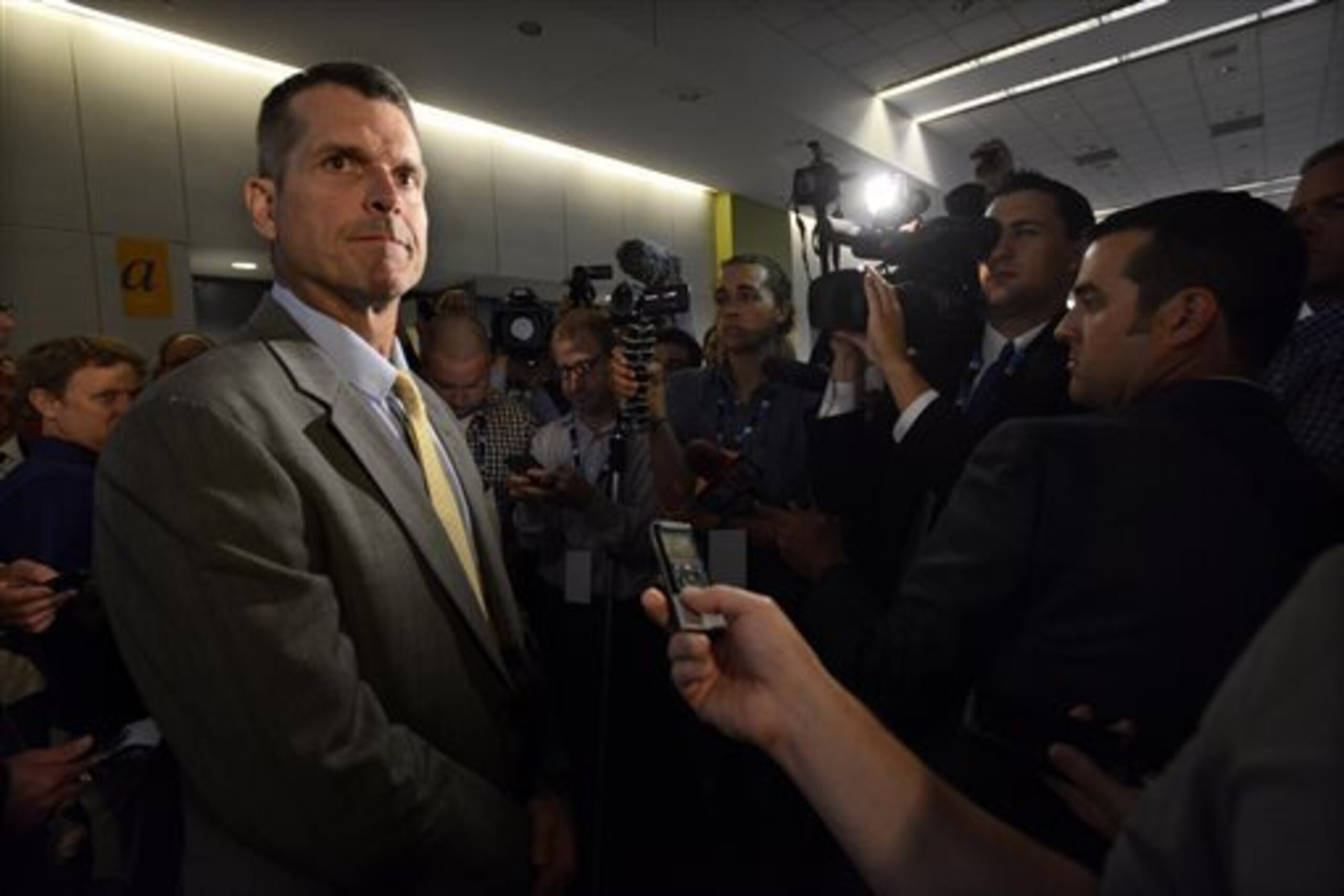
Even Wisconsin lost its coach, Gary Andersen, before the bowl game last year, as he left for Oregon State. And that's why you have to see the symbolism in the picture at the end of the bowl win over Auburn. Longtime Wisconsin tough-guy coach Barry Alvarez, the school's athletic director, came back to coach that one game, and the players hoisted him in celebration.
You had the cliche of Big Ten smashmouth in Alvarez vs. the modern-day coaching genius prototype in Auburn's Gus Malzahn. Ohio State had just crushed Wisconsin. Wisconsin had lost four bowl games in a row.
There was no way Wisconsin was going to win that game.
"There's nothing like winning a game," Wisconsin quarterback Joel Stave said Thursday. "But I never thought winning a bowl game would be as sweet as that was. It really starts a whole different mentality going into the next year."
Stave said it ended his own confidence crisis. It ended Wisconsin's.
It ended the Big Ten's.
Meyer saw Wisconsin win that game and went right to his team, which had to face the closest thing college football had to a dynasty: Alabama.
"I can't necessarily repeat what he said," Ohio State linebacker Joshua Perry said. "He just said the tide's turning and things have changed and it's not what it was before. It's not what everybody wanted to call the big, bad SEC against the Big Ten, which can't hang and compete. You can do what you want to do."
Nothing to be ashamed of anymore about white-picket fences and Mom's apple pie.
Greg Couch covers college football for Bleacher Report.
.jpg?w=2560 "Cam Ward Says He's Not A Loser")
.jpg?w=2560 "🚨 Texans Trade for MHJ")
.jpg?w=2560 "Grading MHJ Trade 📝")
.jpg?w=2560 "Chargers Fall to 0-5 🤢")
.jpg?w=2560 "MHJ Bought Own Jugs Machine")