
The Pitching Blueprint to Defusing MLB's Game-changing Torpedo Bat
Within Major League Baseball, the "torpedo bat" is new, exciting and seemingly unstoppable. Apropos of that last part, though, we would do well to remember Newton's Third Law of Motion.
For every action, there is an equal and opposite reaction.
The premise of the torpedo bat—i.e., the thick part of the bat is shifted more toward the handle, where some hitters are more likely to make contact—is valid, and the promise of it seems to be real. Besides, it's a legitimate revolution in batting tech that is frankly overdue.
TOP NEWS

Ranking Top 25 Trade Chips For Offseason 🔢

MLB Playoffs Winners and Losers ⚾
Brewers Beat Dodgers in Game 1
"The same bat design has been in existence for a century and a half, maybe," Alan Nathan, professor emeritus of physics at University of Illinois at Urbana-Champaign, told Bill Chappell of NPR. "And to come up with something new, to me, is always very exciting."
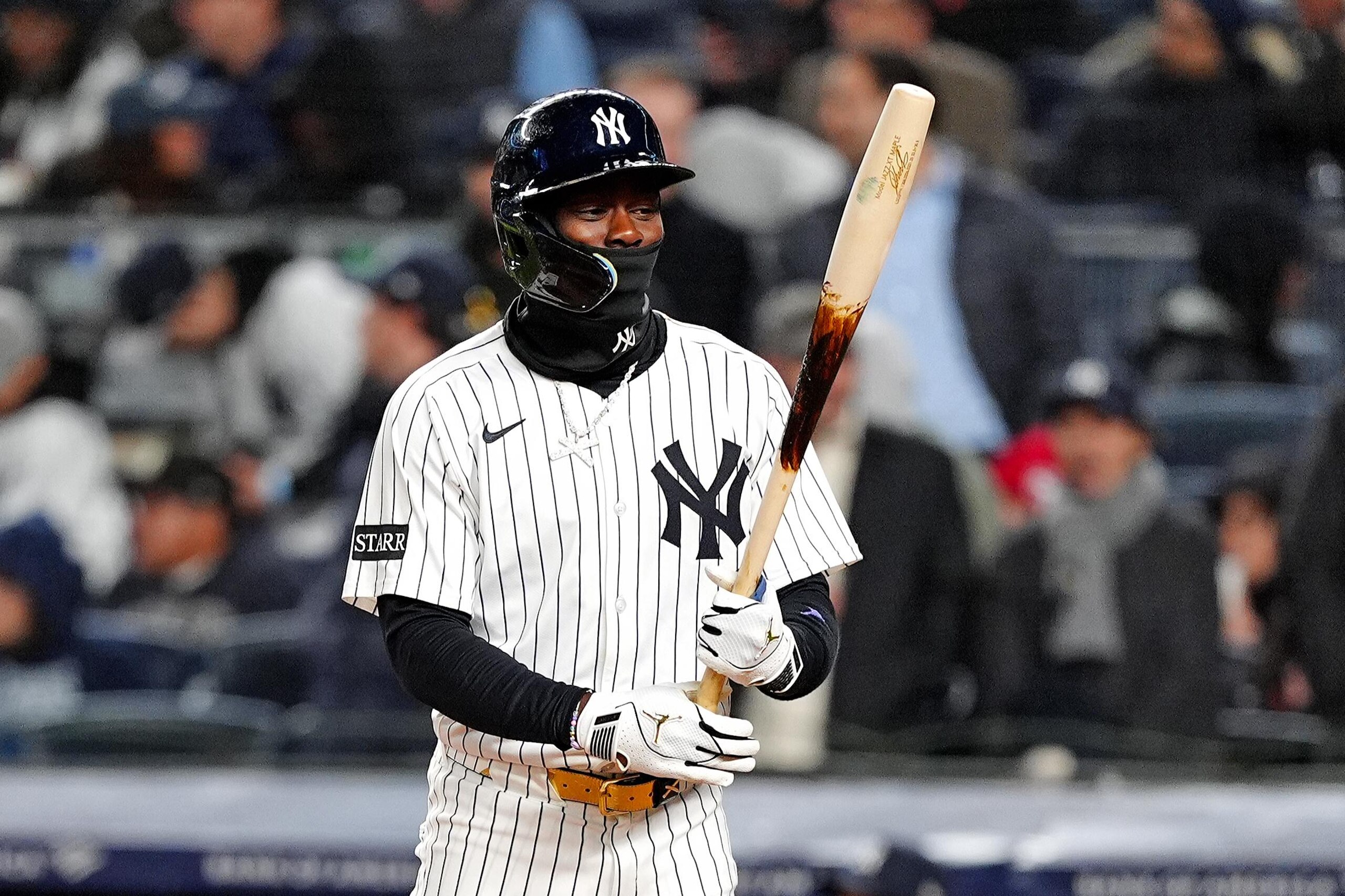
The early results would seem to speak for themselves. The torpedo bat first became a sensation amid the New York Yankees' 15-homer barrage over MLB's opening weekend, and it has since gained other poster boys in Baltimore Orioles catcher Adley Rutschman and Cincinnati Reds shortstop Elly De La Cruz. More players are joining the list every day.
At the end of the day, though, it's like any other baseball bat for pitchers. They've been fighting a winning battle against hitters for generations, and it's hard to fathom that the torpedo bat will be what finally leads to their total defeat.
The Torpedo Bat Has Merit...and Flaws
Mind you, this is not to suggest the torpedo bat is all sizzle and no steak.
Early returns from the five Yankees hitters using it suggest it may help improve bat speed. So far, four of those same five hitters have also upped their exit velocity from 2024 to 2025.
We're talking about a small sample size, of course, but the latter tracks with an initial study that Professor Nathan posted about on Bluesky. It found that torpedo bat users could expect to lose some exit velocity on contact at the end of the bat, but gain even more on batted balls more toward the handle.
It's a fair trade-off for batters who tend to hit balls in just the right spot for a torpedo bat, which is roughly near the label (here's a Louisville Slugger for reference) on a traditional bat.
However, even hitters who are interested in the torpedo bat aren't convinced it's a one-size-fits-all remedy.
"If you're more on the end of the bat, the torpedo's not great for you," Philadelphia Phillies second baseman Bryson Stott, who got a couple to try for himself, told Todd Zolecki of MLB.com. “If you're already in the middle, there's no point. I don't think I'm sold yet. I'm early sometimes and I'll hit a ball off the end and those turn into hits. If I don't have any wood there, it might be a miss."
As for where pitchers are in all this, there's naturally the question of how the torpedo bat might be exploited. And if its users are sacrificing some pop toward the end of the bat, then it behooves pitchers to get them to hit it with precisely that part of the bat.
Logically, that means pitching torpedo bat users away, and not necessarily in the strike zone. As one veteran scout bemoaned to R.J. Anderson of CBS Sports: "Just what we need, another incentive for pitchers to not throw strikes."
Have the Diamondbacks Shown the Way?
After the Yankees laid waste to the Milwaukee Brewers for three games, the Arizona Diamondbacks rolled into New York for their turn to get broadsided by the torpedo bat.
Except, that isn't what happened in the first two games of the series. After crushing the Brewers for 15 homers and 36 runs, the Yankees managed a more modest four homers and eight runs in back-to-back losses to Arizona on Tuesday and Wednesday.
Of note is how D-backs pitchers handled the five Yankees who are known to be using the torpedo bat: Anthony Volpe and Paul Goldschmidt, who bat righty, and Jazz Chisholm Jr., Cody Bellinger and Austin Wells, who bat lefty.
Against the Brewers, these guys combined for nine home runs that mostly came against pitches (see here and here) they could turn on. Think middle-in and middle-middle, leaving little wonder that seven of their nine homers were hit to the batters' respective pull sides.
In two games against the Snakes, however, both the righties and the lefties among the quintet got a steady diet of pitches on the outer half, and mainly in the lower portion of the zone.
Volpe went deep twice anyway, but the five as a whole went 6-for-38 with 15 strikeouts. Zac Gallen certainly did his part to add to the silencing on Wednesday, going 6.2 innings and fanning 13 Yankees in total.
Meanwhile (or thereabouts) on Wednesday in Los Angeles, Dodgers third baseman Max Muncy used the torpedo bat in his first two plate appearances against the Atlanta Braves. He came up empty in both, prompting a switch (h/t Dodgers Nation) back to his customary bat.
The result? A game-tying, 101.7 mph double off a high-and-outside changeup that struck the bat closer to the end than the label.
Maybe It's Not About the Bat
Amid all the hysteria of the last few days, there's been a common anthem even among those who have cause to be fans of the torpedo bat.
"I think it's more the player than the bat," Reds manager Terry Francona said after De La Cruz's torpedo bat-fueled four-hit, two-homer game on Monday, per Mark Sheldon of MLB.com.
It's a statement that Boston Red Sox third baseman Alex Bregman, who tested the torpedo bat on Wednesday, echoed in comments captured by Alex Speier of the Boston Globe: "I don't really think it's the bat. It's not like anybody using it [is going to hit homers]. It's the guy."
These are boring takes, but they're not wrong.
Even if there's an element of truth to the purported benefits of the torpedo bat, it's not as if it automatically turns its users into literal hitting machines. Ultimately, what the pitcher is seeing is still a human being with a stick. A differently shaped stick, granted, but a stick nonetheless.
This is the same basic obstacle pitchers have been facing since the 19th century, and hurlers of this generation have proved to be as good at any at navigating it.
It helps that this is the hardest-throwing generation baseball has ever known. It's probably the most creative, too. New pitches used to be rare. But now, it seems every year brings a sweeper, a splinker, a kick-change or a spittoon-ball*.
[*Only one of these is not real.]
Between these weapons and what may be an effective scouting report courtesy of the 2023 NL champions, Major League Baseball's pitchers have what they need to at least quiet down the hype over the torpedo bat, if not silence it altogether.
Either way, it will then be down to the hitters to come up with an equal and opposite reaction.
Stats courtesy of Baseball Reference, FanGraphs and Baseball Savant.

.jpg?w=2560)
.jpg?w=2560 "AD Trolls Bears WR on IG 😂")
.jpg?w=2560 "Viral Dan Campbell Presser 💙")

.jpg?w=2560 "Report: Steelers WR to Miss 'Weeks'")
.jpg?w=2560 "Cam Ward Says He's Not A Loser")
.jpg?w=2560 "Buzz: MHJ Hired Agents for Trade")
.jpg?w=2560 "Chargers Fall to 0-5 🤢")