Remembering Stirling Moss' 1955 British Grand Prix Victory at Aintree
In the first five British Grands Prix of the Formula One world championship era (beginning in 1950), only two British drivers finished on the lead lap. Reg Parnell was third in 1950, 52 seconds behind the winner, Nino Farina. Mike Hawthorn finished second in 1954, one minute, 10 seconds adrift of Jose Froilan Gonzalez.
London-born Stirling Moss arrived at the 1955 race at Aintree, outside Liverpool, after finishing second to his Mercedes team-mate Juan Manuel Fangio at the previous two grands prix. Fangio was on his way to his third championship that year and was the clear No. 1 driver for the German team.
But everyone was aware of what a home win would mean to Moss and to the British fans. A victory at Aintree would not only be the first home win for a British driver, but the first world championship win of Moss' career.
.jpg?w=2560)

Before the race, the Times reported:
"There is much speculation about the Mercedes team tactics, and whether these might be varied on this occasion. ... The propaganda value of a victory by a British driver in Britain is not lightly to be discarded, and Fangio's leading position on points for the world championship would not be jeopardized by his having to be content with second place today.
"
Team orders or not, Moss qualified first, ahead of Fangio, around the 4.83-kilometre circuit, built on the same grounds as the famous horse track, Aintree Racecourse.
Robert Daley, an American correspondent for the New York Times, was not particularly impressed with the Liverpool track. "The British make much of the amenities of the Aintree circuit, bragging about its grandstands, its bars, its 'lavatories,'" he wrote in his book, Cars at Speed. "It is true that you can buy scotch whiskey during a race, and usually the weather is so awful you will want to."
The weather on race day was clear and hot, though, and the Times estimated more than 100,000 spectators showed up, hoping to see Moss end the British drought on home soil (the Associated Press report was even more optimistic, pegging the crowd at 150,000).
The race was never going to be between anyone but Moss and Fangio. Even their Mercedes team-mates Karl Kling and Piero Taruffi quickly fell away, as Fangio jumped to an early lead, with Moss close behind.
For the first third of the 90-lap race, the two lead Mercedes switched positions back and forth. "It was clear that if Moss was going to be allowed to win, he was going to have to work for it," noted Motor Sport Magazine's race report.
Moss was a great driver, but he is also a great character. While I was reporting a feature on Jim Clark's final F1 race, Daley told me that, of all the drivers he knew in the 1950s and 1960s, "Phil Hill was the best talker of them all and Moss was second—and Clark was down in 25th or something."
As Fangio and Moss chased each other around Aintree, through Anchor Bend, Melling Crossing and Tatts Corner, the 25-year-old Londoner was clearly in his element. His passion for racing is evident in one of many examples of his reputation for delivering a juicy quote, from Daley's Cars at Speed:
"I love motor racing. I love everything about it. I love the competition. I love the bull-throwing that goes with it. For instance, Masten Gregory comes up to me and says: "I notice you're going flat out through such and such corner." And I say: "You may be going flat out, Masten." Now he doesn't know whether I'm going flat out or not, and I'm not going to tell him.
"
Both Fangio and Moss were flat out, or close to it, as they continued to build their lead. Meanwhile, in the heat, cars and drivers were falling off left and right.
Mike Hawthorn, feeling sick, according to Motor Sport, gave up his Ferrari to team-mate Eugenio Castellotti, who had retired earlier with transmission problems. And by the end of the race, only nine of the 25 starters were classified.
As Moss and Fangio came around on the final lap, the Brit was leading, but still no one outside the team knew whether Fangio had been ordered to stand down or not.
At the final corner on the 90th lap, Fangio pulled alongside Moss, and surely there were a few gasps in the main grandstand, but Moss won by a nose, finishing 0.2 seconds ahead of the Argentinean champion.
Kling's was the only other car on the lead lap, more than a minute behind, with Taruffi closing out an all-Mercedes top four (and people complain now when we get two Mercs 20 seconds ahead of the field!).
After the race, according to the Times, Moss addressed the crowd, saying, "Fangio—the greatest driver in the world—could easily have come up and made a different story of the race, but being the sportsman he is, Fangio had given him the opportunity of realizing his ambition to win the Grand Prix."
The victory left Moss 11 points behind Fangio in the drivers' standings, with four races left on the calendar.
However, the German, Swiss and Spanish Grands Prix were eventually cancelled in reaction to the tragedy that had occurred at Le Mans earlier in the year. That left only the Italian Grand Prix in September and handed the title to Fangio before the teams even arrived at Monza.
Moss won the British Grand Prix again in 1957, again at Aintree, sharing a Vanwall with Tony Brooks. He would never win the world championship, though, finishing second from 1955 through 1958 and third in the following three seasons.
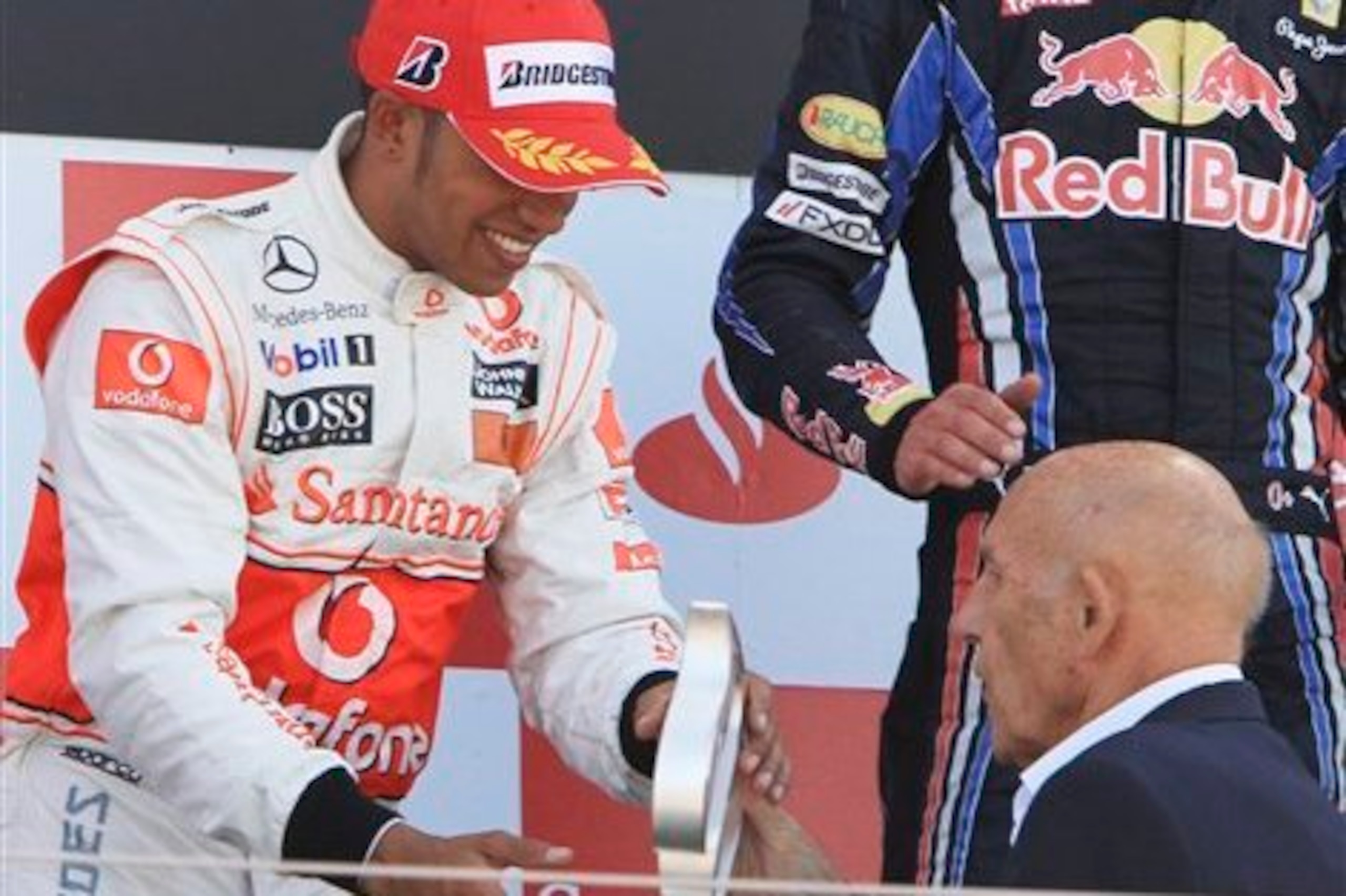
Sixty years have passed since Moss' first victory, and 11 other British drivers have won at Silverstone and Brands Hatch and back at Aintree. This weekend, Lewis Hamilton—also driving a Mercedes—is aiming for his third home win. Among Brits, only Nigel Mansell (four) and Clark (five) have more.
Despite dwindling attendance at some races, the BBC's James Allen reported on his personal site that organisers are expecting 140,000 fans on Sunday. As they once cheered Moss' Silver Arrow, now they will cheer Hamilton's, and six decades after the first, they will be hoping for another British win at home.
Follow me on Twitter for updates when I publish new articles and for other (mostly) F1-related news and banter:
.jpg?w=2560 "Seahawks Chiefs Football")
.jpg?w=2560 "Super Bowl Halftime Jay-Z")

.jpg?w=2560 "Multiple NFL Trades Predicted")